
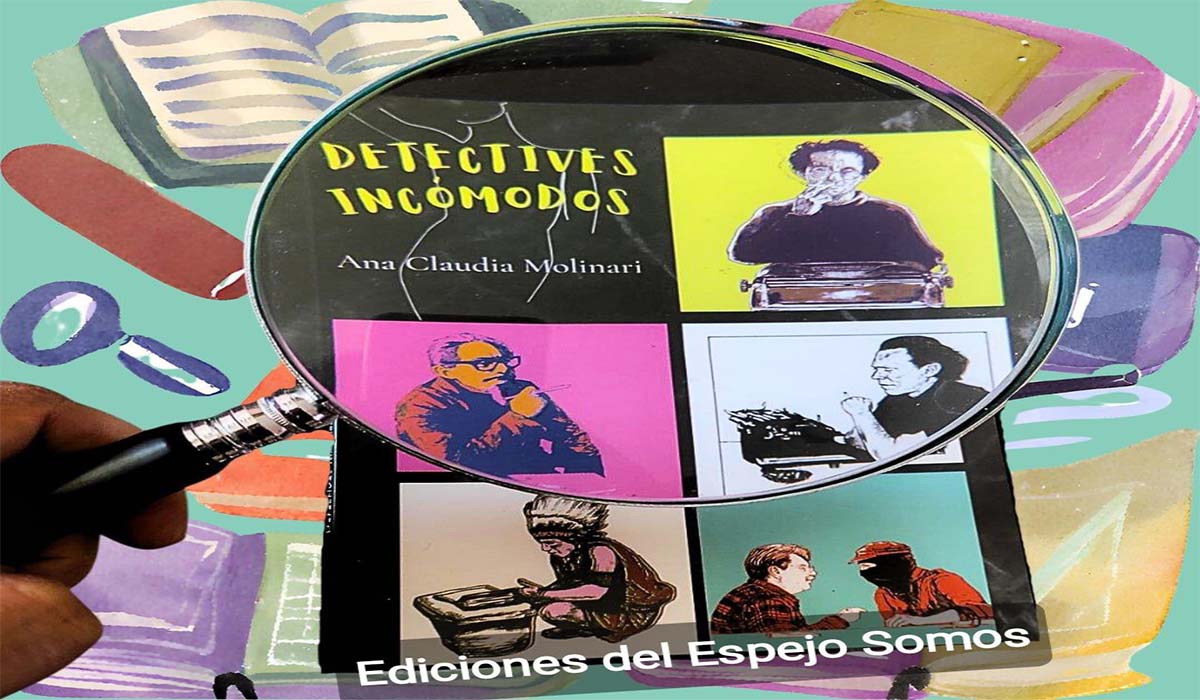
LA VIDA EN ROSA: ESPEJO SOMOS, UNA EDITORIAL AUTODIDACTA «Detectives Incómodos»

Prensa Especializada
It is a book that navigates the shores, but without shores there is no center. Being on the shore is something important, it is the strength of the center, from where it takes its content, its reason: Ana Claudia Molinari
Es un libro que navega por las orillas, pero sin orillas no hay centro. Estar en la orilla es algo importante, es la fuerza del centro, de donde toma su contenido, su razón: Ana Claudia Molinari
The disturbing experience of writing and dedicating herself to it, the decision to abandon the important academic world, allows the Mexican semiologist, ethnographer and professor Ana Claudia Molinari to be a full-time writer, for fourteen years, and founder of the self-taught publishing house Espejos Are. Through this project he publishes Detectives incomodos, which he presented at the septuagenarian Bonilla bookstore in Mexico City.
La inquietante experiencia de escribir y dedicarse a ello, la decisión de abandonar el importante mundo académico, permite que la semióloga, etnógrafa y catedrática mexicana Ana Claudia Molinari, sea de tiempo completo escritora, desde hace catorce años, y fundadora de la editorial autodidacta Espejos Somos. A través de este proyecto publica Detectives incomodos, que presentóen la septuagenaria librería Bonilla, de la Ciudad de México.
As a declaration of principles in this literary universe, Molinari expresses his deep feeling that writing is not only sometimes, it requires a renunciation of the world in a broad sense, it is the response to a need. Writing is like a ship that saves you, like a medicine that allows you to continue living because this world is hard, we know it, it is not an escape, it is a way perhaps to understand what is happening and reconstruct it from the imagination. . “Writing won, I abandoned my students, I left that life and started another.”
Como una declaración de principios en este universo literario, Molinari, expresa su sentir profundo acerca de que escribir no es solo a veces, requiere una renuncia al mundo en un sentido amplio, es la respuesta a una necesidad. La escritura es como un barco que te salva, como una medicina que te permite seguir viviendo porque es duro este mundo, lo sabemos, no es una evasión, es una manera tal vez de entender lo que está pasando y reconstruirlo a partir de la imaginación. “Ganó la escritura, abandoné a mis estudiantes, dejé esa vida y empecé otra”.
In a warm atmosphere inside the bookstore, flanked by the Mexican writer Teresa Icaza, as well as the Tsotsil essayist, translator and poet Xun Betán, the author Ana Claudia Molinari, shared the adventures of her work Uncomfortable Detectives, which invites us through her character Ana Potentino, to dialogues and imaginary trips with writers who she is surprised to be seduced by, such as Roberto Bolaño, José Revueltas, Charles Bukowski, Subcomandante Marcos and Paco Ignacio Taibo II.
En un ambiente cálido dentro de la librería, flanqueada de la escritora mexicana Teresa Icaza, así como del ensayista, traductor y poeta tsotsil Xun Betán, la autora Ana Claudia Molinari, compartió las andanzas de su obra Detectives incómodos, que nos invita a través de su personaje Ana Potentino, a diálogos y viajes imaginarios con escritores de los que se sorprende seducida como Roberto Bolaño, José Revueltas, Charles Bukowski, el subcomandante Marcos y Paco Ignacio Taibo II.
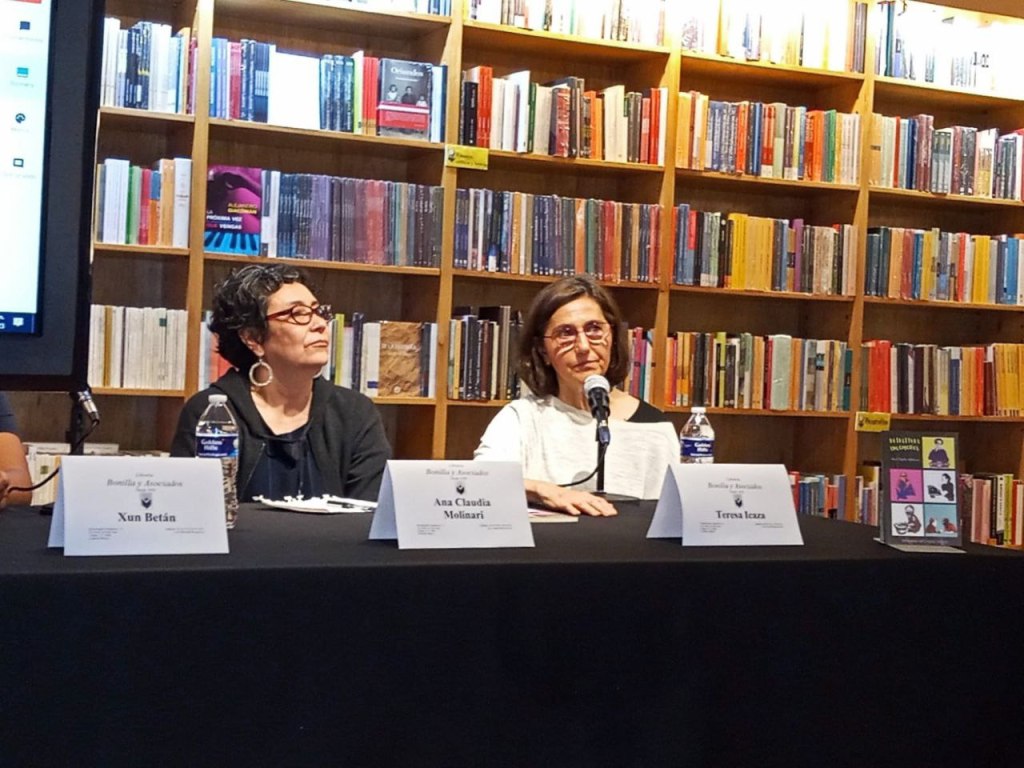
Teresa Icaza commented on this book: “I was excited about this reading from the beginning because Ana Potentino is born as a character when she becomes passionate about reading and no longer wants to go out. Literature is my passion, and I said: I am from here, along with the protagonist. Involved as an alter ego, she has a love affair with Bukowski, with an alter ego, it is a literary game within a literary world, very pleasant. The characters that Potentino chooses are consistent with his work and his life as José Revueltas.”
Teresa Icaza comentó sobre este libro: “me entusiasmó desde el principio esta lectura porque Ana Potentino nace como personaje cuando se apasiona por la lectura y ya no quiere salir. La literatura es mi pasión, y dije: soy de aquí, junto con la protagonista. Metida como alter ego tiene una aventura amorosa con Bukowski, con un alter ego, es un juego literario dentro de un mundo literario, de lo más placentero. Los personajes que elige Potentino son coherentes con su obra y su vida como José Revueltas”.
“It is a self-managed and autonomous project that is not alone, we have the opportunity to present it in this bookstore, which is part of the support and solidarity. We are only interested in writing, luckily there are those who want to edit, which is as commendable as writing, each character has their role in this reality,” adds Icaza.
“Es un proyecto autogestivo y autónomo que no está solo, tenemos la oportunidad de presentarlo en esta librería, que es parte del apoyo y la solidaridad. A nosotros solo nos interesa escribir, por suerte hay quienes quieren editar, que es tan loable como escribir, cada personaje tiene su función en esta realidad”, agrega Icaza.
For his part, from Chiapas, Xun arrived enthusiastically to comment on the work of his colleague Molinari, remembering the time when anthropology united them.
Por su parte, procedente de Chiapas, Xun llegó entusiasta para comentar la obra de su colega Molinari, recordando el tiempo en que la antropología los unió.
Xun comments: “I like the shores, which are not central characters, they are everyday like the vagabond or the imprisoned writer himself, who tells us about many shores, which connects us in this literary reconstruction. I am part of a collective and our proposal is poetry in native languages, promoting and how to generate readers in your language when you do not have material, it was difficult for us, they never gave us the space and we decided to make our publishing house, disseminate in schools, promote this When institutions have political biases, carrying a sheet and sharing is a revolutionary act.”
Xun, comenta: “me gustan las orillas, que no son personajes centrales, son cotidianos como el vagabundo o el mismo escritor preso, que nos habla de muchas orillas, que nos conecta en esta reconstrucción literaria. Formo parte de un colectivo y nuestra propuesta es la poesía en lenguas originarias, promocionar y cómo generar lectores en tu idioma cuando no tienes material, a nosotros nos costó, nunca nos dieron el espacio y decidimos hacer nuestra editorial, difundir en escuelas, promover esto cuando las instituciones tienen sesgos políticos, llevar una hoja y compartir es un acto revolucionario”.
“Reading a book in a language that is not mine, is like dreams, you are in one part dialoguing with a character, we move, the narratives in different places, detective ideas, it is a craft of reconstructing, of spinning,” he comments. Betan.
“Leer un libro en una lengua que no es la mía, es como los sueños, estás en una parte dialogando con un personaje, vamos moviéndonos, las narrativas en distintos lugares, ideas detectivescas, es un oficio de reconstruir, de hilar”, comenta Betán.
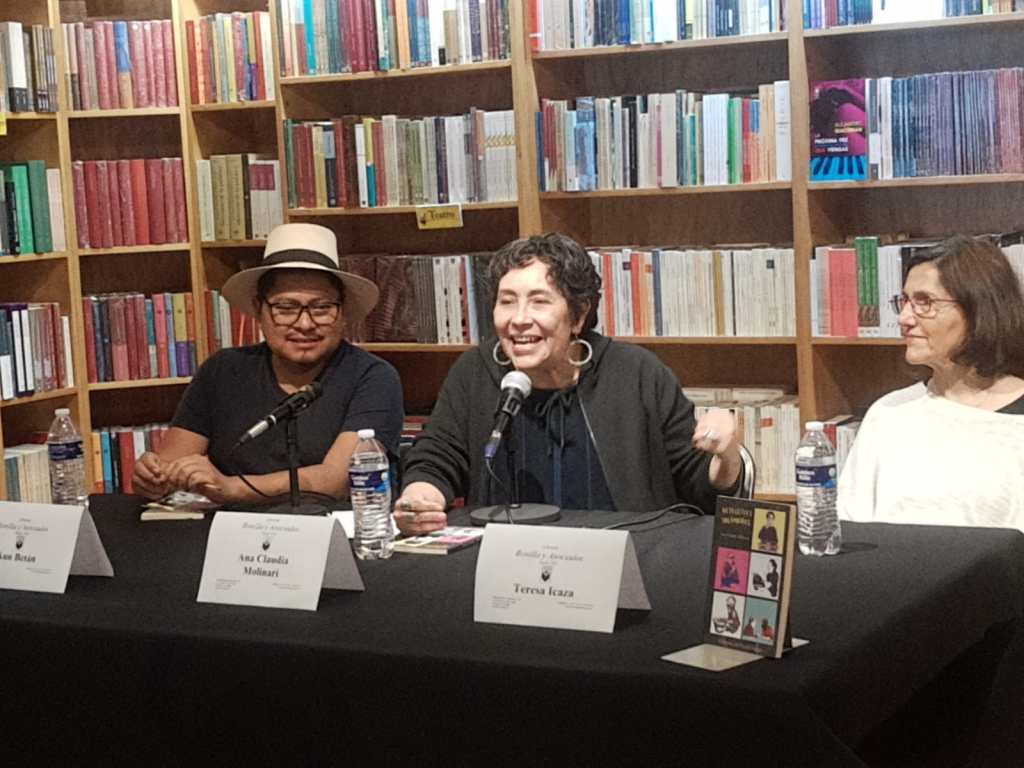
These three writers unite their voices in this presentation and their sense of writing.
Estos tres escritores unen sus voces en esta presentación y su sentido por la escritura.
Molinari expresses that it is a book that navigates the shores, but without shores there is no center, he explains. José Revueltas said in ’68: “They are not alone.” Nowadays it’s a cliché. Biden said it: “Israel, you are not alone.” The cliché is global. According to Elena Poniatowska, José Revueltas said it to the boys. “And the Bonilla bookstore is close to the banks. Being on the shore is something important, it is the strength of the center, from where it takes its content, its reason.”
Molinari expresa que es un libro que navega por las orillas, pero sin orillas no hay centro, explica. José Revueltas dijo en el 68: “No están solos”. Actualmente es un cliché. Biden lo dijo: “Israel, no está solo”. El cliché es mundial. Según Elena Poniatowska lo dijo José Revueltas a los muchachos. “Y librería Bonilla está cerca de los orillados. Estar en la orilla es algo importante, es la fuerza del centro, de donde toma su contenido, su razón”.
Uncomfortable Detectives was written for José Revueltas in a self-publication in 2022, Ana Claudia reveals to us.
Detectives incómodos fue escrito para José Revueltas en una autopublicación en 2022, nos revela Ana Claudia.
“You cannot understand Mexican literature or Mexican authors without reading José Revueltas, who never bowed to any power, and went to prison several times. Revueltas was affected by the revolution and the post-revolution, his literature was overshadowed, but all the great writers are Revueltas, even if they do not say or recognize it, even if they had not read it, starting with Juan Rulfo.
“No se entiende la literatura mexicana ni a los autores mexicanos sin leer a José Revueltas que jamás se doblegó a ningún poder, y fue a la cárcel varias veces. A Revueltas le tocó la revolución y la posrevolución, su literatura fue opacada, pero todos los grandes escritores son revueltianos, aunque no lo digan o reconozcan, incluso aunque no lo hubieran leído, comenzando por Juan Rulfo”.
The title Uncomfortable Detectives, in some way reveals Potentino’s intentions, to unravel the craft of writing, how to stay in it, know that he can do it, building dialogues with these characters, like a trip through time.
El título Detectives incómodos, revela de alguna forma las intenciones de Potentino, de desentrañar el oficio de la escritura, cómo permanecer en ésta, saber que puede hacerlo, construyendo diálogos con estos personajes, como un viaje en el tiempo.
I don’t know what to call them, Molinari insists, if they are essays, stories, there is the epistolary, the historical, the literary, the story, it navigates through various genres, in the end the starting and finishing point is the debate of the protagonist Ana Potentino, who is searching the answer if she is going to be a writer or not.
No sé cómo llamarlos, insiste Molinari, si son ensayos, relatos, está lo epistolar, lo histórico, literario, cuento, navega por diversos géneros, al final el punto de partida y llegada es el debate de la protagonista Ana Potentino, que está buscando la respuesta si va a lograr ser escritora o no.
“The protagonist speaks with dead writers, who I have called without a room of their own, because many men only have their clothes, they persist and persist. I did it inspired by a writer, the greatest in this country, the teacher José Revueltas, when I discovered him through Roberto Bolaño, the world of infrarealists, it was the trigger to say I want to be like Revueltas, I want to be infrarealist, write on the subway, handing out poems in the street, I don’t care about anything, just keep going on this path, the work is a dialogue with José Revueltas. We know that he is the idol of the infrarealists led by Roberto Bolaño, whom I call Chilengo, because he was neither totally Chilean nor chilango.”
“La protagonista habla con escritores muertos, que he llamado sin cuarto propio, porque muchos hombres no tienen sino solo sus ropillas, persisten y persisten. Lo hice inspirada en un escritor, el más grande de este país que es el maestro José Revueltas, cuando lo descubrí a través de Roberto Bolaño, el mundo de los infrarrealistas, fue el detonante para decir quiero ser como Revueltas, quiero ser infrarrealista, escribir en el metro, repartir poemas en la calle, no me importa nada, solo seguir adelante en este camino, la obra es un diálogo con José Revueltas. Sabemos que es el ídolo de los infrarrealistas encabezados por Roberto Bolaño a quien le llamo chilengo, porque ni era totalmente chileno ni chilango”.
La autora dio vida también a un personaje que inventó, es escritor indígena, vive en la calle, pide limosna y es un sabio.
The author also gave life to a character she invented, he is an indigenous writer, he lives on the streets, he begs for alms and he is a wise man.
“Charles Bukowski’s presence is due to his great criticism of racist American society. From the novel Uncomfortable Dead, which Subcomandante Marcos and Paco Ignacio Taibo II wrote in four hands, an analysis and criticism of politics in Mexico with names and surnames, had the need to point out the revolutionary elite of this country that does not accept the art of women, although I say yes, I rested a little from my anger at being marginal to that world where those who direct are men.”
“La presencia de Charles Bukowski obedece a su gran crítica a la sociedad norteamericana racista. De la novela Muertos incómodos, que escribieron a cuatro manos el subcomandante Marcos y Paco Ignacio Taibo II, un análisis y crítica a la política en México con nombres y apellidos, tenía la necesidad de señalar a la élite revolucionaria de este país que no acepta el arte de las mujeres, aunque diga que sí, descansé un poco de mi enojo de ser marginal a ese mundo donde los que dirigen son los hombres”.
With the smile of someone savoring victory, he adds: “I want to share with you that I will begin to publish in a space (another) that I achieved under the pseudonym of a man.”
Con una sonrisa de quien saborea la victoria, añade: “Les quiero compartir que comenzaré a publicar en un espacio (otro) que logré bajo el seudónimo de un hombre”.
“I’m here, celebrating, the path that has been difficult, I made the time to write. In literature everything is self-publishing, because in the end you are looking for someone to know your work. Honest self-publishing is a path that we should be able to do by creating our own publishing house and publishing with friends, but prestige and egos get involved, in the end what it comes down to is being able to communicate something, and I think we can share with people of the environment.”
“Estoy aquí, festejando, el camino que ha sido difícil, me hice el tiempo para escribir. En la literatura todo es autopublicación, porque al final estás buscando que alguien conozca tu obra. La autopublicación honesta es un camino que deberíamos poder hacer al crear nuestra propia editorial y publicar con amigos, pero se cruzan los prestigios, los egos, al final de lo que se trata es de poder comunicar algo, y creo que podemos compartir con las personas del entorno”.
Molinari was born in Mexico City (1966). For those who have a first approach to her work, she has a master’s degree in Latin American Studies from the University of Perpignan, France. Doctor in Roman Studies, from the Sorbonne University, Paris. With the doctoral thesis: Textual semiology of a historical event The war between Mexico and the United States (1845 1848), defended with honors and congratulations from the jury, in May 2006 in the examination room of La Sorbonne, in Paris. She is a social anthropologist from the National School of Anthropology and History ENAH, Mexico.
Molinari nació en la Ciudad de México (1966). Para quienes tienen un primer acercamiento a su trabajo, es maestra en Estudios Latinoamericanos por la Universidad del Perpignan, Francia. Doctora en Estudios Romanos, por la Universidad de la Sorbona, Paris. Con la tesis doctoral: Semiología textual de un acontecimiento histórico La guerra entre México y Estados Unidos (1845 1848), defendida con honores y felicitación del jurado, en mayo de 2006 en la sala de exámenes de La Sorbonne, en Paris. Es antropóloga social por la Escuela Nacional de Antropología e Historia ENAH, México.
She was a Senior Researcher at the National Institute of Anthropology and History INAH Chihuahua (1994 – 1999). Full Professor B of the Faculty of Social Sciences of the Autonomous University of Chiapas (2006 – 2015). For a decade he trained indigenous Mayan and Zoque anthropologists, developing the “Anthropology of the shore” as a method of self-knowledge. Professor at ENAH Chihuahua and ENAH CDMX (1990 – 2005).
Fue Investigadora titular del Instituto Nacional de Antropología e Historia INAH Chihuahua (1994 – 1999). Profesora Titular B de la Facultad de Ciencias Sociales de la Universidad Autónoma de Chiapas (2006 – 2015). Durante una década formó antropólogos indígenas mayas y zoques, desarrollando la “Antropología de la orilla”, como método de autoconocimiento. Catedrática en la ENAH Chihuahua y la ENAH CDMX (1990 – 2005).
Specialist in topics such as religious conversion among Rarámuris of the Sierra Tarahumara and indigenous rebellions in Chiapas. He did ethnohistorical research on the “War of ’47” between Mexico and the United States, in the mid-19th century and the role of the Apache nomads in this war conflict.
Especialista en temas como conversión religiosa entre rarámuris de la Sierra Tarahumara y las rebeliones indígenas en Chiapas. Hizo investigación etnohistórica sobre la “Guerra del 47” entre México y Estados Unidos, a mediados del siglo XIX y el papel de los nómadas apaches en este conflicto bélico.
Her first novel (which takes up the themes of the war between the United States and Mexico along with female infidelity), written during the summer of 2003, On the Other Side of the Turbulent River, was self-published in 2010, under her newly created publishing house. garage. In 2021, this novel was uploaded to the publishing house editionesdelespejosomos.org and can be read in full.
Su primera novela (que retoma los temas de la guerra entre Estados Unidos y México junto con el de la infidelidad femenina), escrita durante el verano del año 2003, Del otro lado del turbulento río, fue autopublicada en 2010, bajo su recién creada editorial de garaje. En 2021, esta novela se subió a la página de la editorial edicionesdelespejosomos.org y puede leerse completa.
Ana Claudia resigned from the academy in 2015, to be able to write novels and to edit books, which is also another way of writing them. It hasn’t been that easy anyway to get enough time and solitude to become a professional novelist. He wrote a second novel, still unpublished, American Company and has recently finished the third novel titled, El viento muerde.
Ana Claudia renunció a la academia en 2015, para poder escribir novelas y para editar libros, que es también otra manera de escribirlos. No ha sido tan fácil de todos modos conseguir el tiempo y la soledad suficientes para convertirse en novelista profesional. Escribió una segunda novela, aun inédita, American Company y ha terminado en estos días la tercera novela titulada, El viento muerde.
The screening of a substantial documentary took us to the bowels of the Espejo Somos publishing house, which was born in 2009 in San Cristóbal de las Casas, Chiapas. On a tour they opened the door for us to learn about the process of printing books and the way in which those who work in that literary world of assembling works, sometimes by hand, delve into poetic reading.
La proyección de un documental sustancioso nos llevó a las entrañas de la editorial del Espejo Somos, que nació en 2009 en San Cristóbal de las Casas, Chiapas. En un recorrido nos abrieron la puerta para conocer el proceso de la impresión de libros y la forma en que también quienes trabajan en ese mundo literario de ensamblar las obras, en ocasiones de forma artesanal, se internan en la lectura poética.
Ediciones del Espejo Somos is self-taught, self-managed, it works with the collaboration and complicity of Denise, daughter of Ana Claudia Molinari. In fourteen years they have published more than 30 books of literature, indigenous, bilingual, Latin American, invisible, feminist, dissident poetry (press, cartoneros, electronic fanzines).
Ediciones del Espejo Somos es autodidacta, autogestiva, funciona con la colaboración y complicidad de Denise, hija de Ana Claudia Molinari. En catorce años han publicado más de 30 libros de literatura, poesía indígena, bilingüe, latinoamericana, invisible, feminista, disidente (prensa, cartoneros, fanzines electrónicos).
Descubre más desde LA AGENCIA MUNDIAL DE PRENSA
Suscríbete y recibe las últimas entradas en tu correo electrónico.
