

Senén González Vélez: Living testament of a soul that does not give up

Hablar con Senén González Vélez es somarse al abismo del pensamiento lúcido, valiente y sin adornos. Es asistir a un juicio interior donde la conciencia no tiene apelación. A sus 81 años, este hombre de verbo preciso y pensamiento afilado no necesita levantar la voz para estremecer verdades. Ex juez, contralor, secretario personal del Jefe de Estado, candidato a gobernador, periodista, escritor, poeta… y a hoy, sigue siendo una fuerza intelectual que no se doblega, siempre fiel a sí mismo. Y ahora, cuando lanza su obra más íntima —La Eutanasia Pasiva— en medio de silencios que lo dicen todo, la justicia íntima, las heridas sin cicatrizar y la dignidad como principio de vida. Senén no busca indulgencias ni titulares: busca dejar constancia. En esta entrevista sin concesiones, abordamos su vida con todo el asador encendido, desde su Cartagena natal hasta las trincheras éticas donde sigue luchando, con dignidad intacta, contra el olvido y la mediocridad.
To speak with Senén González Vélez is to plunge into the abyss of lucid, courageous, and unadorned thought. It is to witness an inner judgment where conscience has no appeal. At 81, this man of precise speech and sharp thought doesn’t need to raise his voice to shake the truth. A former judge, comptroller general, personal secretary to the Head of State, gubernatorial candidate, journalist, writer, poet… and to this day, he remains an unwavering intellectual force, always true to himself. And now, as he launches his most intimate work—Passive Euthanasia—amidst silences that speak volumes, intimate justice, unhealed wounds, and dignity as a life principle. Senén doesn’t seek indulgences or headlines: he seeks to leave a mark. In this uncompromising interview, we delve into his life with all the fires blazing, from his native Cartagena to the ethical trenches where he continues to fight, with intact dignity, against oblivion and mediocrity.
Esta no es una conversación ligera. Es el retrato de un hombre que, aun herido, no claudica. Que escribe desde el borde, pero sin rencor. Que cree en la espiritualidad sin dogmas y en la justicia sin maquillajes. Un hombre que ama el amor, pero detesta la hipocresía. Que ha vivido lo suficiente para hablar sin miedo. Esta entrevista es un viaje a lo más profundo del alma de un hombre. Aquí está Senén: el hombre, el juez, el escritor… y el alma que no se rinde.
This is not a light conversation. It’s the portrait of a man who, even wounded, does not give up. Who writes from the edge, but without rancor. Who believes in spirituality without dogma and in justice without makeup. A man who loves love, but detests hypocrisy. Who has lived long enough to speak without fear. This interview is a journey to the depths of a man’s soul. Here is Senén: the man, the judge, the writer… and the soul that does not give up.

1 CB: Senén, es un privilegio conversar contigo. Tu vida es una narrativa fascinante de servicio, pensamiento crítico y amor por la palabra. ¿Quién es hoy Senén González Vélez? Senén, it’s a privilege to talk with you. Your life is a fascinating narrative of service, critical thinking, and love of words. Who is Senén González Vélez today?
Gracias si para ti es un privilegio, ¿cómo no lo será para mi estar al frente de una mujer brillante, inteligente y bella?
¿Quién es hoy Senen Gonzalez Vélez.? Soy el mismo de siempre, pero con más experiencia, y con unas pocas canas y arrugas que acreditan que mi tránsito por este mundo, se ha movido entre aciertos y desaciertos, y eso me ha permitido conocerme a mí mismo, para poder conocer a los demás.
Thank you, if it’s a privilege for you, how could it not be for me to be at the helm of a brilliant, intelligent, and beautiful woman?
Who is Senen Gonzalez Vélez today? I’m the same as always, but with more experience, and with a few gray hairs and wrinkles that prove that my journey through this world has been marked by successes and failures, and that has allowed me to get to know myself, so I can get to know others.
2 CB: Has tenido una vida profesional extensa, marcada por el servicio público, la docencia, el periodismo, el arte. Has sido juez, político, servidor público, maestro y escritor. Si tuvieras que definir tu existencia en una frase, ¿cuál sería? You’ve had a long professional life, marked by public service, teaching, journalism, and art. You’ve been a judge, politician, public servant, teacher, and writer. If you had to define your life in one sentence, what would it be?
Nací para servirle al projimo.
I was born to serve my neighbor.
3 CB: En tu próximo libro La Eutanasia Pasiva, parece que vas más allá de un tema médico. ¿Es una metáfora de algo más profundo? In your upcoming book, Passive Euthanasia, you seem to be going beyond a medical topic. Is it a metaphor for something deeper?
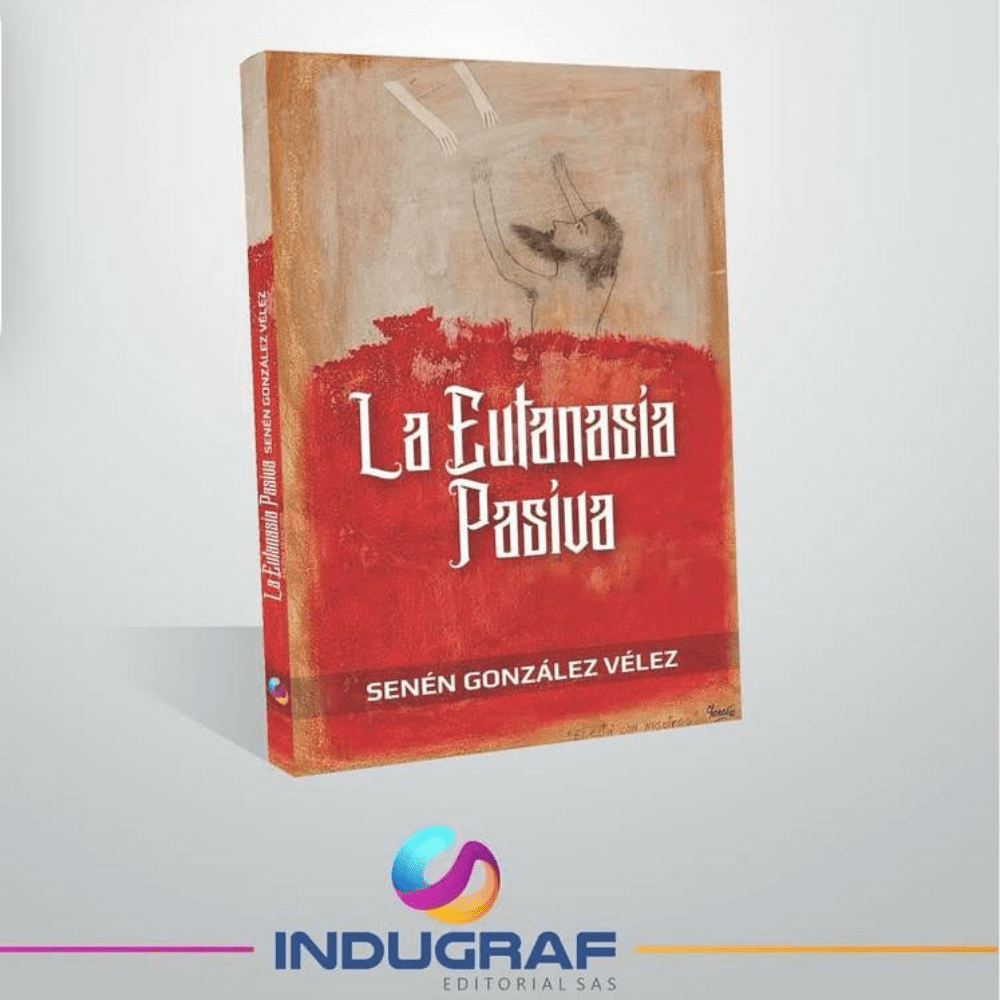
Cuando se me ocurrió escribir sobre la Eutanasia Pasiva entendí que la vida es una chistosa paradoja en que el sentido feliz de nacer, tiene como incoherencia el de morir. Eso es sin duda una metáfora cruda de la existencia humana.
When I decided to write about Passive Euthanasia, I understood that life is a humorous paradox in which the joyful meaning of being born is inconsistent with the meaning of dying. This is undoubtedly a crude metaphor for human existence.
Es bien sabido desde luego que entre el punto de partida y la meta final, siempre el camino estará lleno de momentos felices, como de obstáculos fuertes que hay que superar. Ese un doloroso tránsito de corte viacrucis, que nos obliga a que recurramos no a la medicina que cura la materia, sino a la supra conciencia que nos ayude a trascender mediante un puente que comunique lo humano, con lo divino. Algunos recurren a la meditación, otros al yoga, yo recurro a Dios.
It is well known, of course, that between the starting point and the final goal, the path will always be filled with happy moments, as well as with difficult obstacles to overcome. This is a painful journey, a via crucis, that forces us to turn not to medicine that cures matter, but to the supraconscious that helps us transcend through a bridge that connects the human with the divine. Some turn to meditation, others to yoga, I turn to God.
Mi apreciada Cristina. Las postraciones o sufrimientos que maltratan el alma no se ven, se sufren, y es el pan de cada día de la sociedad moderna; vivimos y nos convertimos en nuestro propio verdugo. Dejamos de ser prácticos para buscar lo ostentoso. Se pasa hambre, pero se guindan al cuello y los dedos, anillos valiosos de oro, diamantes. Por eso descuidan el verdadero tesoro que es la riqueza interna, espiritual.
La medicina solo actúa en la materia para curar lo físico o aliviar el dolor, que ese traslada a través de los nervios periféricos a la medula espinal y luego al cerebro.
My dear Cristina. The prostrations or sufferings that mistreat the soul are not seen, they are endured, and they are the daily bread of modern society; we live and become our own executioners. We stop being practical in favor of ostentatious things. We starve, but valuable gold rings and diamonds are hung around our necks and fingers. That’s why we neglect the true treasure: inner, spiritual wealth.
Medicine only acts on matter to heal physical pain or relieve pain, which is transmitted through the peripheral nerves to the spinal cord and then to the brain.
Pero… ¿qué es el dolor por el maltrato ambiental, laboral, conyugal, político estatal? ¿Que fármaco existe para eso?? Ninguno. Que terrible es cuando se traslada a la mente un problema que se convierte en obsesión. Es un duende invisible, y para eso no hay medicina que valga porque la persecución a la tranquilidad del pensamiento se altera, y la vida se hace invivible. Entonces aparecen las enfermedades mentales, la ansiedad, la depresión, y la locura, que llevan al suicidio. Ese proceso, es el que he llamado eutanasia pasiva.
Créeme Cristina, que es muy frecuente en las relaciones conyugales cuando estas son disimiles por muchas causas, algunas apuntan más a lo cultural y a los valores y principios, que son tan fuertes, que taladran al alma trasformando la alegría en una terrible tristeza. Tienes razón, es un tema más profundo. Por ello en el discurrir temático de mi libro, traigo ejemplos que, aunque parecieran estar desconectados con el título, están íntimamente ligados a la eutanasia pasiva. Hay paradoja hasta en la misma felicidad que se puede convertir en una muerte pasiva, cuando esta se lleva sin medida.
Por eso considere muy importante escribir sobre la muerte pasiva e invisible, estando en salud física.
But… what is the pain of environmental, workplace, marital, or state abuse? What medicine exists for that? None. How terrible it is when a problem is transferred to the mind and becomes an obsession. It’s an invisible gnome, and there’s no medicine that can help because the pursuit of tranquility of thought is disrupted, and life becomes unlivable. Then mental illness, anxiety, depression, and insanity appear, leading to suicide. This process is what I’ve called passive euthanasia.
Believe me, Cristina, it’s very common in marital relationships when they are dissimilar for many reasons. Some point more to culture and to values and principles, which are so strong that they pierce the soul, transforming joy into terrible sadness. You’re right, it’s a deeper issue. That’s why, in the thematic discussion of my book, I bring examples that, although they may seem unrelated to the title, are closely linked to passive euthanasia. There is a paradox even in happiness itself, which can turn into a passive death when it is experienced without measure.
That’s why I consider it very important to write about passive and invisible death, even when one is physically healthy.
4 CB: En esta obra, revelas de forma discreta pero firme, desde un lugar muy íntimo, una parte dolorosa de tu propia historia. ¿Podemos decir que este libro es también un acto de justicia personal? ¿Qué te motivó a escribirlo ahora? In this work, you discreetly but firmly reveal, from a very intimate place, a painful part of your own story. Can we say that this book is also an act of personal justice? What motivated you to write it now?
Todos somos autores de nuestra propia historia y como una forma de aportarle a la sociedad una medicina preventiva basada en las experiencias, estamos en la obligación de pensar en voz alta para ayudar al prójimo, y abrirles los ojos al estado, que se reputa padre de la nación.
No solo es un acto de justicia personal, sino una sentencia contra quienes pretenden manipular nuestros derechos, convicciones, principios, valores, aficiones, gustos y opiniones, en el que se olvidan que el más humilde de los conceptos que salga de un joven, hasta un anciano, puede llevar implícito una gran sabiduría o una excelente lección de buen ejemplo.
We are all authors of our own history, and as a way of providing society with experience-based preventative medicine, we have an obligation to think out loud to help others and open the eyes of the state, which considers itself the father of the nation.
This is not only an act of personal justice, but also a judgment against those who seek to manipulate our rights, beliefs, principles, values, hobbies, tastes, and opinions, forgetting that the humblest of concepts emanating from a young person, or even an old person, can implicitly carry great wisdom or an excellent lesson in good example.
5 CB: ¿Le temes a las represalias por lo que cuentas allí? Are you afraid of retaliation for what you say there?
Mas temor me daría convertirme en cómplice del silencio, o alcahueta de los corruptos. Cuando se habla con la verdad, quien debe temer es a quien se la cantan.
I’d be more afraid of becoming an accomplice to silence, or a pimp for the corrupt. When you speak the truth, the one you should fear is the one you’re telling it to.
6 CB: Fuiste juez, contralor, secretario personal del Jefe de Estado, candidato a gobernador, entre otros cargos. ¿Cuál ha sido tu mayor aprendizaje desde el poder? You’ve served as a judge, comptroller, personal secretary to the head of state, and as a candidate for governor, among other positions. What has been your greatest learning experience while in office?
El mayor aprendizaje, es que pude ver de cerca, la corrupción, y el que se contagia es porque nació para ser corrupto. En cuanto al ejercicio del poder. Para mí su definición la degeneraron los politiqueros. El poder es el medio para servir a la comunidad, no para servirse así mismo.
The greatest lesson I learned was that I saw corruption up close, and those who catch it are born corrupt. As for the exercise of power, for me, politicians have corrupted its definition. Power is the means to serve the community, not oneself.
7 CB: Como escritor, tus obras van desde la crítica social hasta la poesía mística. ¿Qué papel ha jugado la literatura en tu vida? ¿Ha sido tu refugio, tu espada o tu confesionario? As a writer, your works range from social criticism to mystical poetry. What role has literature played in your life? Has it been your refuge, your sword, or your confessional?
Pues esta me enseñó a comunicarme socialmente para saber emplear los medios más adecuado para trasmitir mis pensamientos, y de la forma más sencilla, al tiempo que me abrió la imaginación para idealizar cosas que se me crucen por la mente y poderlas llevar al papel buscando la manera de hacerlas agradables al lector con su toque de arte, humor y buen gusto. Desde luego, está la ironía, y la sátira, que abren otros campos de la imaginación para utilizar las comparaciones y volverlas una metáfora de humor o un fino bisturí. La literatura definitivamente han sido las tres cosas: refugio, espada y confesionario.
Well, it taught me how to communicate socially, knowing how to use the most appropriate means to convey my thoughts in the simplest way possible. At the same time, it opened my imagination to idealize things that cross my mind and put them on paper, finding ways to make them pleasing to the reader with a touch of art, humor, and good taste. Of course, there’s irony and satire, which open up other fields of imagination to use comparisons and turn them into a humorous metaphor or a fine scalpel. Literature has definitely been all three: refuge, sword, and confessional.
8 CB: ¿Qué representa para ti escribir hoy, en un tiempo donde parecería que las verdades incomodan más que nunca? What does it mean to you to write today, at a time when truths seem more uncomfortable than ever?
Es la mejor forma de quitarles la máscara a los hipócritas y farsantes. El que se presta para lo malo, se debe alistar para lo que le viene.
It’s the best way to unmask hypocrites and frauds. He who lends himself to evil must prepare for what comes.

9 CB: A tus 81 años, sigues escribiendo, interactuando en TikTok con ‘Punta de Lanza’, y publicando columnas en medios nacionales e internacionales. ¿Qué te mantiene vivo, intelectualmente hablando? At 81, you continue to write, interact on TikTok with «Punta de Lanza,» and publish columns in national and international media. What keeps you alive, intellectually speaking?
A nadie se le debe impedir que desarrolle su vocación.
Escribir para mí, como cantar; me recuerdan los orgasmos de mi juventud que, con la edad, se hicieron más fuertes en mi cerebro, que hoy es capaz de preñar hojas de ideas absurdas o visionarias, que me dan vida y salud, aunque las procesiones vayan por dentro y nos sorprendan para interrumpir esa pasión.
No one should be prevented from pursuing their vocation. Writing, for me, is like singing; it reminds me of the orgasms of my youth, which, with age, grew stronger in my brain, which today is capable of impregnating pages with absurd or visionary ideas, which give me life and health, even though the processions go on inside and surprise us, interrupting that passion.
10 CB: En tu larga trayectoria has defendido valores como la dignidad, la honestidad y la lealtad. ¿Qué tan vigentes crees que están esos principios en la Colombia actual? Throughout your long career, you’ve championed values such as dignity, honesty, and loyalty. How relevant do you think these principles are in today’s Colombia?
Cristina ese valor hace rato el medio social influenciado por las importaciones de las malas costumbres, las han mandado al carajo. Yo me sostengo en mis bases doctrinarias tradicionales, las enseño a los míos, de manera reflexiva, no impuesta. La Colombia de hoy es un como un péndulo desbocado en que no hay equilibrio en su andar, por ello se atrasa o se precipita.
Cristina, that value has long since been thrown to hell by the social environment, influenced by imported bad customs. I stand by my traditional doctrinal foundations; I teach them to my people in a reflective, non-imposed manner. Today’s Colombia is like a runaway pendulum whose movement is unbalanced, and therefore it either lags behind or rushes.
11 CB: Teniendo en cuenta lo anterior, ¿qué le dirías hoy a los jóvenes abogados, funcionarios o escritores que quieren hacer carrera, pero sin sacrificar su ética? Considering the above, what would you say today to young lawyers, civil servants, or writers who want to pursue a career without sacrificing their ethics?
Sin ética no hay valores. Un abogado por más brillante que sea, si su brillo y audacia está en la compra de fallos, o en el tráfico de influencia, no es otra cosa que un delincuente más con toga, o con diploma y todos los doctorados que guindo en la pared. Detestables.
Without ethics, there are no values. A lawyer, no matter how brilliant, if his brilliance and audacity lie in buying judgments or peddling influence, is nothing more than another criminal in a robe, or with a diploma and all the doctorates hanging on the wall. Detestable.
12 CB: ¿Cuál fue el momento más difícil de tu carrera como juez o como servidor público, y cómo lo enfrentaste? What was the most difficult moment in your career as a judge or public servant, and how did you deal with it?
Cristina esa es muy buena pregunta. Mire, cuando el ser es honesto, se le conoce en su rostro, está seguro de sí mismo, no titubea y, a ese nadie se atreve a proponerle nada sucio. Mi permanencia en la judicatura, fue tranquila en ese sentido, aunque me tocaron casos de resonancia nacional. Como el de CARIBESA en que primo mi compromiso ciego de la aplicación de la ley.
Cristina, that’s a very good question. Look, when someone is honest, you can tell by their face, they’re self-confident, they don’t hesitate, and no one dares to propose anything unto them. My tenure in the judiciary was peaceful in that sense, although I was involved in cases of national renown. Like the CARIBESA case, where my unwavering commitment to the application of the law prevailed.
13 CB: ¿Sientes que Colombia te ha dado todo lo que merecías, o te ha quitado parte de tu esencia? Do you feel that Colombia has given you everything you deserved, or has it taken away part of your essence?
Mi esencia es propia, y nadie se atrevería a semejante despropósito. He servido, sin esperar. Es mi lema.
My essence is my own, and no one would dare such an outrage. I have served, without waiting. That’s my motto.
14 CB: ¿Qué le deja Senén González Vélez a Colombia? What does Senén González Vélez leave for Colombia?
En un país que no da ni quita honra a los buenos, le dejo a Colombia mi hoja de vida abierta a la lectura pública.
In a country that neither honors nor deprives the good, I leave my resume for public reading to Colombia.
15 CB: Tú has amado intensamente. ¿Qué papel ha jugado el amor en tu vida? You have loved intensely. What role has love played in your life?
El amor si ha jugado en mi vida un importante papel para cumplir el precepto bíblico de amar al prójimo, como a mí mismo. Por lo tanto, amar a mi patria es un deber, amar el amor es una poesía, amar a los hijos es celestial y amar a una mujer es música que, de bolero, y chacha, en ocasiones es melodía inconclusa. Ah, que bellas son las mujeres, carajo. Un dolor de cabeza que agrada, pero que no llegue a migraña.
Love has played an important role in my life in fulfilling the biblical precept of loving one’s neighbor as oneself. Therefore, loving my country is a duty, loving love is poetry, loving children is heavenly, and loving a woman is music that, like a bolero and a chacha, is sometimes an unfinished melody. Ah, how beautiful women are, damn it. A headache that pleases, but not one that becomes a migraine.
16 CB: También has dicho que amas el amor con o sin pan, con cama o sin techo… ¿Esa visión romántica ha sido tu fuerza o tu fragilidad? You’ve also said that you love love with or without bread, with or without a roof… Has that romantic vision been your strength or your fragility?
Sin cama, sin pan y sin techo, es ese amor al que no se le pone condiciones. Por tanto mi fuerza.
Without a bed, without bread, and without a roof, it’s that love that has no conditions. Therefore, my strength.

17 CB: Has sido esposo, padre de siete hijos y abuelo de trece nietos. ¿Qué aprendiste del amor y de la familia a lo largo de tu vida? You’ve been a husband, a father of seven children, and a grandfather to thirteen grandchildren. What have you learned about love and family throughout your life?
Aprendí, que ser abuelo es el más alto grado de la felicidad.
I learned that being a grandfather is the highest level of happiness.
18 CB: ¿Cuál es la herencia que quieres dejar a tus hijos y nietos? No en bienes, sino en convicciones. What legacy do you want to leave your children and grandchildren? Not in possessions, but in beliefs.
La herencia de la virtud que prime ante los defectos. Honradez, ante todo. Respeto a la dignidad propia.
The legacy of virtue that prevails over defects. Honesty, above all. Respect for one’s own dignity.
19 CB: Has escrito obras como Contrastes entre la miseria y la opulencia, Habemus Chenco o La revolución de las angustias. ¿Cuál de tus libros crees que más te representa como ser humano? You’ve written works like Contrasts Between Misery and Opulence, Habemus Chenco, and The Revolution of Anguish. Which of your books do you think most represents you as a human being?
Cada libro es un hijo del escritor. Hasta ahora todos me han llenado, desde aquel mal concebido que me enseñó a rectificar y perder el miedo al público, hasta los otros que van mejorando. En cuanto a la pregunta, «todos» porque son escrito con el sentimiento, el que escriba sin el corazón en la mano, está escribiendo con la calculadora en la otra.
Each book is a child of the writer. So far, they’ve all filled me, from that poorly conceived one that taught me to rectify and lose my fear of the public, to the others that are improving. As for the question, «all» because they’re written with emotion. Anyone who writes without their heart in their hand is writing with a calculator in the other.
20 CB: Como vemos has escrito sobre miseria, arte, angustia, poesía y corrupción. ¿Qué te falta por escribir? As we’ve seen, you’ve written about poverty, art, anguish, poetry, and corruption. What else do you have left to write?
Me falta por escribir lo que debo descubrir e imaginar, para cerrar mi ciclo.
I still have to write what I must discover and imagine, to close my cycle.
21 CB: Se me ocurre ahora mismo preguntarte: ¿Qué te enoja? It occurs to me to ask you right now: What angers you?
¿Que me enoja? La imprudencia, que es sinónimo de poca inteligencia.
What angers me? Recklessness, which is synonymous with low intelligence.
22. CB: ¿Qué te conmueve? What moves you?
¿Que me conmueve?. Las demasiadas diferencias entre la opulencia y la miseria. Siempre existirán las diferencias, pero cuando son abismales tocan mis sentimientos, y me dicen que debo hacer más, que lo que hice no es suficiente. Es la impotencia que mortifica mis sentimientos.
What moves me? The vast differences between opulence and poverty. There will always be differences, but when they are vast, they touch my feelings, and they tell me I must do more, that what I’ve done isn’t enough. It’s the helplessness that mortifies my feelings.
23. CB: ¿Qué le dirías hoy a las nuevas generaciones que aún creen en la ética, la poesía, la justicia y la patria? What would you say today to the new generations who still believe in ethics, poetry, justice, and the homeland?
A los que creen en las bellezas de las metáforas y en los espectáculos hermosos de la madre natura, que los aprovechen, son vida para los estados de ánimo.
To those who believe in the beauty of metaphors and the beautiful spectacles of Mother Nature, let them take advantage of them; they are life for their moods.
24. CB: ¿Has perdonado las traiciones que viviste? ¿Cómo se cura una herida moral? Have you forgiven the betrayals you experienced? How do you heal a moral wound?
El concepto de traición suena a infidelidad, quien la haya sufrido debió sufrir mucho. Desencantos si, que es esperar sobre todo cuando uno deposita su fe humana, en sus semejantes. Ya la Biblia lo había advertido: maldito el hombre que cree en el hombre. Y eso en política, abunda.
The concept of betrayal sounds like infidelity; whoever suffered it must have suffered greatly. Disillusionment, yes, is to be expected, especially when one places one’s human faith in one’s fellow human beings. The Bible had already warned: cursed is the man who believes in man. And that abounds in politics.
25. CB: Si la historia te dedicara una sola línea, ¿que quisieras que dijera sobre ti? If history dedicated a single line to you, what would you want it to say about you?
Que fui vertical y no le hice daño a nadie.
That I was vertical and didn’t hurt anyone.
26. CB: Finalmente, ¿que esperas que el lector encuentre en La Eutanasia Pasiva cuando cierre la última página? Finally, what do you hope the reader will find in Passive Euthanasia when they close the last page?
Espero q el lector solo reciba mi mensaje previa reflexión de mis posibles equivocaciones..
I hope the reader only receives my message after reflecting on my possible mistakes.
“Senen en sus propias palabra…» “Senen in your own words…”
“Yo amo el amor con o sin pan. Con cama o sin ella. Con casa y sin techo para ver las estrellas.”
“Siento lástima por los que viven de la ostentación, pero admiro a los sencillos: tienen rostro de sabios.”
“Yo no soy escritor, soy escribiente de mis pensamientos y Sentimiento”
“Aquí no sembramos cizaña, aquí cultivamos la amistad.”
"No existen las justificaciones para cometer un desliz, pero si existe en su ADN, por eso más tarde que temprano pelan el cobre."
"La mayoría, de los casos de corrupción provienen de la educación en casa. Un padre o una madre corrompida, educa hijos, iguales".
“I love love with or without bread. With or without a bed. With a house and no roof over my head to see the stars.” “I feel sorry for those who live off ostentation, but I admire the simple: they have the face of wise men.” “I’m not a writer, I’m a recorder of my thoughts and feelings.” “Here we don’t sow discord, here we cultivate friendship.” “There are no justifications for making a mistake, but it’s in their DNA, which is why they reveal their true colors sooner or later.” “Most cases of corruption stem from homeschooling. A corrupt father or mother raises children who are equal.”
“La mirada de otros sobre él..» “The way others look at him..”
“Don Senén siempre fue una brújula ética en medio del caos político.”
— Ex alumno de Derecho
“Un hombre que me enseñó que la pluma puede ser más justa que un tribunal.”
— Colega jurista
“Don Senén was always an ethical compass in the midst of political chaos.” — Former Law Student “A man who taught me that the pen can be more just than a court.” — Fellow Lawyer
“Obras destacadas…» “Outstanding Works…”
- La eutanasia pasiva (2024) – Crónica existencial escrita con sensibilidad, discreción y denuncia contenida. Passive Euthanasia (2024) – An existential chronicle written with sensitivity, discretion, and restrained denunciation.
- Contrastes entre la miseria y la opulencia – Un análisis honesto de las desigualdades que nos rodean. Contrasts between Poverty and Opulence – An honest analysis of the inequalities that surround us.
- Manual del hombre absurdo – Filosofía cotidiana desde la ironía y el sentido común. Manual of the Absurd Man – Everyday philosophy from irony and common sense.
- Catarsis – Costumbrismo poético que eleva lo rural a sabiduría vital. Catharsis – Poetic costumbrism that elevates the rural to vital wisdom.
- La revolución de las angustias – Reflexión sobre el olvido de lo esencial en la vida moderna. The Revolution of Anguish – Reflection on the forgetting of the essential in modern life.
- La ONU, centro de operaciones de Lucifer – Ensayo crítico sobre el poder global y sus sombras. The UN, Lucifer’s Operations Center – A critical essay on global power and its shadows.
- La toga del diablo – Crónica vivencial de corrupción judicial, prologada por Juan Gossaín. The Devil’s Robe – A personal chronicle of judicial corruption, with a prologue by Juan Gossaín.
- Habemus Chenco – Homenaje biográfico a un artista y amigo de infancia. Habemus Chenco – A biographical tribute to an artist and childhood friend.
- La Biblia de la mano del pecado (en proceso) – Ensayo sobre la contradicción entre fe, política y poder. The Bible by the Hand of Sin (in progress) – An essay on the contradiction between faith, politics, and power.
«Línea de vida..» «Lifeline..»
- 1960s – Inicia su ejercicio periodístico en El Universal de Cartagena. 1960s – Begins his journalism career at El Universal in Cartagena.
- 1970s–1980s – Desarrolla una carrera destacada como servidor público en el ámbito judicial. 1970s–1980s – Develops a distinguished career as a public servant in the judicial system.
- 1990s – Se enfrenta a un caso de injusticia judicial que marcará su vida y su obra literaria. 1990s – Faces a case of judicial injustice that will shape his life and literary work.
- 2000s – Publica sus primeros libros y fortalece su perfil como escritor crítico y comprometido. 2000s – Publishes his first books and strengthens his reputation as a critical and committed writer.
- 2010s – Retorna con obras de tono filosófico, social y autobiográfico. 2010s – Returns with works of philosophical, social, and autobiographical tone.
- 2024 – Publica La Eutanasia Pasiva, considerada su obra más íntima y reflexiva. 2024 – Publishes La Eutanasia Pasiva, considered his most intimate and reflective work.
Al concluir esta entrevista, nos queda claro que Senén González Vélez no es un hombre de respuestas fáciles, ni de caminos lineales. A través de sus palabras, sus silencios y su vida, ha trazado un camino donde la dignidad y la verdad son las únicas guías en una época donde las promesas se desvanecen en el aire y las mentiras parecen tener más espacio que la verdad, Senén se mantiene firme, sin pedir permiso ni perdón por ser quien es. La Eutanasia Pasiva, su última obra, no es solo un libro, es el testamento de un hombre que ha sabido vivir a contracorriente, que se enfrenta a sus propios miedos sin renunciar a su esencia.
At the end of this interview, it’s clear to us that Senén González Vélez is not a man of easy answers or linear paths. Through his words, his silences, and his life, he has forged a path where dignity and truth are the only guides. In an age where promises vanish into thin air and lies seem to have more space than truth. Senén stands firm, without asking permission or forgiveness for who he is. Passive Euthanasia, his latest work, is not just a book; it is the testament of a man who has known how to live against the current, who faces his own fears without surrendering his essence.
Hoy sigue siendo un hombre que piensa, que reflexiona, que no teme ser incómodo. Y lo hace con la convicción de que la única lucha que vale la pena es la que mantiene la integridad intacta.
Today, he remains a man who thinks, who reflects, who is not afraid of being uncomfortable. And he does so with the conviction that the only fight worth fighting is the one that keeps one’s integrity intact.
Con su mirada serena pero desafiante, Senén González Vélez continúa dejando una huella imborrable en todos aquellos que tienen el privilegio de conocer su vida y su obra. Su legado va más allá de sus múltiples logros profesionales: es un ejemplo de cómo la fortaleza interior y la honestidad son capaces de resistir las tempestades del tiempo.
With his serene yet defiant outlook, Senén González Vélez continues to leave an indelible mark on all those who have the privilege of knowing his life and work. His legacy goes beyond his many professional achievements: he is an example of how inner strength and honesty can withstand the storms of time.

Gracias, Senén, por ser un faro de luz, por enseñar que el alma que no se rinde es, en última instancia, la que prevalece.
Thank you, Senén, for being a beacon of light, for teaching that the soul that does not give up is, ultimately, the one that prevails.
A modo de epílogo, quiero compartir unas palabras personales para el hombre que ha hecho de su vida una causa y de la palabra, su lanza…
As an epilogue, I want to share a few personal words for the man who has made his life a cause and his words his spear…
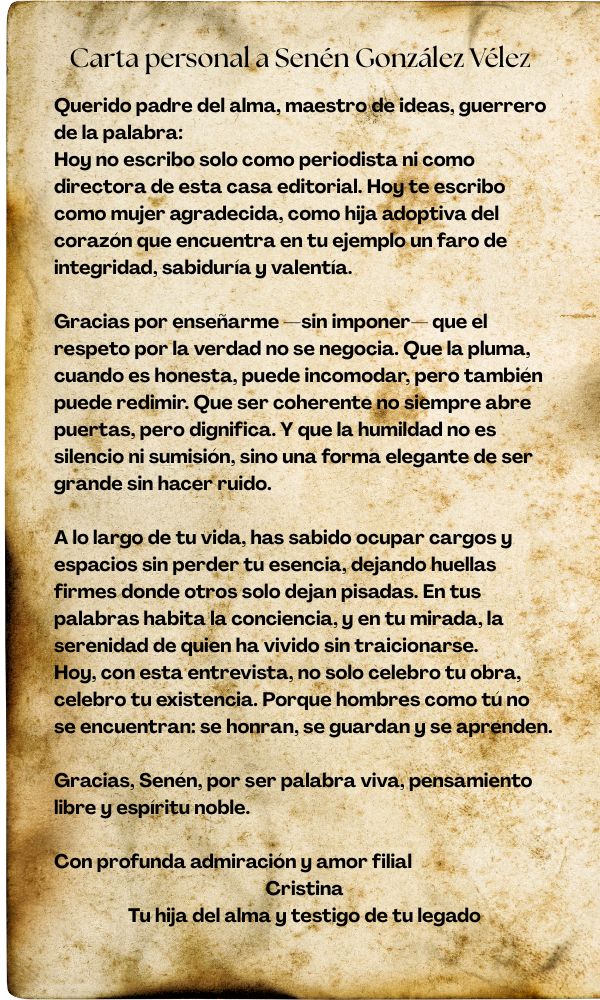
Dear father of my soul, master of ideas, warrior of the word:

Today I write not only as a journalist or as the director of this publishing house. Today I write to you as a grateful woman, as an adopted daughter of the heart who finds in your example a beacon of integrity, wisdom, and courage.

Thank you for teaching me—without imposing—that respect for the truth is not negotiable. That the pen, when it is honest, can be uncomfortable, but it can also redeem. That being consistent doesn't always open doors, but it dignifies. And that humility is not silence or submission, but an elegant way of being great without making a fuss.

Throughout your life, you have known how to occupy positions and spaces without losing your essence, leaving firm footprints where others only leave footprints. In your words dwells conscience, and in your gaze, the serenity of one who has lived without betraying herself.

Today, with this interview, I not only celebrate your work, I celebrate your existence. Because men like you are not found: they are honored, preserved, and learned.

Thank you, Senén, for being a living word, a free thought, and a noble spirit.

With profound admiration and filial love,

Cristina
Your beloved daughter and witness to your legacy

Descubre más desde LA AGENCIA MUNDIAL DE PRENSA
Suscríbete y recibe las últimas entradas en tu correo electrónico.

