
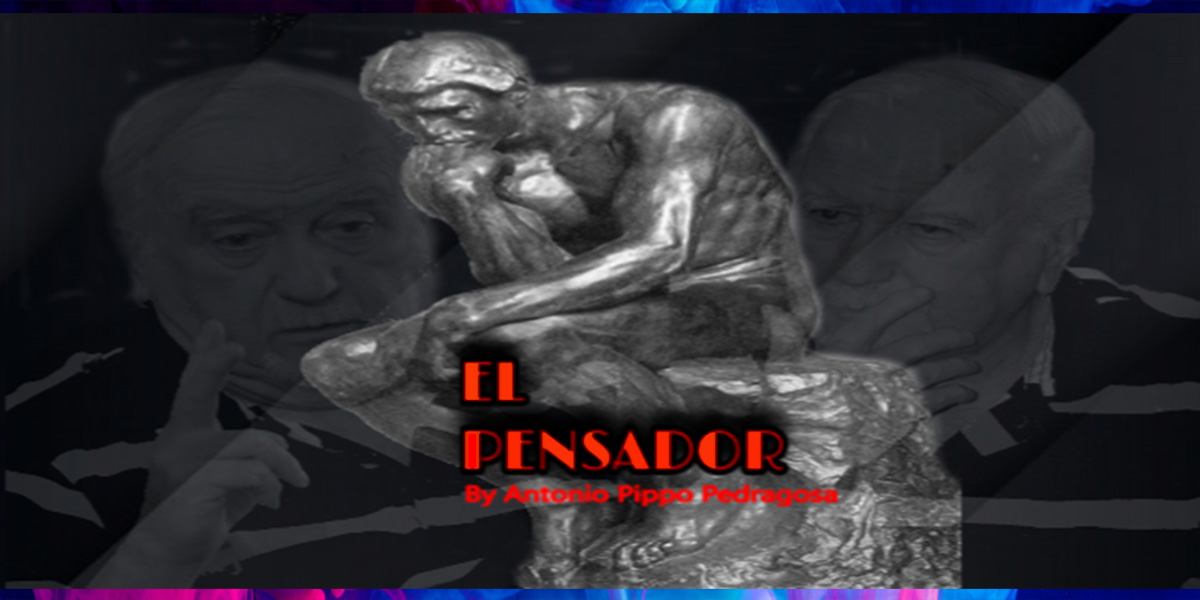
THE THINKER: ART AND PERSONAL HUMOR
Por Antonio Pippo
En unas circunstancias desestimulantes como las que caracterizan la vida social uruguaya, creo que hemos exagerado -yo sí, al menos- ocupándonos de la política, de las ambiciones de poder y del desinterés por crear un contexto benevolente.
In discouraging circumstances such as those that characterize Uruguayan social life, I think we have exaggerated – I have, at least – by dealing with politics, ambitions for power and lack of interest in creating a benevolent context.
Prefiero, al menos hoy, darme el gusto, a través de experiencias personales con un ya fallecido amigo artista, de personalidad absorbente y un ejercicio originalísimo del humor, de pensar cuán diferente sería nuestra vida social, aunque funcionase sólo como paliativo.
I prefer, at least today, to give myself the pleasure, through personal experiences with a now deceased artist friend, with an absorbing personality and a very original exercise of humor, to think about how different our social life would be, even if it worked only as a palliative.
Hubo un excepcional artista plástico -pintor y escultor-, llamado Hugo Nantes, cuyas obras excedieron las fronteras del país, que en nuestra juventud fue mi amigo y que es suficiente leer con atención lo que sigue, y las anécdotas, para saber que elegirlo como ejemplo es de toda justicia.
There was an exceptional plastic artist – painter and sculptor – called Hugo Nantes, whose works exceeded the borders of the country, who in our youth was my friend and it is enough to read carefully what follows, and the anecdotes, to know that choosing him as example is of all justice.
Hugo nació y vivió gran parte de su vida en San José, como yo. Su arte floreció temprano, tanto como su carácter sacudidor, imprevisible y también, si se le entendía, sanador.
Hugo was born and lived much of his life in San José, like me. His art flourished early, as did his shaking, unpredictable and also, if understood, healing character.
A veces, yo pasaba a visitarlo y me decía: -Pah, ya me cansé. Menos mal que viniste. Vamos a dar una vueltita por ahí.
Sometimes, I would visit him and he would tell me: -Pah, I’m tired. Thank goodness you came. Let’s take a walk around there.
Dejaba todo sin ordenar en el enorme galpón que le servía de taller y salía sin sacarse la túnica agrisada, manchada por todas partes con diferentes colores, tomaba el mate y el termo y allá íbamos.
He left everything unorganized in the enormous warehouse that served as his workshop and left without taking off his gray tunic, stained everywhere with different colors, he took the mate and the thermos and off we went.
Vivía en un barrio que le encantaba, a media cuadra del cuartel de Bomberos, de lo que nunca le hablé pero, conociéndolo, eso ya era un chiste. Caminaba despacio y se detenía a mirar las casas bajas, con puerta al centro y dos ventanas a los costados; si había algo abierto no tenía pudor en observar parte del interior, sobre todo las paredes. Un día, se detuvo en seco, miró fijamente y me dijo: -¡Ah, no¡ Esto no puede ser. Esperame que ya vuelvo…
He lived in a neighborhood that he loved, half a block from the Fire Station, which I never told him about but, knowing him, that was already a joke. He walked slowly and stopped to look at the low houses, with a door in the center and two windows on the sides; If there was something open, he was not shy about looking at part of the interior, especially the walls. One day, he stopped in his tracks, looked straight at me and said: -Ah, no! This can’t be. Wait for me, I’ll be back…
Y salió corriendo de vuelta al taller de donde volvió, agitado y con un cuadro debajo del brazo. Tocó a la puerta, salió una señora y se dio esta situación:
And he ran back to the workshop from where he returned, agitated and with a painting under his arm. He knocked on the door, a woman came out and this situation occurred:
-Buen día vecina. ¿Cómo le va?
Good morning neighbor. How are you doing?
-Bien y usted, Nantes. ¿Qué lo trae por aquí?
-Good and you, Nantes. What brings you here?
– Disculpe, pero sin querer porque usted tenía la ventana abierta del dormitorio, que esa pared blanca, lisa, desnuda, es una barbaridad. Mire, le traje este cuadro para que lo coloque a la cabecera de la cama. Vaya y pruebe y verá cómo le cambia la pared, la casa y su ánimo.
– Excuse me, but unintentionally because you had the bedroom window open, that white, smooth, bare wall is outrageous. Look, I brought you this painting to put at the head of the bed. Go and try it and you will see how it changes the wall, the house and your mood.
La mujer, sorprendida y no queriendo desairar al artista, cumplió los deberes, quedó un rato mirando el cuarto y volvíó sonriendo.
The woman, surprised and not wanting to snub the artist, completed her duties, looked around the room for a while and returned smiling.
-¡¿Sabe que tiene razón…!? Pero… claro, yo no creo poder pagarle ese precioso cuadro.
-Do you know you’re right…!? But… of course, I don’t think I can pay you for that beautiful painting.
-¿Pagar? ¿Quién habló de pagar? Se lo regalo. Que sea feliz. Buenos días.
-Pay? Who talked about paying? I give it to him. May he be happy. Good morning.
Y arrancó a caminar con energía y yo atrás. Respiraba satisfacción, sonreía y yo decidí callarme, porque estaba conmovido. Este tipo de actitudes fueron muy frecuentes en él y alcanzarían para dibujarlo como un benefactor.
And he started walking with energy and I was behind him. He breathed satisfaction, he smiled and I decided to remain silent, because I was moved. These types of attitudes were very frequent in him and would be enough to portray him as a benefactor.
Pero hay más.
But there is more.
El profesor de historia Grenno, flaco, asmático, muy inteligente, era otro de sus amigos. Viajaron con Hugo a Montevideo por una gestión que no salió bien y el docente caminaba por 18 de julio amargado. Nantes, que era corpulento, macizo, con pinta más de camionero que de artista plástico, de pronto ve que en sentido contrario, entre la gente, venía un sacerdote de sotana. Se agachó, cargó sobre sus hombros a Grenno, quien comenzó a golpearle la cabeza para detener aquella locura, corrió hasta el cura, se desembarazó del amigo que, mareado, quedó en el suelo y ante el estupefacto servidor de Dios se arrodilló y dijo:
History teacher Grenno, skinny, asthmatic, very intelligent, was another of his friends. They traveled with Hugo to Montevideo for a deal that did not go well and the teacher walked around July 18 bitter. Nantes, who was corpulent, solid, looking more like a truck driver than a visual artist, suddenly saw that in the opposite direction, among the people, a priest in a cassock was coming. He crouched down, picked up Grenno on his shoulders, who began to hit him on the head to stop the madness, ran to the priest, got rid of his friend who, dizzy, remained on the ground, and before the stupefied servant of God he knelt down and said:
-¡Padre, padre…! Algo nos salió como el culo. ¿No nos bendeciría alguna medallita milagrosa que le quede a mano?
-Father, father…! Something went wrong for us. Wouldn’t you bless us with any miraculous medal you have left on hand?
La huida del sacerdote arremangándose la sotana fue el acontecimiento del día. Había un periodista en la vuelta y salió en el diario del día siguiente.
The priest’s escape by rolling up his cassock’s sleeves was the event of the day. There was a journalist around the corner and it appeared in the next day’s newspaper.
Y el estrafalario humor de Nantes creció tanto como su arte y se hizo internacional. Cierta vez su agente arregló una exposición de pintura naturalista en Chile; Hugo no quería ir. Decía que la cordillera la traería mala suerte. Lo convencieron. Pero en el viaje urdió otra picardía. Al salón elegido, entre muchos interesados, llegó el Ministro de Cultura del país vecino. Hugo había permanecido en silencio ante quienes lo saludaban, dando un apretón de manos o asintiendo con la cabeza. Y llega el ministro:
And Nantes’ zany humor grew as much as his art and became international. Once his agent arranged an exhibition of naturalistic paintings in Chile; Hugo didn’t want to go. She said that the mountain range would bring her bad luck. They convinced him. But on the trip he concocted another mischief. Among many interested parties, the Minister of Culture of the neighboring country arrived at the chosen room. Hugo had remained silent before those who greeted him, shaking hands or nodding their heads. And the minister arrives:
-¡Qué alegría, señor Nantes, que usted haya traído su arte a nuestro país. Con esa tendencia naturalista ojalá acá, junto a los Andes, las imponentes montañas, quizás halle más inspiración para que disfrutemos.
-What a joy, Mr. Nantes, that you have brought your art to our country. With that naturalistic tendency, I hope here, next to the Andes, the imposing mountains, perhaps there will be more inspiration for us to enjoy.
-¿Montañas? ¿Y yo para que carajo quiero montañas, si en el Uruguay estamos llenos de montañas…
-Mountains? And why the hell do I want mountains, if in Uruguay we are full of mountains…
Ante la sorpresa del interlocutor, añadió:
To the surprise of the interlocutor, he added:
-Claro… las tenemos todas enterradas…
-Of course… we have them all buried…
No se puede describir el desconcierto del ministro ni su apresurada salida sin saludar.
You cannot describe the minister’s bewilderment or his hasty departure without saying hello.
Amigo lector: es probable que usted lo haya conocido; pero me dirijo a quien no: la escultura caricaturesca que figura en un rincón del frente de la Casa de Gobierno, a la vista de cualquier paseante –“La partida de truco”- es un clásico del arte nacional.
Dear reader: it is likely that you have met him; But I am addressing those who are not: the caricature sculpture that appears in a corner of the front of the Government House, visible to any passerby – “The Trick Party” – is a classic of national art.
Y hubo una originalidad final con ella: sólo hay tres jugadores y una silla vacía. Hoy se cuentan por millones los uruguayos y los turistas de todo el mundo que se han sentado allí para “sacarse la foto de su vida”.
And there was a final originality with it: there are only three players and one empty chair. Today there are millions of Uruguayans and tourists from all over the world who have sat there to “take the photo of a lifetime.”
Si nos educáramos como es debido, su cultiváramos algo útil y constructivo para los demás y si nuestra libertad benevolente tuviera estas características… ¿no estaríamos mejor?
If we educated ourselves properly, if we cultivated something useful and constructive for others, and if our benevolent freedom had these characteristics… wouldn’t we be better off?
Descubre más desde LA AGENCIA MUNDIAL DE PRENSA
Suscríbete y recibe las últimas entradas en tu correo electrónico.
