
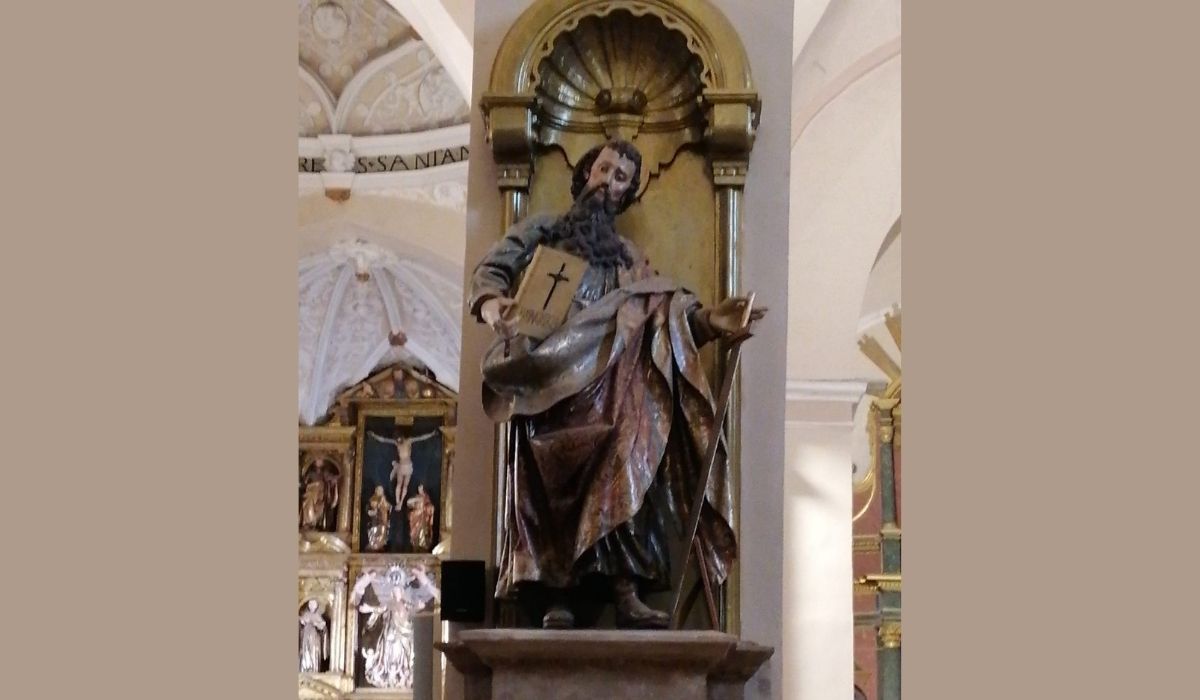
Santa Teresa and San Juan de la Cruz

«Ya tengo fraile y medio para la Reforma», eso es lo que dijo Teresa de Jesús cuando conoció a Juan de Yepes Álvarez. Le llamaba medio fraile, dado que era pequeño de estatura, pero uno de los más grandes como poeta y santo.
‘Now I have a friar and a half for the Reform,’ that’s what Teresa of Jesus said when she met Juan de Yepes Álvarez. She called him half a friar, given that he was short in stature, but one of the greatest as a poet and saint.
El otro fraile era fray Antonio. A los dos los metieron en la cárcel porque eran partidarios de la Reforma Teresiana. Teresa de Cepeda le escribió a Felipe II para que los liberase. Cuando sus carceleros tuvieron noticia de esta petición, se hicieron los tontos y los dejaron escapar. Fray Antonio fue el que administró la extremaunción a Teresa cuando murió en Alba de Tormes.
The other friar was Fray Antonio. Both were thrown in jail because they were supporters of the Teresian Reform. Teresa of Cepeda wrote to Philip II to have them released. When their jailers heard about this request, they played dumb and let them escape. Fray Antonio was the one who administered the last rites to Teresa when she died in Alba de Tormes.
Santa Teresa de Jesús ni nació en Ávila ni murió en esta ciudad. Cuando la enterraron en Ávila, los duques de Alba reclamaron al Vaticano, que les dio la razón y mandó enterrarla en Alba de Tormes.
Saint Teresa of Jesus was neither born in Ávila nor died in that city. When they buried her in Ávila, the Dukes of Alba appealed to the Vatican, which sided with them and ordered her to be buried in Alba de Tormes.
San Juan de la Cruz fue el fraile más apreciado por Santa Teresa. Siempre valoró su altísima santidad y su poesía. En La Bañeza encontraron un poema manuscrito de San Juan de la Cruz. El Cántico espiritual tiene 195 versos; muchos pintan paisajes de La Cepeda (donde también nació Teresa de Cepeda). Por esta razón no debe extrañar que San Juan visitase tierras leonesas.
Saint John of the Cross was the friar most appreciated by Saint Teresa. She always valued his utmost holiness and his poetry. In La Bañeza, they found a handwritten poem by Saint John of the Cross. The Spiritual Canticle has 195 verses; many depict landscapes from La Cepeda (where Teresa of Cepeda was also born). For this reason, it shouldn’t surprise us that Saint John visited Leonese lands.
Eugenio de Nora, gran crítico literario, dice que hay dos formas de escribir: la de los espontáneos, que escriben mucho y apenas releen lo escrito, y la de aquellos que corrigen mucho sus textos hasta que dejan solo lo esencial (escriben poco). Está claro que Santa Teresa estaría en el primer bloque y San Juan en el segundo. A De Nora le gustan más los que pulen mucho el lenguaje, y él mismo se apunta con los perfeccionistas. También me comentó que San Juan de la Cruz se hizo superfamoso con 195 versos.
Eugenio de Nora, a great literary critic, says there are two ways of writing: that of the spontaneous ones, who write a lot and barely reread what they’ve written, and that of those who revise their texts extensively until they leave only the essential (they write little). It’s clear that Saint Teresa would be in the first group and Saint John in the second. De Nora prefers those who polish the language a lot, and he himself aligns with the perfectionists. He also told me that Saint John of the Cross became super famous with 195 verses.
El Nobel Juan Ramón Jiménez y Jorge Luis Borges se suman a Eugenio para constatar que «San Juan de la Cruz es el poeta más grande». Santa Teresa no tenía tiempo de releer lo que escribía porque estaba metida en cien tareas. También es verdad que su grandísima inteligencia le permitía controlar todo lo que salía de su pluma. Si repite algunas cosas es porque lo quiere hacer.
The Nobel laureate Juan Ramón Jiménez and Jorge Luis Borges join Eugenio in affirming that ‘Saint John of the Cross is the greatest poet.’ Saint Teresa didn’t have time to reread what she wrote because she was involved in a hundred tasks. It’s also true that her immense intelligence allowed her to control everything that came from her pen. If she repeats some things, it’s because she wants to.
El catedrático de Lengua y Literatura, nacido en Astorga, Pedro Martínez, me dijo hace poco: «Tú mimetizas a Santa Teresa porque escribes con un lenguaje muy sencillo pero puedes llegar a grandes conclusiones. Además repites las cosas, y ahora con el ordenador sabes perfectamente que lo haces. Dices que lo haces porque lees mucho a Santa Teresa, te gusta cómo escribes y la mimetizas a propósito».
The professor of Language and Literature, born in Astorga, Pedro Martínez, told me recently: ‘You mimic Saint Teresa because you write with very simple language but can reach great conclusions. Plus, you repeat things, and now with the computer, you know perfectly well that you do it. You say you do it because you read a lot of Saint Teresa, you like how you write, and you mimic her on purpose.’
No quiero comparar mi calidad literaria con la de la Santa. Soy solo un aprendiz. Eugenio de Nora también recalcaba el ritmo perfecto, las rimas y las cadencias del Santo Carmelita, un modelo para todos los poetas. Si cambias una palabra o el orden en que la coloca, destrozas el poema de San Juan.
I don’t want to compare my literary quality with that of the Saint. I’m just an apprentice. Eugenio de Nora also emphasized the perfect rhythm, the rhymes, and the cadences of the Carmelite Saint, a model for all poets. If you change a word or the order in which he places it, you destroy Saint John’s poem.
Muchos autores afirman que el Cántico espiritual lo escribió en la cárcel. Y yo aseguro que eso es imposible. Su gran poema interpela a las criaturas y estas le contestan. Él visitaba los lugares que describía, y sus versos lo delatan perfectamente:
Many authors claim that the Spiritual Canticle was written in prison. And I assure you that’s impossible. His great poem addresses the creatures, and they respond to him. He visited the places he described, and his verses reveal it perfectly:
«¡Oh, bosques y espesuras,
plantadas por la mano del Amado!
¡Oh, prado de verduras,
de flores esmaltado,
decid si por vosotros ha pasado!».
‘Oh, woods and thickets,
Planted by the hand of the Beloved!
Oh, meadow of verdure,
Enamelled with flowers,
Tell if He has passed by you!’
Sabemos que Santa Teresa cabalgaba perfectamente: «Por dos veces se me desbocó el caballo y las dos lo controlé». En casa de los Cepeda los hombres y las mujeres tenían que aprender a leer, a escribir y a manejar los caballos.
We know that Saint Teresa rode horseback perfectly: ‘Twice my horse bolted, and both times I controlled it.’ In the Cepeda household, both men and women had to learn to read, write, and handle horses.
San Juan de la Cruz estuvo en la provincia de León en 1590 y 1591. Probablemente vino porque a Santa Teresa la curaron en Castro de Cepeda, en cuya iglesia hay una imagen suya que está en la contraportada de mi libro bilingüe Teresa de Cepeda. Realidad y leyenda.
Saint John of the Cross was in the province of León in 1590 and 1591. He probably came because Saint Teresa was cured in Castro de Cepeda, in whose church there is an image of her that appears on the back cover of my bilingual book Teresa de Cepeda. Reality and Legend.
San Juan de la Cruz tenía una infección terrible (erisipela) que le impedía caminar, aunque solo tuviera 47 años. Ahora se curaría en un mes con antibióticos.
Saint John of the Cross had a terrible infection (erysipelas) that prevented him from walking, even though he was only 47 years old. Nowadays, it would be cured in a month with antibiotics.
El 28 de septiembre de 1591 viajó a Úbeda. Quizá fuera por un tema de exorcismos, ya que era el experto en este asunto. «Santa Teresa también se dislocó el brazo izquierdo porque el demonio la empujó por la escalera». Las curanderas de Úbeda no supieron controlar su infección y en dos meses murió (14 de diciembre de 1591).
On September 28, 1591, he traveled to Úbeda. Perhaps it was for a matter of exorcisms, as he was the expert in that subject. ‘Saint Teresa also dislocated her left arm because the devil pushed her down the stairs.’ The healers in Úbeda didn’t know how to control his infection, and in two months he died (December 14, 1591).
Las fechas cumplen con el llamado Código Cepeda, que es el 28. Santa Teresa nació un día 28 y casi todo lo importante lo hace en esta fecha. Se puede cambiar el orden de los números. En el 82 murió Teresa. Se puede dividir por dos: en fecha 14 murió San Juan de la Cruz. Si hubiese seguido viviendo en La Bañeza o en La Cepeda, quizá habría durado más años.
The dates comply with the so-called Cepeda Code, which is 28. Saint Teresa was born on the 28th and almost everything important she did was on that date. The order of the numbers can be changed. In 82, Teresa died. It can be divided by two: on the 14th, Saint John of the Cross died. If he had continued living in La Bañeza or La Cepeda, perhaps he would have lasted more years.
Probablemente Santa Teresa pararía su caballo en el «Balcón de La Cepeda», y lo mismo haría años después San Juan de la Cruz para escuchar la respuesta de las criaturas:
Probably Saint Teresa would stop her horse at the ‘Balcony of La Cepeda,’ and years later Saint John of the Cross would do the same to hear the response of the creatures:
«Mil gracias derramando
pasó por estos sotos con presura,
y yéndolos mirando,
con sola su figura,
vestidos los dejó de su hermosura».
‘A thousand graces scattering
He passed through these groves in haste,
And gazing upon them,
With His countenance alone,
He left them clothed in His beauty.’
Por cierto, la palabra «presura» es del asturleonés, si bien más tarde la aceptó la Real Academia Española. El Gobierno asturiano tenía un programa denominado «Presura 2025». Era para atender a los pueblos vaciados y hacerlo con prisa, con prontitud
By the way, the word ‘presura’ is from Astur-Leonese, although later it was accepted by the Royal Spanish Academy. The Asturian Government had a program called ‘Presura 2025.’ It was to attend to the emptied villages and do it with haste, with promptness.
Descubre más desde LA AGENCIA MUNDIAL DE PRENSA
Suscríbete y recibe las últimas entradas en tu correo electrónico.

