

FILM: Alfred Hitchcock «The Man Who Taught Us to Be Afraid»

Mucho se ha dicho y escrito sobre este gran maestro como lo fue Alfred Hitchcock, calificado millones de veces como «el maestro del suspenso» y otras tantas se respondió que definirlo así era limitarlo… La última de sus películas, Frenesí, ya tiene más de cincuenta años, y su período inglés data de hace casi ocho décadas. Medio siglo atrás se convertía en el primer director de cine de fama mediática, que funcionaba como una marca registrada con un logo característico: la silueta de su perfil desplegando su prominente labio inferior. Esa silueta, reproducida en millones de carteles y programas de televisión, era ya en vida un símbolo cultural autónomo, separado del hombre y de su obra, capaz de funcionar por sí solo como promesa de algo inquietante que estaba a punto de suceder.
Much has been said and written about this great master, Alfred Hitchcock, described countless times as «the master of suspense,» a label that has been repeatedly countered by critics. His last film, Frenzy, is now over fifty years old, and his English period dates back almost eight decades. Half a century ago, he became the first film director to achieve media fame, operating as a trademark with a distinctive logo: the silhouette of his profile, his prominent lower lip protruding. That silhouette, reproduced on millions of posters and television programs, was already, during his lifetime, an autonomous cultural symbol, separate from the man and his work, capable of functioning on its own as a promise of something unsettling about to happen.
A pesar del tiempo transcurrido, las películas de Sir Alfred siguen funcionando perfectamente. No como piezas de museo que se visitan con respeto distante, sino como mecanismos de precisión que producen exactamente el efecto para el que fueron construidos: incomodidad, risa nerviosa, angustia genuina, ese placer culposo de quien sabe que le están tendiendo una trampa y aun así camina hacia ella.
Despite the passage of time, Sir Alfred’s films still work perfectly. Not like museum pieces to be visited with distant respect, but like precision mechanisms that produce exactly the effect for which they were built: discomfort, nervous laughter, genuine anguish, that guilty pleasure of someone who knows they are being set into a trap and yet walks right into it.
Y es que para Hitchcock, además de un trabajo de ingeniería cuidadosamente planeado, el cine era un juego gozoso. De la misma manera en que para Borges el lenguaje era un juego de posibilidades infinitas, Hitchcock usaba las herramientas del cine —montaje, cámara, actores, luz, música— como piezas de un rompecabezas gigante cuya solución siempre postergaba hasta el último segundo. La consigna que vertebraba su método era tomar al espectador de las narices y no soltarlo hasta la última escena. Y lo cumplió durante seis décadas sin excepción.
For Hitchcock, filmmaking was more than just a meticulously planned feat of engineering; it was a joyful game. Just as language was a game of infinite possibilities for Borges, Hitchcock used the tools of cinema—editing, camera, actors, lighting, music—like pieces of a giant puzzle, always postponing its solution until the very last second. The guiding principle of his method was to grab the viewer by the nose and not let go until the final scene. And he fulfilled this principle for six decades without exception.
La obra de Hitchcock funciona como un gran manual de cine y puede que quizás sea el más completo que existe. Si se quieren conocer los secretos del montaje, no hay más que ver:
Hitchcock’s work functions as a great film manual and may well be the most comprehensive one in existence. If you want to learn the secrets of editing, look no further than:
- La escena de la ducha de Psicosis (1960): setenta y ocho cortes en cuarenta y cinco segundos que generan una sensación de violencia salvaje sin mostrar casi nada. The shower scene in Psycho (1960): seventy-eight cuts in forty-five seconds that generate a sense of savage violence while showing almost nothing.
- Si se quiere reflexionar sobre el uso dramático del color, ahí está Vértigo (1958), considerada en la última votación del British Film Institute como la mejor película de la historia del cine. If you want to reflect on the dramatic use of color, there is Vertigo (1958), considered in the last British Film Institute vote as the best film in the history of cinema.
- Si se quiere experimentar el plano secuencia llevado al límite de sus posibilidades técnicas y narrativas, es ineludible La soga (1948), filmada en aparentes tomas continuas de diez minutos cada una cuando la tecnología apenas lo permitía. If you want to experience the long take pushed to the limits of its technical and narrative possibilities, Rope (1948) is essential, filmed in seemingly continuous takes of ten minutes each when technology barely allowed it.
- Si se quiere apreciar el uso de la música no como decoración sino como tercer protagonista de la acción, basta escuchar cualquiera de las partituras que compuso Bernard Herrmann para él, especialmente la de Vértigo, con sus espirales sonoras que reproducen en el oído lo que la imagen produce en el ojo. If you want to appreciate the use of music not as decoration but as a third protagonist of the action, just listen to any of the scores that Bernard Herrmann composed for him, especially that of Vertigo, with its sonic spirals that reproduce in the ear what the image produces in the eye.
- Y si lo que interesa es el suspenso construido desde el silencio absoluto, Los pájaros (1963) es la única película de terror de su época —y de muchas épocas posteriores— que renuncia por completo a la banda sonora musical, sustituyéndola por una arquitectura de sonidos naturales manipulados electrónicamente que resulta infinitamente más perturbadora que cualquier partitura. Algo que el noventa por ciento de los directores contemporáneos del género serían incapaces siquiera de intentar. And if what interests you is suspense built from absolute silence, The Birds (1963) is the only horror film of its time—and of many subsequent eras—that completely forgoes a musical soundtrack, replacing it with an architecture of electronically manipulated natural sounds that is infinitely more disturbing than any score. Something that ninety percent of contemporary directors of the genre would be incapable of even attempting.

Pero Hitchcock no era solo técnica. Era también, y sobre todo, un narrador de obsesiones humanas universales: la culpa del inocente, el doble, la mirada como forma de poder y de deseo, la trampa que tiende la normalidad cotidiana cuando se le rasca la superficie. Sus argumentos favoritos giraban siempre en torno a una persona ordinaria arrastrada sin explicación aparente a situaciones extraordinarias que no comprende. Ese hombre o esa mujer —que podría ser cualquiera de nosotros— atrapado en la maquinaria de una conspiración que no pidió, perseguido por una acusación que no merece, enamorado de alguien que no es quien dice ser. Ese vértigo —en todos los sentidos de la palabra— es la materia prima de su cine.
But Hitchcock wasn’t just about technique. He was also, and above all, a storyteller of universal human obsessions: the guilt of the innocent, the double, the gaze as a form of power and desire, the trap set by everyday normality when its surface is scratched. His favorite themes always revolved around an ordinary person inexplicably drawn into extraordinary situations they don’t understand. That man or woman—who could be any one of us—caught in the machinery of a conspiracy they didn’t ask for, pursued by an undeserved accusation, in love with someone who isn’t who they claim to be. That vertigo—in every sense of the word—is the raw material of his cinema.
El niño que aprendió el miedo en una celda / The boy who learned fear in a cell
Pocas infancias en la historia del arte tienen un episodio fundacional tan revelador y tan perfectamente cinematográfico. Cuando Alfred tenía apenas seis años, su padre —un verdulero de Leytonstone llamado William Hitchcock, de carácter severo y métodos victorianos— lo llevó a la comisaría local por alguna travesura menor y le pidió al agente de guardia que lo encerrara unos minutos en una celda. La advertencia fue lacónica y devastadora: «Esto es lo que les pasa a quienes hacen cosas malas.» El niño salió de esa celda convertido en otro. Desarrolló un miedo visceral a la policía que nunca abandonó en toda su vida, que le impedía conducir para no ser detenido, que lo hacía temblar ante cualquier figura de autoridad uniformada.
Few childhoods in the history of art have such a revealing and perfectly cinematic foundational episode. When Alfred was just six years old, his father—a Leytonstone greengrocer named William Hitchcock, a man of stern character and Victorian methods—took him to the local police station for some minor mischief and asked the officer on duty to lock him in a cell for a few minutes. The warning was laconic and devastating: «This is what happens to those who do bad things.» The boy emerged from that cell a changed man. He developed a visceral fear of the police that he never relinquished throughout his life, a fear that prevented him from driving for fear of being arrested, that made him tremble before any uniformed authority figure.
Ese miedo se tradujo, película tras película, en la imagen del agente de autoridad como figura amenazante, burocrática, inútil o directamente cómplice del mal. En el universo hitchcockiano, acudir a la policía no solo no resuelve el problema sino que generalmente lo agrava. El inocente que pide ayuda a las instituciones termina más atrapado que antes. La salvación, cuando llega, proviene del propio ingenio del perseguido, de una casualidad inverosímil o de la más azarosa de las providencias. Nunca del Estado.
That fear translated, film after film, into the image of the law enforcement officer as a threatening, bureaucratic, useless figure, or even an accomplice to evil. In the Hitchcockian universe, going to the police not only fails to solve the problem but generally exacerbates it. The innocent who seeks help from institutions ends up more trapped than before. Salvation, when it arrives, comes from the persecuted person’s own ingenuity, an improbable coincidence, or the most haphazard of providences. Never from the State.
Hay algo más en ese episodio de la celda que merece atención: la conciencia temprana de que el castigo puede ser arbitrario, que la culpa puede imponerse desde afuera sin que uno la haya merecido. Ese niño encerrado por orden de su propio padre en una jaula de adultos, sin comprender del todo qué había hecho mal, ya contenía en germen al director que décadas más tarde construiría la más sofisticada exploración cinematográfica de la inocencia perseguida que haya producido el siglo veinte.
There is something else in that cell episode that deserves attention: the early awareness that punishment can be arbitrary, that guilt can be imposed from the outside without one having deserved it. That child, locked in an adult cage by order of his own father, without fully understanding what he had done wrong, already contained the germ of the director who, decades later, would create the most sophisticated cinematic exploration of persecuted innocence that the twentieth century produced.
Un manual de cine que nadie encargó / A filmmaking manual that no one commissioned.
Hitchcock llegó al cine desde el diseño gráfico. Comenzó dibujando intertítulos para películas mudas en los estudios de la London Film Company, y ese origen marcó su manera de pensar las imágenes: como elementos de una composición que comunican por sí solos, antes de que hable ningún personaje. Aprendió los rudimentos del lenguaje cinematográfico en Alemania, en los estudios UFA de Berlín, donde el expresionismo estaba en pleno apogeo y donde la luz y la sombra no eran recursos decorativos sino instrumentos dramáticos de primer orden. Esa influencia nunca lo abandonó.
Hitchcock came to cinema from graphic design. He began by drawing intertitles for silent films at the London Film Company studios, and this background shaped his approach to images: as elements of a composition that communicate on their own, before any character speaks. He learned the rudiments of cinematic language in Germany, at the UFA studios in Berlin, where Expressionism was at its height and where light and shadow were not decorative devices but first-rate dramatic instruments. This influence never left him.
Dirigió su primera película, The Pleasure Garden, en 1925, con veinticinco años. Desde entonces y hasta Familia Plot en 1976, filmó más de cincuenta largometrajes en condiciones completamente distintas —cine mudo, sonoro, blanco y negro, color, estudios ingleses, Hollywood dorado, televisión— sin perder jamás la coherencia de una visión personal. Eso, en sí mismo, es un logro que pocos directores en la historia del cine pueden igualar.
He directed his first film, The Pleasure Garden, in 1925, at the age of twenty-five. From then until Family Plot in 1976, he filmed more than fifty feature films under completely different conditions—silent, sound, black and white, color, British studios, Golden Age Hollywood, television—without ever losing the coherence of his personal vision. That, in itself, is an achievement that few directors in the history of cinema can match.
Su contribución técnica al lenguaje cinematográfico es tan vasta que resulta difícil de inventariar. Inventó o perfeccionó el plano subjetivo como herramienta de identificación con el personaje. Desarrolló el concepto del MacGuffin —ese objeto o dato que todo el mundo persigue y que en realidad no importa, porque lo que importa es la persecución misma— y lo convirtió en uno de los mecanismos narrativos más útiles y más imitados de la historia del cine. Experimentó con el sonido como ningún otro director de su generación, comprendiendo que lo que no se ve ni se escucha pero se intuye es más perturbador que cualquier imagen explícita. Introdujo la construcción del suspenso mediante la información asimétrica entre el espectador y los personajes: nosotros sabemos que hay una bomba bajo la mesa; ellos no. Esa diferencia de conocimiento, esa anticipación angustiosa, es la esencia de su arte.
His technical contribution to cinematic language is so vast that it is difficult to catalog. He invented or perfected the subjective shot as a tool for identifying with the character. He developed the concept of the MacGuffin—that object or piece of information that everyone is chasing but that doesn’t really matter, because what matters is the chase itself—and turned it into one of the most useful and most imitated narrative devices in the history of cinema. He experimented with sound like no other director of his generation, understanding that what is neither seen nor heard but is intuited is more unsettling than any explicit image. He introduced the construction of suspense through asymmetrical information between the viewer and the characters: we know there’s a bomb under the table; they don’t. That difference in knowledge, that agonizing anticipation, is the essence of his art.
Para quien quiera leer sobre estos mecanismos en lugar de simplemente experimentarlos, existe un texto ineludible: el libro de conversaciones entre Alfred Hitchcock y François Truffaut, publicado en 1966, en el que el director francés interroga al inglés durante una semana entera sobre cada una de sus películas. El resultado es uno de los documentos más iluminadores que existen sobre el oficio del cine.
For those who want to read about these mechanisms rather than simply experience them, there is one essential text: the book of conversations between Alfred Hitchcock and François Truffaut, published in 1966, in which the French director questions the Englishman for an entire week about each of his films. The result is one of the most illuminating documents on the craft of filmmaking.
Las películas que quiso borrar del mundo / The films he wanted to erase from the world
Uno de los capítulos más enigmáticos y fascinantes de su leyenda es el de los llamados «Hitchcock perdidos». En virtud de un contrato firmado con Paramount que resultó inusualmente favorable para el director, Hitchcock logró recuperar los derechos de explotación de cinco de sus obras más célebres exactamente ocho años después de su estreno. Lo que hizo con esos derechos asombró a la industria y desconcertó a los historiadores: bloqueó su circulación, presionó activamente para que las copias existentes fuesen destruidas o al menos inmovilizadas y vetó su exhibición en cines, cadenas de televisión, cinematecas y festivales internacionales durante años.
One of the most enigmatic and fascinating chapters of his legend is that of the so-called «lost Hitchcocks.» Under a contract with Paramount that proved unusually favorable to the director, Hitchcock managed to regain the exploitation rights to five of his most celebrated works exactly eight years after their release. What he did with those rights astonished the industry and baffled historians: he blocked their distribution, actively lobbied for existing copies to be destroyed or at least impounded, and banned their exhibition in cinemas, television networks, film archives, and international festivals for years.
Las cinco películas que su propio creador intentó borrar del mundo fueron precisamente algunas de sus mejores: La soga (1948), La ventana indiscreta (1954), Pero… ¿Quién mató a Harry? (1955), El hombre que sabía demasiado (1956) y Vértigo (1958). Es decir, algunas de las obras que hoy consideramos cumbres absolutas del cine del siglo veinte.
The five films that their own creator tried to erase from the world were precisely some of his best: Rope (1948), Rear Window (1954), The Trouble with Harry (1955), The Man Who Knew Too Much (1956), and Vertigo (1958). In other words, some of the works we now consider absolute masterpieces of 20th-century cinema.

La ventana indiscreta no pudo verse en ninguna sala del mundo entre 1968 y 1983. Vértigo —hoy coronada como la mejor película de la historia por el British Film Institute— estuvo prácticamente enterrada durante la misma época. En 1969, Henri Langlois, director de la Cinemateca Francesa y uno de los mayores guardianes del patrimonio fílmico del siglo, consiguió por vías no del todo transparentes una copia de Vértigo para una retrospectiva en Londres. La proyección fue cancelada en el último momento porque el National Film Theatre se negó a revelar la procedencia de la copia ante el temor de represalias legales del director. Ni siquiera el Festival de Berlín de 1982, que dedicó una retrospectiva completa a James Stewart —protagonista de cuatro de estos cinco filmes— consiguió exhibirlas.
Rear Window was not shown in any theater worldwide between 1968 and 1983. Vertigo—now hailed as the greatest film of all time by the British Film Institute—was practically buried during the same period. In 1969, Henri Langlois, director of the French Cinematheque and one of the greatest guardians of film heritage in the 20th century, obtained a copy of Vertigo through less than transparent means for a retrospective in London. The screening was canceled at the last minute because the National Film Theatre refused to reveal the origin of the copy for fear of legal repercussions from the director. Even the 1982 Berlin Film Festival, which dedicated a complete retrospective to James Stewart—star of four of these five films—was unable to screen them.
El bloqueo se extendió más allá de la propia muerte de Hitchcock, ocurrida el 29 de abril de 1980. Su hija Patricia heredó los derechos y mantuvo la misma política restrictiva durante años. Solo en 1983, tras meses de negociaciones conducidas por el agente Herman Citron, Universal Pictures pagó seis millones de dólares por los derechos de distribución y el Festival de Londres proyectó por primera vez las cinco películas juntas, ante un público que en muchos casos las estaba viendo por primera vez en su vida.
The blackout extended beyond Hitchcock’s own death on April 29, 1980. His daughter Patricia inherited the rights and maintained the same restrictive policy for years. Only in 1983, after months of negotiations led by agent Herman Citron, did Universal Pictures pay six million dollars for the distribution rights and the London Festival screened the five films together for the first time, before an audience that in many cases was seeing them for the first time in their lives.
El misterio, cuarenta años después, permanece intacto. ¿Por qué Hitchcock quiso ocultar exactamente esas cinco películas y no otras? Las teorías se acumulan sin que ninguna resulte del todo convincente. Algunos apuntan a desacuerdos económicos con Paramount que nunca se resolvieron del todo. Otros sugieren que el director consideraba esas películas demasiado personales, demasiado reveladoras de sus obsesiones más íntimas, para dejarlas circular libremente. Hay quien sostiene que simplemente quería controlar su legado de manera absoluta, decidir qué se veía y cuándo. Y hay quien especula con que Vértigo en particular —esa exploración brutalmente honesta del deseo de modelar a una mujer hasta hacerla desaparecer como persona— le resultaba demasiado autobiográfica para compartirla sin reservas. El enigma no tiene respuesta documentada. Lo cual, tratándose de Hitchcock, parece completamente apropiado.
The mystery, forty years later, remains unsolved. Why did Hitchcock choose to suppress those five films in particular, and not others? Theories abound, none entirely convincing. Some point to financial disagreements with Paramount that were never fully resolved. Others suggest that the director considered these films too personal, too revealing of his most intimate obsessions, to allow them to circulate freely. Some maintain that he simply wanted absolute control over his legacy, to decide what was seen and when. And others speculate that Vertigo in particular—that brutally honest exploration of the desire to mold a woman until she ceases to exist as a person—was too autobiographical for him to share without reservation. The enigma has no documented answer. Which, given Hitchcock, seems entirely fitting.
Las rubias, la obsesión y el set como campo de batalla / Blondes, obsession, and the set as a battleground
El ideal de mujer de Hitchcock estaba perfectamente codificado y era perfectamente reconocible: rubia, fría en la superficie pero sexualmente perturbadora por debajo, elegante hasta la inaccesibilidad, distante y a la vez sugestiva. Era un tipo que se repetía con una consistencia que los psicoanalistas de su época no tardaron en señalar, y que el director ni confirmaba ni desmentía con esa habilidad suya para convertir incluso las preguntas sobre su vida privada en material de entretenimiento.
Hitchcock’s ideal woman was perfectly codified and instantly recognizable: blonde, outwardly cold but sexually unsettling beneath, elegant to the point of inaccessibility, distant yet alluring. It was a recurring type, a consistency that psychoanalysts of his time were quick to point out, and which the director neither confirmed nor denied, thanks to his knack for turning even questions about his private life into entertainment.

Nadie encarnó ese ideal con mayor perfección que Grace Kelly. Hitchcock filmó con ella La ventana indiscreta (1954) y Para atrapar al ladrón (1955), y la habría filmado más veces de haber podido. Kelly logró mantener una distancia insalvable para el director: lo respetaba, lo admiraba profesionalmente, toleraba su presencia con la gracia glacial que era su marca, pero permanecía impenetrable. Hitchcock la miraba paralizado, exactamente como el personaje que hacía James Stewart en La ventana indiscreta, con la pierna enyesada, confinado en su silla de ruedas, observando impotente a través del patio interior cómo el mundo seguía su curso sin él. Cuando Kelly abandonó Hollywood para casarse con el príncipe Rainiero de Mónaco en 1956, Hitchcock perdió a su musa ideal y algo en su manera de relacionarse con las actrices cambió para siempre. La distancia respetuosa que Kelly le había impuesto desapareció con ella. Lo que vino después fue más oscuro.
No one embodied this ideal more perfectly than Grace Kelly. Hitchcock filmed Rear Window (1954) and To Catch a Thief (1955) with her, and would have filmed her many more times had he been able. Kelly managed to maintain an insurmountable distance from the director: she respected him, admired him professionally, tolerated his presence with her trademark glacial grace, but remained impenetrable. Hitchcock stared at her, paralyzed, exactly like James Stewart’s character in Rear Window, his leg in a cast, confined to his wheelchair, helplessly watching across the courtyard as the world went on without him. When Kelly left Hollywood to marry Prince Rainier of Monaco in 1956, Hitchcock lost his ideal muse, and something in his relationship with actresses changed forever. The respectful distance Kelly had maintained vanished with her. What followed was darker.
Los casos de Vera Miles y Tippi Hedren son los más documentados y los más perturbadores. En ambos, el patrón se repite con variaciones: una actriz desconocida o poco conocida es descubierta y elegida por Hitchcock, que invierte en ella tiempo, dinero, atención y una forma retorcida de afecto. Ropa elegida personalmente, flores, notas, reuniones a solas, consejos sobre cómo moverse y hablar y existir en pantalla. Una inversión que no era desinteresada.
The cases of Vera Miles and Tippi Hedren are the best documented and the most disturbing. In both, the pattern repeats itself with variations: an unknown or little-known actress is discovered and chosen by Hitchcock, who invests time, money, attention, and a twisted form of affection in her. Personally selected clothes, flowers, notes, private meetings, advice on how to move, speak, and exist on screen. An investment that was not selfless.
Vera Miles protagonizó El hombre equivocado (1957) y fue convocada para protagonizar Vértigo, que Hitchcock consideraba su obra más personal. Miles rechazó el papel porque estaba embarazada. La reacción del director fue desproporcionada e hiriente: «Iba a convertirse en una verdadera estrella con este film, pero no pudo resistir al Tarzán de su esposo. ¡Debería haber tomado la píldora de la jungla!», dijo Hitchcock, sin ningún pudor. El personaje de Madeleine/Judy en Vértigo —una mujer literalmente remodelada según los deseos de un hombre obsesionado— fue a parar a Kim Novak, a quien el director nunca reconoció mérito alguno en la película, como si no pudiera perdonarle haber ocupado el lugar de la mujer que él había elegido.
Vera Miles starred in The Wrong Man (1957) and was offered the lead role in Vertigo, which Hitchcock considered his most personal work. Miles turned down the part because she was pregnant. The director’s reaction was disproportionate and hurtful: «She was going to become a real star with this film, but she couldn’t stand her husband’s Tarzan. She should have taken the jungle pill!» Hitchcock said, without any shame. The role of Madeleine/Judy in Vertigo—a woman literally reshaped according to the desires of an obsessive man—went to Kim Novak, whom the director never acknowledged for her performance in the film, as if he couldn’t forgive her for taking the place of the woman he had chosen.

Tippi Hedren es el caso más extremo y el más debatido. Actriz de anuncios publicitarios sin experiencia cinematográfica cuando Hitchcock la descubrió en 1961, fue lanzada al estrellato por el director en Los pájaros (1963) y Marnie, la ladrona (1964). La atención de Hitchcock se convirtió pronto en algo que Hedren describió como hostigamiento sistemático. Cuando la actriz rechazó sus avances de manera definitiva, el director no la reemplazó ni la liberó del contrato: la sometió. Durante el rodaje de la escena del ataque de los pájaros en el ático del motel —una secuencia que en el guión original debía filmarse con pájaros mecánicos— Hitchcock ordenó de improviso que se utilizaran animales reales. Durante seis días consecutivos, gaviotas, cuervos y grajos vivos fueron lanzados contra la actriz, que los recibía atada con cuerdas de nailon en una habitación cerrada. Al final del sexto día, uno de los pájaros le abrió una herida junto al ojo. El médico del rodaje ordenó una semana de interrupción obligatoria. Hedren había sufrido un colapso nervioso.
Tippi Hedren is the most extreme and most debated case. A commercial actress with no film experience when Hitchcock discovered her in 1961, she was launched to stardom by the director in The Birds (1963) and Marnie (1964). Hitchcock’s attention soon turned into what Hedren described as systematic harassment. When the actress definitively rejected his advances, the director didn’t replace her or release her from her contract: he subjugated her. During the filming of the bird attack scene in the motel attic—a sequence that in the original script was to be filmed with mechanical birds—Hitchcock suddenly ordered that real animals be used. For six consecutive days, live seagulls, crows, and jackdaws were released at the actress, who was tied up with nylon ropes in a closed room. At the end of the sixth day, one of the birds opened a wound near her eye. The film’s doctor ordered a mandatory week-long break. Hedren had suffered a nervous breakdown.
La tensión psicológica Hitchcock la utilizaba como herramienta de dirección desde mucho antes de estos episodios. Con Joan Fontaine en Rebecca (1940), manipuló deliberadamente la relación entre la actriz y su co protagonista Laurence Olivier para generar en ella una inseguridad genuina que la cámara pudiese capturar. Con Diane Baker en Marnie, hablaba sobre ella en voz alta como si no estuviera presente y evitaba mirarla antes de las escenas más exigentes, amplificando la desorientación. Carole Lombard lo resumió con la franqueza que la caracterizaba: Hitchcock «agitaba deliberadamente las emociones de sus actores». El director jamás lo negó. Para él, la cámara no mentía, y un actor que realmente sintiese algo —aunque ese algo fuese miedo genuino o humillación real— daba mejores resultados que uno que simplemente interpretase.
Hitchcock used psychological tension as a directing tool long before these episodes. With Joan Fontaine in Rebecca (1940), he deliberately manipulated the relationship between the actress and her co-star Laurence Olivier to generate genuine insecurity in her that the camera could capture. With Diane Baker in Marnie, he spoke about her aloud as if she weren’t there and avoided looking at her before the most demanding scenes, amplifying her disorientation. Carole Lombard summed it up with her characteristic candor: Hitchcock «deliberately stirred his actors’ emotions.» The director never denied it. For him, the camera didn’t lie, and an actor who truly felt something—even if that something was genuine fear or real humiliation—yielded better results than one who merely acted.
La película que mejor cuenta toda esa dinámica —el deseo de modelar a una mujer según los propios fantasmas, de vestirla y desvestirla, de borrar su identidad y sustituirla por la del objeto deseado, de manipularla hasta perder la cabeza— ya estaba filmada antes de que ningún biógrafo la describiese. La hizo el propio Hitchcock en 1958. Se llama Vértigo. Y es, precisamente, la película que intentó ocultar.
The film that best captures this entire dynamic—the desire to mold a woman according to one’s own fantasies, to dress and undress her, to erase her identity and replace it with that of the desired object, to manipulate her until she loses her mind—had already been filmed before any biographer described it. Hitchcock himself made it in 1958. It’s called Vertigo. And it is, precisely, the film he tried to hide.
El marketing del secreto: cómo Hitchcock inventó el spoiler / The marketing of secrecy: how Hitchcock invented the spoiler

Mucho antes de que los grandes estudios comprendiesen el valor comercial del misterio, Hitchcock lo practicaba con una maestría que era al mismo tiempo intuitiva y calculada. Para Psicosis diseñó una campaña publicitaria sin precedentes en la historia de Hollywood, construida entera sobre lo que no se mostraba.
Long before the major studios grasped the commercial value of mystery, Hitchcock practiced it with a mastery that was both intuitive and calculated. For Psycho, he devised an unprecedented publicity campaign in Hollywood history, built entirely on what wasn’t shown.
Primero, compró todos los ejemplares disponibles de la novela de Robert Bloch en la que se basaba el guión, para impedir que el público conociese el argumento. A continuación, prohibió la distribución del guión fuera del equipo de producción. Rodó la película con el equipo técnico de su serie televisiva Alfred Hitchcock Presents, en lugar del equipo habitual de sus producciones cinematográficas, para maximizar el secreto. El tráiler que se distribuyó a los cines no contenía ni una sola imagen de la película: mostraba únicamente al propio Hitchcock guiando al espectador por las instalaciones del motel Bates con la tono desenfadado y ligeramente macabro de un guía turístico que muestra su mejor atracción. Era publicidad pura sin contenido, y funcionó perfectamente.
First, he bought up every available copy of Robert Bloch’s novel on which the screenplay was based, to prevent the public from knowing the plot. Then, he forbade the distribution of the script outside the production team. He shot the film with the technical crew from his television series Alfred Hitchcock Presents, instead of his usual film crew, to maximize secrecy. The trailer distributed to theaters contained not a single image from the film: it showed only Hitchcock himself guiding the viewer through the Bates Motel with the casual, slightly macabre tone of a tour guide showing off his best attraction. It was pure advertising without content, and it worked perfectly.
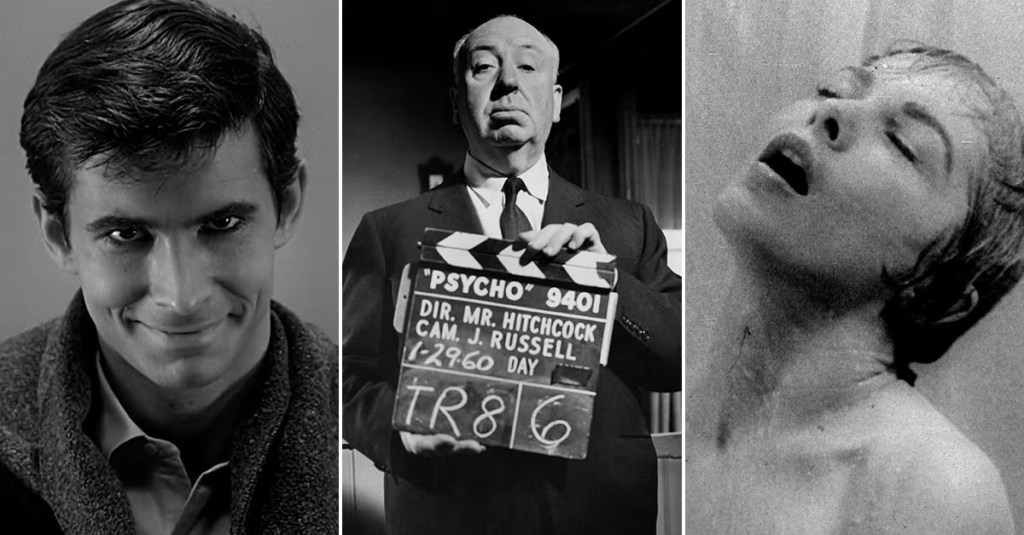
Luego vino la medida más radical: exigió a los exhibidores de todo el mundo que no permitiesen entrar a nadie después de que la proyección hubiese comenzado. Algo completamente inaudito en la industria, donde la práctica habitual era entrar y salir de las salas en cualquier momento. Hitchcock instaló carteles en los vestíbulos de los cines, firmados por él mismo, explicando la norma. Publicó anuncios en los periódicos pidiendo al público que guardara silencio sobre lo que ocurría en la película. Construyó alrededor de Psicosis una burbuja de anticipación que convirtió el acto de verla en un acontecimiento social y casi ritual.
Then came the most radical measure: he demanded that exhibitors worldwide not allow anyone to enter after the film had begun. This was completely unheard of in the industry, where the usual practice was to enter and leave theaters at any time. Hitchcock posted signs in cinema lobbies, signed by himself, explaining the rule. He placed advertisements in newspapers asking the public to remain silent about what was happening in the film. He built a bubble of anticipation around Psycho that transformed the act of seeing it into a social and almost ritualistic event.
El resultado justificó cada precaución. Psicosis costó ochocientos mil dólares y recaudó más de cincuenta millones solo en su estreno original. Janet Leigh, que protagonizó la escena de la ducha, declaró que tardó años en poder ducharse sin angustia. La sangre que fluye por el desagüe no era sangre: era sirope de chocolate, elegido porque su densidad y color resultaban más realistas en blanco y negro que cualquier sucedáneo. La escena entera tardó siete días en filmarse, con setenta y ocho angulaciones de cámara distintas para cuarenta y cinco segundos de metraje. Herrmann compuso para ella una música de cuerdas en pizzicato que se convirtió en uno de los fragmentos musicales más reconocibles de la historia del cine. Aunque, según el propio Hitchcock, su primera intención era que esa escena se desarrollase en silencio absoluto.
The result justified every precaution. Psycho cost eight hundred thousand dollars and grossed over fifty million in its original release alone. Janet Leigh, who starred in the shower scene, stated that it took her years to be able to shower without anxiety. The blood flowing down the drain wasn’t blood: it was chocolate syrup, chosen because its density and color looked more realistic in black and white than any substitute. The entire scene took seven days to film, with seventy-eight different camera angles for forty-five seconds of footage. Herrmann composed a pizzicato string score for it that became one of the most recognizable musical fragments in film history. Although, according to Hitchcock himself, his initial intention was for the scene to unfold in complete silence.

El legado que España lleva puesto / The legacy that Spain carries
Hay una pequeña curiosidad lingüística que la mayoría de hispanohablantes desconoce: la palabra «rebeca» —esa chaqueta de punto abotonada que se usa con total naturalidad en el español peninsular— viene directamente de una película de Hitchcock. Rebecca (1940), adaptación de la novela de Daphne du Maurier, fue su primer filme americano y le valió el único Oscar a la mejor película de su carrera —aunque el premio fue para el productor David O. Selznick, no para él, lo cual Hitchcock nunca olvidó. La actriz Joan Fontaine vestía durante el rodaje ese tipo de prenda de punto abotonada, y el término se instaló en el español peninsular a partir del estreno de la película en España en 1942. La Real Academia Española lo registra en el Diccionario Histórico de la Lengua Española con su primera documentación en 1944, citando explícitamente el origen en el título del filme. Es el único caso documentado en que una película ha dado nombre a una prenda de vestir en el idioma español. Cada vez que alguien se abriga con una rebeca, sin saberlo, lleva puesta una pequeña parte de Hitchcock.
There’s a little linguistic tidbit that most Spanish speakers are unaware of: the word «rebeca»—that button-up cardigan so commonly used in Peninsular Spanish—comes directly from a Hitchcock film. Rebecca (1940), an adaptation of Daphne du Maurier’s novel, was his first American film and earned him the only Oscar for Best Picture of his career—though the award went to producer David O. Selznick, not to him, something Hitchcock never forgot. Actress Joan Fontaine wore this type of button-up cardigan during filming, and the term entered Peninsular Spanish after the film’s release in Spain in 1942. The Royal Spanish Academy (RAE) includes it in the Historical Dictionary of the Spanish Language, with its first entry in 1944, explicitly citing the film’s title as the origin. It is the only documented case of a film giving its name to an article of clothing in the Spanish language. Every time someone puts on a cardigan, without knowing it, they are wearing a small part of Hitchcock.
El hombre detrás del mito: el debate que no cesa / The man behind the myth: the debate that never ends
La reputación de Hitchcock es una construcción que lleva décadas revisándose y que en 2026 sigue en activo. La imagen pública del director se conformó a partir de capas superpuestas y a menudo contradictorias: sus propias declaraciones, calculadas hasta el milímetro para alimentar la leyenda; los testimonios de actores y colaboradores, frecuentemente enfrentados entre sí; y la interpretación de los biógrafos, que han leído los mismos hechos de maneras radicalmente distintas.
Hitchcock’s reputation is a construct that has been revised for decades and remains active in 2026. The director’s public image was built from overlapping and often contradictory layers: his own statements, meticulously calculated to fuel the legend; the testimonies of actors and collaborators, frequently at odds with one another; and the interpretations of biographers, who have read the same events in radically different ways.
Donald Spoto fue el primero en intentar un retrato psicológico exhaustivo con El lado oscuro del genio (1983), un libro que influyó decisivamente en la percepción del director durante décadas. Spoto priorizó los aspectos más oscuros: los abusos, las obsesiones, la crueldad con ciertos actores. El crítico John Russell Taylor, que mantuvo una relación personal con Hitchcock durante años, ofreció una imagen completamente distinta: más cordial, más compleja, más matizada. Ambos leyeron a la misma persona y vieron cosas diferentes. Lo cual, en sí mismo, es perfectamente hitchcockiano.
Donald Spoto was the first to attempt a comprehensive psychological portrait with *The Dark Side of Genius* (1983), a book that decisively influenced the perception of the director for decades. Spoto prioritized the darker aspects: the abuses, the obsessions, the cruelty toward certain actors. The critic John Russell Taylor, who maintained a personal relationship with Hitchcock for years, offered a completely different picture: more cordial, more complex, more nuanced. Both read the same person and saw different things. Which, in itself, is perfectly Hitchcockian.
Algunos de los episodios más célebres de su leyenda han sido cuestionados por testigos directos. El asistente de cámara Dudley Lovell desmintió la historia —repetida en varias biografías— según la cual Hitchcock encadenó a un miembro del equipo durante toda una noche en el almacén durante el rodaje de Los 39 escalones. Según Lovell, el episodio ocurrió, pero el trabajador regresó a casa con las esposas puestas: era una broma del ambiente londinense de la época, no un castigo. Pequeñas correcciones que alteran el cuadro completo.
Some of the most celebrated episodes of his legend have been challenged by eyewitnesses. Camera assistant Dudley Lovell refuted the story—repeated in several biographies—that Hitchcock chained a crew member up overnight in the warehouse during the filming of The 39 Steps. According to Lovell, the incident did occur, but the worker returned home still handcuffed: it was a joke typical of London at the time, not a punishment. Small corrections that alter the overall picture.
Lo que permanece indiscutible es la escala de su influencia. Generaciones enteras de cineastas —Truffaut, De Palma, Spielberg, Fincher, Nolan— lo citan como referencia fundacional. Sus técnicas son hoy el vocabulario estándar del thriller universal. Sus temas —la culpa, la doble identidad, el deseo como trampa, la normalidad como máscara— siguen siendo los temas del cine contemporáneo.
What remains indisputable is the scale of his influence. Entire generations of filmmakers—Truffaut, De Palma, Spielberg, Fincher, Nolan—cite him as a foundational reference. His techniques are now the standard vocabulary of the universal thriller. His themes—guilt, double identity, desire as a trap, normality as a mask—remain central to contemporary cinema.
En octubre de 2025, Netflix estrenó Monster: La historia de Ed Gein, serie que reconstruye la historia real que inspiró al personaje de Norman Bates e incluye al propio Hitchcock como personaje, interpretado por Tom Hollander. Es solo el último ejemplo de una cultura que no puede dejar de pensar en él, que lo convierte una y otra vez en personaje de sus propias ficciones, que lo usa para explicarse a sí misma.
In October 2025, Netflix released Monster: The Ed Gein Story, a series that reconstructs the true story that inspired the character of Norman Bates and includes Hitchcock himself as a character, played by Tom Hollander. It is just the latest example of a culture that can’t stop thinking about him, that repeatedly makes him a character in its own fiction, that uses him to explain itself.
Alfred Hitchcock murió el 29 de abril de 1980 en Los Ángeles, sin haber recibido jamás el Oscar a la mejor dirección, pese a cinco nominaciones. El único reconocimiento oficial de la Academia fue el Irving G. Thalberg Memorial Award de 1968, un premio a la trayectoria que se entrega cuando ya no queda nada más que reconocer. Ironía que él, mejor que nadie, habría sabido convertir en escena de suspenso.
Alfred Hitchcock died on April 29, 1980, in Los Angeles, never having received the Oscar for Best Director, despite five nominations. The only official recognition from the Academy was the 1968 Irving G. Thalberg Memorial Award, a lifetime achievement award given when there is nothing left to recognize. An irony that he, better than anyone, would have known how to turn into a scene of suspense.
Lo que queda, en 2026, es esto: cada vez que alguien siente un escalofrío al correr la cortina de la ducha, o mira con desconfianza a una bandada de pájaros posada en los cables de luz, o nota que el edificio de enfrente tiene las persianas sin bajar, Alfred Hitchcock sigue filmando.
What remains, in 2026, is this: every time someone feels a shiver when they pull back the shower curtain, or looks suspiciously at a flock of birds perched on power lines, or notices that the building across the street has its blinds up, Alfred Hitchcock is still filming.


Descubre más desde LA AGENCIA MUNDIAL DE PRENSA
Suscríbete y recibe las últimas entradas en tu correo electrónico.
