

MICHAEL JACKSON RETURNS TO THE MOVIES WITH THE FACE OF HIS OWN BLOOD
El biopic más esperado del año llega con ovación de fans, vapuleo de críticos y una pregunta que nadie puede cerrar: ¿puede una familia contar su propia leyenda sin traicionarla?
The most anticipated biopic of the year arrives with fan acclaim, critical drubbing, and a question no one can answer: can a family tell its own legend without betraying it?

Hay regresos que no son regresos, sino reapariciones con pólvora. Hay nombres que no necesitan presentación…. Hay silencios que el tiempo no cierra. Y hay películas que, antes de proyectarse, ya cargan el peso de lo que pretenden contar. Michael, la película sobre la vida (biopic) del Rey del Pop Michael Jackson protagonizada por su sobrino Jaafar Jackson, pertenece a esa categoría de estrenos que no solo buscan público: buscan dominar la conversación. El Rey del Pop vuelve al cine desde el propio árbol genealógico, y el efecto es inmediato: curiosidad, nostalgia, fascinación y una inevitable punzada de morbo elegante.
There are comebacks that aren’t comebacks at all, but rather explosive reappearances. There are names that need no introduction… There are silences that time cannot break. And there are films that, even before they’re released, already carry the weight of what they intend to tell. Michael, the biopic about the King of Pop, Michael Jackson, starring his nephew Jaafar Jackson, belongs to that category of releases that don’t just seek an audience: they seek to dominate the conversation. The King of Pop returns to the cinema from within his own family tree, and the effect is immediate: curiosity, nostalgia, fascination, and an inevitable touch of sophisticated morbidity.

Que el papel recaiga en un familiar directo no es un detalle menor, sino el núcleo del acontecimiento. Jaafar Jackson, hijo de Jermaine Jackson, se pone al frente de un proyecto que carga con el peso de un apellido legendario y con el desafío de encarnar a uno de los rostros más reconocibles del siglo XX. El resultado, al menos en su presentación pública, tiene algo de ceremonia familiar y algo de gran operación cultural.
That the role falls to a direct relative is not a minor detail, but rather the crux of the matter. Jaafar Jackson, son of Jermaine Jackson, takes the helm of a project that carries the weight of a legendary name and the challenge of embodying one of the most recognizable faces of the 20th century. The result, at least in its public presentation, has something of a family ceremony and something of a major cultural undertaking.
Una película dirigida por Antoine Fuqua que aterrizó en las salas españolas ayer 22 de abril y se despliega internacionalmente desde mañana 24 de abril. Su llegada a la pantalla grande no es solo un acontecimiento cinematográfico: es un espejo que obliga a mirarse a una industria, a una familia y a una memoria colectiva que sigue sin saber exactamente qué hacer con Michael Jackson.
A film directed by Antoine Fuqua that premiered in Spanish theaters yesterday, April 22nd, and will be released internationally starting tomorrow, April 24th. Its arrival on the big screen is not just a cinematic event: it is a mirror that forces an industry, a family, and a collective memory that still doesn’t quite know what to do with Michael Jackson to confront itself.
El gancho más poderoso de la película no es la música, ni los efectos, ni siquiera la recreación del moonwalk ante miles de fans. El gancho es el rostro. Porque el hombre que interpreta al Rey del Pop lleva su mismo apellido, su misma sangre y, según quienes lo han visto en pantalla, algo que va más allá del parecido físico: el mismo magnetismo extraño que convertía a Michael Jackson en una figura imposible de ignorar.
The film’s most powerful draw is not the music, nor the effects, nor even the recreation of the moonwalk before thousands of fans. The draw is the face. Because the man who plays the King of Pop shares his last name, his blood, and, according to those who have seen him on screen, something that goes beyond physical resemblance: the same strange magnetism that made Michael Jackson an impossible figure to ignore.
El hombre detrás de la máscara
The man behind the mask
La primera gran pregunta del proyecto ya está respondida: sí, Jaafar Jackson se parece lo suficiente a su tío como para convertir el biopic en una experiencia casi fantasmática. Esa semejanza, reforzada por el material promocional, sostiene buena parte del magnetismo del filme, que apuesta por la recreación de gestos, pasos y miradas que forman parte del archivo universal de Michael Jackson.
The first big question of the project has already been answered: yes, Jaafar Jackson looks enough like his uncle to make the biopic an almost ghostly experience. That resemblance, reinforced by the promotional material, sustains much of the film’s magnetism, which relies on recreating gestures, steps, and glances that are part of Michael Jackson’s universal archive.

En una industria donde el parecido físico suele ser un reclamo, aquí se convierte en el centro de gravedad. No se trata solo de interpretar a un artista; se trata de devolverle cuerpo, pulso y presencia a una figura que el imaginario colectivo nunca dejó de ver en movimiento. Jaafar Jeremiah Jackson tiene 29 años, es hijo de Jermaine Jackson —cuarto de los hermanos del mítico clan— y hasta hace muy poco era prácticamente desconocido fuera del círculo familiar. Cantante y bailarín de formación, nunca había actuado en el cine cuando Graham King, el productor británico detrás de Bohemian Rhapsody y El Aviador, decidió apostar por él para encarnar al mayor ícono del pop del siglo XX.
In an industry where physical resemblance is often a selling point, here it becomes the center of gravity. It’s not just about portraying an artist; it’s about giving body, pulse, and presence to a figure that the collective imagination never stopped seeing in motion. Jaafar Jeremiah Jackson is 29 years old, the son of Jermaine Jackson—the fourth of the brothers in the legendary clan—and until very recently was virtually unknown outside the family circle. A trained singer and dancer, he had never acted in a film when Graham King, the British producer behind Bohemian Rhapsody and The Aviator, decided to cast him to embody the greatest pop icon of the 20th century.
El proceso no fue un golpe de suerte ni un capricho de nepotismo. Fue una apuesta de riesgo total. Dos años de preparación intensiva con coaches de interpretación y coreógrafos directamente vinculados al universo de Michael Jackson. Horas repitiendo un solo paso hasta alcanzar la perfección. Y un método de inmersión que rozó lo obsesivo: Jaafar accedió a los escritos personales de su tío —textos, poemas, mantras, afirmaciones— y empezó a replicarlos en las paredes y espejos de su casa. Llegó incluso a dormir en el suelo de la mansión familiar de Hayvenhurst, la residencia californiana donde Michael vivió casi hasta los 30 años, para acercarse a la esencia de quien iba a interpretar.
The process wasn’t a stroke of luck or a whim of nepotism. It was a total gamble. Two years of intensive preparation with acting coaches and choreographers directly linked to the world of Michael Jackson. Hours spent repeating a single step until perfection was achieved. And an immersion method that bordered on obsessive: Jaafar accessed his uncle’s personal writings—texts, poems, mantras, affirmations—and began replicating them on the walls and mirrors of his house. He even went so far as to sleep on the floor of the family mansion in Hayvenhurst, the Californian residence where Michael lived until he was almost 30, to get closer to the essence of the man he was going to portray.
Y lo que tal vez más llama la atención: durante un año completo, ni su padre Jermaine ni el resto de la familia supieron que Jaafar había conseguido el papel. Él mismo necesitaba sentirse preparado antes de compartir una responsabilidad de esa magnitud. Cuando finalmente lo reveló, la mezcla de sorpresa y orgullo familiar fue, según sus propias palabras, abrumadora.
And perhaps most striking: for a whole year, neither his father Jermaine nor the rest of the family knew that Jaafar had landed the role. He needed to feel prepared before sharing such a weighty responsibility. When he finally revealed it, the mixture of surprise and family pride was, in his own words, overwhelming.
El resultado visible está sobre la pantalla. LaToya Jackson, hermana del artista, lo resumió con una frase que circula desde los primeros pases: «Olvidas que es Jaafar. Crees que es Michael.» La crítica especializada, por más que haya desmenuzado la película con dureza, coincide en un punto: la actuación de Jaafar es prácticamente el único elemento que reúne elogios generalizados. Los medios especializados destacan que su interpretación está «hecha a medida», y que resulta imposible imaginar a otro actor en el papel.
The visible result is on screen. LaToya Jackson, the artist’s sister, summed it up with a phrase that has been circulating since the first screenings: «You forget it’s Jaafar. You think it’s Michael.» Despite some harsh critiques of the film, critics agree on one point: Jaafar’s performance is practically the only element that garners widespread praise. Specialized media outlets emphasize that his portrayal is «tailor-made,» and that it’s impossible to imagine any other actor in the role.
La herencia como espectáculo
Inheritance as spectacle

Hay algo profundamente sensacional en la idea de que el propio clan Jackson sea quien vuelva a abrir la puerta del mito. Esa decisión añade una capa de legitimidad emocional y, al mismo tiempo, alimenta la expectativa de un relato con vocación de gran evento. La película no llega como una simple biografía, sino como un ritual de resurrección pop.
There’s something profoundly sensational about the idea of the Jackson family themselves reopening the door to the myth. That decision adds a layer of emotional legitimacy and, at the same time, fuels the expectation of a story with the ambition of a major event. The film doesn’t arrive as a simple biography, but as a pop resurrection ritual.
El tráiler, según la información difundida, ya ha dejado ver escenas que remiten a la iconografía clásica del artista: el baile, la puesta en escena, la construcción de una figura que trascendió la música para instalarse en la cultura visual global. Todo apunta a que el filme quiere jugar en dos ligas a la vez: la del homenaje respetuoso y la del espectáculo de gran formato.
The trailer, according to reports, has already revealed scenes reminiscent of the artist’s classic iconography: the dance, the staging, the construction of a figure who transcended music to become a fixture in global visual culture. Everything suggests that the film aims to play on two fronts simultaneously: that of a respectful tribute and that of a large-scale spectacle.
El mito que no se apaga
The myth that never dies
Michael Jackson sigue siendo una de esas estrellas que no envejecen: mutan, persisten, regresan. Su figura conserva una potencia casi magnética porque no pertenece del todo al pasado. Está en la memoria de varias generaciones, en la estética de miles de imitadores, en la historia del videoclip y en la idea misma de lo que significa ser una superestrella mundial.
Michael Jackson remains one of those stars who don’t age: they mutate, persist, and return. His image retains an almost magnetic power because it doesn’t entirely belong to the past. He’s in the memory of several generations, in the aesthetic of thousands of imitators, in the history of the music video, and in the very idea of what it means to be a global superstar.
Pero también está en la zona más incómoda de los grandes mitos modernos: la del debate permanente, la polémica, la contradicción y la relectura constante. Por eso Michael no es solo una película sobre un cantante célebre, sino una prueba de resistencia para el relato biográfico en tiempos de saturación mediática. ¿Cómo contar a alguien que ya fue contado mil veces y sigue generando titulares como si acabara de ocurrir?
But he also occupies the most uncomfortable territory of great modern myths: that of perpetual debate, controversy, contradiction, and constant reinterpretation. That’s why *Michael* isn’t just a film about a famous singer, but a test of endurance for biographical storytelling in times of media saturation. How do you tell the story of someone whose story has already been told a thousand times and who continues to generate headlines as if it just happened?
Entre el brillo y la sombra
Between light and shadow
Ahí está el secreto del interés. La película promete brillo, coreografía, iconografía y una reactivación emocional del legado Jackson. Pero también juega con una sombra inevitable: la de un personaje cuya vida privada, sus escándalos y su capacidad de desbordar la narrativa clásica hacen que cualquier reconstrucción resulte necesariamente incompleta.
Therein lies the secret to its appeal. The film promises glamour, choreography, iconography, and an emotional revival of Jackson’s legacy. But it also plays with an unavoidable shadow: that of a figure whose private life, scandals, and capacity to transcend the traditional narrative render any reconstruction necessarily incomplete.

El hecho de que sea su sobrino quien lo interprete añade un filo particular. No es solo una actuación; es una transmisión de imagen, apellido y memoria. Y eso, en términos de cultura pop, tiene un poder enorme: el de convertir una biografía en acontecimiento y un estreno en conversación pública de primer nivel.
The fact that his nephew is playing him adds a particular edge. It’s not just a performance; it’s a transmission of image, surname, and memory. And that, in terms of pop culture, has enormous power: the power to transform a biography into an event and a premiere into a top-tier public conversation.
Que cuenta y que calla la película
What the film reveals and what it leaves unsaid
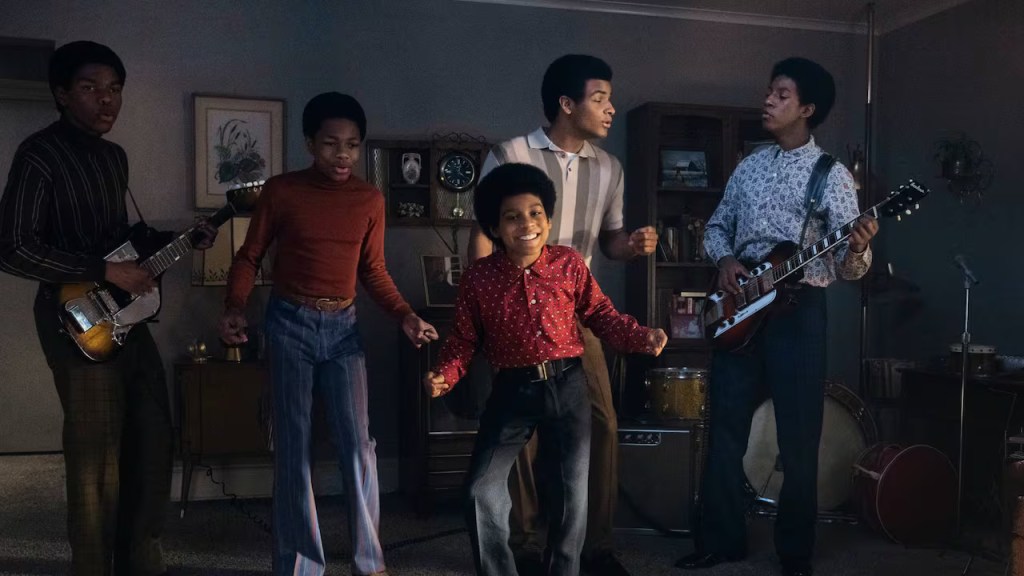
Michael narra el ascenso de Jackson desde su infancia como niño prodigio en los Jackson 5 hasta convertirse en el artista más influyente de la historia del entretenimiento. El guion, firmado por John Logan —nominado al Oscar por Gladiator y El Aviador— se estructura como un drama entre padre e hijo, con Joe Jackson como figura central de tensión, encarnado por Colman Domingo. Nia Long interpreta a Katherine Jackson, y el reparto incluye a Kat Graham como Diana Ross, Larenz Tate como Berry Gordy y Miles Teller como el abogado John Branca.
Michael chronicles Jackson’s rise from his childhood as a prodigy in the Jackson 5 to becoming the most influential artist in entertainment history. The screenplay, written by John Logan—an Oscar nominee for Gladiator and The Aviator—is structured as a father-son drama, with Joe Jackson, played by Colman Domingo, as the central figure of tension. Nia Long portrays Katherine Jackson, and the cast includes Kat Graham as Diana Ross, Larenz Tate as Berry Gordy, and Miles Teller as lawyer John Branca.
La película abarca aproximadamente los primeros 26 años de vida de Michael y cerca de dos décadas de carrera artística. Recrea momentos icónicos del espectáculo —el moonwalk, las coreografías de Thriller, los grandes conciertos— con una apuesta visual de gran escala que, según quienes la han visto, logra evocar la magnitud real de lo que fue ese fenómeno.
The film covers roughly the first 26 years of Michael’s life and nearly two decades of his artistic career. It recreates iconic moments from his show—the moonwalk, the choreography of Thriller, the massive concerts—with a large-scale visual spectacle that, according to those who have seen it, manages to evoke the true magnitude of what this phenomenon was.

Pero la película también calla. Y ese silencio es probablemente el ruido más ensordecedor del estreno.
But the film also has silences. And that silence is probably the most deafening noise of the premiere.
Las acusaciones de abuso sexual infantil que marcaron la vida pública de Michael Jackson a partir de 1993 no aparecen en pantalla. No se mencionan, no se aluden, no existen. El largometraje, producido con el respaldo directo del patrimonio Jackson —con su hijo Prince como productor ejecutivo—, simplemente las omite. Y la razón, tal como informó Variety, tiene más de contractual que de artística: el acuerdo extrajudicial alcanzado con la familia de Jordan Chandler en los años noventa incluía una cláusula que, según los abogados del legado, impide su mención o representación en cualquier tipo de película sobre Jackson. Esa cláusula costó cara: el equipo tuvo que invertir entre 10 y 15 millones de dólares para volver a rodar escenas que sí abordaban ese capítulo, ya que una versión anterior del guion sí las incluía.
The child sexual abuse allegations that marked Michael Jackson’s public life from 1993 onward are absent from the screen. They are not mentioned, not alluded to, they simply don’t exist. The feature film, produced with the direct backing of the Jackson estate—with his son Prince as executive producer—simply omits them. And the reason, as reported by Variety, is more contractual than artistic: the out-of-court settlement reached with Jordan Chandler’s family in the 1990s included a clause that, according to the estate’s lawyers, prohibits its mention or depiction in any film about Jackson. That clause came at a high price: the team had to invest between $10 and $15 million to reshoot scenes that did address that chapter, since an earlier version of the script included them.
La propia hija del artista, Paris Jackson, que no participó en el proyecto, describió el guion inicial como «edulcorado» y señaló que las películas biográficas de Hollywood suelen moldear las narrativas a conveniencia. Janet Jackson, según medios como TMZ, se mostró muy crítica con el resultado final. Y el documentalista Dan Reed, director de Leaving Neverland, calificó el proyecto como un intento de blanquear la historia del artista.
The artist’s own daughter, Paris Jackson, who was not involved in the project, described the initial script as «sweetened» and noted that Hollywood biopics often shape narratives to suit their purposes. Janet Jackson, according to outlets like TMZ, was highly critical of the final result. And documentary filmmaker Dan Reed, director of Leaving Neverland, described the project as an attempt to whitewash the artist’s history.
El resultado, en palabras de varios críticos internacionales, es una especie de película de fantasía: revive los momentos más extraordinarios de Michael Jackson mientras hace la vista gorda ante los más oscuros.
The result, in the words of several international critics, is a kind of fantasy film: it revives the most extraordinary moments of Michael Jackson while turning a blind eye to the darkest ones.
El mito que nadie puede cerrar
El mito que nadie puede cerrar

Significativamente, el filme no aborda los años más oscuros de la carrera del artista: ni las acusaciones de la segunda mitad de los noventa, ni el documental Living with Michael Jackson de Martin Bashir de 2003, ni el juicio de 2005 en el que Jackson fue absuelto de todos los cargos. La película termina antes de toda esa etapa. Los pasa por alto con un moonwalk, como señaló con ironía uno de los críticos.
Significantly, the film doesn’t address the darkest years of the artist’s career: neither the accusations of the late 1990s, nor Martin Bashir’s 2003 documentary Living with Michael Jackson, nor the 2005 trial in which Jackson was acquitted of all charges. The film ends before that entire period. It glosses over them with a moonwalk, as one critic ironically pointed out.
Más allá de las críticas y las valoraciones sobre la película, la pregunta real que plantea Michael es de fondo y no tiene respuesta fácil: ¿puede la familia de una leyenda contar la historia de esa leyenda sin traicionarla?
Beyond the reviews and assessments of the film, the real question Michael raises is fundamental and has no easy answer: can the family of a legend tell the story of that legend without betraying it?
Michael Jackson murió el 25 de junio de 2009 a los 50 años. Desde entonces, su figura ha atravesado múltiples relecturas. La nostalgia de una generación que lo vivió en directo convive con la controversia de quienes lo asocian a las acusaciones de abuso infantil, amplificadas por el documental Leaving Neverland en 2019. Su música sigue siendo omnipresente. Su nombre sigue generando debate. Y ahora, por primera vez, un miembro directo de su familia lo encarna físicamente en la gran pantalla.
Michael Jackson died on June 25, 2009, at the age of 50. Since then, his figure has been subject to multiple reinterpretations. The nostalgia of a generation that experienced him live coexists with the controversy of those who associate him with the child abuse allegations, amplified by the 2019 documentary Leaving Neverland. His music remains omnipresent. His name continues to generate debate. And now, for the first time, a direct member of his family physically embodies him on the big screen.
La elección de Jaafar tiene una lógica emocional y comercial que va más allá del parecido. Da a la película una aura de legitimidad sanguínea que ningún actor externo podría aportar. Convierte el proyecto en algo que oscila entre el homenaje familiar y la canonización institucional. Pero esa misma legitimidad es su mayor límite: no puede morder la mano que la autoriza.
The choice of Jaafar has an emotional and commercial logic that goes beyond mere resemblance. It lends the film an aura of familial legitimacy that no outside actor could provide. It transforms the project into something that oscillates between a family tribute and institutional canonization. But that very legitimacy is its greatest limitation: it cannot bite the hand that feeds it.
El legado de Michael Jackson es, en 2026, un territorio tan cargado como cuando él vivía. Quizá más. Michael, la película, no resuelve la tensión entre el mito y la sombra. No lo pretende. Apuesta por el espectáculo, por la nostalgia y por el relato del genio sin las fracturas que lo acompañaron. Es, en ese sentido, exactamente lo que su familia quería que fuera.
Michael Jackson’s legacy, in 2026, is as fraught a territory as it was when he was alive. Perhaps even more so. The film, Michael, doesn’t resolve the tension between the myth and the shadow. It doesn’t try to. It opts for spectacle, nostalgia, and a narrative of the genius stripped of the fractures that accompanied him. In that sense, it is exactly what his family wanted it to be.
Si eso basta para hacer historia en la taquilla está por verse. Lo que sí está claro es que el debate seguirá mucho después de que se apaguen las luces de la sala.
Whether that’s enough to make box office history remains to be seen. What is clear, however, is that the debate will continue long after the lights go down.
La taquilla como campo de batalla
The box office as a battleground
Pese al vapuleo crítico, las proyecciones económicas apuntan a un potencial éxito comercial de primera línea. Lionsgate, distribuidora en Estados Unidos, aspiraba a recaudar 70 millones de dólares solo en el primer fin de semana de estreno en el mercado norteamericano. Universal Pictures, responsable de la distribución internacional, manejaba cifras de hasta 80 millones fuera de Estados Unidos.
Despite the critical drubbing, economic projections point to a potential blockbuster. Lionsgate, the US distributor, aimed to gross $70 million in the opening weekend alone in the North American market. Universal Pictures, responsible for international distribution, was working with figures of up to $80 million outside the United States.
Si esas previsiones se cumplen, Michael demostrará algo que la industria ya sospechaba: el nombre Jackson todavía mueve masas. El Rey del Pop puede tener un 27% en Rotten Tomatoes y aun así dominar el fin de semana en la taquilla mundial. Eso, de alguna manera, dice más sobre su legado que cualquier reseña.
If these predictions come true, Michael will prove something the industry already suspected: the Jackson name still draws huge crowds. The King of Pop can have a 27% rating on Rotten Tomatoes and still dominate the global box office. That, in a way, says more about his legacy than any review.
Una portada en sí misma
A cover in itself
Michael llega con todos los ingredientes de una portada de suplemento cultural y con el pulso de un tabloide de clase alta: una figura inmortal, un heredero directo, una producción de gran escala y una pregunta que aún no se agota. La película quiere ser homenaje, espectáculo y acontecimiento al mismo tiempo, y por ahora parece haber conseguido lo más difícil: que todo el mundo mire.
Michael arrives with all the trappings of a cultural supplement cover and the pulse of an upper-class tabloid: an immortal figure, a direct heir, a large-scale production, and a question that remains unanswered. The film aims to be a tribute, a spectacle, and an event all at once, and for now, it seems to have achieved the most difficult feat: getting everyone to watch.

El Rey del Pop ha vuelto a la pantalla. Y ha vuelto, una vez más, sin dejar que nadie lo cierre del todo y lo hace por la puerta más inesperada: la de su propia sangre.
The King of Pop is back on screen. And he’s back, once again, without letting anyone shut him down completely, and he’s doing it through the most unexpected door: the door of his own blood.
Ficha técnica: Título: Michael Director: Antoine Fuqua Guion: John Logan Protagonista: Jaafar Jackson Reparto secundario: Colman Domingo, Nia Long, Miles Teller, Kat Graham, Larenz Tate Distribución: Lionsgate (EE.UU.) / Universal Pictures (Internacional) Estreno en España: 22 de abril de 2026 Estreno internacional: 24 de abril de 2026 Duración: 2h 10 min | Clasificación: PG-13
Technical specifications: Title: Michael Director: Antoine Fuqua Screenplay: John Logan Starring: Jaafar Jackson Supporting cast: Colman Domingo, Nia Long, Miles Teller, Kat Graham, Larenz Tate Distribution: Lionsgate (USA) / Universal Pictures (International) Spanish release: April 22, 2026 International release: April 24, 2026 Running time: 2h 10 min | Rating: PG-13
Descubre más desde LA AGENCIA MUNDIAL DE PRENSA
Suscríbete y recibe las últimas entradas en tu correo electrónico.
