
Neuroscience: What is it and what isn’t it? Its importance, and how can it help you take care of your memory? Tips

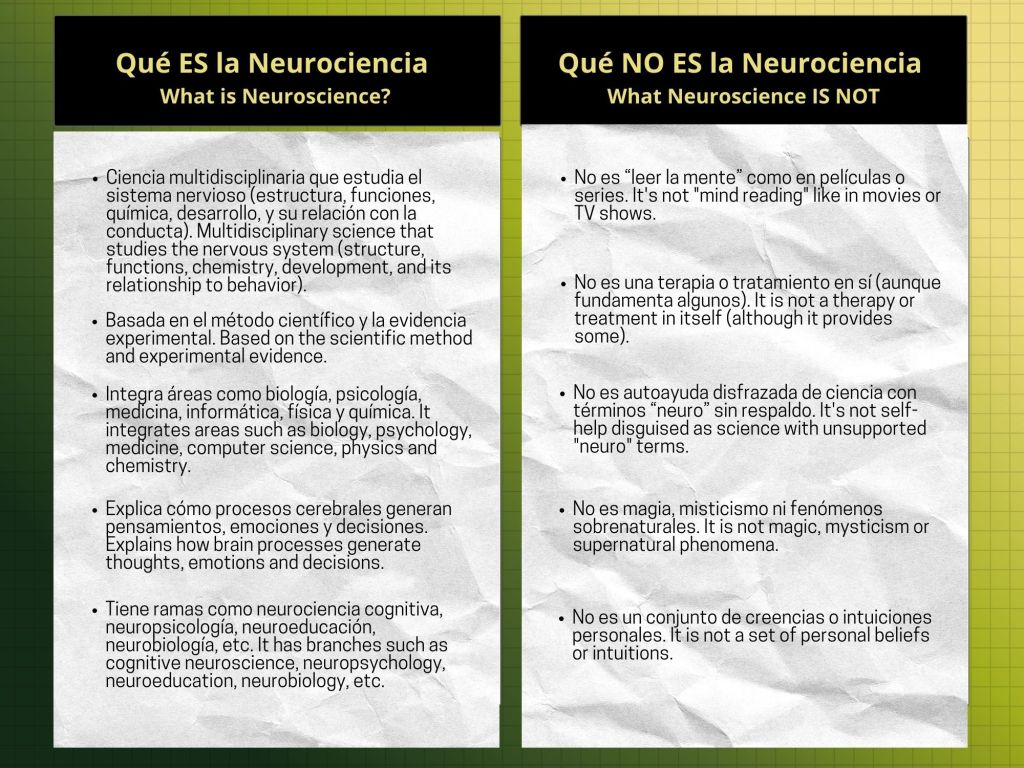
La neurociencia es, en esencia, la ciencia que estudia el sistema nervioso: su estructura, funcionamiento, desarrollo, química, fisiología y cómo se relaciona con el comportamiento y los procesos mentales. Esta palabra «neurociencia» está en boca de todos. Se usa en conferencias, redes sociales, libros e incluso en estrategias de marketing. Pero entre la moda y la ciencia hay una línea muy clara: y es que la neurociencia no es magia, ni autoayuda disfrazada de tecnicismo. Es una disciplina rigurosa que estudia el sistema nervioso y nos ayuda a entender cómo pensamos, sentimos y actuamos.
Neuroscience is, in essence, the science that studies the nervous system: its structure, function, development, chemistry, physiology, and how it relates to behavior and mental processes. The word «neuroscience» is on everyone’s lips. It’s used in conferences, on social media, in books, and even in marketing strategies. But there’s a very clear line between hype and science: neuroscience isn’t magic, nor self-help disguised as technical jargon. It’s a rigorous discipline that studies the nervous system and helps us understand how we think, feel, and act.
Podemos verlo en los siguientes puntos..:
We can see it in the following points:
Su importancia es innegable: desde la educación y la salud hasta la inteligencia artificial, sus hallazgos han transformado la forma en que comprendemos al ser humano.
Its importance is undeniable: from education and healthcare to artificial intelligence, its discoveries have transformed the way we understand human beings.
Por qué es importante…..
Why is it important
- Entender cómo pensamos, sentimos y actuamos → Permite comprender el origen de nuestras conductas y decisiones. Understanding how we think, feel, and act → Allows us to understand the origins of our behaviors and decisions.
- Avances médicos → Ayuda en el diagnóstico y tratamiento de enfermedades como Alzheimer, Parkinson, depresión, epilepsia, lesiones medulares, etc. Medical Advances → Helps in the diagnosis and treatment of diseases such as Alzheimer’s, Parkinson’s, depression, epilepsy, spinal cord injuries, etc.
- Educación y aprendizaje → Explica cómo aprende el cerebro, mejorando métodos educativos. Education and Learning → Explains how the brain learns, improving educational methods.
- Tecnología y IA → Inspira el desarrollo de redes neuronales artificiales y prótesis cerebrales. Technology and AI → Inspires the development of artificial neural networks and brain prostheses.
- Mejor calidad de vida → Permite desarrollar estrategias para optimizar memoria, atención, regulación emocional y rehabilitación. Better Quality of Life → Allows us to develop strategies to optimize memory, attention, emotional regulation, and rehabilitation.
La neurociencia no es una moda pasajera ni un concepto abstracto: es ciencia aplicada a la vida real. Comprender cómo funciona nuestro cerebro nos da herramientas para cuidarlo y potenciarlo. La memoria, como cualquier otra capacidad, puede fortalecerse si se entrena con constancia, disciplina y hábitos saludables.
Neuroscience is not a passing fad or an abstract concept: it’s science applied to real life. Understanding how our brain works gives us tools to care for and enhance it. Memory, like any other ability, can be strengthened if trained with consistency, discipline, and healthy habits.
Secretos de la Neurociencia / Secrets of Neuroscience
Hábitos para mejorar la memoria, según la neurociencia / Habits to improve memory, according to neuroscience
La memoria no solo sirve para recordar hechos: es la base de nuestro aprendizaje, toma de decisiones y comunicación. Con el paso del tiempo —y en ausencia de ciertos cuidados— puede verse afectada. Hoy según investigaciones respaldadas en nuerociencia, se recomienda los siguientes hábitos simples y efectivos para mantener la memoria fuerte a cualquier edad.
Memory isn’t just for remembering facts: it’s the basis of our learning, decision-making, and communication. Over time—and in the absence of certain care—it can be affected. Today, according to neuroscience-backed research, the following simple and effective habits are recommended to maintain a strong memory at any age.
Mantén tu mente activa / Keep your mind active
El cerebro es como un músculo: si no lo usamos, se atrofia. La neurociencia ha comprobado que aprender cosas nuevas —como un idioma, un instrumento o incluso una ruta diferente al trabajo— provoca neuroplasticidad, es decir, la creación y fortalecimiento de nuevas conexiones neuronales. Esto no solo potencia la memoria, sino que también incrementa la flexibilidad cognitiva, ayudándonos a adaptarnos a cambios y resolver problemas con mayor rapidez. Cuanto más variada y desafiante sea la actividad, más áreas del cerebro se activan, lo que actúa como una red de seguridad contra el deterioro cognitivo.
The brain is like a muscle: if we don’t use it, it atrophies. Neuroscience has proven that learning new things—such as a language, an instrument, or even a different route to work—causes neuroplasticity, the creation and strengthening of new neural connections. This not only enhances memory but also increases cognitive flexibility, helping us adapt to changes and solve problems more quickly. The more varied and challenging the activity, the more areas of the brain are activated, which acts as a safety net against cognitive decline.
Cultiva tu vida social / Cultivate your social life
La interacción social estimula el cerebro de formas que ninguna actividad solitaria logra. Conversar, debatir, reír o simplemente escuchar a otros pone en marcha procesos complejos: desde la memoria de trabajo (para seguir el hilo de la conversación) hasta la empatía (para comprender emociones ajenas). Estudios han demostrado que las personas con redes sociales activas tienen menor riesgo de demencia y depresión. Además, el contacto humano libera oxitocina y dopamina, hormonas que reducen el estrés y mejoran la salud cerebral.
Social interaction stimulates the brain in ways that no solitary activity can. Talking, debating, laughing, or simply listening to others triggers complex processes: from working memory (to follow the thread of a conversation) to empathy (to understand other people’s emotions). Studies have shown that people with active social networks have a lower risk of dementia and depression. Furthermore, human contact releases oxytocin and dopamine, hormones that reduce stress and improve brain health.
Ordena tu entorno y tus ideas / Organize your environment and your ideas
Un espacio físico ordenado se traduce en un entorno mental más claro. El cerebro gasta mucha energía procesando estímulos irrelevantes, por lo que el desorden visual y auditivo puede sobrecargarlo, afectando la concentración y la memoria. Al asignar un lugar fijo para cada cosa, anotar pendientes y verbalizar acciones, estamos liberando “memoria de trabajo” para tareas más complejas. Esto también disminuye el cortisol (hormona del estrés), lo que protege estructuras clave para la memoria como el hipocampo.
An orderly physical space translates into a clearer mental environment. The brain spends a lot of energy processing irrelevant stimuli, so visual and auditory clutter can overload it, affecting concentration and memory. By assigning a fixed place for everything, writing down to-do lists, and verbalizing actions, we free up «working memory» for more complex tasks. This also decreases cortisol (the stress hormone), which protects key memory structures like the hippocampus.
Incorpora la lectura diaria / Incorporate daily reading
La lectura no es solo entretenimiento o aprendizaje; es un ejercicio integral para el cerebro. Implica decodificar símbolos, acceder a conocimientos previos, procesar información nueva y mantener la atención sostenida. Todo esto activa simultáneamente redes neuronales relacionadas con la memoria a corto y largo plazo. Incluso leer ficción mejora la capacidad de imaginar escenarios, lo que estimula la creatividad y la memoria visual. Según la neurociencia, leer diariamente fortalece la conectividad cerebral y retarda el envejecimiento cognitivo.
Reading isn’t just entertainment or learning; it’s a comprehensive exercise for the brain. It involves decoding symbols, accessing prior knowledge, processing new information, and maintaining sustained attention. All of this simultaneously activates neural networks related to short- and long-term memory. Even reading fiction improves the ability to imagine scenarios, which stimulates creativity and visual memory. According to neuroscience, reading daily strengthens brain connectivity and slows cognitive aging.
Cuida tu cuerpo para cuidar tu mente / Take care of your body to take care of your mind
La salud cerebral está íntimamente ligada a la salud física. Dormir bien permite consolidar recuerdos, ya que durante el sueño profundo el cerebro “clasifica” y almacena la información adquirida en el día. Una dieta equilibrada —rica en ácidos grasos omega-3, antioxidantes y vitaminas— protege las neuronas del daño oxidativo. El ejercicio físico aumenta el flujo sanguíneo cerebral y promueve la liberación de BDNF (factor neurotrófico derivado del cerebro), una proteína clave para el crecimiento y supervivencia neuronal. Además, controlar enfermedades crónicas como hipertensión o diabetes previene daños en la microcirculación cerebral, manteniendo una buena oxigenación y nutrición del tejido nervioso.
Brain health is closely linked to physical health. A good night’s sleep helps consolidate memories, as during deep sleep the brain «classifies» and stores the information acquired during the day. A balanced diet—rich in omega-3 fatty acids, antioxidants, and vitamins—protects neurons from oxidative damage. Physical exercise increases cerebral blood flow and promotes the release of BDNF (brain-derived neurotrophic factor), a key protein for neuronal growth and survival. Furthermore, managing chronic diseases such as hypertension or diabetes prevents damage to cerebral microcirculation, maintaining good oxygenation and nutrition of nervous tissue.
Tips xpress para una memoria en forma / Express tips for a fit memory
La memoria, esa capacidad de almacenar y recuperar información, clave no solo para recordar, también para aprender, tomar decisiones y comunicarnos.
Memory, the ability to store and retrieve information, is key not only to remembering, but also to learning, making decisions, and communicating.
(Con respaldo neurocientífico en cada uno)
(With neuroscientific support in each one)
- Haz pausas activas: levantarte, estirarte y moverte cada hora mejora la oxigenación cerebral. Take active breaks: Getting up, stretching, and moving around every hour improves brain oxygenation.
- Asocia y visualiza: vincula la información nueva con imágenes mentales o historias para recordarla mejor. Associate and visualize: Link new information with mental images or stories to remember it better.
- Escribe a mano: refuerza la memoria motora y la retención de datos. Handwriting: Strengthens motor memory and data retention.
- Ríe y canta: ambas actividades liberan endorfinas y mejoran la conexión entre áreas cerebrales. Laugh and sing: both activities release endorphins and improve connections between brain areas.
- Practica la gratitud diaria: reduce el estrés y favorece la memoria a largo plazo. Practice daily gratitude: it reduces stress and improves long-term memory.
A continuación otras maneras simples de agudizar la memoria e infórmate sobre cuándo buscar ayuda para la pérdida de memoria.
- Haz actividad física todos los días. El ejercicio regular oxigena el cerebro y mejora la concentración y la memoria. El ejercicio cardiovascular aumenta la neurogénesis en el hipocampo, una región cerebral clave para la memoria. Get physical activity every day. Regular exercise oxygenates the brain and improves concentration and memory. Cardiovascular exercise increases neurogenesis in the hippocampus, a brain region key to memory.
- Mantente activo mentalmente. Estimulación mental: Mantén el cerebro activo con juegos cognitivos como el sudoku, los rompecabezas o el ajedrez, y la lectura diaria. Aprender un nuevo idioma, tocar un instrumento musical o incluso tomar rutas diferentes al conducir puede estimular el cerebro significativamente. Stay mentally active. Mental stimulation: Keep your brain active with cognitive games like Sudoku, puzzles, or chess, and daily reading. Learning a new language, playing a musical instrument, or even taking a different route while driving can significantly stimulate your brain.
- Actividades cerebrales: Desafía tu cerebro con juegos como sudokus, crucigramas, rompecabezas y juegos de mesa. Brain Activities: Challenge your brain with games like Sudoku, crossword puzzles, jigsaw puzzles, and board games.
- Aprendizaje continuo: Aprende cosas nuevas, como un nuevo idioma o a tocar un instrumento musical. Técnicas de aprendizaje y recuerdo: Continuous learning: Learn new things, like a new language or how to play a musical instrument. Learning and recall techniques:
- Lectura activa: Leer diariamente no solo amplía el vocabulario o la imaginación, sino que también estimula la atención y el procesamiento de información, efectos positivos que se traducen en una mejor memoria, por lo que incorporar libros, artículos o incluso cómics en la rutina puede tener un impacto duradero. Mientras lees, hazte preguntas, toma notas y resalta la información importante para interactuar con el texto. Active reading: Reading daily not only expands vocabulary and imagination, but also stimulates attention and information processing, positive effects that translate into improved memory. Therefore, incorporating books, articles, or even comics into your routine can have a lasting impact. As you read, ask yourself questions, take notes, and highlight important information to engage with the text.
- Repaso intermitente: Repasa la información a intervalos, explicando las ideas principales con tus propias palabras, para mejorar la retención. Repasar la información repetidamente fortalece las conexiones neuronales. Además, espaciar el estudio en el tiempo (práctica distribuida) es más efectivo que estudiar de forma intensiva. Intermittent review: Review information at intervals, explaining the main ideas in your own words, to improve retention. Reviewing information repeatedly strengthens neural connections. Additionally, spreading out your studying time (distributed practice) is more effective than cramming.
- Atención y concentración: Enfócate en la información y concéntrate en el aprendizaje para fragmentar y entender la información correctamente. Attention and concentration: Focus on the information and concentrate on learning to fragment and understand the information correctly.
- Conexiones emocionales:Asocia la información con un significado emocional o vívido para crear recuerdos más sólidos y duraderos. Emotional Connections: Associate information with emotional or vivid meaning to create stronger, longer-lasting memories.
- Uso de los sentidos: Involucra más sentidos (vista, oído, olfato) al aprender para activar más neuronas y mejorar la recuperación futura de la información. Use of the senses: Engaging more senses (sight, hearing, smell) when learning to activate more neurons and improve future information retrieval.
- Pasa tiempo con otras personas. Conversar con otras personas es una forma de ejercitar la mente. El aislamiento – para quienes viven solos– puede propiciar el estrés y la depresión, dos factores que aceleran el deterioro cognitivo. Compartir con amigos, participar en actividades grupales o asistir a reuniones familiares contribuye a mantener la agilidad mental. Spend time with other people. Talking with others is a way to exercise your mind. Isolation—for those who live alone—can lead to stress and depression, two factors that accelerate cognitive decline. Spending time with friends, participating in group activities, or attending family gatherings helps maintain mental agility.
- Organízate. Tener un espacio ordenado ayuda a que también lo esté la mente. Asignar lugares fijos para los objetos, anotar tareas y verbalizar lo que se debe hacer ayudan a la retención de información y previenen olvidos, además de reducir el estrés cotidiano. Mantener por tanto un estilo de vida organizado. Get organized. Having an organized space helps keep your mind organized, too. Assigning fixed places for objects, writing down tasks, and verbalizing what needs to be done helps with information retention and prevents forgetfulness, while also reducing daily stress. Therefore, maintaining an organized lifestyle
- Duerme bien. Dormir bien, mantener una dieta equilibrada y controlar enfermedades crónicas como la diabetes o la hipertensión también influyen en la memoria. A esto se suma el valor de actividades como escribir a mano, escuchar música, reír, cantar, practicar pasatiempos que exijan concentración y explorar nuevos lugares. Todo lo que estimule diferentes áreas del cerebro es bienvenido. El sueño por tanto es esencial para la consolidación de la memoria, es decir, el proceso de convertir los recuerdos a corto plazo en recuerdos a largo plazo. Sleep well. Sleeping well, maintaining a balanced diet, and managing chronic conditions such as diabetes or hypertension also influence memory. Added to this is the value of activities such as handwriting, listening to music, laughing, singing, engaging in hobbies that require concentration, and exploring new places. Anything that stimulates different areas of the brain is welcome. Sleep is therefore essential for memory consolidation, the process of converting short-term memories into long-term ones.
- Come una dieta saludable. Consume una dieta rica en antioxidantes, vitaminas (B y E) y omega-3. Los carbohidratos complejos proporcionan al cerebro glucosa, su «combustible», y el folato, una vitamina B, es importante para la memoria. Eat a healthy diet. Consume a diet rich in antioxidants, vitamins (B and E), and omega-3s. Complex carbohydrates provide the brain with glucose, its «fuel,» and folate, a B vitamin, is important for memory.
- Controla tus problemas crónicos de salud. Recordemos que el estrés crónico puede dañar la memoria; practicar técnicas de relajación como la meditación puede ayudar a mejorar la claridad mental. Manage your chronic health problems. Remember that chronic stress can damage memory; practicing relaxation techniques like meditation can help improve mental clarity.
- Cuándo buscar ayuda profesional, si la pérdida de memoria es significativa, es importante consultar a un médico para evaluar la causa y recibir orientación. When to seek professional help: If memory loss is significant, it is important to consult a doctor to evaluate the cause and receive guidance.
Descubre más desde LA AGENCIA MUNDIAL DE PRENSA
Suscríbete y recibe las últimas entradas en tu correo electrónico.

