
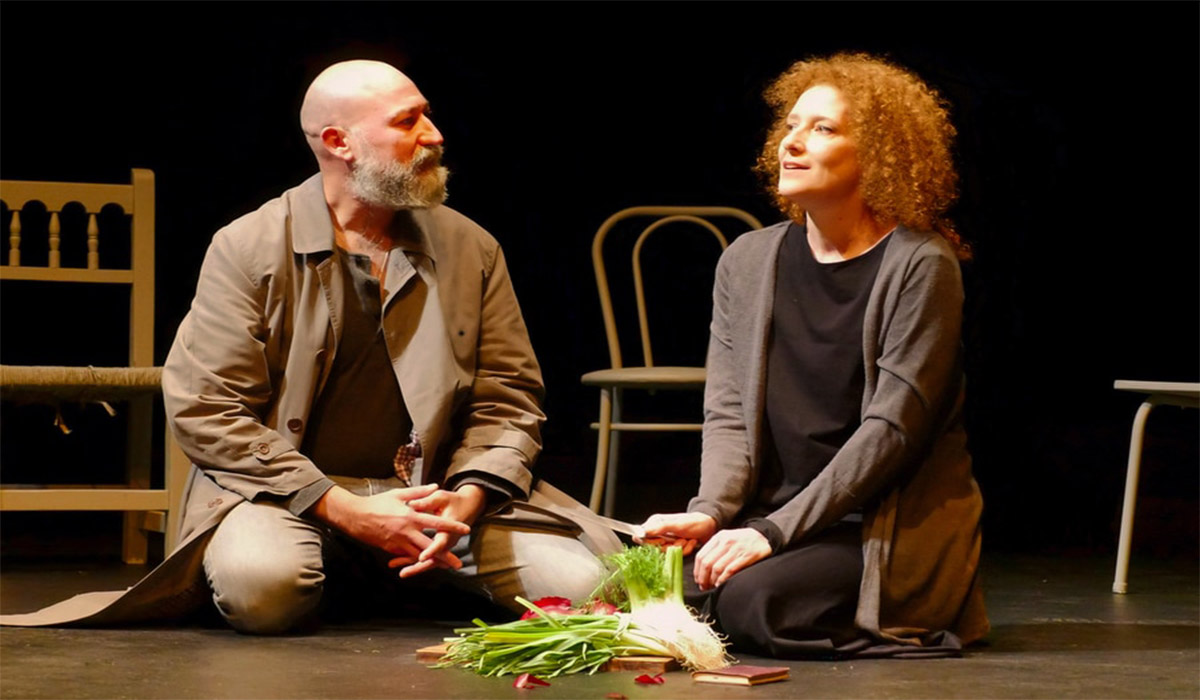
«The tongue in pieces» by Teresa de Jesús

PRENSA ESPECIALIZADA
El Teatro del Barrio, centro cultural ubicado en el de Lavapies de Madrid, es conocido y reconocido por su compromiso con los temas sociales. Considerado como un espacio de reflexión y transformación social, sus producciones teatrales están orientadas a crear una experiencia cultural única.
The Teatro del Barrio, a cultural center located in Lavapies in Madrid, is known and recognized for its commitment to social issues. Considered a space for reflection and social transformation, its theatrical productions are aimed at creating a unique cultural experience.
Sin duda es el espacio ideal para ver La lengua en pedazos, pieza teatral basada en El libro de la vida de Teresa de Jesús. La adaptación del texto teresiano a teatro le valió a su autor y director Juan Mayorga, el Premio Nacional de Literatura Dramática.
Without a doubt, it is the ideal space to see The Language in Pieces, a play based on The Book of Life by Teresa de Jesús. The adaptation of Teresian text to theater earned its author and director Juan Mayorga the National Prize for Dramatic Literature.
Con dos actores de la talla de Clara Sanchís y Daniel Albaladejo lleva a sentir o mejor a vivir las emociones de la propia Teresa, que llegan a fundirse con la enorme admiración por aquella mujer del siglo XVI que decidió vivir su vida en libertad, cuando esta solo podía conseguirse en un convento, para así poder desarrollar sus talentos, incluso su enorme vocación, su enamoramiento de Jesús, su irrevocable determinación de reformar el Carmelo, nada menos.
With two actors of the stature of Clara Sanchís and Miguel Albaladejo, it takes us to agree or rather to live the emotions of Teresa herself, which come to merge with the enormous admiration for that woman of the 16th century who decided to live her life in freedom, when she was alone. could be obtained in a convent, in order to develop her talents, including her enormous vocation, her infatuation with Jesus, her irrevocable determination to reform Carmel, nothing less.
La acción transcurre en la cocina del convento de San José, primera de las fundaciones de Teresa. Juan Mayorga dice de ella que es “un ser a contracorriente en nuestro propio tiempo”, para resaltar la modernidad de su pensamiento, y que a pesar de la distancia en el tiempo, las experiencias de Teresa podrían trasladarse a mujeres de ahora mismo.
The action takes place in the kitchen of the convent of San José, the first of Teresa’s foundations. Juan Mayorga says of her that she is “a being against the current in our own time,” to highlight the modernity of her thought, and that despite the distance in time, Teresa’s experiences could be transferred to women of today.
No es necesario compartir sus creencias ni su vocación. Es su enorme voluntad, su determinación, su fe en ella misma, aunque arriesgue por ello ser sometida a un juicio inquisitorial, lo que fascina. Teresa que esculpió la frase “Entre pucheros también anda Dios”, en esa cocina del convento de San José, su primera fundación contra viento y marea, protagoniza un combate verbal como insólita mujer reformadora, con un hombre de la iglesia, un Inquisidor.
It is not necessary to share your beliefs or your vocation. It is her enormous will, her determination, her faith in herself, even though she risks being subjected to an inquisitorial trial, that fascinates. Teresa, who sculpted the phrase “God also walks between pots,” in that kitchen of the convent of San José, her first foundation against all odds, stars in a verbal combat as an unusual woman reformer, with a man from the church, an Inquisitor.
Emociona hasta el desgarro su palabra, en una interpretación impecable de Clara Sanchís, palabra tan violentamente hermosa, tanto cuando habla de su cuerpo herido, como cuando pinta ángeles o infiernos. En esa cocina, el Inquisidor tiene el firme propósito de cerrar el convento de San José, que Teresa renuncie a veleidades reformadoras ¡lo nunca visto en una mujer! y que regrese a la ortodoxia del Carmelo. Pero Teresa, muy segura de sí misma, muy convencida de lo que quiere, ha aprendido a decir NO con todos sus argumentos, incluido el de la libertad.
His words move you to tears, in an impeccable interpretation by Clara Sanchís, a word so violently beautiful, both when he talks about his wounded body and when he paints angels or hells. In that kitchen, the Inquisitor has the firm intention of closing the convent of San José, that Teresa renounces reforming whims, something never seen in a woman! and return to the orthodoxy of Carmel. But Teresa, very sure of herself, very convinced of what she wants, has learned to say NO with all her arguments, including that of freedom.
Tremendo y violento combate dialéctico, teológico, social, político y personal. A los argumentos y amenazas del Inquisidor, Teresa opone su fe y su carácter. Si ella afirma que Dios se le aparece y le habla, el Inquisidor opone que esas visiones son ilusorias, cuando no inspiradas por el Maligno, para desacreditarla y amedrentarla. Tarea inútil con Teresa, que está dispuesta a todo, incluso a morir, pero nunca a retroceder. San José debe seguir y fundará más conventos del reformado Carmelo.
Tremendous and violent combat, theological, social, political and personal. To the arguments and threats of the Inquisitor, Teresa opposes her faith and her character. If she affirms that God appears to her and speaks to her, the Inquisitor objects that these visions are illusory, if not inspired by the Evil One, to discredit and intimidate her. Useless task with Teresa, who is willing to do anything, even die, but never back down. Saint Joseph must continue and will found more convents of the reformed Carmel.
La interpretación, tanto de Clara Sanchís como de Daniel Albaladejo, es sencillamente brillante. Tanto en la expresión de la palabra, tan llena de matices, con los que Clara/Teresa narra su vida, su noviciado, su desacuerdo con las reglas, su fidelidad sin fisuras en su amor a Jesús, su entrega, su falta de miedo ante las amenazas del Inquisidor, su defensa de su libertad, como la intensidad del gesto corporal, el movimiento por la escena, el protagonismo de las sillas de las doce novicias del nuevo convento, volcadas por el Inquisidor/Albaladejo y puestas en pie de nuevo por la irreductible Teresa de Jesús.
The interpretation, both by Clara Sanchís and Miguel Albaladejo, is simply brilliant. Both in the expression of the word, so full of nuances, with which Clara/Teresa narrates her life, her novitiate, her disagreement with the rules, her unwavering fidelity in her love for Jesus, her dedication, her lack of fear before the threats of the Inquisitor, his defense of his freedom, such as the intensity of the bodily gesture, the movement through the scene, the prominence of the chairs of the twelve novices of the new convent, overturned by the Inquisitor/Albaladejo and put back on their feet by the irreducible Teresa of Jesus.
La obra no lo dice, porque seguramente tampoco lo dice El Libro de la Vida de Teresa de Jesús. Pero la historia sí dice, que al final las tesis del nuevo Carmelo se sostuvieron gracias a la intervención personal en su defensa, del mismísimo Felipe II, rey de las Españas.
The work does not say it, because surely neither does The Book of Life of Teresa de Jesús say it. But history does say that in the end the theses of the new Carmel were sustained thanks to the personal intervention in its defense of Philip II himself, king of Spain.
La Inquisición tuvo que dejar en paz a Teresa. A esa increíble mujer en el tiempo que le tocó vivir. Sigue siendo un ejemplo, un modelo de fe en su libertad para mujeres de hoy, sean sus creencias las que sean, aunque crean no tener ninguna.
The Inquisition had to leave Teresa alone. To that incredible woman in the time she lived. She continues to be an example, a model of faith in her freedom for women today, whatever their beliefs may be, even if they believe they have none.
Descubre más desde LA AGENCIA MUNDIAL DE PRENSA
Suscríbete y recibe las últimas entradas en tu correo electrónico.
