

GEOPOLITICA: Próxima avalancha

Currently there are different urgent issues on the Mexico-United States agenda, as soon as Donald Trump arrives on Monday, January 20, to take the reins of a country that does not want to lose hegemony, when the world seems to be in full reorganization.
Actualmente hay distintos temas urgentes en la agenda México-Estados Unidos, apenas Donald Trump, llegue el lunes 20 de enero a tomar las riendas de un país que no quiere perder la hegemonía, cuando el mundo parece estar en plena reorganización.
We continue to wait. The world watches the steps and listens to the speeches of Donald Trump, president-elect of the United States. As the days draw closer for him to return to the White House, the governments of Canada, Mexico, Panama, and Greenland are taking their precautions. We have to wait and see their actions on the first day and those that follow.
Continuamos a la expectativa. El mundo observa los pasos y escucha los discursos de Donald Trump, presidente electo de Estados Unidos. Mientras los días se acercan para que regrese a la Casa Blanca, los gobiernos de Canadá, México, Panamá, Groenlandia, toman sus precauciones. Hay que esperar y ver sus acciones en el primer día y los que siguen.
The government of President Claudia Sheinbaum will continue to focus on lowering the rates of violence generated in part by drug trafficking cartels, implicitly the seizure of drugs, imposing tariffs on the import of products from Asia, migration, among other issues. 74 percent of the weapons seized in Mexico come from the United States, the president stated in her morning conference, and this is recognized by the United States Department of Justice. Meanwhile, the Attorney General of the Republic, Alejandro Gertz Manero, reported that all the strength of criminal cartels is in their firepower (weapons).
El gobierno de la presidenta Claudia Sheinbaum, continuará atendiendo bajar los índices de violencia generada en parte por los cárteles del narcotráfico, implícitamente el decomiso de drogas, imponer aranceles a la importación de productos de Asia, la migración, entre otros asuntos.
El 74 por ciento de las armas que se incautan en México provienen de Estados Unidos, afirmó la presidenta en su conferencia matutina, y lo reconoce el Departamento de Justicia de Estados Unidos. En tanto, el Fiscal General de la República, Alejandro Gertz Manero, informó que toda la fuerza de los cárteles delictivos está en su capacidad de fuego (las armas).
Faced with this situation, President Sheinbaum is sure that the only path with Republican Donald Trump, when he takes office, is greater collaboration and coordination on the issue of security. How can we expect results in further reducing or containing the violence caused by drug trafficking cartels, when weapons continue to arrive from the United States?
Ante esta situación, la presidenta Sheinbaum, está segura que el único camino con el republicano Donald Trump, cuando tome el cargo, es la colaboración y coordinación con mayor fuerza en el tema de seguridad. ¿Cómo esperar resultados en bajar más o contener la violencia provocada por los cárteles del narcotráfico, cuando las armas siguen llegando desde Estados Unidos?.
Why leave Mexico the responsibility of stopping migrant caravans to the United States? What does it resolve to impose tariffs on products made in Mexico, which are destined for the United States?
In a recent remote interview with the Mexican priest and activist José Filiberto Velázquez Florencio (survivor of threats and attacks by criminal groups in the state of Guerrero), who has worked with migrants, he forcefully expresses that: “What can happen, has already happened.”
¿Por qué dejarle a México la responsabilidad de frenar las caravanas de migrantes a Estados Unidos?. ¿Qué resuelve imponer aranceles a productos hechos en México, que tienen por destino Estados Unidos?.
En una reciente entrevista a distancia con el sacerdote mexicano y activista José Filiberto Velázquez Florencio (sobreviviente de amenazas y atentados de grupos criminales en el estado de Guerrero), quien ha trabajado con migrantes, expresa contundente que: “Lo que puede pasar, ya pasó”.
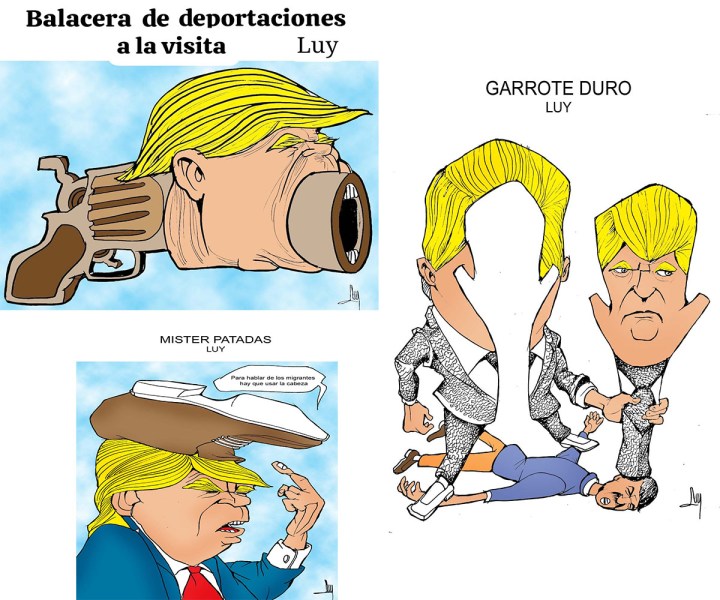
Intuitively, the clergyman José Filiberto remains silent for a moment while reflecting before stating that: “This is not the first time that Donald Trump uses that speech. It is also a myth that only republican or right-wing governments have anti-immigrant laws; with the Democrats there were waves of deportations as in the then government of Barack Obama. This is a constant. What could affect the reception of migrants is overcrowding in shelters. We have experienced other waves like in 2018, when there were more than deportations, caravans that in some way were a response to the psychosis that it is impossible to reach the United States with a president like that, and in some way the State mobilized infrastructure to draw attention . There is no need to be alarmed, we are a country that generates migrants and at the same time expels them, it is a permanent reality, and we have to learn to live with them, we are a border country with a world power that many want to go there.”
Intuitivo, el clérigo José Filiberto, guarda silencio un momento mientras reflexiona antes de afirmar que: “No es la primera vez que Donald Trump, utiliza ese discurso. Es también un mito que solo los gobiernos republicanos o de derecha son los que tienen leyes antimigrantes; con los demócratas hubo oleadas de deportaciones como en el entonces gobierno de Barack Obama. Esto es una constante. Lo que podría afectar en la acogida de migrantes es la sobrepoblación en los albergues. Hemos vivido otras oleadas como en 2018, cuando se hicieron más que deportaciones, caravanas que de alguna manera eran respuesta a la psicosis de que es imposible llegar a Estados Unidos con un presidente así, y de alguna manera el Estado movilizó infraestructura para llamar la atención. No hay que alarmarse, somos un país generador de migrantes y al mismo tiempo expulsor, es una realidad permanente, y tenemos que aprender a convivir con ellos, somos un país fronterizo con una potencia mundial que muchos quieren ir hacia allá”.
“What would worry me is that for young people who have education, the (Mexican) government can use their training (give them job opportunities) and reduce the bureaucracy for the homologation of credentials and titles. We have to learn to live in this ambivalent reality.”
“A mí lo que me preocuparía es que los jóvenes que tienen educación, el gobierno (mexicano) pueda utilizar su formación (darles oportunidades laborales) y disminuir la burocracia para la homologación de credenciales, de títulos. Tenemos que aprender a vivir en esta realidad ambivalente”.
“On the other hand, it is not possible to deport people who were immigrants at the time and who have already achieved American nationality.”
“Por otra parte, no es posible deportar a personas que en su momento fueron inmigrantes y que lograron ya la nacionalidad estadounidense”.
“Before looking at Donald Trump’s behavior, you have to look at the behavior of the Mexican government itself, which also deports migrants, it is like a contradiction. This is a broader issue, of geopolitics, economic interests. Very rarely do they value the human person as an individual, they use them as merchandise.”
“Antes que ver el comportamiento de Donald Trump, hay que ver el comportamiento del propio gobierno mexicano, que también deporta a migrantes, es como una contradicción. Se trata de una cuestión más amplia, de geopolítica, intereses económicos. Muy pocas veces valoran a la persona humana como individuo, los utilizan como mercancía”.
Most of the shelters in our country are on the southern and northern border. The Documentation Network of Migrant Defense Organizations REDODEM, A.C., has 23 shelters.
La mayoría de los albergues en nuestro país están en la frontera sur y norte. La Red de Documentación de las Organizaciones Defensoras de Migrantes REDODEM, A.C., cuenta con 23 albergues.
The Demographic Dynamics Survey of the National Institute of Statistics and Geography records that between 2018 and 2023, around 1.2 million people emigrated from Mexico. This represents an increase of 58 percent compared to the period 2013-2018.
La Encuesta de Dinámica Demográfica del Instituto Nacional de Estadística y Geografía, tiene un registro que entre los años 2018 y 2023, alrededor de 1.2 millones de personas emigraron de México. Esto representa un aumento de 58 por ciento en comparación con el periodo 2013-2018.
A report from the Migration Policy Unit of the Ministry of the Interior records that between January and June 2024, in Mexico there were 712,226 people in an irregular migratory situation, that is, an increase of 193 percent compared to the same period. period of 2023.
Un informe de la Unidad de Política Migratoria de la Secretaría de Gobernación, tiene registrado que entre enero y junio de 2024, en México se contó con 712,226 personas en situación migratoria irregular, es decir, un aumento del 193 por ciento en comparación con el mismo periodo de 2023.
Descubre más desde LA AGENCIA MUNDIAL DE PRENSA
Suscríbete y recibe las últimas entradas en tu correo electrónico.
