

Kumb Mela: In search of immortality
TERESA FERNANDEZ HERRERA.
Periodista, Escritora, Editorialista.
CDG de Cultura.
COLUMNISTA
¿Qué tienen de cierto los antiguos mitos, que son capaces de reunir millones de personas en busca del amrita o néctar de la inmortalidad?
What is true about the ancient myths, which are capable of gathering millions of people in search of the amrita or nectar of immortality?
No hay otro lugar como la inmensa India donde podamos encontrar mitos que son seguidos hoy en día por millones de occidentales. Y el más poderoso de esos mitos es el Khumb Mela.
There is no other place like the immense India where we can find myths that are followed today by millions of Westerners. And the most powerful of those myths is the Khumb Mela.
La leyenda / the legend
Hubo en tiempos inmemoriales un océano de leche que tras ser batido en una ceremonia llamada Samudra Manthan producía el amrit o néctar de la inmortalidad. En una era remota los dioses y los demonios crearon una alianza para conseguir juntos la elaboración del amrita o néctar de la inmortalidad, a partir del batido del océano primigenio de leche y compartirlo.
In time immemorial there was an ocean of milk that, after being churned in a ceremony called Samudra Manthan, produced the amrit or nectar of immortality. In a remote era, the gods and demons created an alliance to together produce the amrita or nectar of immortality, from the churning of the primordial ocean of milk and share it.
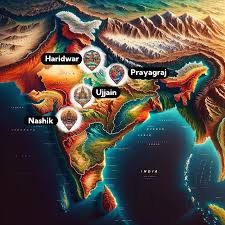
Pero los demonios o asuras robaron el cántaro que contenía el néctar al dios Dhanu Antari y huyeron con él perseguidos por los dioses o devas.. Durante doce días y doce noches equivalentes a doce años humanos, los dioses y los demonios combatieron en los cielos por la posesión del cántaro de amrita. En el forcejeo, cuatro gotas de néctar cayeron en cuatro lugares: Prayagraj, Haridwar, Ujjain y Nasik. Por eso estas cuatro ciudades son sagradas y sedes de la celebración cada doce años del ritual khumbamela o inmersión en los ríos sagrados, Ganges o Yamuna en el momento en que el agua se transforma en el néctar de la inmortalidad. Los hindúes creen que el agua sagrada los limpiará de pecado, a ellos y a sus ascendientes en 88 generaciones, lo que los librará del ciclo continuo de las reencarnaciones.
But the demons or asuras stole the jug containing the nectar from the god Dhanu Antari and fled with it, pursued by the gods or devas. For twelve days and twelve nights equivalent to twelve human years, the gods and demons fought in the heavens for the possession of the pot of amrita. In the struggle, four drops of nectar fell at four places: Prayagraj, Haridwar, Ujjain and Nasik. That is why these four cities are sacred and host to the celebration every twelve years of the khumbamela ritual or immersion in the sacred rivers, Ganges or Yamuna at the moment when the water is transformed into the nectar of immortality. Hindus believe that holy water will cleanse them and their ancestors of sin in 88 gen
Del 14 de enero al 26 de febrero 2025 se celebrará un Maha Kumbh Mela en la ciudad de Prayagraj, en el estado de Uttar Pradesh, situada en la confluencia de los ríos Ganges, Yamuna y el mítico e invisible Saraswati.
From January 14 to February 26, 2025, a Maha Kumbh Mela will be held in the city of Prayagraj, in the state of Uttar Pradesh, located at the confluence of the Ganges, Yamuna and the mythical and invisible Saraswati rivers.
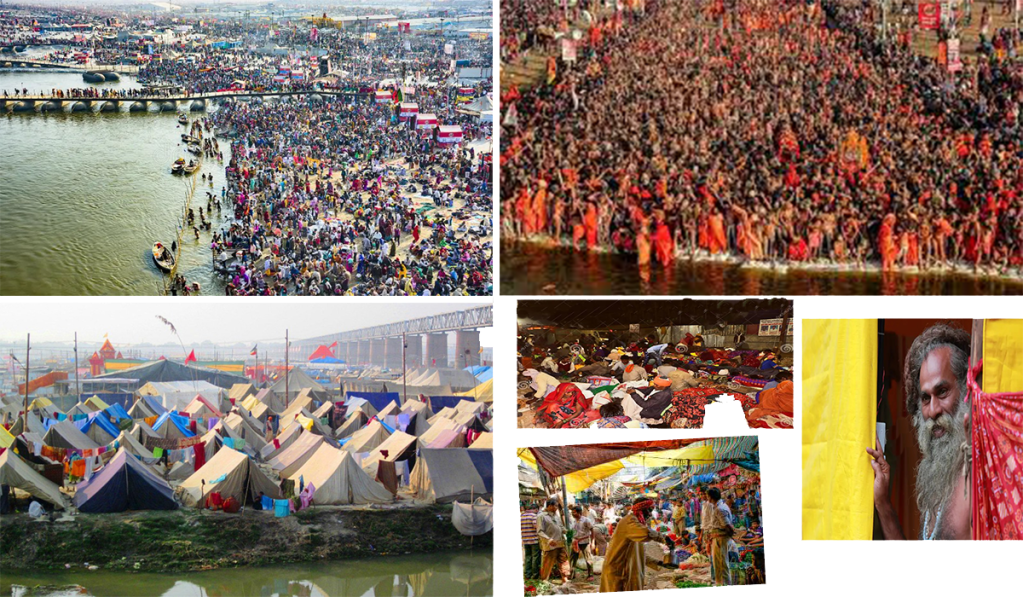
El epicentro del Kumb Mela son los baños sagrados, o Shahi Snans. Estos tienen lugar en días específicos, los considerados propicios por el calendario hindú. En 2025 estos días son Paush Purnima el 13 de enero, Makar Sankranti el 14 de enero y Mauni Amavasya el 29 de enero, entre otros.
The epicenter of the Kumb Mela is the sacred baths, or Shahi Snans. These take place on specific days, those considered auspicious by the Hindu calendar. In 2025 these days are Paush Purnima on January 13, Makar Sankranti on January 14 and Mauni Amavasya on January 29, among others.
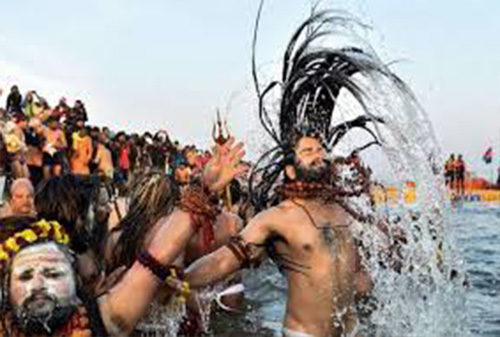
El ritual en un día de Shahi Snan comienza al amanecer. Miles de sadhus y peregrinos se preparan para la inmersión. Ascetas desnudos cubiertos de ceniza lideran la procesión. Las aguas sagradas se transforman en la ceremonia antigua, donde cada inmersión es el símbolo de la purificación del alma y la eliminación de los pecados. Fraternidades espirituales con siglos de antigüedad se presentan con sus rituales de yoga, meditación, y recitación de escrituras. Procesiones llamadas Peshwai, con devotos montados sobre elefantes, caballos y carros decorados. La atmósfera se llena de energía con la recitación de mantras, canto de bhajans, o canciones devocionales.
The ritual on a Shahi Snan day begins at dawn. Thousands of sadhus and pilgrims prepare for the immersion. Naked ascetics covered in ash lead the procession. The sacred waters are transformed into the ancient ceremony, where each immersion is the symbol of the purification of the soul and the elimination of sins. Centuries-old spiritual fraternities present themselves with their rituals of yoga, meditation, and scripture recitation. Processions called Peshwai, with devotees riding elephants, horses and decorated chariots. The atmosphere is filled with energy with the recitation of mantras, singing of bhajans, or devotional songs.
El Kumb Mela no es solo una experiencia espiritual. Es también una celebración de la rica herencia cultural de la India. Cultura que incluye los mercados de joyas, ricas telas, artesanías tradicionales, gastronomía callejera.
The Kumb Mela is not just a spiritual experience. It is also a celebration of India’s rich cultural heritage. Culture that includes jewelry markets, rich fabrics, traditional crafts, street cuisine.
Visitar alrededores sagrados es una oportunidad de oro. Varanasi con sus ghats y templos, es uno de los lugares más sagrados del hinduismo. Ayodhya, ciudad natal del Señor Rama, Mathura lugar donde nació el Señor Krishna, Vrindavan, lleno de recuerdos de la infancia de Krishna con unos maravillosos jardines, Chitrakoot, lugar de exilio de Rama y Sita… visitas obligadas para peregrinos.
Visiting sacred surroundings is a golden opportunity. Varanasi with its ghats and temples is one of the most sacred places in Hinduism. Ayodhya, the birthplace of Lord Rama, Mathura, the birthplace of Lord Krishna, Vrindavan, full of memories of Krishna’s childhood with wonderful gardens, Chitrakoot, the place of exile of Rama and Sita… must-sees for pilgrims.
Kumb Mela es un festival inclusivo. De hecho desde la segunda mitad del siglo XX el número de peregrinos occidentales ha crecido exponencialmente. La cultura y la fe hindú se han extendido por occidente a través de la práctica del yoga y la meditación. Y es que participar del Kumb Mela a la par de bañarse en aguas sagradas se realiza una inmersión en esta riquísima cultura.
Kumb Mela is an inclusive festival. In fact, since the second half of the 20th century the number of Western pilgrims has grown exponentially. Hindu culture and faith have spread throughout the West through the practice of yoga and meditation. And participating in the Kumb Mela, along with bathing in sacred waters, is an immersion in this delicious culture.
Ahora es el momento de programar para comienzos de 2025 esta extraordinaria experiencia que te cambia por dentro, porque hasta dentro de otros doce años no volverá a ocurrir. Y Dios sabe donde estaremos para entonces.
Now is the time to schedule this extraordinary experience that changes you inside for the beginning of 2025, because it will not happen again for another twelve years. And God knows where we will be by then.
Según estadísticas fiables más de doscientos millones de hindúes se reunieron en el Maha Kumb Mela de 2013, incluidos treinta millones en el día más sagrado, Mauni Amavasya.
According to reliable statistics, more than two hundred million Hindus gathered at the 2013 Maha Kumb Mela, including thirty million on the holiest day, Mauni Amavasya.

Kumb Mela está considerado como la mayor concentración pacífica del mundo. En 2017 fue declarada Patrimonio Cultural Inmaterial de la Humanidad de la UNESCO.
Kumb Mela is considered the largest peaceful gathering in the world. In 2017 it was declared Intangible Cultural Heritage of Humanity by UNESCO.
Descubre más desde LA AGENCIA MUNDIAL DE PRENSA
Suscríbete y recibe las últimas entradas en tu correo electrónico.
