
A reunion that makes history

Ayer, sin saber muy bien porqué, me puse a hacer revisión, reordenación y limpieza de mi gran armario con baldas para archivo de lo que bien puedo llamar mi historia. Me encontré con cosas que ni siquiera recordaba haber guardado, como el documento excepcional de la edición de una separata en el “Sábado Cultural” del diario ABC del 17 de marzo de 1984.
Yesterday, without really knowing why, I started reviewing, rearranging and cleaning my large closet with shelves to archive what I can well call my story. I found things that I didn’t even remember having saved, like the exceptional document from the edition of an offprint in the “Sábado Cultural” of the ABC newspaper of March 17, 1984.
Dedicada a Federico García Lorca.
Dedicated to Federico García Lorca.
Dedicada a la primera aparición oficial de los “Sonetos de amor” –oscuro, en lenguaje lorquiano, secreto.- Excepcional primicia con autorización de la familia de García Lorca, de unos sonetos que constituyen sin duda una de las más altas muestras de la poesía española de todos los tiempos. Sonetos, de los que en 1968 escribió su amigo Pablo Neruda: “Son de increíble belleza”, recordando que él se los había recitado la última vez que se vieron, cuando en España ya soplaban vientos cercanos a la guerra civil.
Dedicated to the first official appearance of the “Love Sonnets” – dark, in Lorca language, secret. – Exceptional scoop with authorization from García Lorca’s family, of sonnets that undoubtedly constitute one of the highest examples of poetry Spanish of all time. Sonnets, of which his friend Pablo Neruda wrote in 1968: “They are of incredible beauty,” remembering that he had recited them to him the last time they saw each other, when winds close to civil war were already blowing in Spain.
Una edición de dieciséis páginas de huecograbado y veinte de tipografía en primicia literaria excepcional, en las que encontramos artículos, como el de Fernando Lázaro Carreter, “Poesía de García Lorca recuperada”; de Miguel García-Posada, “Un monumento al amor”. García-Posada, experto conocedor de la obra de García Lorca, hace un estudio en profundidad del concepto oscuro. Amor oscuro como sinónimo de amor secreto. Federico mismo así lo reconoce en el soneto sin título, “Ay voz secreta del amor oscuro / ¡Ay balido sin lanas, ay herida! … El autor del artículo especula que si este no fue el título definitivo de los Sonetos quizá deba atribuirse al asesinato del poeta.
An edition of sixteen pages of intaglio and twenty of typography in an exceptional literary premiere, in which we find articles, such as that of Fernando Lázaro Carreter, “Poetry of García Lorca recovered”; by Miguel García-Posada, “A monument to love.” García-Posada, an expert in the work of García Lorca, makes an in-depth study of the dark concept. Dark love as a synonym for secret love. Federico himself recognizes this in the untitled sonnet, “Oh secret voice of dark love / Oh bleat without wool, oh wound! …The author of the article speculates that if this was not the definitive title of the Sonnets, perhaps it should be attributed to the poet’s murder.
Siempre citando a García-Posada, también este concepto está presente en otras obras de García Lorca. En “Bodas de sangre”, acto III, escena I, cuando los amantes fugitivos llegan al bosque, Leonardo dice: “Vamos al rincón oscuro / dónde yo siempre te quiera”. En “Poeta en Nueva York”, en el “Poema del lago Edem Mills”, nos reencontramos con la misma imagen, Quiero mi libertad, mi amor humano / en el rincón más oscuro de la brisa que nadie quiera. Y en el “Soneto gongorino” de nuevo estamos ante el mismo concepto: “Pienso en la cárcel del amor oscura”. Cárcel sin luz, porque falta la luz del ser amado. Alegorías de la tortura de la ausencia, y de cárcel como muerte.
Always citing García-Posada, this concept is also present in other works by García Lorca. In “Blood Wedding”, act III, scene I, when the fugitive lovers arrive at the forest, Leonardo says: “Let’s go to the dark corner / where I always love you.” In “Poet in New York”, in the “Poem of Lake Edem Mills”, we meet again with the same image, I want my freedom, my human love / in the darkest corner of the breeze that no one wants. And in the “Gongorino Sonnet” we are again faced with the same concept: “I think of the dark prison of love.” Jail without light, because the light of the loved one is missing. Allegories of the torture of absence, and of prison as death.
Siempre según el análisis de García-Posada, amor oscuro puede ser también sinónimo de amor que mata o hace morir, literal o figuradamente, en asociación con la tradición occidental de Eros y Tánatos. Lo encontramos en el terceto final del “Soneto de la carta”: Llena pues de palabras mi locura / o déjame vivir en mi serena / noche del alma, para siempre oscura.
Always according to García-Posada’s analysis, dark love can also be synonymous with love that kills or causes death, literally or figuratively, in association with the Western tradition of Eros and Thanatos. We find it in the final tercet of the “Sonnet of the Letter”: So fill my madness with words / or let me live in my serene / night of the soul, forever dark.
Finalmente y siempre citando a García-Posada. “En el esplendido soneto Adam· de “Poeta en Nueva York” distingue entre un Adam procreador y un Adam estéril; Y en la Oda a Walt Whitman hace una clara defensa del Adán estéril, como amor que no busca la perpetuación de la especie, pero que no excluye ni ataca al amor fértil. Nunca prostituye el sentimiento amoroso: Madres de todo. Arpías, enemigos sin sueño / del amor que reparte coronas de alegría. Ahí está lo decisivo. La corona de gozo la reencrontramos en los Sonetos convertida en Guirnalda de rosas. Y Walt Whitman es presentado como, Adán de sangre, Macho…
Finally and always quoting García-Posada. “In the splendid sonnet Adam from “Poet in New York” he distinguishes between a procreative Adam and a sterile Adam; And in the Ode to Walt Whitman he makes a clear defense of the sterile Adam, as a love that does not seek the perpetuation of the species, but that does not exclude or attack fertile love. Never prostitutes the feeling of love: Mothers of everything. Harpies, sleepless enemies / of the love that distributes crowns of joy. That’s what’s decisive. We find the crown of joy again in the Sonnets converted into a Garland of roses. And Walt Whitman is presented as, Blood Adam, Macho…
Todo el texto está basado en los manuscritos conservados en los archivos de la familia García Lorca.
The entire text is based on the manuscripts preserved in the archives of the García Lorca family.
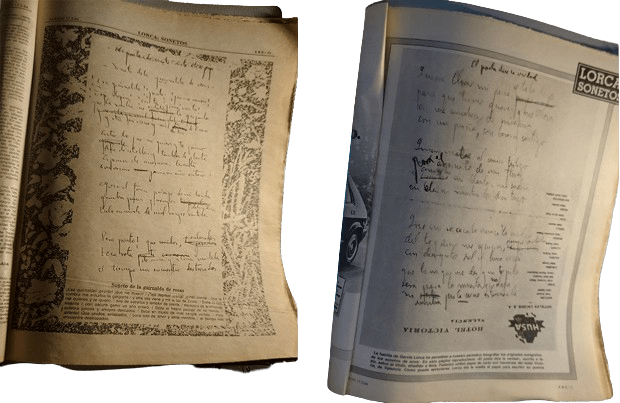
Dos sonetos, fotografiados con permiso de la familia García Lorca de los originales autógrafos de Federico: El poeta dice la verdad y Soneto de la guirnalda de rosas. Pedimos permiso a la redacción del diario ABC para ilustrar nuestra crónica con fotografías de sus fotografías. Rezamos por una repuesta positiva.
Two sonnets, photographed with permission from the García Lorca family from Federico’s original autographs: The Poet Tells the Truth and Sonnet of the Rose Garland. We asked the ABC newspaper’s editorial staff for permission to illustrate our chronicle with photographs of their photographs. We pray for a positive response.
El sobrino de Federico García Lorca, Manuel Fernández-Montesinos, hijo de Conchita García Lorca y del último alcalde republicano de Granada, llamado igual que su hijo, y que fue asesinado por los rebeldes a la II República el mismo día que fue arrestado Federico en casa de la familia Rosales, 16 de agosto de 1936, firma en esta histórica separata, el artículo “Algunos sonetos de Federico García Lorca: ¿Por qué ahora y en el ABC?”
Federico García Lorca’s nephew, Manuel Fernández-Montesinos, son of Conchita García Lorca and the last republican mayor of Granada, named the same as his son, and who was murdered by the rebels of the Second Republic on the same day that Federico was arrested in house of the Rosales family, August 16, 1936, signs in this historical offprint, the article “Some sonnets by Federico García Lorca: Why now and on the ABC?”
Publica una fotografía del poema autógrafo que inicia el poemario “Diwan* del Tamarit”. Cito esto en primer lugar por la importancia que le da su autor al situarlo en el centro de la página 57 que ocupa el artículo. ¿Por qué en el ABC? Citamos a Fernández-Montesinos: “Porque a Luis María Ansón, buen amigo de Neruda, quien en nada menos que en tres ocasiones le había hablado de los sonetos de Federico García Lorca, se le ocurre dedicar parte del periódico de su dirección a este tema”. Añade Fernández-Montesinos: “es poco probable que a mí se me hubiera ocurrido el proyecto de una edición de los once sonetos en un periódico como el ABC. Además la colaboración de Francisco Giner de los Ríos y de Fernando Lázaro Carreter y que el proyecto sería coordinado por Miguel García-Posada, era bastante convincente y garantía suficiente para que se presentase esta edición periodística como desagravio a la piratería y a la violencia de la que habían sido víctimas estas once inocentes criaturas del ascua de la creación artística.”
Publish a photograph of the autograph poem that begins the collection of poems “Diwan* del Tamarit”. I cite this first because of the importance that its author gives it by placing it in the center of page 57 of the article. Why at ABC? We quote Fernández-Montesinos: “Because Luis María Ansón, a good friend of Neruda, who on no less than three occasions had spoken to him about the sonnets of Federico García Lorca, thought of dedicating part of his management’s newspaper to this topic. ”. Fernández-Montesinos adds: “it is unlikely that the project of an edition of the eleven sonnets in a newspaper like ABC would have occurred to me. Furthermore, the collaboration of Francisco Giner de los Ríos and Fernando Lázaro Carreter and that the project would be coordinated by Miguel García-Posada, was quite convincing and sufficient guarantee for this journalistic edition to be presented as a remedy for the piracy and violence of which These eleven innocent creatures had been victims of the ember of artistic creation.”
El artículo de Francisco Giner de los Ríos, citado en el párrafo anterior, aparece en la página 59 de la separata, con el título, “Lorca o el asombro”. Va precedido de una carta de agradecimiento a García-Posada, por invitarle a colaborar en el proyecto. Y citamos el párrafo final del artículo, como compendio del “asombro”.
The article by Francisco Giner de los Ríos, cited in the previous paragraph, appears on page 59 of the offprint, with the title, “Lorca or astonishment.” It is preceded by a letter of gratitude to García-Posada, for inviting him to collaborate on the project. And we quote the final paragraph of the article, as a compendium of “astonishment.”
“Dejemos a Federico y a los Sonetos quietos y erizados, como enseñando en su mármol definitivo el temblor siempre nuevo que tienen, esa verdad final del amor verdadero, alegría y angustia, esa esplendorosa luz que sube de lo hondo a iluminar –el amor no es oscuro- el absoluto amor para hacerlo poesía y verdad.” “El poeta dice la verdad”.
“Let us leave Federico and the Sonnets still and bristling, as if showing in their definitive marble the ever new tremor they have, that final truth of true love, joy and anguish, that splendid light that rises from the depths to illuminate – love is not dark- the absolute love to make it poetry and truth.” “The poet tells the truth.”
Además, dibujos de sus obras teatrales, en cartas dirigidas a amigos, los dibujos que ilustran sus once sonetos, -auténtica joya- a página completa y uno, el Soneto Gongorino a doble página.
In addition, drawings of his plays, in letters addressed to friends, the drawings that illustrate his eleven sonnets, – a true gem – on a full page and one, the Gongorino Sonnet on a double page.
Sería exhaustivo describir la riquísima colección de fotografías que narran prácticamente la historia del poeta desde su más tierna infancia hasta alguna de 1936, poco antes de su muerte. Familiares, amigos, poetas, actrices de sus obras teatrales, del proyecto teatral universitario La Barraca… Son ocho páginas en huecograbado dedicadas a su fascinante vida, más la de la portada a página completa, de un joven y bellísimo Federico.
It would be exhaustive to describe the rich collection of photographs, without the photographs, which practically narrate the poet’s story from his earliest childhood until one from 1936, shortly before his death. Family, friends, poets, actresses of his plays, of the university theater project La Barraca… There are eight pages in gravure dedicated to his fascinating life, plus the full-page cover of a young and beautiful Federico.
El documento incluye una doble página con la biografía cronológica de Federico García Lorca y otra página completa con la Bibliografía selecta sobre Lorca y su obra.
The document includes a double page with the chronological biography of Federico García Lorca and another full page with the selected Bibliography about Lorca and his work.
Sin duda ayer, y como casi siempre inesperadamente, fue uno de los días más felices de mi vida, de lo que va de este año 2024.
Without a doubt yesterday, and as almost always unexpectedly, was one of the happiest days of my life, so far this year 2024.
*(Diwan) En el original como en la transcripción árabe
Descubre más desde LA AGENCIA MUNDIAL DE PRENSA
Suscríbete y recibe las últimas entradas en tu correo electrónico.
