
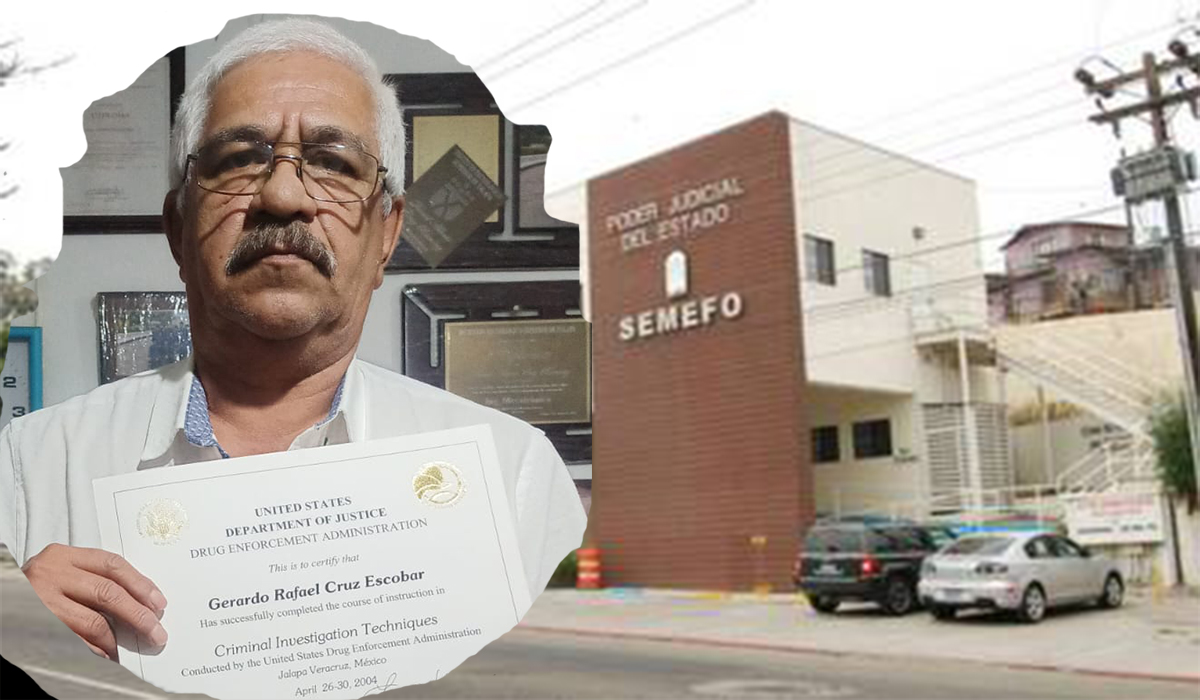
ENTREVISTA AL PERITO CRIMINALISTA GERARDO CRUZ “Los muertos me esperaban, era mi suerte” (II)

Xalapa, Veracruz.- In this second part of the interview with Veracruz criminal expert Gerardo Cruz Escobar, he tells us in detail about his work and the pressures of someone who exercises with commitment, always willing to give everything and solve cases, despite the circumstances.
Xalapa, Veracruz.- En esta segunda parte de la entrevista al perito criminalista veracruzano Gerardo Cruz Escobar, nos cuenta a detalle su trabajo y las presiones de alguien que ejerce con compromiso, dispuesto a dar siempre todo y a resolver casos, a pesar de las circunstancias.
“I obtained the appointment as a criminal expert. I immediately started working alone. On my guard there were always two or three dead people waiting for me, it was my luck, it started to rain dead. We were 3 criminalists who worked 24/24, which in reality for me took 36 hours, I never left the General Directorate of Expert Services with a pending opinion. Everything that came to me, I did, and it was not a few things, the job of a criminologist was that if a death had been reported, the entire investigation had to be done, the report made, the detainees were booked, the files filled out, carry out all the appraisals and visual inspections required by the agents of the Public Ministry; Taking charge during the guard when there were detainees, it was a world of work.” (He emphatically lengthened tasks because he knew he was accomplished and had earned a reputation for hard work at PGJ.)
“Obtuve el nombramiento como perito criminalista. Enseguida comencé a trabajar solo. En mis guardias siempre había dos o tres muertos que me esperaban, era mi suerte, empezaron a llover muertos. Éramos 3 criminalistas que trabajábamos 24 por 24, que en realidad para mí se hacían 36 horas, nunca salí de la Dirección General de Servicios Periciales con un dictamen pendiente. Todo lo que me llegaba, lo hacía, y no eran pocas cosas, el trabajo de un criminalista era que si habían reportado un muerto, se debía hacer toda la investigación, realizar el dictamen, ir a fichar a los detenidos, llenar las fichas, hacer todos los avalúos y las inspecciones oculares que requerían los agentes del Ministerio Público; hacerse cargo durante la guardia cuando había detenidos, era un mundo de trabajo”. (Alarga con énfasis las tareas porque sabía que cumplía y se había ganado una reputación de trabajo arduo en la PGJ).
“This is how I spent 9 years doing it until they changed our schedule from 24 hours of work to 48 hours of rest. That was apparent to me, because I reported on Monday at 9 in the morning when I went into my guard, and I was supposed to leave on Tuesday at 9 in the morning. It actually happened that I was leaving between 3 and 4 in the afternoon due to the amount of work. I was going to rest a little, eat, and I had to return that same day at 9 pm to go get a truck and be a support expert in case there was a second death, and report to my guard on Wednesday. of 24 hours. There were at least 10 guards of 36 hours each, so they gave 360 hours a month, minimum, of my work.”
“Así pasé 9 años haciéndolo hasta que nos cambiaron el horario de 24 horas de trabajo por 48 horas de descanso. Eso era aparente para mí, porque me reportaba el lunes a las 9 de la mañana cuando entraba a mi guardia, y se supone debía salir el martes a las 9 de la mañana. Realmente ocurría que iba saliendo entre 3 y 4 de la tarde por el cúmulo de trabajo. Me iba a descansar un poco, a comer, y tenía que regresar ese mismo día a las 9 de la noche para ir por una camioneta y quedar como perito de apoyo en caso de que hubiera un segundo muerto, y presentarme el miércoles a mi guardia de 24 horas. Eran mínimo 10 guardias de 36 horas cada una, por lo que daban 360 horas al mes, mínimo, de mi trabajo”.
“I spent 12 years as a criminal expert under the orders of the General Directorate of Expert Services.”
“Como perito criminalista a las órdenes de la Dirección General de Servicios Periciales estuve 12 años”.

ANY ANECDOTES?
¿ALGUNA ANÉCDOTA?
«Over time I found out, it seemed funny to me (although it wasn’t) that the agents of the Public Ministry waited until I was on duty to send me all their opinions, because they knew that I would deliver them the next day, while to my other two colleagues did not send them anything, because they had the jobs sleeping for months. From the statistics that we provided monthly, my other two colleagues reported that they had 5 to 7 deaths maximum in a month; For example, two one day and then another, and another two another day, out of 10 guards, inspections, appraisals, opinions, they reported 8 to 10 procedures, making about 15 opinions per month.”
“Con el tiempo me enteré, me pareció chistoso (aunque no lo era) que los agentes del Ministerio Público esperaban a que yo estuviera de guardia para enviarme todos sus dictámenes, porque sabían que se los entregaría al otro día, mientras que a mis otros dos compañeros no les mandaban nada, porque tenían los oficios durmiendo durante meses. De la estadística que entregábamos mensual, mis otros dos compañeros reportaron que tuvieron de 5 a 7 muertos máximo en un mes; por ejemplo, dos un día y luego otro, y otros dos otro día, de 10 guardias, inspecciones, avalúos, dictámenes, reportaban de 8 a 10 diligencias, haciendo unos 15 dictámenes mensuales”.
“In my case, my monthly report statistics did not go below 20 to 30 deaths, plus all the reports I prepared, not counting the detainee files; works of 60 to 70 opinions.”
“En mi caso, mi estadística de informe mensual no bajaba de 20 a 30 muertos, más todos los dictámenes que elaboraba, sin contar las fichas de detenidos; trabajos de 60 a 70 dictámenes”.
«One of the secretaries of the Public Ministry confessed to me: we wait, like the other prosecutors, for you to be on duty to send the letters and prepare the opinions.»
“Uno de los secretarios del Ministerio Público, me confesó: nosotros esperamos al igual que los otros fiscales a que tú estés de guardia para mandar los oficios y elabores los dictámenes”.
“It made me laugh, but at the same time a mixed feeling of anger, because as is clear, they were often abused.”
“Me provocó risa, pero al mismo tiempo un sentimiento encontrado de coraje, porque como queda claro, muchas veces abusaban”.
“Under the Code of Criminal Procedures, we had a minimum of 24 hours to deliver the opinion of a dead person. I remember the case of an agent of the Public Ministry, good in his work performance, sometimes this prosecutor, I was still at the scene of the removal of a corpse with her or with her secretaries and she gave me two hours to deliver the opinion of that dead, who was barely investigating, he demanded and set a time for me to deliver it, and I fulfilled it, yes, I made them go to the offices of Expert Services and there they gave me the letter, from there was the little time I had given as a deadline, it was an abuse of the Public Ministries.”
“Nosotros conforme al Código de Procedimientos Penales, teníamos 24 horas mínimas para entregar el dictamen de un muerto. Recuerdo el caso de un agente del Ministerio Público, bueno en su desempeño laboral, a veces esta fiscal, yo me encontraba todavía en el lugar del levantamiento de un cadáver con ella o con sus secretarios y me daba dos horas para entregar el dictamen de ese muerto, que apenas estaba investigando, me exigía y marcaba una hora para entregarlo, y se lo cumplía, eso sí, los hacía que fueran hasta las oficinas de Servicios Periciales y que ahí me entregaran el oficio, de ahí corría el poco tiempo que me daba como plazo, era un abuso de los Ministerios Públicos”.
ON RELEVANT ISSUES
SOBRE ASUNTOS RELEVANTES
“The relevant matters were up to me, the current director of Expert Services reported my name as the criminal expert in charge. Of the Prosecutors in my time, they always considered me the best criminal expert, according to them.”
“Los asuntos relevantes me tocaban a mí, el director en turno de Servicios Periciales informaba mi nombre como perito criminalista a cargo. De los Procuradores en mis tiempos siempre me consideraron el mejor perito criminalista, dicho por ellos”.
THE PRECARIOUSNESS IN WHICH WE WORKED
LA PRECARIEDAD EN LA QUE TRABAJÁBAMOS
“In 1998, when I arrived, the material we had to work with was an old machine to write the opinions, a few sheets of carbon paper and onion, we (the experts) had to buy the tape, the corrector, and on many occasions paper ”.
“En el año 98´ cuando llegué, el material que teníamos para trabajar era una máquina vieja para escribir los dictámenes, pocas hojas papel carbón y cebolla, nosotros (los peritos) teníamos que comprar la cinta, el corrector, y en muchas ocasiones papel”.
“The problem back then was, and most likely still is, the lack of material to work with, the miserable lands that paid us taking into consideration the important work we did, and the hours worked. The risk we ran. I also faced jealousy within the work environment, I had consequences just for working and clarifying hundreds of cases.”
“El problema en aquel entonces era, y muy probablemente lo sigue siendo, la falta de material para trabajar, los suelos miserables que nos pagaban tomando en consideración el trabajo importante que realizábamos, y las horas laboradas. El riesgo que corríamos. Me enfrentaba además a los celos dentro del ambiente laboral, tenía consecuencias solo por trabajar y esclarecer cientos de casos”.
«One day they agreed and loosened the tires of the ambulance that I was driving, when at that time there was an emergency and when I left in a hurry, a wheel came off that could have caused a fatal accident. These types of things caused me to be on my guard.»
“Un día se pusieron de acuerdo y aflojaron las llantas de la ambulancia que yo manejaba, cuando en esos momentos hubo una emergencia y al salir apresurado, se desprendió una rueda que pudo ocasionar un mortal accidente, este tipo de cosas me provocaban en mi guardia”.
PROMOTIONS WERE ALWAYS FOR OTHERS
LOS ASCENSOS SIEMPRE FUERON PARA OTROS
“I must say that if we jointly carried out a relevant investigation, the Public Ministry agent obtained good points in his favor to advance in his career. The commander of the Ministerial Police, the same, added points, but for me as a criminal expert the most I earned was a pat on the back, and that, sometimes, was never an incentive for criminalists.”
“Debo decir que si sacábamos en conjunto una investigación relevante, el agente del Ministerio Público obtenía buenos puntos a su favor para ascender en su carrera. Al comandante de la Policía Ministerial, lo mismo, le sumaba puntos, pero a mí como perito criminalista lo más que ganaba era una palmadita en la espalda, y eso, a veces, nunca hubo un estímulo para los criminalistas”.
THE PRIVILEGES OF SOME
LOS PRIVILEGIOS DE ALGUNOS
«It must be said that the criminalists who were in charge of the same thing as me, when I arrived and another colleague joined, they were not going to pick up dead people because they were disgusted or they were tired, they no longer carried out investigations of deaths or homicides, they no longer «They were in charge of nothing, but the reality is that they were placed in other departments and charged for making the opinions; if the interested party did not come to an agreement with them, months passed and they did nothing.»
“Hay que decir que los criminalistas que se encargaban de lo mismo que yo, cuando llegué y se integró otro compañero, ellos no iban a levantar muertos porque les daba asco o estaban cansados, ya no hacían investigaciones de muertos u homicidios, ya no se encargaban de nada, pero la realidad es que a ellos los colocaban en otros departamentos y cobraban por hacer los dictámenes, si no iba el interesado a ponerse de acuerdo con ellos pasaban meses y no hacían nada”.
“With each change of director in Expert Services they brought their people, they pressured us, it was a matter of holding on and we continued like this for a long time.”
“Con cada cambio de director en Servicios Periciales ellos traían a su gente, nos presionaban, era cuestión de aguantar y así seguimos mucho tiempo”.
“Salaries were precarious for people like me, because for those recommended it was something else, there were some who earned 16 thousand pesos a fortnight for doing nothing.”
“Los sueldos eran precarios para la gente como yo, porque para los recomendados era otra cosa, había algunos que ganaban 16 mil pesos quincenales por no hacer nada”.
WORK IN THE SEMEFO
EL TRABAJO EN EL SEMEFO
“When I prepared opinions, I never spoke with a lawyer or with the relative of a murderer. I arrived at the office with the body and immediately carried out all the criminalistic work within the Forensic Medical Service, and I locked myself in to make the report. In one or two hours it was already delivered to the party’s office for them to send it. «Everything depended on the number of deaths he had in a guard.»
“Cuando yo elaboraba dictámenes, nunca platiqué con un abogado o con el familiar de un homicida. Llegaba a la oficina con el cadáver y de inmediato realizaba todo el trabajo criminalístico dentro del Servicio Médico Forense, y me encerraba a realizar el dictamen en una o dos horas ya estaba entregado en oficialía de partes para que lo enviaran. Todo dependía del número de muertos que tuviera en una guardia”.
HE PAID FOR THE MATERIAL HE USED
PAGABA POR EL MATERIAL QUE UTILIZABA
“Our work material, at least mine, was a tape measure or a 3 or 5 meter tape measure, which I could afford, a compass of the most modest price, a notebook, a pen and a camera, By the way, she was the oldest one in Expert Services, rejected by all the criminalists, a situation that took a while.”
“Nuestro material de trabajo, al menos el mío, era una cinta métrica o un flexómetro de 3 o 5 metros, para lo que me alcanzaba el dinero, una brújula de las más modestas de precio, una libreta, un lapicero y una cámara, por cierto, era la más vieja que había en Servicios Periciales, rechazada por todos los criminalistas, situación que tardó un tiempo”.
“The director sent us to print the photographs at a store and I was the one who took the most photographs of everyone, when they took out half a roll, I took two rolls for each subject, because I knew that of all the photographs, a maximum of 10 would be useful to me. , the rest came out out of focus and moved.”
“Nos mandaba el director a imprimir las fotografías a una tienda y yo era el que más fotografías sacaba de todos, cuando ellos sacaban medio rollo, yo sacaba dos rollos por cada asunto, porque sabía que de todas las fotografías máximo me iban a servir 10, el resto salían desenfocadas y movidas”.
“There came a time when it was a lot of money to have photos developed, the director called a meeting and told one by one to reduce the photographs, except for Gerardo. You can continue taking out what you need. I took the opportunity to remind him that each guard asked for a new camera or one in better condition.”
“Llegó un momento en que era mucho dinero mandar a revelar fotos, el director convocó a una reunión y dijo a uno por uno que redujeran las fotografías, menos a Gerardo. Tú si puedes seguir sacando las que necesites. Aproveché para recordarle que cada guardia pedía una cámara nueva o en mejores condiciones”.
“Things happened to me like the fact that the Expert Services accountant reduced the pairs of gloves for my entire guard, he gave me 8 pairs of gloves. He forced me while I was at the Forensic Medical Service when I was working with a corpse, he insistently interrupted me to show up at his office, and I had to justify why they had given me 10 pairs of gloves. I went up to his office and I put the bloody gloves with which the corpse was working on his desk, and I said: sir, here is one of the pairs and right now I’ll bring you the other used ones, he didn’t ask me again for an account. gloves».
“A mí me pasaban cosas como el hecho de que el contador de Servicios Periciales me reducía los pares de guantes para toda mi guardia, me daba 8 pares de guantes. Me obligó estando en el Servicio Médico Forense cuando trabajaba con un cadáver, me interrumpió insistentemente a que me presentara en su oficina, que debía justificar por qué me habían dado 10 pares de guantes. Subí a su oficina y los guantes con sangre con los que estaba trabajando el cadáver se los puse encima de su escritorio, y dije: señor, aquí está uno de los pares y ahorita le traigo los demás usados, no me volvió a pedir cuenta de los guantes”.
“I had to explain with patience and detail, sir: for every movement we make as a criminal expert in an investigation we have to change our gloves, because if we don’t we contaminate the evidence. In a single investigation we sometimes used up a box of gloves, but they gave me 4, sometimes 5 or 6 pairs of gloves. I went through all that, I bought the material I had to use.”
“Tuve que explicar con paciencia y detalle, señor: por cada movimiento que realizamos como perito criminalista en una investigación tenemos que cambiarnos los guantes, porque de no hacerlo contaminamos los indicios. En una sola investigación nos acabábamos a veces una caja de guantes, pero a mí me daban 4, a veces 5 o 6 pares de guantes. Todo eso pasé, compraba el material que debía usar”.
RESOLVED MATTERS, MAXIMUM SENTENCES
ASUNTOS RESUELTOS, SENTENCIAS MÁXIMAS
“I dealt with the most relevant matters and they were all resolved, with maximum sentences, due to the evidence, the laboratory work, but the basis of everything was the collection of the evidence, making it available, sending it to the corresponding laboratory, more «The results that they produced became evidence, so the agents of the Public Prosecutor’s Office provided them to the judge who evaluated them and that was useful to set the sentences.»
“Me tocaban los asuntos más relevantes y todos salían resueltos, con sentencias máximas, debido a los indicios, a los trabajos de laboratorio, pero la base de todo era la recolección de los indicios, la puesta a disposición, enviar al laboratorio correspondiente, más los resultados que arrojaban para convertirse en evidencias, entonces los agentes del Ministerio Público los aportaban al juez que los valoraba y eso era útil para fijar las sentencias”.
“In 2005 there was a notorious case of patricide, a young man who had his parents killed to keep the money, that same day everything was clarified with the little we had and the boy received a 60-year sentence. Among the indications that we provided, it was the biological material to carry out genetic studies, among the most relevant, on this occasion the genetics laboratory was already functioning, there were many areas that did not work, the devices were available but they were not installed because they were It required investing in calibration costs, installation, training of those who were going to handle these devices, most important of all, at the scene we had to locate the evidence that could be useful to us, protect them, and create a good chain of custody. . For a criminalist, it is not worth it for me to think that it was a certain way, no, we are doing that according to the evidence that we are finding and the results that are being produced. This is how we are clarifying the hypotheses that we formulated when we arrived.»
“En el año 2005 hubo un asunto sonado de parricidio, un joven que mandó a matar a sus padres para quedarse con el dinero, ese mismo día todo quedó esclarecido con lo poco que teníamos y el muchacho obtuvo una sentencia de 60 años. Dentro de lo indicios que aportamos, fue el material biológico para hacer estudios genéticos, entre lo más relevante, en esta ocasión el laboratorio de genética ya estaba funcionando, había muchas áreas que no funcionaban, se contaba con los aparatos pero no estaban instalados porque se requería invertir en gastos de calibración, instalación, la capacitación de quienes iban a manejar estos aparatos, lo más importante de todo, en el lugar de los hechos teníamos que localizar los indicios que nos pudieran servir, protegerlos, y hacer una buena cadena de custodia. Para un criminalista no vale que yo piense que fue de cierta manera, no, eso lo vamos haciendo de acuerdo a los indicios que vamos encontrando y los resultados que van arrojando así es como vamos esclareciendo hipótesis que nos formulamos al llegar”.
“Thanks to one of these cases, Discovery Channel staff arrived in Mexico City and when investigating the PGR and the Attorney General’s Offices throughout the country, investigating relevant matters, they were looking for stories for a television program within the series that It was called “Latent Print.” The work team of this television station was attracted by the previous case, the way in which it was clarified with the support of the genetics laboratory, and the indictment of those involved.”
“Gracias a uno de estos casos llegó personal de Discovery Channel a la Ciudad de México y al investigar en PGR y las Procuradurías de todo el país, indagando sobre asuntos relevantes, estaban en busca de historias para un programa de televisión dentro de la serie que se llamó “Huella latente”. El equipo de trabajo de esta televisora fue atraído por el anterior caso, la forma en cómo fue esclarecido con el apoyo del laboratorio de genética, y la consignación de los involucrados”.
“It was one day after three years of the patricide, the Discovery Channel team arrived in Xalapa (Veracruz), they met with the governor. The order was given for the program to be recorded. They interviewed some people who were not in the investigation, the doctor, the genetics personnel, a commander of the ministry, the agent of the Public Ministry, and I, in the end, but I told them I am not interested in appearing on their program, I They explained that they couldn’t finish without my participation. I immediately received a call in which they forced me, explaining to me that this program is very important for the PGJ of Veracruz, in general for the state, so that they can see the type of delivery of justice that we have and the projection is worldwide, they ordered me «Either you record it or you leave, and since I already knew what could happen to me, I recorded.»
“Fue un día después de haberse cumplido tres años del parricidio, llegó el equipo de Discovery Channel a Xalapa (Veracruz), se entrevistaron con el gobernador. Se dio la orden de que se grabara el programa. Entrevistaron a algunas personas que no estuvieron en la investigación, al médico, al personal de genética, a un comandante de la ministerial, al agente del Ministerio Público, y yo, al final, pero les dije no me interesa salir en su programa, me explicaron que no podían terminar sin mi participación. De inmediato recibí una llamada en la que me obligaron, explicándome este programa es muy importante para la PGJ de Veracruz, en general para el estado, para que vean el tipo de impartición de justicia que tenemos y la proyección es a nivel mundial, me ordenaron o lo grabas o te vas, y como ya sabía lo que me podía pasar, grabé”.
“I stipulated that I was going to participate for as little time as possible, because it appeared in the newspapers every day, even when I wasn’t working they published a photo lifting a dead person. They knew me, but not all of them were good people, there were vengeful people and we were just doing work. You could have enemies and not know who is attacking from behind. Sometimes, in addition to the local press, they came from the television channels, I couldn’t hide anywhere anymore.”
“Estipulé que iba a participar el menor tiempo posible, a raíz de que salía todos los días en los periódicos, hasta cuando no trabajaba publicaban una foto levantando un muerto. Me conocían, pero no todos eran buenas personas, había gente vengativa y nosotros solo hacíamos trabajo. Se podía tener enemigos y no saber quién ataca por la espalda. A veces además de la prensa local, llegaban de los canales de televisión, ya no me podía ocultar en ningún lado”.
“Two years later the program came out on the Discovery Channel. The day of the premiere I was on duty, I went to get food and when I returned they were hanging out in the dining area of Expert Services, the colleagues, when I entered they started to applaud, I thought they were making fun, I didn’t know what was happening, and it was because they had shown the program in which we participated, they congratulated me.”
“A los dos años salió el programa en Discovery Channel. El día del estreno estaba de guardia, fui por comida y al regresar estaban asomados en el área de comedor de Servicios Periciales, los compañeros, cuando entré comenzaron a aplaudir, pensé que se estaban burlando, no sabía qué pasaba, y era porque habían exhibido el programa en el que participamos, me felicitaron”.
“In Veracruz it takes time for judges to issue a sentence, despite having all the elements. The program “Latent Footprint” came out stating that the person responsible for this case had a sentence of 20 years in prison (although it was not known) and it was said that there were fugitives. The sentence still took a while to be resolved and the parricide was sentenced to 60 years, then another person involved was captured and given another 60 years, two more fugitives were apprehended, all with maximum sentences.”
“En Veracruz es tardado que dicten una sentencia los jueces, a pesar de contar con todos los elementos. El programa “Huella latente” salió afirmando que el responsable de este caso tenía una sentencia de 20 años de cárcel (a pesar que no se sabía) y se dijo que había prófugos. La sentencia todavía tardó en resolverse y le dictaron 60 años al parricida, luego se capturó a otro involucrado dictándole otros 60 años, dos prófugos más fueron aprehendidos, todos con sentencia máxima”.
“The above brought good consequences for the PGJ of Veracruz, in general.”
“Lo anterior trajo buenas consecuencias para la PGJ de Veracruz, en general”.
That’s it for the second installment. I look forward to seeing you in the third and final part of this interview.
Hasta aquí la segunda entrega. Los espero en la tercera y última parte de esta entrevista.
Descubre más desde LA AGENCIA MUNDIAL DE PRENSA
Suscríbete y recibe las últimas entradas en tu correo electrónico.
