
The road to Santiago

Prensa Especializada.
Pocos años después de la resurrección y ascensión de Jesús, hacia el año 40 a.d., el apóstol Santiago el Mayor, por inspiración divina, llegó en una barca milagrosa, guiada por la Vía Láctea desde Palestina hasta la costa romana de Gallaecia Regnum, a la ciudad de Iria Flavia, en el noroeste de la entonces Hispania, para predicar a aquellas gentes la doctrina del Maestro.
A few years after the resurrection and ascension of Jesus, around the year 40 AD, the apostle James the Greater, by divine inspiration, arrived in a miraculous boat, guided by the Milky Way from Palestine to the Roman coast of Gallaecia Regnum, to the city of Iria Flavia, in the northwest of what was then Hispania, to preach the doctrine of the Master to those people.
Durante años predicó la nueva doctrina a aquellos habitantes romanizados de esta península, aparentemente sin conseguir muchos frutos, lo que le producía una gran frustración. Un buen día se le apareció la Virgen María sobre una columna o pilar, en la ciudad llamada Caesar Augusta, siglos más tarde Zaragoza.
For years he preached the new doctrine to those Romanized inhabitants of this peninsula, apparently without achieving much fruit, which caused him great frustration. One day the Virgin Mary appeared to him on a column or pillar, in the city called Caesar Augusta, centuries later Zaragoza.
La Virgen, dice la tradición o la leyenda, le consoló en su frustración, profetizándole que en un futuro sin determinar, aún lejano, las enseñanzas de su Hijo se extenderían desde Hispania a territorios al otro lado del océano, en ese tiempo desconocidos. Esto sucedía en el siglo I después de Cristo. Esa fue la primera profecía del Descubrimiento de América.
The Virgin, tradition or legend says, consoled him in his frustration, prophesying to him that in an undetermined, still distant future, the teachings of her Son would spread from Hispania to territories on the other side of the ocean, at that time unknown. This happened in the 1st century after Christ. That was the first prophecy of the Discovery of America.
Dice la tradición, la leyenda o ambas, que Santiago el Mayor regresó a Palestina, donde Herodes Agripa lo condenó a ser decapitado. Sus discípulos trajeron su cuerpo de regreso a Hispania, en un segundo viaje milagroso, para depositar sus restos en el lugar donde había iniciado años atrás su predicación, de nuevo siguiendo la luz de la galaxia Vía Láctea.
Tradition, legend or both says that James the Greater returned to Palestine, where Herod Agrippa condemned him to be beheaded. His disciples brought his body back to Hispania, on a second miraculous journey, to deposit his remains in the place where he had begun his preaching years ago, again following the light of the Milky Way galaxy.
Santiago permaneció olvidado durante siglos. Fue en el año 813 cuando un ermitaño llamado Paio, observó cómo una brillante estrella señalaba un cierto punto con una luz radiante. Intervino su obispo, y bajo ese lugar hallaron la tumba de un hombre degollado con la cabeza bajo el brazo y una inscripción que decía: “Aquí yace Santiago, hijo de Zebedeo y de Salomé ”.
Santiago remained forgotten for centuries. It was in the year 813 when a hermit named Paio observed how a bright star pointed to a certain point with a radiant light. Their bishop intervened, and under that place they found the tomb of a man with his head slit under his arm and an inscription that said: “Here lies James, son of Zebedee and Salome.”
Pasando el tiempo, sobre esa tumba se construyó un templo en su honor. El templo del Campus Stellae, (Campo de la Estrella) origen del nombre de la ciudad Santiago de Compostela. (Compostela, Campus Stellae).
As time went by, a temple was built in his honor over that tomb. The temple of the Campus Stellae, (Field of the Star) origin of the name of the city Santiago de Compostela. (Compostela, Campus Stellae).
Pero ahí no acabaron los avatares de la leyenda o tradición del apóstol. Parece que en 1589, un desembarco de piratas cercano a la tumba amenazaba su integridad. Así que los restos fueron escondidos en un lugar cercano dentro de la catedral, tras el altar mayor. Y ahí fueron redescubiertos en 1879.
But the vicissitudes of the legend or tradition of the apostle did not end there. It seems that in 1589, a pirate landing near the tomb threatened its integrity. So the remains were hidden in a nearby place inside the cathedral, behind the main altar. And there they were rediscovered in 1879.
El siglo XIX era ya un siglo en el que la constatación de la identidad era importante. Así que el obispo de Santiago encargó a una comisión de expertos una investigación que demostrase la identidad de esos huesos con el apóstol Santiago. No se sabe si ello llegó a demostrarse científicamente, puesto que se desconocía el ADN. Pero Santiago es una estela de milagros, así que en 1884 el papa León XIII confirmó mediante Bula Papal Deus Omnipotens, la autenticidad de los restos. Y añadió: “Ojalá estuviéramos tan seguros de la autenticidad de los restos de Pedro, aquí en Roma, como lo estamos de los de Santiago”.
The 19th century was already a century in which the verification of identity was important. So the bishop of Santiago commissioned a commission of experts to carry out an investigation to demonstrate the identity of those bones with the apostle Santiago. It is not known if this was scientifically proven, since DNA was unknown. But Santiago is a trail of miracles, so in 1884 Pope Leo XIII confirmed, through the Papal Bull Deus Omnipotens, the authenticity of the remains. And he added: “I wish we were as sure of the authenticity of Peter’s remains, here in Rome, as we are of those of Santiago.”
Las peregrinaciones a Santiago
The pilgrimages to Santiago.
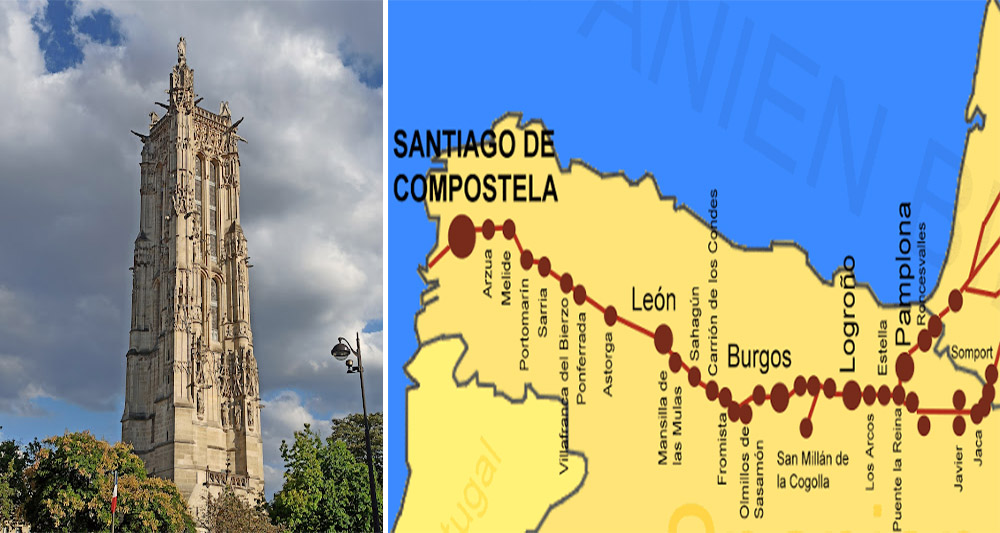
Las peregrinaciones a Santiago comenzaron en el siglo IX, a raíz de que la estrella radiante señalara el lugar de reposo de los restos del apóstol. Entre los peregrinos ilustres estuvo San Francisco de Asís, que hizo su camino hasta la tumba en 1214. A lo largo de los siglos siguientes al siglo IX fueron estableciéndose las rutas jacobeas, nacionales e internacionales, siendo la más notoria la ruta francesa, cuyo punto de reunión de peregrinos fue la famosa e histórica Tour Saint Jacques, (Torre de Santiago) en el París medieval y que pervive hasta nuestros días. Esa torre llegó a ser desde el siglo X, punto de reunión de peregrinos de varias nacionalidades, que confluían en París desde cuatro vías del norte de Europa. Desde París bajaban hasta Saint Jean-Pied-de-Port para atravesar los Pirineos por el paso del Somport a Roncesvalles, pasando después por los santuarios de Jaca, Pamplona, Logroño, Santo Domingo de la Calzada, Burgos, León, Astorga y siempre hacia el oeste hasta Santiago. Tengamos en cuenta que los peregrinos eran fácil objeto de robo y violencia; los amigos de lo ajeno siempre han estado cerca de donde podían obtener gran beneficio. Por eso, estos peregrinos viajaban en grandes grupos, para poder defenderse.
Pilgrimages to Santiago began in the 9th century, after the radiant star marked the resting place of the apostle’s remains. Among the illustrious pilgrims was Saint Francis of Assisi, who made his way to the tomb in 1214. Throughout the centuries following the 9th century, the national and international Jacobean routes were established, the most notable being the French route, whose meeting point for pilgrims was the famous and historic Tour Saint Jacques, (Tower of Saint James) in the Medieval Paris that survives to this day. Since the 10th century, that tower became a meeting point for pilgrims of various nationalities, who converged on Paris from four routes from northern Europe. From Paris they went down to Saint Jean-Pied-de-Port to cross the Pyrenees through the Somport pass to Roncesvalles, then passing through the sanctuaries of Jaca, Pamplona, Logroño, Santo Domingo de la Calzada, Burgos, León, Astorga and always towards west to Santiago. Let us keep in mind that pilgrims were easy targets for robbery and violence; Friends of others have always been close to where they could obtain great benefit. Therefore, these pilgrims traveled in large groups, to be able to defend themselves.
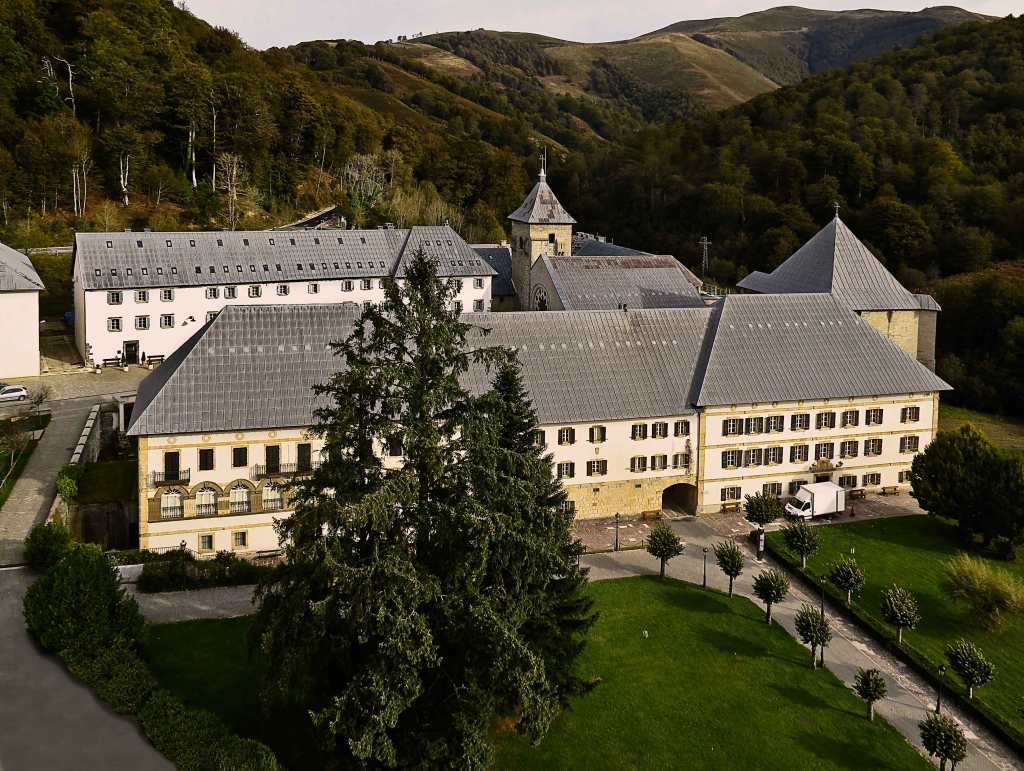
Son conocidos el Camino inglés, por mar desde la costa inglesa hasta Ferrol o La Coruña. Muy corto pues, por tierra, desde uno de estos dos puertos hasta Santiago. El Camino portugués, que confluye en la catedral románica de Tui; el camino andaluz que ascendía por la Vía de la Plata desde el suroeste al noroeste de España. Camino primitivo, con origen en Oviedo. Sería prolijo aquí hablar de ramificaciones de estas rutas que con el paso del tiempo han crecido muchísimo.
The English Way is known, by sea from the English coast to Ferrol or La Coruña. Very short, then, by land, from one of these two ports to Santiago. The Portuguese Way, which converges at the Romanesque cathedral of Tui; the Andalusian road that ascended the Vía de la Plata from the southwest to the northwest of Spain. Primitive path, originating in Oviedo. It would be too long to talk about the ramifications of these routes, which have grown a lot over time.
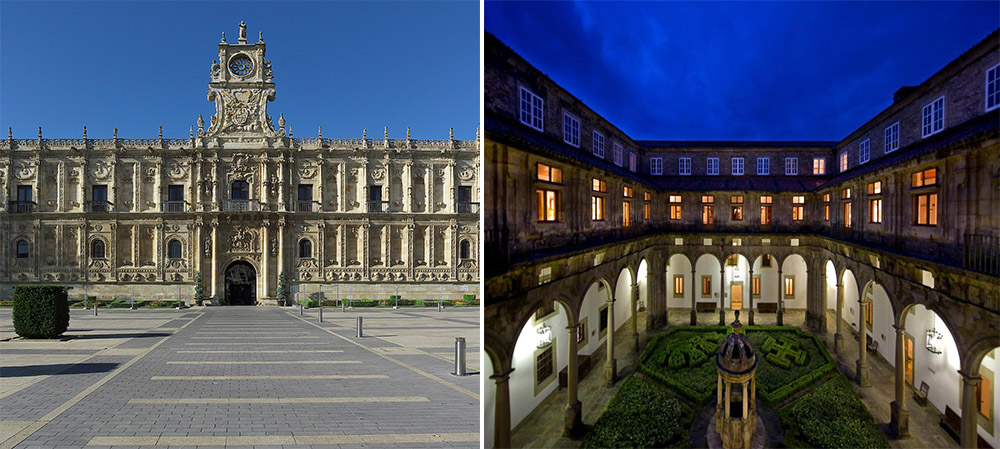
Hablar del Camino de Santiago es hablar de la riqueza arquitectónica que éste ha producido en España y países aledaños. Ciudades, albergues, hospitales, iglesias, monasterios, ermitas, santuarios, castillos, posadas, al servicio de los peregrinos. Los dos lugares de alojamiento más importantes en cuanto a su arquitectura e historia, son los renacentistas Hospital de San Marcos de León y el Hostal de los Reyes Católicos en Santiago de Compostela.
To talk about the Camino de Santiago is to talk about the architectural wealth that it has produced in Spain and surrounding countries. Cities, hostels, hospitals, churches, monasteries, hermitages, sanctuaries, castles, inns, at the service of pilgrims. The two most important accommodation places in terms of their architecture and history are the Renaissance Hospital de San Marcos in León and the Hostal de los Reyes Católicos in Santiago de Compostela.
Realizar el camino de Santiago es no solamente una experiencia mística y espiritual, es también una gran experiencia histórica, artística y cultural, plagada de tradiciones y leyendas. Es también una experiencia gastronómica de primer orden, de hospitalidad y acogida.
Taking the Camino de Santiago is not only a mystical and spiritual experience, it is also a great historical, artistic and cultural experience, full of traditions and legends. It is also a first-class gastronomic experience, hospitality and welcome.
Hoy en día peregrinan a Santiago cristianos de todos los continentes, entre ellos gran número de asiáticos, predominantemente japoneses. En el último Año Santo Jacobeo, 2021, en que a causa del coronavirus, el Papa Francisco decretó que se extendiese hasta 2022, llegaron a Santiago de Compostela cerca de nueve millones de peregrinos.
Today, Christians from all continents make pilgrimages to Santiago, including a large number of Asians, predominantly Japanese. In the last Jacobean Holy Year, 2021, when, due to the coronavirus, Pope Francis decreed that it be extended until 2022, nearly nine million pilgrims arrived in Santiago de Compostela.
En 1985 la UNESCO le otorga al Camino la calificación de Patrimonio de la Humanidad.
In 1985, UNESCO granted the Camino the status of World Heritage Site.
También ha sido declarado Itinerario Cultural Europeo por el Consejo de Europa para promover una cultura europea común.
It has also been declared a European Cultural Itinerary by the Council of Europe to promote a common European culture.
En 2004 el Camino recibe el premio Príncipe de Asturias.
In 2004 the Camino received the Prince of Asturias award.
Importancia del Camino de Santiago en la formación de Europa.
Importance of the Camino de Santiago in the formation of Europe.
Las peregrinaciones a Santiago de Compostela fueron cruciales en la construcción de Europa, especialmente durante los siglos XI y XII. Por eso se reconoce como un axioma que “Europa se construyó caminando a Santiago”. A fecha de hoy, el Camino sigue creciendo, como apuntábamos anteriormente, ahora con peregrinos de todos los continentes.
The pilgrimages to Santiago de Compostela were crucial in the construction of Europe, especially during the 11th and 12th centuries. That is why it is recognized as an axiom that “Europe was built by walking to Santiago.” To date, the Camino continues to grow, as we noted previously, now with pilgrims from all continents.
Cierto, se puede sostener y hay quien sostiene, que no existe rigor científico sobre los hechos milagrosos que rodean al apóstol ni sobre la identidad de sus restos. Es una cuestión de tradición y fe, mantenida por millones de peregrinos a lo largo de muchos siglos.
True, it can be maintained, and there are those who maintain, that there is no scientific rigor regarding the miraculous events surrounding the apostle or the identity of his remains. It is a matter of tradition and faith, maintained by millions of pilgrims over many centuries.
Y todo lo que antecede, en parte tradición, en parte creencia, en parte leyenda o hechos milagrosos, empezó con una barca guiada por mano invisible, siguiendo la estela de la Vía Láctea.
And everything that precedes it, part tradition, part belief, part legend or miraculous facts, began with a boat guided by an invisible hand, following the wake of the Milky Way.
Descubre más desde LA AGENCIA MUNDIAL DE PRENSA
Suscríbete y recibe las últimas entradas en tu correo electrónico.
