

GHANA: MONUMENTOS HISTÓRICOS Y SITIOS TURÍSTICOS

Prensa Especializada
ASSIN MANSO SLAVE RIVER SITE
The Assin Manso Ancestral Slave River also called Nnonkonsuo or Donkor Nsuo was one of the slave markets for gathering indigenes during the trans-Atlantic slave trade. It is located in the Central Region of Ghana, forty (40) kilometers along the Cape Coast-Kumasi highway. It served as the final link in the slavery route from Northern Ghana.
El río de esclavos ancestrales Assin Manso, también llamado Nnonkonsuo o Donkor Nsuo, fue uno de los mercados de esclavos para reunir a los indígenas durante la trata transatlántica de esclavos. Está ubicado en la Región Central de Ghana, a cuarenta (40) kilómetros a lo largo de la carretera Cape Coast-Kumasi. Sirvió como último eslabón en la ruta de la esclavitud desde el norte de Ghana.
THE LAST BATH
On the way to the coastal dungeon, the slave merchants stopped at the DONKOR NSUO, ”the slave river”, in Assin Manso. Captured Africans were allowed to recuperate there after their long journey. Here, they were well fed and rested for several days or weeks. The merchants knew they could guarantee higher prices if they appeared healthy and strong. DONKO NSUO is where the captives would take their last bath in waters of their native land. The Portuguese began the inhumane practice of branding. They would use a red, hot branding iron to burn an identifying nark onto the skin of captives. The burns mark would leave a scar on the shoulder, the breast or the upper arm to show ownership. Other times branding was used to show that proper duty had been paid. When it was time to leave, they were sorted, leaving the weak ones behind chained trees, where the unthinkable happened. The stronger captives continued walking for approximately 40 miles to Cape Coast Castle, still shacked and chained.
De camino al calabozo costero, los traficantes de esclavos se detuvieron en el DONKOR NSUO, «el río de los esclavos», en Assin Manso. A los africanos capturados se les permitió recuperarse allí después de su largo viaje. Aquí estuvieron bien alimentados y descansaron durante varios días o semanas. Los comerciantes sabían que podían garantizar precios más altos si parecían sanos y fuertes. DONKO NSUO es donde los cautivos tomaban su último baño en aguas de su tierra natal. Los portugueses iniciaron la práctica inhumana de marcar. Usaban un hierro rojo y candente para quemar una marca de identificación en la piel de los cautivos. La marca de las quemaduras dejaría una cicatriz en el hombro, el pecho o la parte superior del brazo para demostrar la propiedad. Otras veces se utilizaba la marca para demostrar que se habían pagado los derechos correspondientes. Cuando llegó el momento de partir, fueron seleccionados, dejando a los débiles detrás de árboles encadenados, donde sucedió lo impensable. Los cautivos más fuertes continuaron caminando aproximadamente 40 millas hasta el castillo de Cape Coast, todavía encadenados y encadenados.
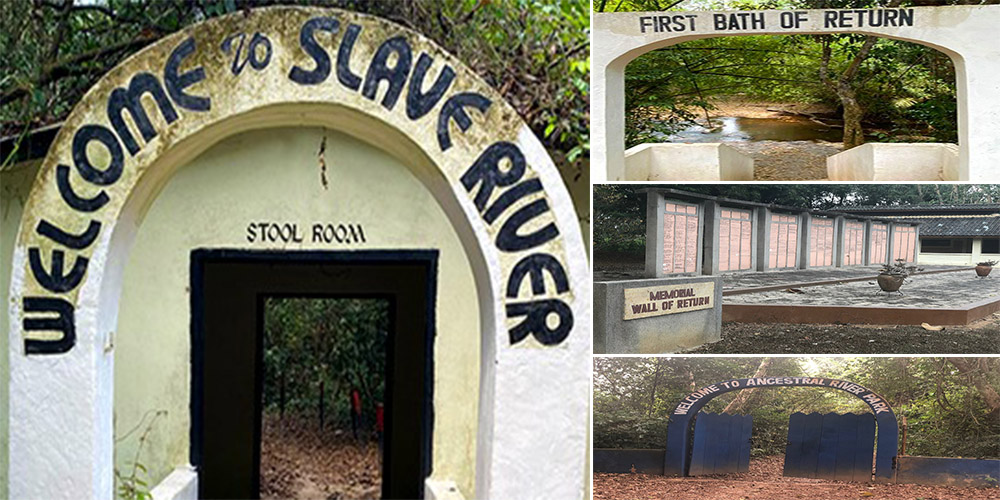
The Memorial Wall of Return is where most Africans write their names on the wall indicating they have found their root. There was an epitaph which pays tribute to some prominent people who were involved in slavery. Captured Africans were forced to trek barefoot, through the harsh bush and over rough terrain for sometimes hundreds of miles headed to the Gold Coast Dungeon. They suffered abuse, they were starved and beaten into compliance by the hired drivers of the slave merchant. They were often attacked by wild animals, but unable to fight or run because they remained shackled and chained. Many lives and spirits were lost along this hazardous journey.
El Muro Conmemorativo del Retorno es donde la mayoría de los africanos escriben sus nombres en el muro, indicando que han encontrado su raíz. Había un epitafio que rinde homenaje a algunas personas destacadas que estuvieron involucradas en la esclavitud. Los africanos capturados se vieron obligados a caminar descalzos, a través de la dura maleza y sobre terreno accidentado durante, a veces, cientos de millas en dirección al Gold Coast Dungeon. Sufrieron abusos, los conductores contratados por el comerciante de esclavos los mataron de hambre y los golpearon para que obedecieran. A menudo eran atacados por animales salvajes, pero no podían luchar ni huir porque permanecían encadenados y con grilletes. Muchas vidas y espíritus se perdieron a lo largo de este peligroso viaje.
Descubre más desde LA AGENCIA MUNDIAL DE PRENSA
Suscríbete y recibe las últimas entradas en tu correo electrónico.


Buenos días, excelente texto, y también me recordó lo poco que sabemos sobre la esclavitud, mucho por aprender.gracias por compartir.
Me gustaMe gusta