
ART on THE NETWORK: What is a border?

Periodista – Escritora
Columnista, Prensa Especializada
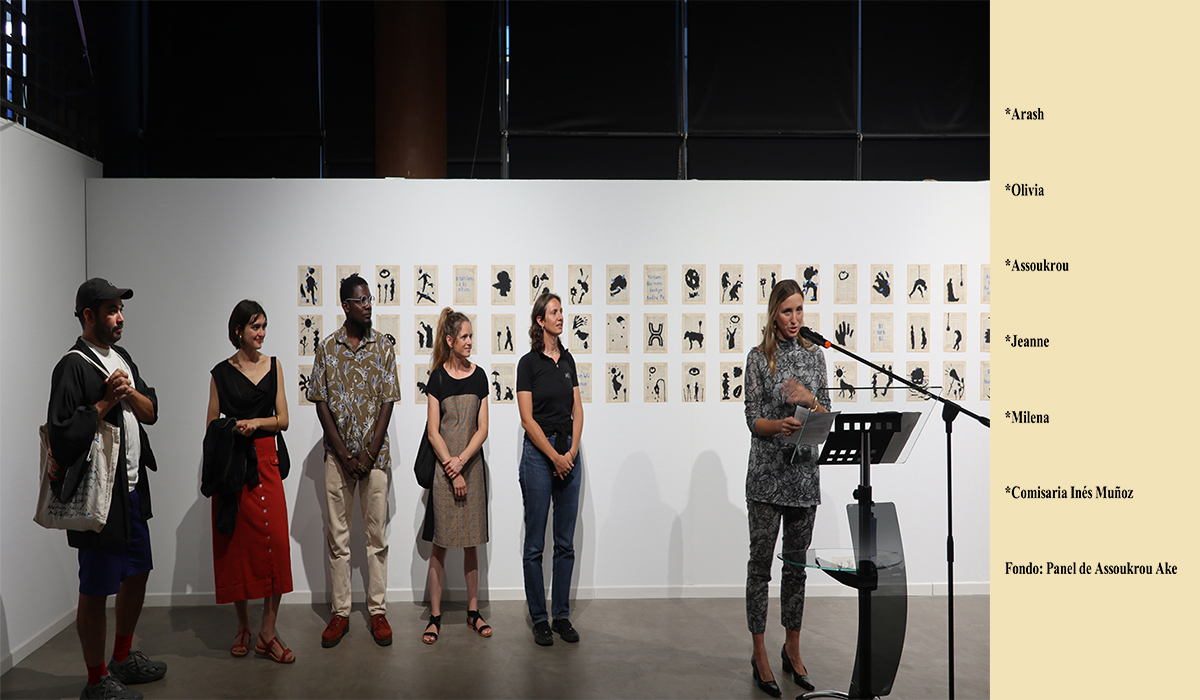
Hay decenas de definiciones y usos de la palabra frontera, casi siempre en el sentido de división o conflicto, pero el pasado miércoles 13 de septiembre, en la inauguración de la exposición La noche de la frontera en el Instituto Francés de Madrid, aprendimos otros abordajes de la mano de la comisaria Inés Muñoz Cano, y de las obras de cinco artistas en residencia en la Casa de Velázquez, Milena Charbit, Arash Fayez y Jeanne Lafont residentes 2022/2023 y Olivia Funes Lastra y Assoukrou Ake que están al principio de su beca este curso 2023/2024.
There are dozens of definitions and uses of the word border, but last Wednesday, September 13, at the opening of the exhibition The Night of the Border at the French Institute of Madrid, we learned other approaches from the curator Inés Muñoz Cano, and from the works of five artists in residence at the Casa de Velázquez, Milena Charbit, Arash Fayez and Jeanne Lafont residents 2022/2023 and Olivia Funes Lastra and Assoukrou Ake who are at the beginning of their scholarship this 2023/2024 academic year.
Una frontera no es un no lugar, por el contrario es un lugar en sí misma, – empezó diciendo la comisaria Inés Muñoz – no tiene porqué ser un ente en conflicto. Los artistas me enseñaron que es un lugar de tránsito, de oportunidades, de encuentro con el otro, un lugar de resistencia, de creatividad, de convivencia… Así que tras hablar con los artistas, pensé en la exposición como un recorrido por cinco fronteras simbólicas. Un espacio sin referencias claras, con el fin de apreciar su potencial y sumergirse en él.
A border is not a non-place, on the contrary it is a place in itself, -Commissioner Inés Muñoz began by saying – it does not have to be an entity in conflict. The artists taught me that it is a place of transit, of opportunities, of encounter with the other, a place of resistance, of creativity, of coexistence… So after speaking with the artists, I thought of the exhibition as a journey through five symbolic borders. A space without clear references, in order to appreciate its potential and immerse yourself in it.
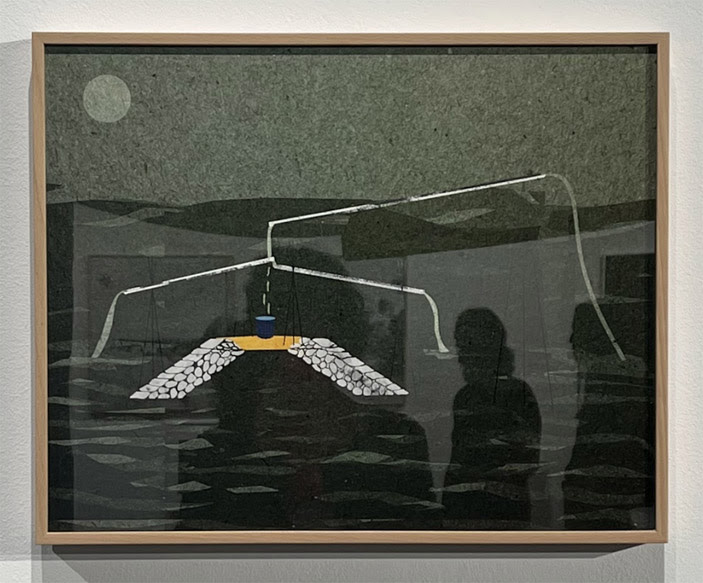
El trabajo presentado por esta polifacética francesa, Milena Charbit, da nombre a la exposición. La noche de la frontera que representa el tránsito de nacionalidad dos veces al año de la Isla de los Faisanes, un lugar sin habitantes, en la desembocadura del río Bidasoa en el Golfo de Vizcaya.
The work presented by this versatile Frenchwoman, Milena Charbit, gives its name to the exhibition. The night of the border that represents the twice-yearly transit of nationality from Pheasant Island, a place without inhabitants, at the mouth of the Bidasoa River in the Bay of Biscay.
Es seis meses española y otros seis francesa desde 1659. Como lugar de encuentro entre Luis XIV y Felipe IV cuando se reunieron en esa ocasión para firmar el Tratado de los Pirineos. Y desde ese momento cuenta con dos virreyes, uno español y otro francés. Como lugar de arte, el pintor Diego Velázquez plasmó en un cuadro la escena de ese encuentro histórico. Hasta el Camino de Santiago se menciona en el enorme panel, es tradición que cada peregrino que regresa del Camino deposite allí una vieira. La creatividad de Milena ha plasmado todas las posibilidades de recreación de cualquier mundo, real o ficticio, un laboratorio de prototipos relacionados con las peculiaridades de la isla.
It has been Spanish for six months and French for six months since 1659. As a meeting place between Louis XIV and Philip IV when they met on that occasion to sign the Treaty of the Pyrenees. And since that moment it has two viceroys, one Spanish and the other French. As a place of art, the painter Diego Velázquez captured the scene of that historic meeting in a painting. Even the Camino de Santiago is mentioned on the huge panel, it is tradition that each pilgrim returning from the Camino deposits a scallop there. Milena’s creativity has captured all the possibilities of recreating any world, real or fictional, a laboratory of prototypes related to the peculiarities of the island.
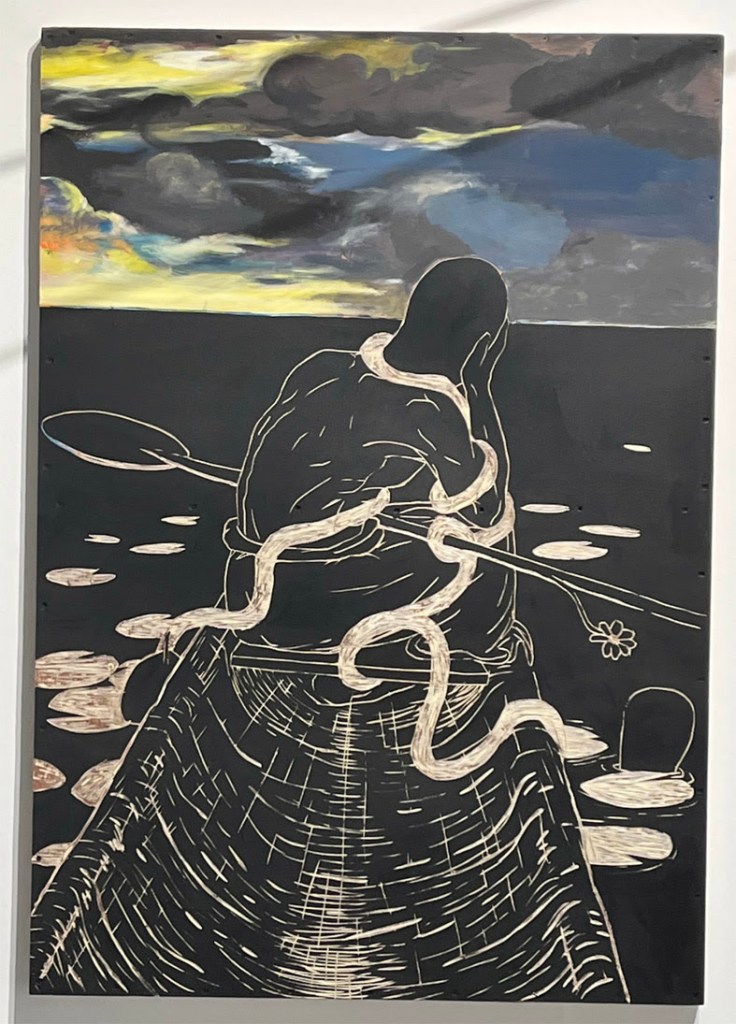
Para el ciudadano de Costa de Marfil, Assoukrou Ake su instalación, un collage de formas negras sobre rectángulos de páginas de enciclopedia en pequeño formato, quiere reflejar la idea sin distancia, De los tumultos del mundo al silencio del papel, que conecta con la temática de frontera.
For the citizen of the Ivory Coast, Assoukrou Ake, his installation, a collage of black shapes on rectangles of encyclopedia pages in small format, wants to reflect the idea without distance, From the tumults of the world to the silence of paper, which connects with the theme of border.
Una obra hija del confinamiento del Covid, frontera mundial, con formas que representan la violencia del momento junto a algunas frases talismán, protectoras, contra cualquier violencia. Ake se sirve de un diccionario editado en su país bajo el mandato británico en 1906, curiosamente dirigido a los niños y empleados para fomentar el estudio y el trabajo; y también de una leyenda que escuchó de pequeño sobre la lección que un niño dio a su padre, un dios del conocimiento, quien acabó reconociendo humildemente que el verdadero conocimiento radica donde no alcanza la vista. Un collage construido con metáforas en imagen que nos acerca a toda una simbología de fronteras.
A work born from the Covid confinement, a world border, with shapes that represent the violence of the moment along with some talismanic, protective phrases against any violence. Ake uses a dictionary published in his country under the British mandate in 1906, curiously aimed at children and employees to encourage study and work; and also of a legend that he heard as a child about the lesson that a child gave to his father, a god of knowledge, who ended up humbly recognizing that true knowledge lies where the eye cannot see. A collage built with image metaphors that brings us closer to a whole symbology of borders.
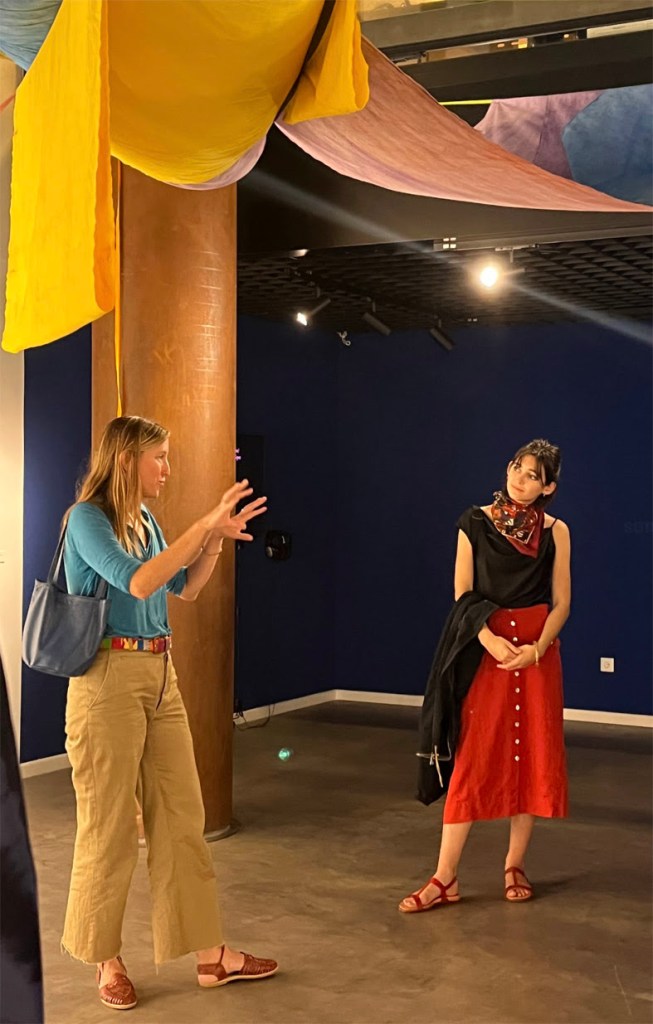
(right) next to its textile installation.
La instalación de la argentina Olivia Funes Lastra, es una arquitectura de telas pintadas, texturas y colores, que ocupa el centro de la galería, casi en cascada que cae de modo asimétrico de un techo también textil. El concepto frontera aquí se define como la pintura itinerante que refleja la memoria de territorios que se identifican por medio de telas y colores en un diálogo transcultural. El material textil y los colores han sido como viajeros nómadas a lo largo y ancho de tiempos y geografías. El color representa la frontera entre las distintas lenguas, como en la historia de la artista, que creció en varios lugares e idiomas. El resultado es su encuentro con un lenguaje propio en su expresión artística a través de la pintura.
The installation by Argentine Olivia Funes Lastra is an architecture of painted fabrics, textures and colors, which occupies the center of the gallery, almost in a cascade that falls asymmetrically from a textile ceiling. The border concept here is defined as itinerant painting that reflects the memory of territories that are identified through fabrics and colors in a transcultural dialogue. Textile material and colors have been like nomadic travelers throughout time and geography. The color represents the border between different languages, as in the story of the artist, who grew up in various places and languages. The result is his encounter with his own language in his artistic expression through painting.
Olivia con esa complejidad creativa que la caracteriza, capta su relación con la arquitectura del premio Pritzker japonés Tadao Ando, nómada autodidacta que creó su estilo y personalidad viajando por Europa, África y Estados Unidos. Así, para esta instalación, le interesaron los colores nocturnos de costaneras y paisajes marítimos, salpicados por la luz de la luna y faros que dialogan de forma abstracta del azul al violeta, del verde oscuro al marrón y como pilar de anclaje el amarillo. Todo ello se construye alrededor de pilares de la galería.
Olivia, with the creative complexity that characterizes her, captures her relationship with the architecture of the Japanese Pritzker Prize winner Tadao Ando, a self-taught nomad who created his style and personality traveling through Europe, Africa and the United States. Thus, for this installation, he was interested in the nocturnal colors of coastlines and maritime landscapes, dotted by moonlight and lighthouses that dialogue in an abstract way from blue to violet, from dark green to brown and yellow as an anchoring pillar. All of this is built around pillars of the gallery.

El trabajo de la francesa Jeanne Lafont describe diversos ámbitos de Madrid, observados durante su año de residencia. Se interesó por la naturaleza “salvaje” dentro de la ciudad; descampados, bordes de autopistas, partes no construidas, presencia de una naturaleza que en Francia no existe.
The work of the Frenchwoman Jeanne Lafont describes various areas of Madrid, observed during her year of residence. He became interested in the “wild” nature within the city; open fields, highway edges, unbuilt parts, presence of a nature that does not exist in France.
Esta naturaleza salvaje está lejos de su experiencia cotidiana. Su proyecto también atraviesa Madrid a través de sus espacios verdes. Su gran descubrimiento fueron los arroyos hoy subterráneos sobre los que se construyó la ciudad primitiva.
This wilderness is far from your everyday experience. His project also crosses Madrid through its green spaces. His great discovery was the now underground streams on which the primitive city was built.
Ahí nació la noción de esta artista sobre la desaparición de fronteras entre espacios salvajes y domesticados, donde empieza la relación sensible con los seres humanos de Madrid. Una de sus propuestas es la desaparición de la zona este de la M-30, que pasa sobre el principal arroyo soterrado. La supresión es para hacer reaparecer el arroyo. La artista basa otra de sus propuestas en la rareza actual de la presencia de águilas imperiales ibéricas en Madrid, especie en peligro de extinción. Lafont se propone marcar los territorios de estas águilas, poniendo el foco en su existencia en una ciudad tan grande como el Madrid actual.
There was born this artist’s notion of the disappearance of borders between wild and domesticated spaces, where the sensitive relationship with the human beings of Madrid begins. One of their proposals is the disappearance of the eastern area of the M-30, which passes over the main underground stream. The suppression is to make the stream reappear. The artist bases another of her proposals on the current rarity of the presence of Iberian imperial eagles in Madrid, a species in danger of extinction. Lafont aims to mark the territories of these eagles, focusing on their existence in a city as large as today’s Madrid.
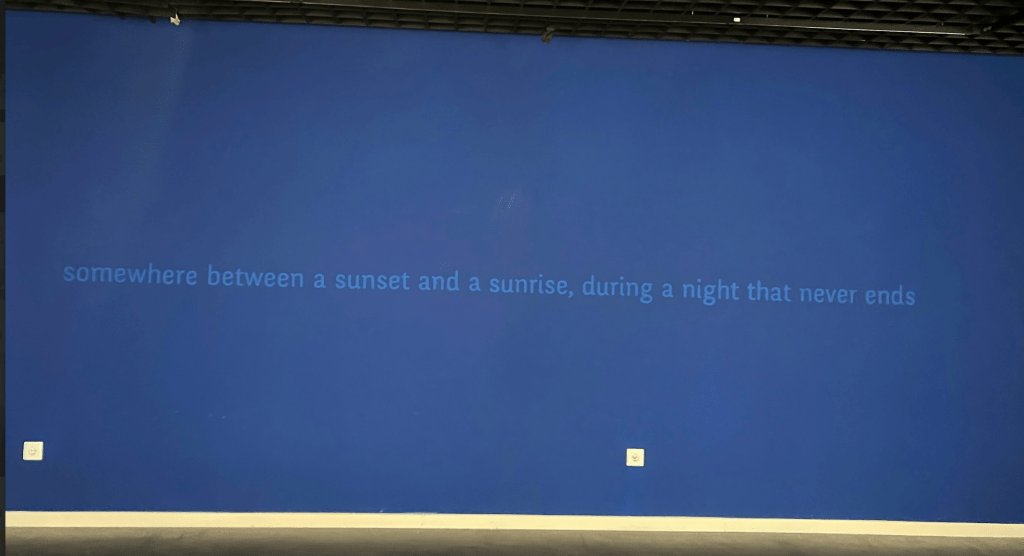
La obra del artista iraní Arash Fayez cierra la exposición, con una gran paradoja de la idea de frontera. Aquí es un espacio de poder fascinante a la par que ignorado.
The work of the Iranian artist Arash Fayez closes the exhibition, with a great paradox of the idea of the border. Here is a fascinating yet ignored space of power.
Su trabajo resalta esta dualidad, y el desafío del esfuerzo de adaptación y transformación, como indicador de que nos encontramos en un espacio entre dos mundos. Conclusión: La identidad que habita la frontera no es sino una creación en evolución continua e ilimitada.
His work highlights this duality, and the challenge of the effort of adaptation and transformation, as an indicator that we find ourselves in a space between two worlds. Conclusion: The identity that inhabits the border is nothing but a creation in continuous and unlimited evolution.
Excelentes trabajos, creadores de aperturas hacia conceptos muy novedosos y positivos de frontera. Y excelente la oferta anual de residencias a artistas procedentes de cualquier parte del mundo por parte de la Casa de Velázquez, la institución cultural francesa en el extranjero dedicada aquí al estudio de la hispanidad. Depende del Ministerio de Educación Nacional de Francia.
Excellent works, creators of openings towards very innovative and positive frontier concepts. And excellent is the annual offer of residencies to artists from any part of the world by the Casa de Velázquez, the French cultural institution abroad dedicated here to the study of Hispanic heritage. It depends on the French Ministry of National Education.
Descubre más desde LA AGENCIA MUNDIAL DE PRENSA
Suscríbete y recibe las últimas entradas en tu correo electrónico.
