

Reality and Legend: Antonio Natal Álvarez Unveils the True Identity of Teresa de Cepeda and Challenges Centuries of Erroneous Versions
Hay autores cuya voz se extingue con el tiempo, y hay otros cuya palabra —aunque nazca desde la madurez de los años— irrumpe con la fuerza silenciosa de quienes han dedicado su vida a pensar, a buscar y a revelar. Antonio Natal Álvarez pertenece a esta última estirpe: la de los filósofos que no se conforman con repetir lo sabido, sino que se atreven a devolver a la historia aquello que la historia misma había extraviado.
There are authors whose voices fade with time, and others whose words—though emerging from the maturity of years—burst forth with the silent strength of those who have dedicated their lives to thinking, seeking, and revealing. Antonio Natal Álvarez belongs to this latter lineage: that of philosophers who are not content to repeat what is known, but dare to restore to history what history itself had lost.

Con la serenidad que solo concede una vida consagrada al estudio riguroso, y con la lucidez intelectual que lo distingue, Natal Álvarez emprende en “Realidad y Leyenda” que no es solo el título de un libro, sino la declaración de un hombre que ha dedicado su vida a devolverle a la historia la verdad que le pertenece. Antonio Natal Álvarez, filósofo, historiador y estudioso incansable, ha desentrañado, con pasión inquebrantable, los orígenes reales de Teresa de Cepeda, la Santa cuya voz y legado han trascendido siglos.
With the serenity that only a life consecrated to rigorous study can grant, and with the intellectual clarity that distinguishes him, Natal Álvarez undertakes in “Reality and Legend” not just the title of a book, but the declaration of a man who has devoted his life to returning to history the truth that belongs to it. Antonio Natal Álvarez, philosopher, historian, and tireless scholar, has unraveled, with unyielding passion, the real origins of Teresa de Cepeda, the Saint whose voice and legacy have transcended centuries.
Estamos hablando de una tarea que trasciende lo académico: restituir la identidad de Teresa de Cepeda, la mujer que el mundo conoce como Santa Teresa de Jesús, y cuyo origen ha sido envuelto durante siglos en versiones contradictorias, silencios convenidos y relatos incompletos. Y es que la vida de Teresa ha estado envuelta en versiones oficiales que ocultaban fragmentos esenciales de su historia. Natal Álvarez, armado con filología, documentos históricos y una memoria viva de tradiciones locales, demuestra hoy que la Santa nació y vivió sus primeros años en La Cepeda, León, y no en Ávila, como se creía. Cada palabra, cada giro lingüístico que ella empleaba, es evidencia de sus raíces, y Antonio ha sabido leer en ellas la verdad que otros habían ignorado o silenciado.
We are talking about a task that transcends the academic: restoring the identity of Teresa de Cepeda, the woman the world knows as Saint Teresa of Jesus, and whose origin has been shrouded for centuries in contradictory versions, convenient silences, and incomplete accounts. And the life of Teresa has been enveloped in official versions that hid essential fragments of her story. Natal Álvarez, armed with philology, historical documents, and a living memory of local traditions, demonstrates today that the Saint was born and lived her first years in La Cepeda, León, and not in Ávila, as was believed. Every word, every linguistic turn she used, is evidence of her roots, and Antonio has known how to read in them the truth that others had ignored or silenced.
Su obra no es un simple ejercicio de erudición —aunque la erudición le sobra—. Su investigación no solo es académicamente impecable, sino profundamente humana. Hay en él una emoción tangible: la de un hombre que, con la serenidad de quien ha vivido plenamente y la pasión de quien aún sueña, busca que la verdad sobre Teresa sea conocida y comprendida por todos. Respeto, admiración y justicia histórica convergen en su obra, recordándonos que la historia no es solo lo que se escribe, sino lo que se descubre, se entiende y se honra. Es, ante todo, un acto de justicia histórica. Una búsqueda que él mismo define como inaplazable, urgente y profundamente humana. En cada página se reconoce la pasión del investigador, la delicadeza del filósofo y la firmeza del hombre que sabe que la verdad no se impone: se revela.
His work is not a simple exercise in erudition—though he has erudition to spare. His research is not only academically impeccable, but profoundly human. There is a tangible emotion in it: that of a man who, with the serenity of one who has lived fully and the passion of one who still dreams, seeks for the truth about Teresa to be known and understood by all. Respect, admiration, and historical justice converge in his work, reminding us that history is not just what is written, but what is discovered, understood, and honored. It is, above all, an act of historical justice. A search that he himself defines as unpostponable, urgent, and profoundly human. In every page, one recognizes the passion of the researcher, the delicacy of the philosopher, and the firmness of the man who knows that truth is not imposed: it is revealed.
Hoy, cuando su mensaje cobra una relevancia inesperada, Antonio Natal Álvarez nos abre las puertas de su pensamiento para comprender, a la luz de documentos, testimonios y análisis, quién fue realmente Teresa de Cepeda; la mujer, la hija, la figura histórica detrás del icono espiritual. Esta entrevista —quizá una de las más importantes de su vida— recoge esa verdad que él ha decidido entregar al mundo antes de que el tiempo pueda arrebatársela.
Today, when his message takes on an unexpected relevance, Antonio Natal Álvarez opens the doors of his thought to us to understand, in the light of documents, testimonies, and analyses, who Teresa de Cepeda really was; the woman, the daughter, the historical figure behind the spiritual icon. This interview—perhaps one of the most important of his life—captures that truth that he has decided to deliver to the world before time can take it away from him.
Lo que sigue no es solo una conversación: es un encuentro con la valentía intelectual de un hombre que, cree que la verdad merece ser contada. Y que, gracias a él, vuelve hoy a colocarse en su lugar legítimo en la historia. Hoy, Antonio Natal Álvarez nos invita a mirar más allá de los mitos y las leyendas. Nos entrega la Santa Teresa de Cepeda en su realidad más auténtica, y con ella, un legado de valentía, coherencia y amor por la verdad que trasciende generaciones.
What follows is not just a conversation: it is an encounter with the intellectual courage of a man who believes that truth deserves to be told. And that, thanks to him, today returns to its rightful place in history. Today, Antonio Natal Álvarez invites us to look beyond myths and legends. He delivers to us Saint Teresa of Cepeda in her most authentic reality, and with her, a legacy of courage, coherence, and love for truth that transcends generations.
ORÍGENES Y MOTIVACIÓN / ORIGINS AND MOTIVATION
CB: Antonio, ¿qué te llevó a centrar su investigación en Santa Teresa de Jesús, una figura que parecía ya estudiada hasta el agotamiento? Antonio, what led you to focus your research on Saint Teresa of Jesus, a figure who seemed to have been studied to the point of exhaustion?
Considero que Santa Teresa está mal estudiada. Se han tergiversado muchos hechos y quiero que se conozca la verdad sobre esta Santa. No nació en Ávila ni vivió allí sus quince primeros años.
El Catedrático de Lengua y Literatura de la Universidad Complutense me dijo hace casi cuarenta años que Teresa de Cepeda usaba numerosas palabras y giros del dialecto leonés, lo cual demostraba que había vivido en La Cepeda de León. Me recomendó estudiar el lenguaje teresiano para sacar conclusiones.
Menéndez Pidal y Azorín señalaban lo mismo: la Santa emplea diminutivos y superlativos con mucha frecuencia, algo poco propio del castellano.
La monja escolapia Felicidad Bernabéu también subraya este hecho.
El Catedrático de la Complutense Antonio Garrido escribió: “El hecho de que utilice la lengua cepedana es uno de los argumentos fuertes en relación con los orígenes del personaje”.
I consider that Saint Teresa has been poorly studied. Many facts have been distorted, and I want the truth about this Saint to be known. She was not born in Ávila nor did she live there for her first fifteen years. The Professor of Language and Literature at the Complutense University told me almost forty years ago that Teresa de Cepeda used numerous words and turns of phrase from the Leonese dialect, which demonstrated that she had lived in La Cepeda de León. He recommended that I study the Teresian language to draw conclusions. Menéndez Pidal and Azorín pointed out the same thing: the Saint uses diminutives and superlatives very frequently, something not typical of Castilian. The Escolapian nun Felicidad Bernabéu also emphasizes this fact. The Professor at the Complutense, Antonio Garrido, wrote: “The fact that she uses the Cepedan language is one of the strong arguments in relation to the origins of the character.”
CB: ¿Cuándo descubriste el primer indicio de que Teresa podría no haber nacido en Ávila, sino en La Cepeda (León)? When did you discover the first indication that Teresa might not have been born in Ávila, but in La Cepeda (León)?
Al leer las obras completas de Teresa de Cepeda observé que utilizaba giros propios del leonés, especialmente en la colocación de frases mediante hipérbaton, muy distinto del castellano.
De niño escuché las leyendas de Quintana del Castillo y Villagatón (León), donde se decía que la Santa fue engendrada en el castillo de Quintana de Cepeda y que allí nació y vivió su niñez.
La Duquesa de Alba declaró que la habían bautizado en el Monasterio de los Hospitalarios de La Cepeda y que lo sabía porque asistió al bautismo.
El padre de la Santa afirmó que los padrinos vivían entonces en La Cepeda: María del Águila y Francisco Vela, que tenía a su mando más de setecientos lanceros y seiscientos caballos en las tierras cepedanas.
Upon reading the complete works of Teresa de Cepeda, I observed that she used turns of phrase typical of Leonese, especially in the placement of phrases through hyperbaton, very different from Castilian. As a child, I heard the legends of Quintana del Castillo and Villagatón (León), where it was said that the Saint was conceived in the castle of Quintana de Cepeda and that she was born and lived her childhood there. The Duchess of Alba declared that she had been baptized in the Monastery of the Hospitalarios de La Cepeda and that she knew because she attended the baptism. The Saint’s father affirmed that the godparents lived then in La Cepeda: María del Águila and Francisco Vela, who had under his command more than seven hundred lancers and six hundred horses in the Cepedan lands.
CB: ¿Hubo un momento concreto —una frase, un documento, una palabra— que te hizo decir “aquí está la clave”? Was there a specific moment—a phrase, a document, a word—that made you say “here is the key”?
Me di cuenta de la importancia del dialecto cuando detecté palabras del habla cepedana que empleaban mis padres y abuelos.
I realized the importance of the dialect when I detected words from the Cepedan speech that my parents and grandparents used.
CB: ¿Qué sentiste al comprender que tu hallazgo podía desafiar cinco siglos de historia eclesiástica y cultural española? What did you feel when you understood that your discovery could challenge five centuries of Spanish ecclesiastical and cultural history?
Comprendí que mis teorías podían cambiar cinco siglos de historia manipulada, llena de falsedades y documentos ocultos. Pensé que sería un David contra Goliat. Sin embargo, algunos Carmelitas Calzados y el padre Albano, Carmelita Descalzo, me dieron la razón desde el principio.
I understood that my theories could change five centuries of manipulated history, full of falsehoods and hidden documents. I thought it would be a David against Goliath. However, some Calced Carmelites and Father Albano, a Discalced Carmelite, agreed with me from the beginning.
LA INVESTIGACIÓN / THE INVESTIGATION
CB: Tu libro “Teresa de Cepeda. Realidad y Leyenda” combina historia, filología y filosofía. ¿Cómo estructuras tu método de trabajo? Your book “Teresa de Cepeda. Reality and Legend” combines history, philology, and philosophy. How do you structure your method of work?

Tras defender mis teorías en medios de comunicación, en 2017 publiqué Teresa de Cepeda. Realidad y leyenda, una obra entre novela y “nivola” (en términos de Unamuno), que me permitía añadir algo de ficción.
Me enfrentaba a la teoría oficial de los Carmelitas Descalzos, que sin documentos afirman que nació en Ávila. Creí que aceptarían mejor una novela que un estudio histórico directo. Aun así, considero que el libro es un 90% histórico y solo un 10% de ficción.
After defending my theories in the media, in 2017 I published Teresa de Cepeda. Reality and Legend, a work between novel and “nivola” (in Unamuno’s terms), which allowed me to add some fiction. I was facing the official theory of the Discalced Carmelites, who without documents affirm that she was born in Ávila. I believed they would accept a novel better than a direct historical study. Even so, I consider that the book is 90% historical and only 10% fiction.
Ahora está en imprenta una nueva edición bilingüe: castellano (con teorías nuevas) y asturleonés, traducido por la Academia de la Lengua Asturiana.
El Conde de Santa Teresa me dijo que era “un libro magnífico y muy bien argumentado”.
El Encargado de Asuntos Religiosos de la Casa de Alba también me manifestó su acuerdo con mis teorías.
Now a new bilingual edition is in print: Castilian (with new theories) and Asturleonese, translated by the Academy of the Asturian Language. The Count of Santa Teresa told me it was “a magnificent book and very well argued.” The Head of Religious Affairs of the House of Alba also expressed his agreement with my theories.
CB: ¿Qué papel tuvo el análisis del lenguaje teresiano en esta investigación? What role did the analysis of the Teresian language play in this research?
El lenguaje teresiano y su parecido con el cepedano o leonés ha sido decisivo. Por ello publico una edición bilingüe para que los lectores puedan comprobar ese parecido de la lengua de la Santa con la lengua hablada en la Cepeda leonesa.
The Teresian language and its similarity to Cepedan or Leonese has been decisive. That is why I am publishing a bilingual edition so that readers can verify that similarity between the Saint’s language and the one spoken in the Leonese Cepeda.
CB: Has contado con el aval de catedráticos de la Universidad Complutense, como Francisco Sánchez Castañer y Antonio Garrido Domínguez. ¿Qué respaldo académico considera más decisivo? You have had the endorsement of professors from the Complutense University, such as Francisco Sánchez Castañer and Antonio Garrido Domínguez. What academic support do you consider most decisive?
Los Catedráticos Sánchez Castañer y Antonio Garrido, de la Universidad Complutense, han sido un apoyo fundamental.
Sánchez Castañer me orientó al principio y Garrido después. Este último me escribió: “Te aconsejo que tengas fe en lo que has hecho. Sigue trabajando”, despidiéndose con un abrazo.
The Professors Sánchez Castañer and Antonio Garrido, from the Complutense University, have been fundamental support. Sánchez Castañer guided me at the beginning and Garrido later. The latter wrote to me: “I advise you to have faith in what you have done. Keep working,” signing off with a hug.
CB: ¿Podrías mencionar tres pruebas concretas que demuestren que Teresa era de La Cepeda? Could you mention three concrete proofs that demonstrate that Teresa was from La Cepeda?
Las pruebas documentales no están en mi poder. Las pedí a los Carmelitas Descalzos pero no me las facilitaron, aunque otras personas las han visto.
A) Declaración de la Duquesa de Alba (folio 41), donde afirma que Teresa fue bautizada en La Cepeda y que ella estuvo presente.
B) El Libro Primero de la Vida, escrito por la propia Santa, donde indicaba dónde nació y vivió de niña. El agustino Bonifacio Moral afirmó haberlo visto en El Escorial antes de que desapareciera.
C) Considero necesario aplicar ADN de la Santa a una mujer de Astorga-León llamada Teresa de Cepeda, familia directa de los Cepeda.
The documentary proofs are not in my possession. I requested them from the Discalced Carmelites but they did not provide them, although other people have seen them.
A) Declaration of the Duchess of Alba (folio 41), where she affirms that Teresa was baptized in La Cepeda and that she was present.
B) The First Book of Life, written by the Saint herself, where she indicated where she was born and lived as a child. The Augustinian Bonifacio Moral affirmed having seen it in El Escorial before it disappeared.
C) I consider it necessary to apply DNA from the Saint to a woman from Astorga-León named Teresa de Cepeda, a direct family member of the Cepedas.
CB: ¿Qué importancia tiene el cuadro atribuido a Velázquez y cómo fue manipulado o interpretado con el paso del tiempo? What importance does the painting attributed to Velázquez have and how was it manipulated or interpreted over time?
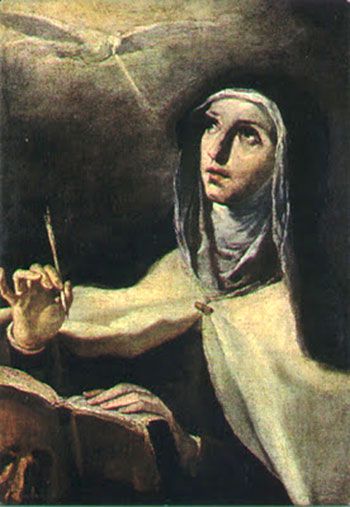
El mejor retrato de Santa Teresa lo hizo Velázquez, aunque no la conoció y trabajó a partir de documentos y dibujos. Los Carmelitas Descalzos no lo citan, sin razón conocida.
Curiosamente, lo usaron en un sello del IV Centenario de la Reforma Teresiana, donde figura: “Sta. TERESA (VELÁZQUEZ). F.N.M.T.”.
Sin embargo, en un cartel reciente afirman que el autor es “desconocido”.
The best portrait of Saint Teresa was done by Velázquez, although he did not know her and worked from documents and drawings. The Discalced Carmelites do not cite it, for no known reason. Curiously, they used it on a stamp for the IV Centenary of the Teresian Reform, where it reads: “Sta. TERESA (VELÁZQUEZ). F.N.M.T.” However, on a recent poster they claim the author is “unknown.”
CB: En tu opinión, ¿por qué la orden carmelita ha preferido mantener el relato tradicional abulense? In your opinion, why has the Carmelite order preferred to maintain the traditional Abulense narrative?
No comprendo por qué los directivos de los Carmelitas Descalzos insisten en su versión. El Papa Francisco anuló su visita a Ávila en el V Centenario porque, al parecer, dudaba del origen abulense de la Santa.
Cuando se abrió el sepulcro de la Santa, el Papa envió una carta a los Carmelitas de Alba de Tormes. Pedí copia al Prior y se negó. ¿Qué dirá esa carta?
I do not understand why the leaders of the Discalced Carmelites insist on their version. Pope Francis canceled his visit to Ávila for the V Centenary because, apparently, he doubted the Abulense origin of the Saint. When the Saint’s tomb was opened, the Pope sent a letter to the Carmelites of Alba de Tormes. I requested a copy from the Prior and he refused. What does that letter say?
LOS OBSTÁCULOS Y EL VALOR / OBSTACLES AND COURAGE
CB: ¿Qué tipo de resistencias o ataques haz enfrentado en el mundo académico o religioso por defender esta tesis? What kind of resistances or attacks have you faced in the academic or religious world for defending this thesis?
Solo algunos dirigentes de los Carmelitas Descalzos han mostrado disgusto con mis teorías, pero la mayoría ha preferido callar o negar la existencia de documentos clave.
Daniel de Pablo Maroto me envió unos folios criticando mi libro. Le respondí con la frase: “Con la misma vara que midieres, serás medido”. Le recordé mis cuarenta años estudiando a Teresa de Cepeda y los errores de su biografía, además de que mi libro llegó a finales de certámenes internacionales.
Only some leaders of the Discalced Carmelites have shown displeasure with my theories, but the majority have preferred to remain silent or deny the existence of key documents. Daniel de Pablo Maroto sent me some folios criticizing my book. I responded with the phrase: “With the same rod that you measure, you will be measured.” I reminded him of my forty years studying Teresa de Cepeda and the errors in his biography, in addition to the fact that my book reached the finals of international competitions.
CB: Has respondido con serenidad y argumentos, no con polémica. ¿Es tu formación filosófica la que le ha dado esa fortaleza? You have responded with serenity and arguments, not with controversy. Is it your philosophical training that has given you that strength?
Soy dialogante y moderado. Mi carácter y mi filosofía me han ayudado a evitar polémicas. Creo que es fácil dialogar conmigo.
I am dialogical and moderate. My character and my philosophy have helped me avoid controversies. I believe it is easy to dialogue with me.
CB: ¿Has sentido que algunos sectores buscan silenciar tu voz por miedo a la verdad? Have you felt that some sectors seek to silence your voice out of fear of the truth?
He percibido cierto rechazo, algo comprensible: cambiar quinientos años de historia es complicado. Pero ya es hora de decir la verdad. Santa Teresa era “amiga de decir la verdad”, y debemos honrarla revelándola.
I have perceived certain rejection, something understandable: changing five hundred years of history is complicated. But it is time to tell the truth. Saint Teresa was “a friend of telling the truth,” and we must honor her by revealing it.
CB: ¿Has recibido apoyo institucional o moral de figuras de peso dentro de la Iglesia o la política? Have you received institutional or moral support from weighty figures within the Church or politics?
Sí, he recibido apoyos importantes en política y religión, aunque prefiero ser discreto. El Cardenal Parolin me pidió tres ejemplares de mi libro y está muy interesado en la verdad histórica.
Yes, I have received important support in politics and religion, although I prefer to be discreet. Cardinal Parolin asked me for three copies of my book and is very interested in historical truth.
EL PAPA Y EL VATICANO / THE POPE AND THE VATICAN
CB: Sabemos que el Papa Francisco mostró interés personal por tu investigación. ¿Cómo llegó esa información hasta el Vaticano? We know that Pope Francis showed personal interest in your research. How did that information reach the Vatican?
Envié al Papa Francisco un ejemplar del libro con mis teorías. Él comía a veces en el convento agustino junto al Vaticano; sé que hablaron con él sobre el tema. Como falleció, desconocemos su conclusión final.
I sent Pope Francis a copy of the book with my theories. He sometimes ate at the Augustinian convent next to the Vatican; I know they spoke to him about the topic. Since he passed away, we do not know his final conclusion.
CB: ¿Puedes confirmarnos que el Papa pidió a los Carmelitas investigar y “aclarar los orígenes de la Santa”? Can you confirm to us that the Pope asked the Carmelites to investigate and “clarify the origins of the Saint”?
Algunos Carmelitas Calzados comentaron que el Papa Francisco convocó a los dirigentes de ambas Órdenes para pedirles dos cosas:
A) Que unieran ambas órdenes (Calzados y Descalzos), dado que su doctrina es prácticamente la misma.
B) Que aclararan los orígenes de la Santa.
León XIV respondió a una carta mía muy rápidamente. Hace pocos días recibí otra, con su foto y su lema. Creo que me recibirá en audiencia cuando sus obligaciones lo permitan.
Some Calced Carmelites commented that Pope Francis summoned the leaders of both Orders to ask them two things:
A) That they unite both orders (Calced and Discalced), since their doctrine is practically the same.
B) That they clarify the origins of the Saint.
Leo XIV responded to a letter of mine very quickly. A few days ago I received another, with his photo and his motto. I believe he will receive me in audience when his obligations allow.
CB: ¿Crees que el reconocimiento oficial de este hallazgo podría transformar la relación entre historia, fe y territorio? Do you believe that the official recognition of this discovery could transform the relationship between history, faith, and territory?
Si se confirman mis teorías, Ávila compartiría la gloria con León; la Santa es tan grande que puede llenar varias provincias. La fe no se vería alterada.
Podríamos hermanar La Cepeda y Ávila sin problema.
Sobre un acto público, dependerá de lo que dictamine el Vaticano. La Casa de Alba cedería el Palacio de Liria, y también dispondríamos del Palacio de los Pernía en La Cepeda, donde ya presentamos la primera edición.
If my theories are confirmed, Ávila would share the glory with León; the Saint is so great that she can fill several provinces. Faith would not be altered. We could twin La Cepeda and Ávila without problem. Regarding a public act, it will depend on what the Vatican dictates. The House of Alba would lend the Palacio de Liria, and we would also have the Palacio de los Pernía in La Cepeda, where we already presented the first edition.
CB: ¿Haz tenido algún tipo de comunicación o invitación oficial para presentar tu obra ante autoridades eclesiásticas o académicas en Roma? Have you had any kind of communication or official invitation to present your work before ecclesiastical or academic authorities in Rome?
Sobre un acto público, dependerá de lo que dictamine el Vaticano. La Casa de Alba cedería el Palacio de Liria, y también dispondríamos del Palacio de los Pernía en La Cepeda, donde ya presentamos la primera edición.
Regarding a public act, it will depend on what the Vatican dictates. The House of Alba would lend the Palacio de Liria, and we would also have the Palacio de los Pernía in La Cepeda, where we already presented the first edition.
DIMENSIÓN FILOSÓFICA Y HUMANA / PHILOSOPHICAL AND HUMAN DIMENSION
19. Como filósofo, ¿qué representa para ti, Santa Teresa: un símbolo de espiritualidad o una expresión de identidad cultural? As a philosopher, what does Saint Teresa represent to you: a symbol of spirituality or an expression of cultural identity?
Santa Teresa representa espiritualidad y cultura. Es maestra de oración, incluida la oración mental. El confesor Pedro Ibáñez, Prior de Trianos, la animó a usar la comparación de las cuatro formas de riegos, que ocupa casi la mitad del Libro de la Vida.
Como escritora fue magnífica. Hoy sería Premio Nobel de Literatura.
Saint Teresa represents spirituality and culture. She is a master of prayer, including mental prayer. The confessor Pedro Ibáñez, Prior of Trianos, encouraged her to use the comparison of the four ways of watering, which occupies almost half of the Book of Life. As a writer, she was magnificent. Today she would be a Nobel Prize in Literature.
CB: ¿Crees que la verdad histórica también tiene un componente espiritual, una forma de justicia trascendente? Do you believe that historical truth also has a spiritual component, a form of transcendent justice?
Lo importante es que se conozca la verdad histórica. No cambia nada de su doctrina ni espiritualidad.
Ávila intentó encarcelarla y frenar sus reformas. Los frailes leoneses Pedro Ibáñez y Pedro de Villaturiel la defendieron; uno se jugó la vida y el otro consiguió permisos desde Roma. Felipe II tuvo que intervenir para parar a los opositores.
What is important is that historical truth be known. It changes nothing of her doctrine or spirituality. Ávila tried to imprison her and stop her reforms. The Leonese friars Pedro Ibáñez and Pedro de Villaturiel defended her; one risked his life and the other obtained permissions from Rome. Philip II had to intervene to stop the opponents.
CB: Tú fuiste político, pedagogo y filósofo. ¿Cómo ha influido esa diversidad de experiencias en tu forma de investigar y comunicar la verdad? Do you believe that historical truth also has a spiritual component, a form of transcendent justice?
Mis mayores éxitos los logré como profesor. Comunicaba bien y los alumnos comprendían con facilidad. Esta experiencia me ayudó en política durante ocho años.
Los ciudadanos entienden cuando se les explica con claridad. En tierra conservadora, logramos ganar cinco Ayuntamientos con siglas de izquierda. Conseguimos que el Consejo de Ministros nos declarase Comarca de Acción Especial. Siempre busqué consensos.
My greatest successes were achieved as a teacher. I communicated well and the students understood easily. This experience helped me in politics for eight years. Citizens understand when things are explained clearly to them. In conservative land, we managed to win five Town Halls with left-wing acronyms. We achieved that the Council of Ministers declared us a Special Action Region. I always sought consensus.
CB: ¿Qué paralelismos ves entre la figura de Teresa de Cepeda y tu propio camino de búsqueda y coherencia? What parallels do you see between the figure of Teresa de Cepeda and your own path of search and coherence?
He aprendido mucho de Teresa. Ella era coherente e intachable. Yo intento serlo también. Pensaba que una parte de las riquezas debía destinarse a los necesitados, algo que repetía a su familia y a su hermano Lorenzo.
I have learned a lot from Teresa. She was coherent and impeccable. I try to be so as well. She thought that a part of the riches should be destined to the needy, something she repeated to her family and to her brother Lorenzo.
EL NUEVO LIBRO Y SU LEGADO / THE NEW BOOK AND ITS LEGACY
CB: Sabemos que vienes trabajando en una segunda parte. ¿Qué nuevos documentos o revelaciones incluirá? We know you are working on a second part. What new documents or revelations will it include?
Mi nuevo libro, bilingüe, incluye novedades:
– Aclara el bautizo de Teresita y la identidad cepedana de los padrinos.
– Identifica por primera vez a su hermano “fantasma”: Julián, constructor de la iglesia de Quintana del Castillo, explotador de las médulas de oro, enterrado en Santa Clara de Astorga.
– Explica el origen de los Cepeda y su poder económico y militar: obtuvieron la Carta de Privilegios de Felipe IV y las Ocho Aspas de San Andrés.
– Una descendiente directa, también Teresa de Cepeda, vive hoy en León.
My new book, bilingual, includes novelties:
– It clarifies the baptism of Teresita and the Cepedan identity of the godparents.
– It identifies for the first time her “ghost” brother: Julián, builder of the church of Quintana del Castillo, exploiter of the gold médulas, buried in Santa Clara de Astorga.
– It explains the origin of the Cepedas and their economic and military power: they obtained the Charter of Privileges from Philip IV and the Eight Aspas of San Andrés.
– A direct descendant, also Teresa de Cepeda, lives today in León.
CB: Mencionas una relación epistolar entre Santa Teresa y Cervantes. ¿Podrías adelantarnos algo de ese fascinante hallazgo? You mention an epistolary relationship between Saint Teresa and Cervantes. Could you give us a preview of that fascinating discovery?
El libro detalla la relación epistolar entre Santa Teresa y Cervantes.
Cervantes, preso, escribió a la tía de la Santa para que la carta llegase a Teresa y ella convenciera a Lorenzo para pagar una multa que le salvaría la mano. Y así fue.
Otra carta pedía anular un matrimonio, pero ahí la Santa no pudo intervenir.
Tras la Beatificación hubo un Certamen literario; Cervantes participó en agradecimiento y ganó por poco, pues Lope de Vega tenía enemigos en el jurado.
The book details the epistolary relationship between Saint Teresa and Cervantes.
Cervantes, imprisoned, wrote to the Saint’s aunt so that the letter would reach Teresa and she would convince Lorenzo to pay a fine that would save his hand. And so it was. Another letter asked to annul a marriage, but there the Saint could not intervene. After the Beatification, there was a literary contest; Cervantes participated in gratitude and won by a narrow margin, since Lope de Vega had enemies on the jury.
CB: ¿Qué esperas lograr con este nuevo libro: el reconocimiento académico, el eclesiástico, o simplemente la verdad histórica? What do you hope to achieve with this new book: academic recognition, ecclesiastical, or simply historical truth?
Quiero que se sepa la verdad histórica. Ya he recibido todos los reconocimientos que podía tener. No deseo ninguno más.
I want historical truth to be known. I have already received all the recognitions I could have. I desire no more.
CB: Si Santa Teresa pudiera oírte hoy, ¿qué crees que te diría? If Saint Teresa could hear you today, what do you think she would say to you?
«Durante cuarenta años has estudiado mis escritos y creo que has comprendido bastante bien lo que yo quería transmitir. Hay estudiosos que hablan de mí pero no han leído mis obras. Escribo en un lenguaje sencillo, muy similar al que hablan las personas de La Cepeda leonesa. A veces mimetizas mi lenguaje y mis pensamientos. Estoy contenta con lo que escribes sobre mí y sobre mis hermanos. Pocos escriben sobre mi hermano Lorenzo pero ha sido una gran ayuda para que pudiera fundar mis Monasterios. También comprendió muy bien que las riquezas deben servir, en primer lugar, para ayudar a los pobres y necesitados. Amar a Dios y al prójimo, esos son los dos pilares de mi doctrina».
«For forty years you have studied my writings and I believe you have understood quite well what I wanted to transmit. There are scholars who talk about me but have not read my works. I write in a simple language, very similar to that spoken by the people of La Cepeda Leonesa. Sometimes you mimic my language and my thoughts. I am happy with what you write about me and about my brothers. Few write about my brother Lorenzo but he has been a great help so that I could found my Monasteries. He also understood very well that riches must serve, first and foremost, to help the poor and needy. Love God and neighbor, those are the two pillars of my doctrine.»
CB: ¿Cómo te gustaría que la historia recuerde a Antonio Natal Álvarez? How would you like history to remember Antonio Natal Álvarez?
Quiero que me recuerden como una persona solidaria y “amiga de decir la verdad”.
I want to be remembered as a supportive person and “a friend of telling the truth.”
REFLEXIÓN / REFLECTION
DC: Haz dicho que “el alma también tiene tierra”. ¿Qué significa para ti esa frase en el contexto de tu vida y tu obra? You have said that “the soul also has land.” What does that phrase mean to you in the context of your life and your work?
Hay que vivir con los pies en la tierra, pero aspirando a que nuestra alma y mente admiren la belleza de la creación y la grandeza del Creador.
One must live with feet on the ground, but aspiring for our soul and mind to admire the beauty of creation and the greatness of the Creator.
29. ¿Crees que España está preparada para aceptar que una de sus santas más universales nació en un lugar distinto al que se le atribuyó durante siglos? Do you believe that Spain is prepared to accept that one of its most universal saints was born in a place different from the one attributed to her for centuries?
Conocer la verdad sobre el origen de la Santa traerá tranquilidad, no problemas. Respetar la verdad histórica es un deber.
Knowing the truth about the Saint’s origin will bring tranquility, not problems. Respecting historical truth is a duty.
30. ¿Qué mensaje te gustaría dejar a los investigadores, creyentes y lectores que buscan la verdad más allá de las versiones oficiales? What message would you like to leave to researchers, believers, and readers who seek the truth beyond official versions?
Los investigadores deberían estar felices si contribuyen a revelar la verdadera historia. Sería un éxito colectivo y un alivio.
Researchers should be happy if they contribute to revealing the true history. It would be a collective success and a relief.
Al concluir esta entrevista, queda en evidencia que Antonio Natal Álvarez no ha hecho solo una investigación: ha tejido un legado de verdad, perseverancia y valentía. Frente a siglos de versiones oficiales, silencios y obstáculos, ha mantenido la integridad de su labor con la misma claridad que caracterizó a Teresa de Cepeda: firme, coherente y fiel a los hechos.
Upon concluding this interview, it becomes evident that Antonio Natal Álvarez has not merely conducted research: he has woven a legacy of truth, perseverance, and courage. In the face of centuries of official versions, silences, and obstacles, he has maintained the integrity of his work with the same clarity that characterized Teresa de Cepeda: firm, coherent, and faithful to the facts.
Su obra “Realidad y Leyenda” no solo corrige la historia; la ilumina. Nos recuerda que la grandeza de una Santa no se mide únicamente por su espiritualidad o sus obras, sino también por la fidelidad con que su memoria es honrada. Gracias a su trabajo, los textos, los documentos y los giros lingüísticos de Teresa adquieren un nuevo significado, revelando sus raíces reales en La Cepeda, León.
His work “Reality and Legend” does not merely correct history; it illuminates it. It reminds us that the greatness of a Saint is not measured solely by her spirituality or her works, but also by the fidelity with which her memory is honored. Thanks to his efforts, Teresa’s texts, documents, and linguistic expressions take on new meaning, revealing her true roots in La Cepeda, León.
Más allá de la academia, Antonio nos deja una lección de vida: la verdad, aunque tardía, siempre encuentra su camino. Su pasión y su rigor muestran que la historia no es inmutable; que la justicia histórica es posible, y que un solo hombre, con paciencia, respeto y convicción, puede corregir siglos de errores.
Beyond academia, Antonio leaves us a profound life lesson: truth, however late it arrives, always finds its way. His passion and rigor demonstrate that history is not immutable; that historical justice is possible, and that a single man, armed with patience, respect, and conviction, can correct centuries of errors.
Hoy, cuando su investigación ha alcanzado los círculos más influyentes de la Iglesia y del pensamiento académico, nos invita a todos a mirar la historia con honestidad, a valorar la coherencia y a reconocer que la grandeza de una vida se refleja en la verdad que deja atrás.
Today, as his research has reached the most influential circles of the Church and academic thought, he invites us all to look at history with honesty, to value coherence, and to recognize that the greatness of a life is reflected in the truth it leaves behind.
Antonio Natal Álvarez nos recuerda que revelar la auténtica identidad de Teresa de Cepeda no es un acto de confrontación, sino de justicia, admiración y amor por la historia. Y en esa verdad, la Santa y León encuentran, por fin, su reconocimiento merecido.
Antonio Natal Álvarez reminds us that revealing the authentic identity of Teresa de Cepeda is not an act of confrontation, but of justice, admiration, and love for history. And in that truth, both the Saint and León finally receive the recognition they so richly deserve.

Descubre más desde LA AGENCIA MUNDIAL DE PRENSA
Suscríbete y recibe las últimas entradas en tu correo electrónico.


muy interesante pero opino que más que de donde naces eres de dónde te haces. Y Teresa de Cepeda y Ahumada se hizo en Ávila. Puede que la Casa Natal de Teresa se transforme en residencia de los Cepeda en Ávila. No cambiaría gran cosa.
Me gustaMe gusta