
El Farru de los Fernández Montoyas, genius and figure

Gitano de cuerpo y alma, ayer le vimos en un espectáculo que ha querido llamar “Kintsugi” como una forma de inspirarse en una filosofía japonesa restauradora, para revivir experiencias con el alma puesta en el movimiento del baile más flamenco, más Farruco que yo le recuerdo.
A gypsy in body and soul, yesterday we saw him in a show that he wanted to call “Kintsugi” as a way of being inspired by a restorative Japanese philosophy, to relive experiences with his soul in the movement of the most flamenco dance, the most Farruco that I remember.
Y es que estaba interpretando su propia vida, pasada y presente. Cerrando heridas, rememorando al padre que se fue en plena escena en brazos de su hermano mayor. Vida llena de drama la de esta familia. Y El Farru, Antonio Fernández Montoya, nombre que evoca poesía lorquiana y que seguramente lo hubiera sido de no vivir en tiempos dispares, ha querido afrontar frente al público, con su arte con denominación de origen, las heridas propias. Y como nunca antes ha llegado al alma de un patio abarrotado de público.
And he was interpreting his own life, past and present. Healing wounds, remembering the father who left in the middle of the stage in the arms of his older brother. This family’s life was full of drama. And El Farru, Antonio Fernández Montoya, a name that evokes Lorca’s poetry and who surely would have been one had he not lived in different times, wanted to confront his own wounds in front of the public, with his art with a designation of origin. And like never before, he has reached the soul of a courtyard packed with an audience.

Y para este llegar a lo más profundo, por primera vez y muy sabiamente ha querido tener un director que en este caso lo es también de la I Bienal madrileña, Ángel Rojas, también autor de un diseño de iluminación que recrea y trae al presente la dimensión del que ya no está aquí, Juan Fernández Flores, El Moreno, el Padre.
And to reach the deepest depths, for the first time and very wisely, he wanted to have a director who in this case is also the director of the First Madrid Biennial, Ángel Rojas, also author of a lighting design that recreates and brings to the present the dimension of the one who is no longer here, Juan Fernández Flores, El Moreno, the Father.
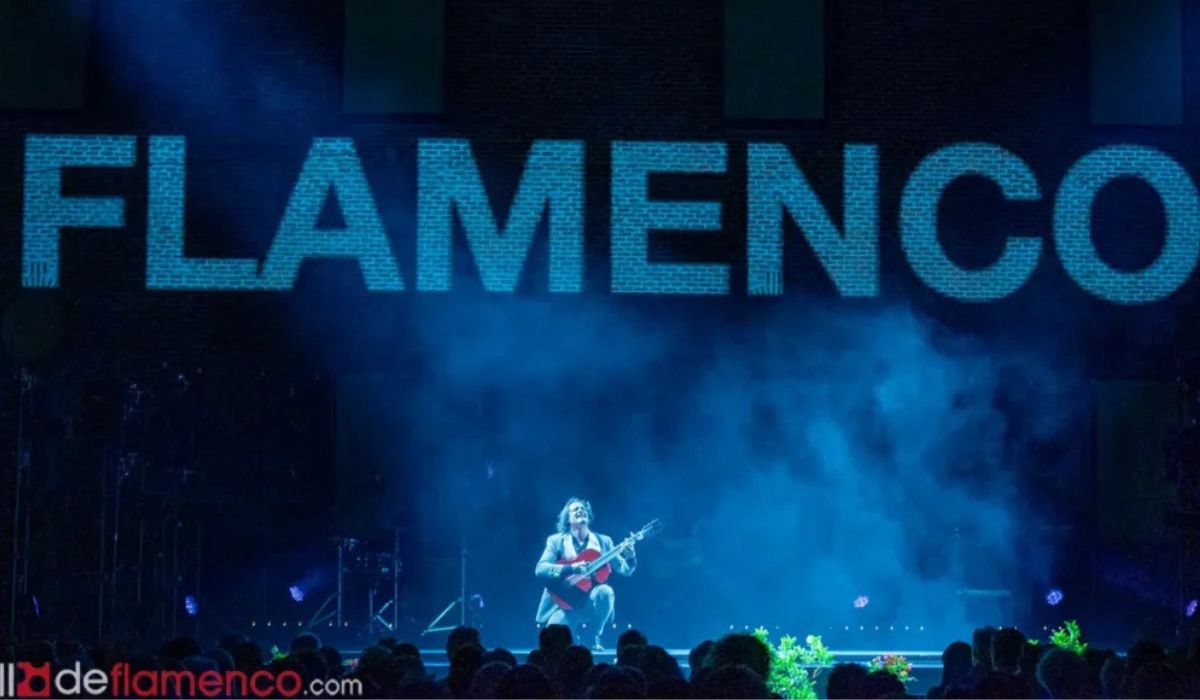
Un juego de palabras que aparecen fugazmente sobre el muro de ladrillo del patio, vida, legado, familia, camino, crecimiento, decepción, alguna más que no recuerdo, todas evocadoras de sentimientos que aquí se bailan y se cantan. Que para eso están Rafael de Utrera y El Galli, para llevar al límite del dolor y al fin a la realidad gloriosa del FLAMENCO, así con mayúsculas, a ese hijo mediano, en términos de psicología infantil, el más descolocado, entre la fuerza del mayor y los mimos del pequeño. El mediano, en un vacío que hay que superar y este Farru, Farruco a medias está aquí para vivir y hacer vivir a quienes ahí estábamos su tránsito hacia el encuentro consigo mismo en el Flamenco, el arte familiar, herencia del abuelo.
A play on words that appears fleetingly on the brick wall of the courtyard: life, legacy, family, path, growth, disappointment, a few more I can’t remember, all evocative of feelings that are danced and sung here. That’s what Rafael de Utrera and El Galli are for, to take that middle child, in terms of child psychology, the most disoriented, between the strength of the eldest and the pampering of the youngest, to the limits of pain and finally to the glorious reality of FLAMENCO, with a capital F. The middle child, in a void that must be overcome, and this Farru, half-Farruco, is here to live and help those of us who were there live his journey toward finding himself in Flamenco, the family art, inherited from his grandfather.
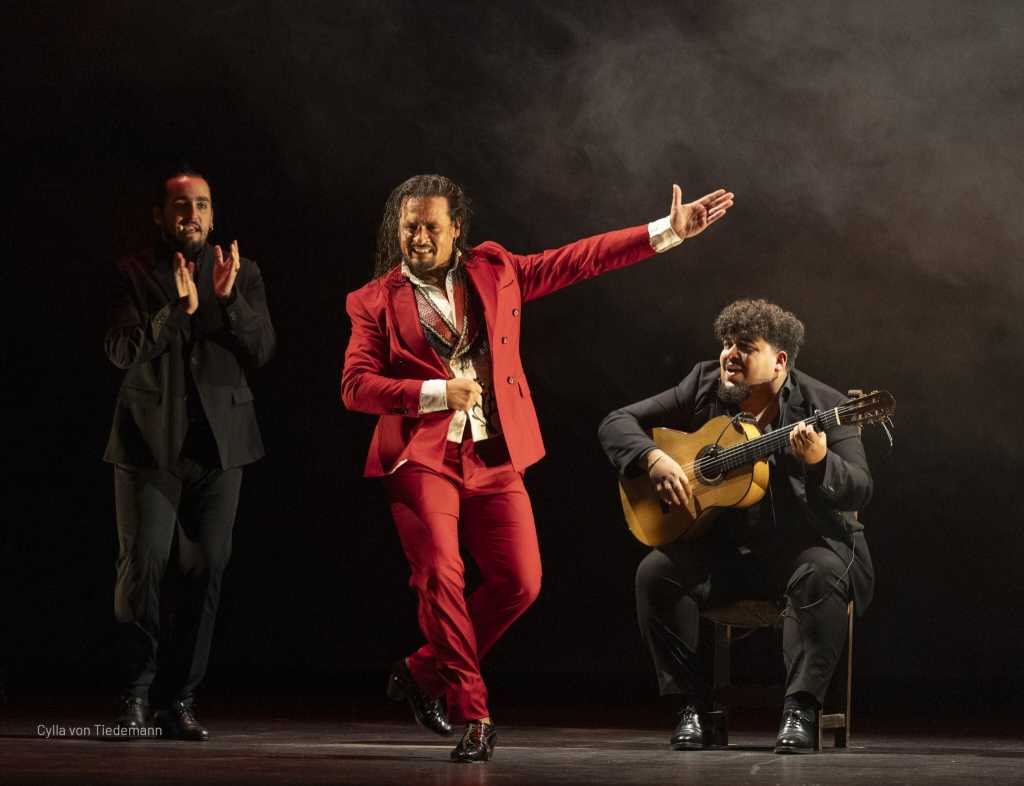
El Hijo. Por qué será que las indumentarias de El Farru de siempre tienen significados asociados a su vida. Siempre, la necesidad de llamar la atención, de decir este soy yo y estoy aquí, en mi sitio, con mi baile, el más farruco de los descendientes de Farruco. Aquí, esta noche, primero de negro, color insólito en él, el negro de la pérdida del padre. Luego como en transición, un traje a pequeños cuadros con matices marrones para finalmente aparecer como el Hijo triunfante de rojo que deja ver chaleco bordado a su estilo. En escena, una guitarra sola, sobre la silla de anea, sin tocaor, pero gran protagonista. ¿Qué es, que significa esa guitarra, qué ausencia evoca? La respuesta, en el abrazo final.
The Son. Why is it that El Farru’s clothing always has meanings associated with his life? Always, the need to attract attention, to say this is me and I am here, in my place, with my dance, the most farruco of Farruco’s descendants. Here, tonight, first in black, an unusual color for him, the black of the loss of his father. Then, as if in transition, a suit with small checks with brown shades to finally appear as the triumphant Son in red, revealing an embroidered vest in his style. On stage, a single guitar, on the wicker chair, without a guitarist, but a great protagonist. What is it, what does that guitar mean, what absence does it evoke? The answer lies in the final embrace.
La moda, que yo recuerde, de curar heridas a través del lenguaje más veraz, el del baile, el de la expresión corporal tan fuerte en el baile flamenco, la puso Ana Morales hace años.
The trend, as far as I can remember, of healing wounds through the most truthful language, that of dance, that of the body language so strong in flamenco dance, was established by Ana Morales years ago.
El Farru con su Kintsugi nos ha enfrentado esta noche a nuestras propias heridas.
El Farru, with his Kintsugi, brought us face to face with our own wounds tonight.
Grande Farru, el mejor Farru de su historia.
Great Farru, the best Farru in his history.
Descubre más desde LA AGENCIA MUNDIAL DE PRENSA
Suscríbete y recibe las últimas entradas en tu correo electrónico.
