
«Embracing the World»: An Amma initiative in Honduras

No es la primera vez que hablamos en Culturas del Mundo, de la maestra espiritual y humanitaria hindú, Mata Amritanandamayi Devi, coloquialmente conocida como Amma.
This is not the first time we have spoken in Cultures of the World about the Hindu spiritual teacher and humanitarian, Mata Amritanandamayi Devi, colloquially known as Amma.
Su labor humanitaria, tanto en India como en el resto del mundo le han merecido tres doctorados Honoris Causa: State University of New York en 2010; por la Universidad de Mysore en 2019; por la KIIT (Instituto Kalinga de Tecnología Industrial de Bhubaneswar, Odissa) en 2021. Por su labor en los campos de la educación, el medio ambiente, acciones humanitarias, la espiritualidad. Reconocimientos de Naciones Unidas, de la UNESCO, etc.
Her humanitarian work, both in India and around the world, has earned her three honorary doctorates: from the State University of New York in 2010; from the University of Mysore in 2019; and from KIIT (Kalinga Institute of Industrial Technology in Bhubaneswar, Odissa) in 2021. For her work in the fields of education, the environment, humanitarian action, and spirituality, she has also received recognition from the United Nations, UNESCO, and others.
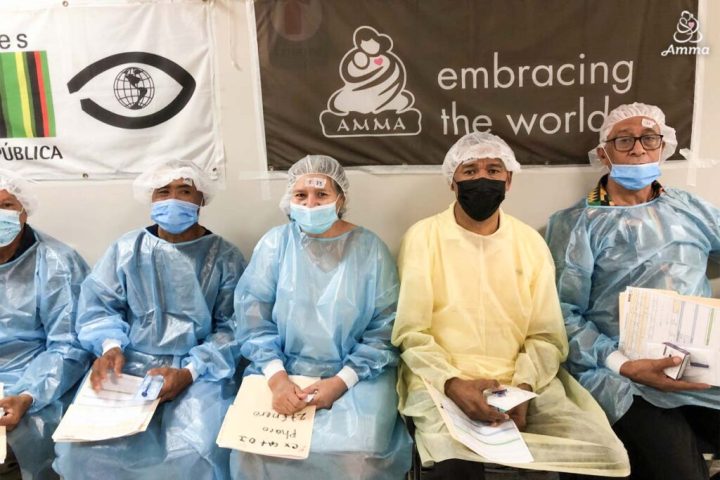
Hoy hablamos de un programa de su ONG Abrazando al Mundo en Honduras. Por el interés que pueda tener para los receptores de esta crónica transcribo a continuación el original en inglés y mi traducción al español. Me cabe el honor de ser la traductora oficial de Amma en España.
Today we’re talking about a program from her NGO, Embracing the World, in Honduras. Due to the interest this article may have for readers, I’m transcribing the original English version and my Spanish translation below. I have the honor of being Amma’s official translator in Spain.
Programa gratuito de cirugía de cataratas en Honduras de “Abrazando al Mundo” para poblaciones rurales.
Free Cataract Surgeries Restore Vision for People in Rural Honduras
31 Marzo 2025
Su nombre era Kevin, tenía tres años y ya estaba ciego debido a cataratas congénitas bilaterales. Pero un día después de su operación en el sur de Honduras, él reía y jugaba. Inmediatamente corrió tras un balón, en el mismo momento que descubrieron sus ojos.
His name was Kevin, just three years old, and he was already blind due to bilateral congenital cataracts. But just one day after his surgery in southern Honduras, he was laughing and playing. He immediately chased after a balloon the moment his eyes were uncovered.
Fue uno de esos momentos adorables que tuvo lugar durante nuestro primer campamento de cirugía de cataratas lejos del África subsahariana. En colaboración con la ONG española Visión sin fronteras, nuestros voluntarios realizaron 251 operaciones en el Hospital Valle de San Lorenzo. Más dos niños de 10 y 11 años.
It was one of the many endearing moments that took place during our first cataract surgery camp outside of Sub-Saharan Africa. In partnership with the Spanish NGO Visión Sin Fronteras (Vision Without Borders), our volunteers performed 251 procedures at San Lorenzo Hospital, Valle, including two more children aged 10 and 11.
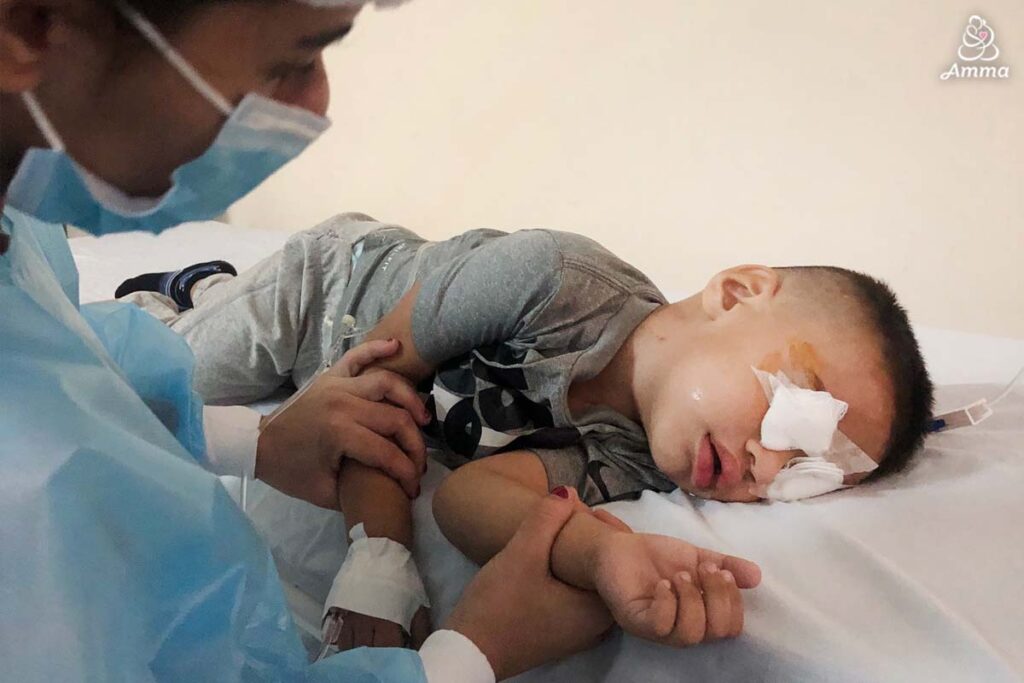
“Cuando Kevin llegó con su familia no podía hacer nada solo. Solo tenía percepción de luz” nos dijo la Dra. Isabel Signes, una de nuestras optometristas voluntarias. “Cuando tras la operación él empezó a coger cosas y a correr, su madre exclamó: “¡Por fin, Dios mío!”
When Kevin arrived with his family, he couldn’t do anything alone. He only had light perception,” shared Dr Isabel Signes, one of our volunteer optometrists. “When he started grabbing things and running after his surgery, his mother exclaimed, ‘Oh my God. At last!’”
Kevin de tres años podía ver por primera vez.
Three-year-old Kevin was able to see for the first time
Nuestros voluntarios fueron invitados por el Club Rotario de Choluteca para realizar las operaciones. Isabel sabía que era una región empobrecida pero no imaginaba que sería tan difícil como lo que habían visto en África. Se quedó sorprendida.
Our volunteers were invited by the Rotary Club of Choluteca to perform the surgeries. Isabel knew it was an impoverished region, but didn’t think it would be as difficult as what they have witnessed in Africa. Instead, she was shocked.
“La gravedad de las cataratas a las que nos enfrentábamos era realmente alta. Tuvimos que realizar la cirugía más invasiva en la mayoría de los pacientes. Las estadísticas de Naciones Unidas advierten que casi el 60% de la población vive en la pobreza y los servicios sanitarios son escasos”.
The severity of the cataracts we were dealing with was really, really bad. We had to perform the more invasive surgery on most of the patients. UN statistics report that nearly 60 percent of the population live in poverty and the health services are very poor,” she explained.
“Solo hay un hospital público en la capital y en el resto del país hay que pagar. Y los precios, -no podía creerlo- son los mismos que en Europa. 1.500,- euros por la operación de cada ojo.”
There is only one government hospital in the capital and in the rest of the country you have to pay. And the prices—I couldn’t believe it. They were the same as in Europe. €1,500 for one cataract surgery per eye.”
Los voluntarios locales vieron 870 pacientes y seleccionaron 250 para operar, antes de la llegada de nuestro equipo desde España, compuesto por tres oftalmólogos, dos enfermeras, tres optpmetristas y un médico que dirigieron el campamento desde el 25 de enero al 2 de febrero.
Local volunteers screened 870 patients and selected 250 for surgery before our team from Spain arrived. It was made up of three ophthalmologists, two nurses, three optometrists, and one physician who conducted the camp from January 25 to February 2.
El esfuerzo quirúrgico fue intenso, con horarios de trabajo desde las 7.30 am hasta las 8 pm. La mayoría de los pacientes solo percibían luz antes de la operación. Un significativo predominio de diabéticos añadió dificultades.
The surgical effort was intense, with workdays starting at 7:30 am and ending around 8:00 pm. Most of the patients could only perceive light before the procedure, and as well, a significant prevalence of diabetes among them posed additional challenges.
Al término del campamento llegó inesperadamente José Marcelino, un hombre de 47 años que llevaba ciego año y medio debido a una diabetes severa incontrolada. Con el ojo derecho podía ver movimientos de la mano y con el izquierdo solo una mínima percepción de luz.
At the end of the camp, Jose Marcelino arrived unexpectedly, a 47-year-old man who was blind for a year-and-a-half due to severe uncontrolled diabetes. Through his right eye, he could only see hand movements, and through his left, only light perception.
“Normalmente operamos un ojo y al día siguiente el segundo. Pero era el último día y su estado era muy extremo. El oftalmólogo dijo: “Operamos ambos”, -dijo Isabel.
Normally, we do one eye and the next day, we do the second eye. But it was the last day and his condition was so extreme. The ophthalmologist said, ‘Let’s do both eyes,’” Isabel said.
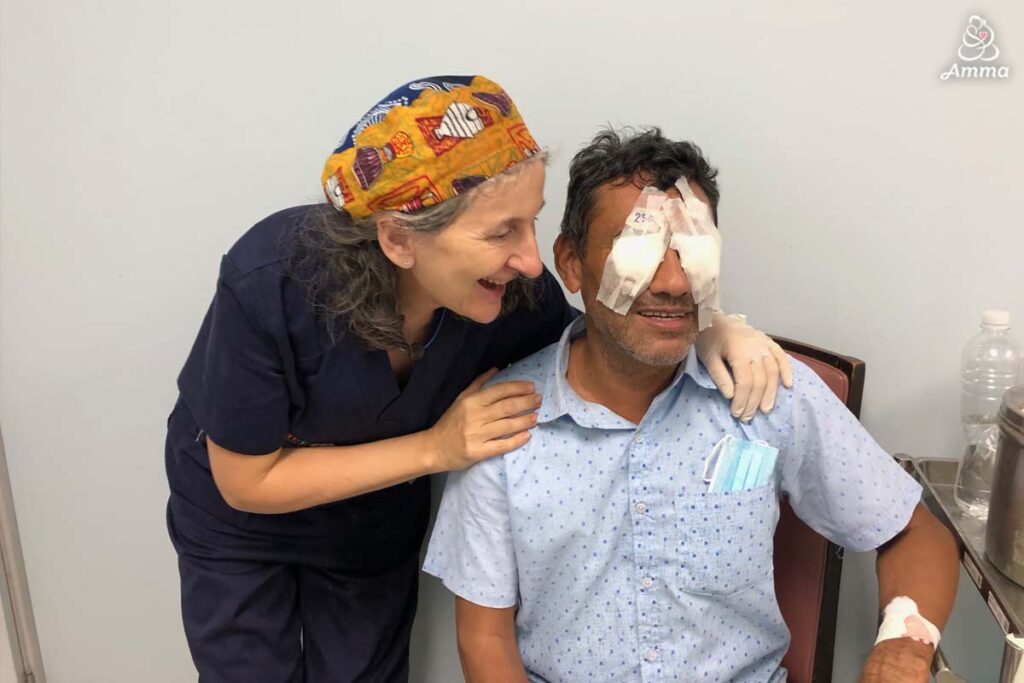
“Entre las operaciones destapamos brevemente el primer ojo y José inmediatamente exclamó: ¡Doctor, puedo ver! ¡Puedo ver! A la mañana siguiente su visión de larga distancia era del 60 % y podía leer.
In between the procedures, the first eye was briefly uncovered and Jose immediately exclaimed, ‘Doctor! I can see! I can see! By the next morning, his long-distance vision was 60% and he could read.
“Su hermana estaba muy feliz, porque él era una carga para ella. Tenía que hacerle todo, incluso ayudarle a vestirse y a comer. Ahora él trabaja de nuevo y gana el sustento de su familia”.
His sister was so happy, because he was a burden for her. She had to do everything—including helping him to get dressed and eat. Now, he is able to work again and earn for his family.”
En una decisión excepcional, los médicos operaron a Marcelino de los dos ojos el mismo día.
In a rare decision, doctors operated on both of Jose Marcelino’s eyes on the same day
Otro hito fue que una estudiante del master del programa de optometría y óptica de la Universidad de Valencia participó por primera vez. Con Isabel como mentora, Ana Perea dirigió los exámenes preoperatorios del paciente, contribuyó a realizar los cálculos para las lentes intraoculares y asistió en vivo a las intervenciones.
In another milestone, a Master’s student from the University of Valencia’s Optics and Optometry program participated for the first time. With Isabel as her professor, Ana Perea was able to conduct pre-operative patient exams, contribute to intraocular lens calculations, and assist in live surgeries.
“Estoy muy agradecida por la oportunidad de estar con los pacientes. Son personas que viven en condiciones de pobreza extrema. Recopilé datos y voy a hacer mi tesis para el master sobre este proyecto. Más allá de eso, espero de verdad poder continuar en estos campamentos de cirugía de cataratas en el futuro”, -dijo Ana.
I’m very grateful for the opportunity to be with the patients. These are people who live in such difficult conditions. I collected data and will do my thesis for the Master’s level about this project. Beyond that, I truly hope to continue with these cataract surgery camps in the future,” said Ana.
Para Isabel, fue una expresión más de la compasión de Amma mediante sus iniciativas humanitarias sobre el terreno.
For Isabel, it was a larger expression of Amma’s compassion through her on-the-ground humanitarian initiatives.
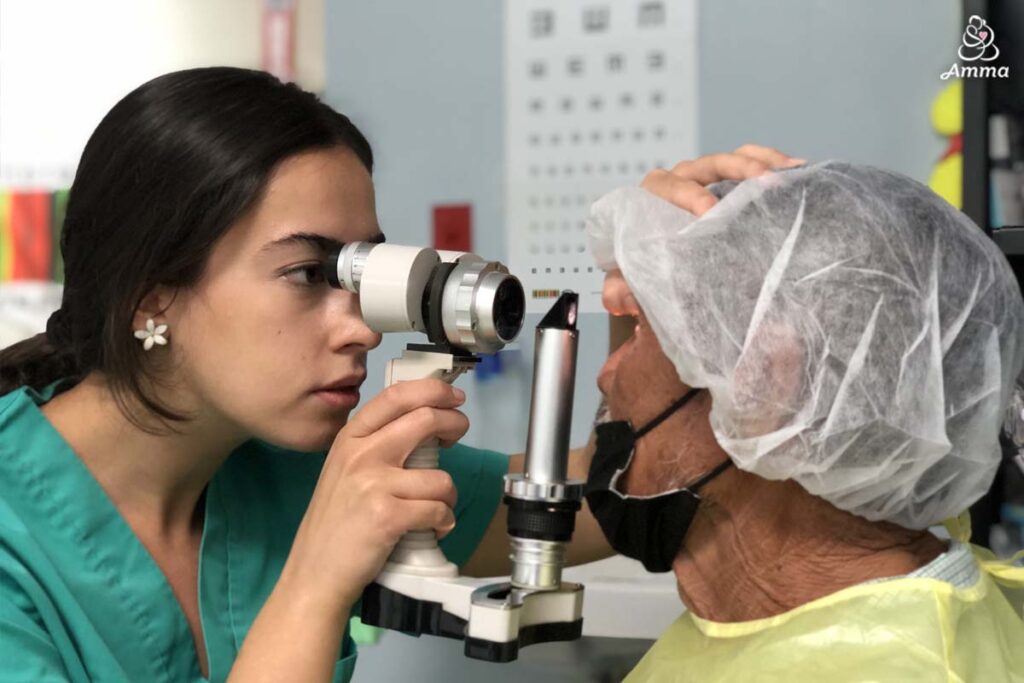
“Ana es un hermoso ejemplo de nuestros jóvenes que dan testimonio de las condiciones en que viven estas personas. Una semilla de servicio altruista brota en sus corazones y ese amor continuará fluyendo en otros.”
Ana is a beautiful example of our young people arriving to witness the conditions of the people. A seed of selfless service sprouts in their hearts and that love will continue to flow to others.”
Dentro de las 24 horas de la operación, los pacientes mostraban córneas limpias, un signo de recuperación rápida. Algunas cirugías eran particularmente complejas debido al largo periodo de ceguera de muchos pacientes, pero en general los resultados fueron altamente satisfactorios.
Within 24 hours of surgery, most patients showed clear corneas—a sign of rapid recovery. Some surgeries were particularly complex due to the long-standing blindness of many patients, but the overall results were highly satisfactory.
El personal local del hospital proporcionó una excelente ayuda durante la campaña. El equipo español contó con el soporte de logística y asistencia en quirófano de enfermeras y auxiliares hondureñas.
The local hospital staff provided excellent support throughout the campaign. The Spanish team was assisted by Honduran nurses and auxiliary staff, who helped with logistics and provided operating room assistance.
El seguimiento post operatorio inmediato estará a cargo de un equipo local de optometristas de una región al norte del país. En tres meses enviaremos dos optometristas para evaluar el progreso de los pacientes, recopilar datos sobre su mejoría y aportar gafas que optimicen su visión.
Immediate postoperative follow-up will be carried out by a team of local optometrists from another northern region of the country. Additionally, within three months, we will send two optometrists to evaluate patient progress, collect data on their improvement, and provide glasses to optimise their vision.
Isabel nos dice que hubo un elemento memorable en la experiencia de Honduras. El equipo podía comunicarse con los pacientes porque compartían la misma lengua.
Isabel shares there was one more memorable element to the experience in Honduras. The team was able to speak to the patients in the same language.
“Podíamos decir en español, “mira aquí”, “no te preocupes” “abre tu ojo”. Eso era diferente a África, lo que nos facilitó mucho las cosas y ayudó a los pacientes a entender los resultados”, -dijo una sonriente Isabel.
In Spanish, we could say, ‘Look here,’ ‘Don’t worry,’ and ‘Just open your eye.’ That was different from Africa, so made things much easier for us, as well as helping the patients understand the results,” said Isabel with a smile.
El equipo español estuvo compuesto por los oftalmólogos Dr. Jaime Javaloy, Sr. José Ignacio Valls y la Dra. Clara Martín; optometristas, Dra. María Isabel Signes, Sr. Rafael Sirvent y Sra. Ana Perea; enfermeras, Sras. Marta Fernández y Elvira Rodríguez; y el Dr. Luis Santos.
Overall, the Spanish team included the opthamologists Dr Jaime Javaloy, Dr Jose Ignacio Valls and Dr Clara Martin; optometrists Dr Mª Isabel Signes, Mr Rafael Sirvent and Ms Ana Perea; nurses Ms Marta Fernandez and Ms Elvira Rodriguez; and physician Dr Luis Santos.
NOTA DE LA AUTORA:
El programa gratuito de intervención de cataratas en África, es en Kenia, donde Abrazando al Mundo cuenta con una importante structura.
AUTHOR’S NOTE: The free cataract surgery program in Africa is located in Kenya, where Embracing the World has a significant presence.
Descubre más desde LA AGENCIA MUNDIAL DE PRENSA
Suscríbete y recibe las últimas entradas en tu correo electrónico.
