

THE DETERMINANTS FIVE VALUES

Prensa Especializada
Sabemos del largo camino recorrido por nuestra especie hasta el día de hoy. Del tiempo cuando según la teoría, un antepasado nuestro hace seis millones de años decidió bajar del árbol, ponerse en pie, convirtiéndose al andar en el primer Homo Sapiens. Fue el motor de su expansión cerebral, su postura bípeda y destreza manual, “evolución en mosaico” como gusta decir la paleontología.
We know of the long path traveled by our species to this day. From the time when, according to theory, an ancestor of ours six million years ago decided to come down from the tree, stand up, becoming the first Homo Sapiens by walking. It was the engine of their brain expansion, their bipedal posture and manual dexterity, “mosaic evolution” as paleontology likes to say.

(Juan Luis Arsuaga 2019) “Los finalistas” quedaron atrás con su apuesta: “el desarrollo del cerebro fue antes que la postura bípeda”. Hoy sabemos que el motor de la evolución humana, fue la destreza manual. Si, el cerebro es función de la pericia. De cómo se va desenvolviendo el cuerpo, de cómo lanzando piedras cada vez con mejor puntería, tirando palos -coordinación visomotora- marchando erguido y corriendo cada día más veloz, el cerebro se fue expandiendo y creando nuevas fisuras.
(Juan Luis Arsuaga 2019) “The finalists” were left behind with their bet: “the development of the brain came before the bipedal posture.” Today we know that the driving force of human evolution was manual dexterity. Yes, the brain is a function of expertise. From how the body develops, from how throwing stones with increasingly better aim, throwing sticks – visual-motor coordination – walking upright and running faster every day, the brain expanded and created new fissures.
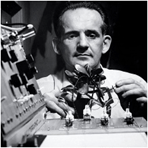
Y es que la vida en sí es un proceso inteligente, independiente del cerebro como lo demuestran los microorganismos que carecen de él y sin embargo: actúan inteligentemente (Grover Cleveland “Cleve” Backster Jr. Efecto Backster 2003).
And life itself is an intelligent process, independent of the brain, as demonstrated by microorganisms that lack it and yet act intelligently (Grover Cleveland “Cleve” Backster Jr. Backster Effect 2003).
Que ante el principio de la selección natural que formularon Charles Darwin y Alfred Russel Wallace, dónde basaban dicha selección en la competencia entre individuos, afirmando que sobreviven los más aptos, adaptativos y fuertes, debemos preguntarnos ¿Cómo es posible que un gorila o bonobo torpe y lento, cuando decidió un día dejar de utilizar las ramas de los árboles para trasladarse por el suelo pudo transformarse en la especie más dominante del planeta? Ni era el más fuerte, ni el más alto, ni el más veloz. ¿Qué pudo pasar? La respuesta la encontramos observando la naturaleza, constatando que, si por algo se caracteriza nuestro mundo y sigue en pie, no es precisamente porque destacamos en fuerza e inteligencia, sino por nuestra determinación en estar permanentemente en comunidad, por nuestra voluntad de cooperar y ser altruistas.
Given the principle of natural selection formulated by Charles Darwin and Alfred Russel Wallace, where they based said selection on competition between individuals, stating that the fittest, most adaptive and strongest survive, we must ask ourselves: How is it possible that a clumsy gorilla or bonobo and slowly, when it decided one day to stop using tree branches to move along the ground, could it become the most dominant species on the planet? He was neither the strongest, nor the tallest, nor the fastest. What could have happened? We find the answer by observing nature, confirming that, if our world is characterized by something and still stands, it is not precisely because we stand out in strength and intelligence, but because of our determination to be permanently in community, for our will to cooperate and be altruistic
Los más aptos son aquellos que no solo saben adaptarse al entorno, sino que logran adaptarse con éxito al proceso de vida. De su vida. Qué se adaptan a ellos mismos, a sus metas, a sus valores; a la dignidad. Los aptos son aquellos que son ellos. “La locura es no ser tú” y como menester requerimos de cinco valores básicos que debemos cultivar y transmitir: paciencia, cooperación/altruismo, empatía, confianza y honestidad. (valor comentado en un anterior artículo.)
The fittest are those who not only know how to adapt to the environment, but also manage to successfully adapt to the life process. Of his life. What suits themselves, their goals, their values; to dignity. The fit are those who are them. “Madness is not being you” and as a necessity we require five basic values that we must cultivate and transmit: patience, cooperation/altruism, empathy, trust and honesty. (value discussed in a previous article.)
Paciencia / Patience
Si nos emplazamos con mirada de etólogos a observar la naturaleza, podremos constatar como la mayoría de los animales siguen de manera puntual tres instintos básicos: comida, reproducción y huida. A pesar del hambre que los anima a lanzarse sobre la primera presa que encuentran, las especies que hemos permanecido y evolucionado; todas hemos desarrollado “la paciencia”. Sabemos esperar. Entra en acción cuando su cerebro primario les avisa de esa necesidad; actúan “por instinto” y sin pensárselo dos veces su respuesta inmediata es la paciencia. Y unas veces cenan, otras son el mejor manjar. La paciencia es imprescindible para el depredador, sea animal salvaje o humano. Valor en alza a medida que se van ampliando ramas en la evolución. Estadio de perfeccionamiento donde al sentir hambre el depredador, todo su ser toma la decisión de moverse en busca de una pieza, y en cuento la encuentra, antes de cualquier ataque y a pesar del hambre y ansia; se contiene. Observa, selecciona, hasta encontrar aquello que puede vencer o fácilmente cazar, y solo es en ese momento cuando decide lanzarse al ataque. O ir en grupo buscando para el embate en la manada enemiga, a lo más tierno, tullido o añejo. Un éxito, y todo gracias a que ha desarrollado el valor de la paciencia. Aprendido a dominar, contener al instinto.
If we look at nature with the eyes of ethologists, we can see how most animals specifically follow three basic instincts: food, reproduction and flight. Despite the hunger that encourages them to pounce on the first prey they find, the species that we have remained and evolved; We have all developed “patience”. We know how to wait. It goes into action when your primary brain alerts you to that need; They act “on instinct” and without thinking twice their immediate response is patience. And sometimes they have dinner, other times they are the best delicacy. Patience is essential for the predator, whether wild animal or human. Rising value as branches expand in evolution. Perfection stage where when the predator feels hungry, its entire being makes the decision to move in search of a piece, and soon finds it, before any attack and despite the hunger and craving; is contained. He observes, selects, until he finds what he can defeat or easily hunt, and it is only at that moment that he decides to go on the attack. Or go in a group looking for the attack on the enemy herd, for the most tender, crippled or old. A success, and all thanks to the fact that he has developed the value of patience. Learned to dominate, contain instinct.
También los seres humanos somos capaces de esperar si la recompensa nos satisface. Nos contenemos, y con paciencia decidimos esperar un poco más con tal de tener una mejor vivienda, detener el ansia de comer el grano de trigo para disfrutar después del pan recién horneado. La paciencia en años de formación, quizás ante temas que se pueden antojar abstrusos, pero que la clara meta que visualizamos hace que nos armemos de paciencia con tal de alcanzarla. Si, la paciencia es una de las necesarias estrategias de adaptación para andar con éxito a lo largo del proceso de vida.
Human beings are also capable of waiting if the reward satisfies us. We restrain ourselves, and with patience we decide to wait a little longer in order to have a better home, to stop the desire to eat the wheat grain to later enjoy the freshly baked bread. Patience in years of training, perhaps in the face of topics that may seem abstruse, but the clear goal that we visualize makes us arm ourselves with patience in order to achieve it. Yes, patience is one of the necessary adaptation strategies to navigate successfully throughout the life process.
Cooperación – Altruismo / Cooperation – Altruism

El Dr. William M. Muir, profesor de ciencias animales en la Universidad de Purdue, dirige su programa de investigación sobre los nuevos métodos genéticos para mejorar el bienestar de los animales agrícolas.
Dr. William M. Muir, professor of animal sciences at Purdue University, directs its research program on new genetic methods to improve the welfare of agricultural animals.
En uno de sus trabajos, sobre el valor que representa la cooperación, llevó a cabo el siguiente proceso: coloco en distintas jaulas a un grupo de gallinas sin llevar un criterio. A partir de ese momento, empezó a observarlas con el fin de seleccionar a las más productivas. Una vez obtenido el grupo compuesto por las mejores, concentró a todas ellas en una misma jaula. Y fue un rotundo éxito; se convirtieron en unas auténticas máquinas de poner huevos. Había seleccionado solo a las mejores y como consecuencia ofrecían lo mejor. Generación tras generación el aumento de huevos era exponencial. Triunfo completo ya que había conseguido rodearse mediante la selección de las mejores. Pero ocurrió que al llegar a la sexta generación apareció algo insólito, estas nuevas maravillosas gallinas, ponedoras ejemplares, fuertes, robustas, las mejores entre todas, se volvieron agresivas, empezaron a desplumarse, bajando la producción en picado a la siguiente generación. Después de esta experiencia, el Dr. William incorporó en su investigación una nueva variable. En la selección a llevar a cabo el nuevo grupo estuvo compuesto por algunas de las mejores gallinas ponedoras, otras medianas e inclusive con otras que no producían, y empezó a observar cómo generación tras generación la producción iba en aumento hasta que al llegar a la quinta descendencia, la obtención de huevos había aumentado un 160%. ¿Qué había ocurrido? Para sorpresa de los investigadores resultó que a medida que pasaban las generaciones se encontraban frente a un grupo cada vez más tranquilo, colaborador y empático. (Wilson, D.S. y Wilson, E.O. 2009). Los egoístas ganan a los cooperadores dentro del grupo, y los cooperadores ganan a los egoístas entre grupos.
In one of his works, about the value that cooperation represents, he carried out the following process: he placed a group of chickens in different cages without using criteria. From that moment on, he began to observe them in order to select the most productive ones. Once he had obtained the group made up of the best, he concentrated all of them in the same cage. And it was a resounding success; They became real egg-laying machines. He had selected only the best and as a consequence they offered the best. Generation after generation the increase in eggs was exponential. Complete triumph since he had managed to surround himself by selecting the best. But it happened that upon reaching the sixth generation something unusual appeared, these new wonderful hens, exemplary layers, strong, robust, the best among all, became aggressive, began to pluck their feathers, dropping production plummeting to the next generation. After this experience, Dr. William incorporated a new variable into his research. In the selection to be carried out, the new group was made up of some of the best laying hens, others medium ones and even others that did not produce, and began to observe how generation after generation production increased until reaching the fifth offspring, egg production had increased by 160%. What had happened? To the researchers’ surprise, it turned out that as the generations passed, they found themselves facing an increasingly calm, collaborative and empathetic group. (Wilson, D.S. and Wilson, E.O. 2009). Egoists beat cooperators within the group, and cooperators beat egoists between groups.
El éxito del grupo, de la sociedad, no tiene nada que ver con los más fuertes, ni los más listos, sino con la voluntad de sus integrantes sobre su disposición a cooperar. Y es que vale quien sirve.
The success of the group, of society, has nothing to do with the strongest or the smartest, but with the will of its members and their willingness to cooperate. And it is worth who serves.
Empatía / Empathy

El primatólogo y etólogo Dr. Franciscus Bernardus Mari de Waal profesor de psicología, Universidad de Emory. Atlanta, Georgia, llevó a cabo una investigación centrada en el comportamiento social de los primates incluyendo: resolución de conflictos, cooperación, aversión a la desigualdad e intercambio de alimentos.
Primatologist and ethologist Dr. Franciscus Bernardus Mari de Waal professor of psychology, Emory University. Atlanta, Georgia, conducted research focused on primate social behavior including: conflict resolution, cooperation, inequality aversion, and food sharing.
Uno de sus hallazgos (De Waal, 1993) fue comprobar –entre otras- que, en la supervivencia y fuerza de las especies, uno de sus éxitos consistió en la presión que empuja a una madre a cuidar de sus hijos. –primero conducta, después desarrollo encefálico- Comprobamos aquí la importancia capital que tuvo y tiene el desarrollo de la empatía en el proceso de la vida; la orientación de toda madre hacia sus crías. Solo las hembras de las especies que han llevado a cabo esta conducta, son las que aún persisten.
One of his findings (De Waal, 1993) was to verify – among others – that, in the survival and strength of the species, one of its successes consisted of the pressure that pushes a mother to take care of her children. –first behavior, then brain development- We see here the capital importance that the development of empathy had and has in the process of life; the orientation of every mother towards her offspring. Only the females of the species that have carried out this behavior are the ones that still persist.
La ciencia nos dice que los seres humanos no somos egoístas por naturaleza. Somos pacientes, cooperativos y empáticos, valores que sumados a los que a continuación expondremos, nos han permitido sobrevivir y dominar al mundo. Intimando en la empatía, el etólogo Marck Bekoll profesor titular de Biología en la Universidad de Colorado, premio de la Animal Behaviour Society en el año 2000 por su contribución al estudio del comportamiento animal, y la filósofa Jessica Pierce (Bekoff, M y Pierce,J..2010) en su investigación sobre la moral pudieron constatar en algunos animales todo un conjunto de comportamientos como: la empatía, la compasión, la honestidad, el altruismo, la confianza, el consuelo, el juego limpio y el perdón. A tenor de ello Bekoff y Pierce llegaron a la conclusión que la piedra angular de la moral es la empatía. Si los animales pueden ponerse en lugar de los otros, sentir lo que un tercero siente, también podrán ser compasivos, procurar no hacer daño y velar por su bienestar. La empatía es la fuente de la moral. Elemento necesario para la supervivencia.
Science tells us that human beings are not selfish by nature. We are patient, cooperative and empathetic, values that, added to those that we will present below, have allowed us to survive and dominate the world. Intimating empathy, the ethologist Marck Bekoll, professor of Biology at the University of Colorado, winner of the Animal Behavior Society in 2000 for his contribution to the study of animal behavior, and the philosopher Jessica Pierce (Bekoff, M and Pierce, J..2010) in their research on morality were able to verify in some animals a whole set of behaviors such as: empathy, compassion, honesty, altruism, trust, consolation, fair play and forgiveness. Based on this, Bekoff and Pierce concluded that the cornerstone of morality is empathy. If animals can put themselves in the place of others, feel what a third party feels, they can also be compassionate, try not to do harm and ensure their well-being. Empathy is the source of morality. Necessary element for survival.
La Confianza / Trust

Para saber por qué la gente tiende a la confianza, vamos a referirnos al Dr. Paul Zak, profesor de la Universidad de Claremont, California del Norte y hablar de su campo de investigación al ser uno de los científicos más preocupados en la confianza; en ese constructo que la engloba que no es otro que la moral; conjunto de costumbres y normas de comportamiento que el ser humano tiene introyectado como buenas.
To find out why people tend to trust, we are going to refer to Dr. Paul Zak, professor at Claremont University, Northern California, and talk about his field of research as he is one of the scientists most concerned about trust; in that construct that encompasses it, which is none other than morality; set of customs and norms of behavior that human beings have introjected as good.
La confianza es un valor fundamental y como tal, todos debemos poseer. ¿Cómo vamos a poder efectuar acción alguna si carecemos de confianza? Necesitamos creer. ¿Cómo acometer alguna acción sin contar con la confianza, con la certeza que estás haciendo la correcto? La confianza proporciona seguridad y participa a su vez, en la génesis y mantenimiento de la paciencia.
Trust is a fundamental value and as such, we should all possess. How can we take any action if we lack trust? We need to believe. How can you undertake any action without having confidence, with the certainty that you are doing the right thing? Trust provides security and participates, in turn, in the genesis and maintenance of patience.
En su investigación sobre la búsqueda de una química de la confianza, (Zak, P.L 2012) pudo comprobar lo determinante que es la oxitocina para el desarrollo de este valor. Esta hormona exclusiva de los mamíferos, tiene la virtud de ser el motor, hacer posible en las hembras cuidar por su camada y a las mujeres facilitar el parto y la lactancia. Recordemos: primero es la conducta, conducta que provoca oxitocina. Oxitocina que provoca una agradable sensación; placer. Delicia que crea adicción a confiar, a realizar una conducta moral. Podemos afirmar que la oxitocina es la hormona de la confianza. ¿Por qué lo hacemos? ¿Qué se siente cuando la oxitocina inunda el cuerpo?: Confianza y empatía. Como decíamos al inicio de este artículo la ciencia sigue manteniendo como teoría el paradigma de la evolución. El principio de la selección natural de Darwin y Wallace, basado en la competencia, en los más aptos y fuertes; en el egoísmo, hoy nos dice que está descaminado. Para alcanzar el éxito debemos apoyarnos en la paciencia, el altruismo, la empatía, la confianza y la honradez. Son estas virtudes las que nos han posibilitado dominar la Tierra. Estamos diseñados genéticamente para ser morales. Para ser nosotros.
In his research on the search for a chemistry of trust, (Zak, P.L 2012) he was able to verify how decisive oxytocin is for the development of this value. This hormone, exclusive to mammals, has the virtue of being the driving force, making it possible for females to take care of their litter and for women to facilitate childbirth and breastfeeding. Let’s remember: first is the behavior, behavior that provokes oxytocin. Oxytocin that causes a pleasant sensation; pleasure. Delight that creates addiction to trust, to perform moral behavior. We can say that oxytocin is the hormone of trust. Why do we do it? What does it feel like when oxytocin floods the body?: Trust and empathy. As we said at the beginning of this article, science continues to maintain the paradigm of evolution as a theory. Darwin and Wallace’s principle of natural selection, based on competition, on the fittest and strongest; in selfishness, today he tells us that he is wrong. To achieve success we must rely on patience, altruism, empathy, trust and honesty. It is these virtues that have enabled us to dominate the Earth. We are genetically designed to be moral. To be us.
Referencias.
- Arsuaga, JL. Vida, la gran historia. (2019) Ed. Destino. Barcelona.
- Backster, C. Primary Perception: Biocommunication with Plants, Living Foods, and Human Cells (2003). Edt. White Rose Millennium Pr.
- Bekoff, M y Pierce, J. Justicia salvaje. La vida moral de los animales. (2010). Ed. Turner. Madrid.
- De Waal, F. La política de los chimpancés (1993) Alianza Editorial. Madrid.
- Wilson, D.S. y Wilson, E.O. (2009). Evolución por el bien del grupo. Investigación y ciencia, 288: pp.46-57.
- Zak, P.L., La molécula de la felicidad. El origen del amor, la confianza y la prosperidad. (2012). Ed. Indicios. Barcelona.
Descubre más desde LA AGENCIA MUNDIAL DE PRENSA
Suscríbete y recibe las últimas entradas en tu correo electrónico.

