

¿EDUCACIÓN TRANSFORMACIONAL? «Educación en tiempos de crisis»

“Education in Times of Crisis: Pandemic, War and Uncertainty”, is a book with different authors dedicated to education, in which the debate around the progressive versus traditional is presented; What we should protect from the past and what we should think about for the future. The reality is that each student learns differently and it is the teacher who must be prepared to present various options in the classroom, the work is multiplied when evaluating and commitment is required, agree the academics, who affirm that it is not about the application of a method, but the combination of those that have existed since the origin of education.
“Educación en Tiempos de Crisis: Pandemia, Guerra e Incertidumbre”, es un libro con distintos autores dedicado a la educación, en el que se presenta el debate en torno a lo progresivo frente tradicional; qué debemos de proteger del pasado y qué debemos de pensar hacia el futuro. La realidad es que cada estudiante aprende de forma diferente y es el maestro quien debe estar preparado para presentar diversas opciones en el aula, el trabajo se multiplica al evaluar y se requiere compromiso, coinciden los académicos, quienes afirman que no se trata de la aplicación de un método, sino la combinación de los que existen desde el origen de la educación.
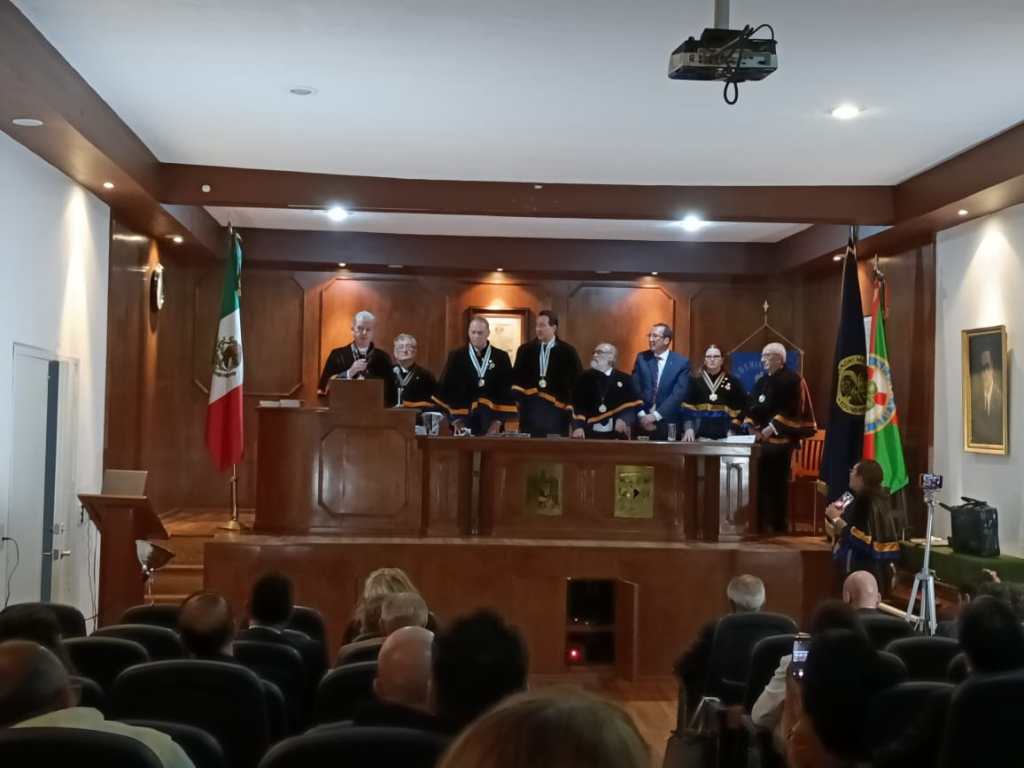
The auditorium of the National Academy of Geography and History (ANGH) of UNAM in Mexico City was the setting that brought together researchers and academics from the American continent, united in this commitment to educate and present a broad debate that led to multiple answers.
El auditorio de la Academia Nacional de Historia y Geografía (ANHG) de la UNAM en la Ciudad de México, fue el escenario que reunió a investigadores y académicos del continente americano, hermanados en este compromiso de educar y exponer un debate amplio que condujo a múltiples respuestas.
The vice president of the ANGH, the physicist José Alejandro Dosal Luce, welcomed the authors from countries such as Puerto Rico, Dominican Republic, Ecuador, Peru, Mexico, the United States, and Venezuela.
El vicepresidente de la ANGH, el físico José Alejandro Dosal Luce dio la bienvenida a los autores procedentes de países como Puerto Rico, República Dominicana, Ecuador, Perú, México, Estados Unidos, Venezuela.
The chapter that begins Education in Times of Crisis: Pandemic, War and Uncertainty, from the Plaza y Valdés publishing house, coordinated by ambassador Otto Federico Von Feigenblatt and María de Jesús Araiza Vázquez, is dedicated to the meanings of progressive and traditional that are have been politicized in debates about education and that each person gives it a different meaning.
El capítulo con que inicia Educación en Tiempos de Crisis: Pandemia, Guerra e Incertidumbre, de la editorial Plaza y Valdés, coordinado por el embajador Otto Federico Von Feigenblatt y María de Jesús Araiza Vázquez, está dedicado a los significados de progresivo y tradicional que se han politizado en los debates sobre educación y que cada persona le da un significado distinto.
When addressing the term traditional, as co-editor of this book, Dr. Oscar Yecid Aparicio Gómez, considered that in the 1950s it is not the same as traditional in the 19th century; Now it is said that methods that were used in the 80’s are now traditional, we have to go further, to what students need and the essence of education.
Al abordar el término tradicional, como coeditor en este libro, el doctor Oscar Yecid Aparicio Gómez, consideró que en los años 50´ no es lo mismo que tradicional en el siglo XIX; ahora se dice, que, métodos que se utilizaban en los años 80´, ahora son tradicionales, tenemos que ir más allá, a lo que necesitan los estudiantes y la esencia de la educación.
“The issue of artificial intelligence, how technology is going to change the world, that GPT chat is going to dominate us; that studying and teaching are going to change. If we start to think about the Socratic method of ancient Greece, it is just as relevant today as it was more than a thousand years ago. If we remove the stigma, the teaching-learning process, the student-teacher relationship, we can advance further, we do not seek to reach to a consensus, to a single answer, to transcend the debate, for philosophers to speak with educators, for social scientists to speak with psychologists, since education is a broad field that is made up of many other disciplines».
“El asunto de la inteligencia artificial, cómo la tecnología va a cambiar el mundo, de que el chat GPT va a dominarnos; que el estudio y la enseñanza van a cambiar. Si nos ponemos a pensar el método socrático de la antigua Grecia es igual de pertinente hoy, que hace más de mil años, si le quitamos el estigma, el proceso enseñanza-aprendizaje, la relación estudiante y maestro, podemos avanzar más, no buscamos llegar a un consenso, a una sola respuesta, trascender el debate, que filósofos hablen con educadores, que científicos sociales hablen con psicólogos, ya que la educación es un campo amplio que está compuesto de muchas otras disciplinas”.
“In a debate, everything is possible through arguments and they have written from the perspective of engineers, philosophers, educators and those who work in educational administration in universities. It is not that traditional education comes before progressive education or vice versa, but that they complement each other.”
“En un debate, todo es posible a través de los argumentos y han escrito desde su perspectiva de ingeniería, filósofos, educadores y quienes trabajan en administración educativa en universidades. No es que la educación tradicional es antes de la progresiva o viceversa, sino que se complementan”.
“Technology is not only digital as we understand it, it is a tool and allows the learning processes to be much more promising, at the beginning the disciples were not chosen by the teacher but on the contrary, the disciple chose the teacher and the first technology was walking in the Greek agora, and as I walked, knowledge was being fixed through maieutics and dialectics, then the blackboards and writing appeared and that was scary, how is it that writing is going to take away the oral tradition from us -they questioned- , the same thing happened when the printing press was invented with Gutenberg, and current technology asks us: what is the relationship between education and technology? How do we approach the relationship between technology and education, so we learn from technology, for and With technology».
“La tecnología no es solo digital como la entendemos, es una herramienta y permite que los procesos de aprendizaje sean mucho más prometedores, al principio los discípulos no eran elegidos por el maestro sino al contrario, el discípulo elegía al maestro y la primera tecnología era caminar en el ágora griega, y mientras caminaba, el conocimiento se iba fijando a través de la mayéutica y dialéctica, luego aparecen las pizarras, la escritura y eso asustaba, cómo es que la escritura nos va a quitar la tradición oral -se cuestionaban-, lo mismo pasó cuando se inventó la imprenta con Gutenberg, y la tecnología actual nos plantea: ¿qué relación hay entre educación y tecnología?, cómo nos acercamos a la relación entre tecnología y la educación, así que aprendemos de la tecnología, para y con la tecnología”.
“Technology is always a means, a cognitive tool that amplifies the mind. The debate now has more discussion scenarios in the world, it has been held in Miami, Mexico, Colombia, New York, it is necessary that it be taken beyond closed spaces, where we are all building this humanity to whom we have been entrusted the education of the youngest.”
“La tecnología siempre es un medio, herramienta cognitiva amplificadora de la mente. El debate ahora tiene más escenarios de discusión en el mundo, se ha hecho en Miami, México, Colombia, Nueva York, es necesario que se lleve más allá de los espacios cerrados, donde todos vamos construyendo esta humanidad a quienes se nos ha confiado la educación de los más jóvenes”.
That in higher education institutions there is talk of a debate through research. Digital culture and artificial intelligence. Let it be a constructive dialogue, academics propose.
Que en instituciones de educación superior se hable de un debate por medio de la investigación. Cultura digital e inteligencia artificial. Que sea un diálogo constructivo, proponen académicos.
Working on this book we realize that we disagree and we have some points of connection, we are learning from everyone, accepting that the answer is not always an answer, that it is a linear process of discovery, the authors agree on that.
Trabajando en este libro nos damos cuenta que estamos en desacuerdo y tenemos algunos puntos de conexión, vamos aprendiendo de todos, aceptar que la respuesta no es siempre una respuesta, que es un proceso lineal de descubrimiento, en eso coinciden los autores.
Dr. Dosal Luce affirms that one of the challenges for teachers is to try to overcome the theories of forgetting; we have the challenge of achieving knowledge in the medium and long term for students.
El doctor Dosal Luce afirma que uno de los retos de los docentes es tratar de vencer las teorías del olvido, tenemos el reto de que los conocimientos se logren a mediano y largo plazo para los estudiantes.
During his participation, doctor and academic Ángel Toledo López, from Puerto Rico, expressed that the practice of traditional and progressive education alters the teacher and student relationship, the student has a central role in the learning process, we practice that the student learns of its own process as an active entity, and the teacher as a guide continues to be a tool in the learning process, allowing it to be a process of exchanges, in progressive education there is also an intersection with the traditional model, demonizing one of the two models does not help, we are seeking to facilitate a learning process.
Durante su participación, el doctor y académico Ángel Toledo López, de Puerto Rico, expresó que la práctica de la educación tradicional y progresista alteran la relación maestro y estudiante, el estudiante tiene un rol central en el proceso de aprendizaje, practicamos que el estudiante aprenda de su propio proceso como un ente activo, y el maestro como guía sigue siendo una herramienta en el proceso de aprendizaje, permite que sea un proceso de intercambios, en la educación progresiva también existe una intersección con el modelo tradicional, demonizar a uno de los dos modelos no ayuda, estamos buscando facilitar un proceso de aprendizaje.
“In the classrooms there is a relationship between human being and human being; ask them: How do you like to learn?; This is how progressive education is produced, there is an exchange both in the traditional and the progressive, there are more meeting points than differences. Traditional education normally focuses on the teacher and progressive education on the student, using techniques from both methodologies and being able to integrate them, that should be our educational model, the traditional and the progressive are not divorced.»
“En las aulas hay una relación ser humano con ser humano; preguntarles: ¿Cómo te gusta aprender?; así se produce la educación progresista, hay un intercambio tanto en lo tradicional como la progresista, hay más puntos de encuentro que de diferencias. La educación tradicional normalmente se enfoca en el maestro y la progresista en el estudiante, el utilizar técnicas de ambas metodologías y poderlas integrar, ese debería ser nuestro modelo educativo, lo tradicional y lo progresista no están divorciados”.
“I tell teachers, we have to teach how the student learns, and if the student learns when guided that is traditional and if he learns by letting him do that it would be progressive, the problem for teachers is that we are not prepared for that reality.” , we want to believe that the student enters and we are going to deposit all the knowledge, if we begin to teach the way the student learns and I would call it not progressive education but transformational education, this will represent that each student learns in a different way and that in a classroom I am going to have to implement various learning techniques to activate knowledge and knowledge, that is possible, if we manage to convince our teachers that this is the route, to transform the way we educate.”
“Le digo a los maestros, nosotros tenemos que enseñar como el estudiante aprende, y si el estudiante aprende cuando se le guía eso es tradicional y si aprende dejándole hacer eso sería progresista, el problema de los maestros es que no estamos preparados para esa realidad, queremos creer que el estudiante entra y le vamos a depositar todo el conocimiento, si nosotros comenzamos a enseñar de la forma en que el estudiante aprende y lo llamaría no educación progresista sino educación transformacional, esto va a representar que cada estudiante aprende de distinta forma y que en un salón voy a tener que implementar diversas técnicas de aprendizaje para que active los saberes y conocimientos, eso es posible, si logramos convencer a nuestros maestros que esa es la ruta, transformar la manera en la que educamos”.
“A model that lasts in the long term. The child can learn by doing the work again, again and again, I believe that exams can be solved collectively and in the end that is learning. I have no problem with a student telling me I want to repeat the work, and in the process of doing it again they are learning more. Doing the exams collaboratively, I don’t see anything wrong with it, in the end, in the dialogue, social sharing occurs and learning occurs, it is a model that I propose, if we agree, it works.»
“Un modelo que dure a largo plazo. El niño puede aprender haciendo el trabajo una, otra vez y otra vez, creo que se pueden resolver los exámenes en forma colectiva y al final eso es aprendizaje. No tengo ningún problema con que un estudiante me diga quiero repetir el trabajo, y en el proceso de hacerlo otra vez está aprendiendo más. Hacer los exámenes de manera colaborativa no le veo nada malo, al final en el diálogo se da ese compartir social y se da el aprendizaje, es un modelo que propongo, si estamos de acuerdo, funciona”.
For academic Dosal, “each field of knowledge will have to choose certain preferential didactics.”
Para el académico Dosal, “cada campo de conocimiento tendrá que escoger ciertas didácticas preferenciales”.
For her part, the professor at the University of Nuevo León and control and computing engineer, Olga Lucía Ostos, in the chapter on education in times of war, addresses at the supranational level the consequences of war and its impact on children in the world.
Por su parte, la catedrática de la Universidad de Nuevo León e ingeniero en control y computación, Olga Lucía Ostos, en el capítulo educación en tiempos de guerra se aborda en el ámbito supranacional las consecuencias de la guerra y su impacto en los niños en el mundo.
Another chapter is dedicated to mental health, in part due to the inappropriate use of the internet and social networks in terms of content consumed in the educational field.
Otro capítulo está dedicado a la salud mental, en parte debido al uso inadecuado del internet y redes sociales en términos de contenido consumido en el ámbito educativo.
Dr. Elena Toxtle commented on how necessary it is to remove stigmas from crystal children, millennials, in these generations and look for other connotations.
La doctora Elena Toxtle comentó lo necesario que es quitar estigmas de niños cristal, milenials, en estas generaciones y buscar otras connotaciones.
At the end of the event, Dr. Dosal Luce presented the winners with a diploma and medal in this exchange to which they already belong honorarily to the National Academy of Geography and History of the UNAM, Aris Anif, member of the British Brain Charty Trust; Franklin Alberto Rodríguez Garabitos, senator in the Dominican Republic; Ángel Toledo López, Undersecretary of Education of Puerto Rico.
Al finalizar el evento el doctor Dosal Luce, entregó a los galardonados diploma y medalla en este intercambio al que ya pertenecen en forma honoraria a la Academia Nacional de Geografía e Historia de la UNAM, Aris Anif, miembro del British Brain Charty Trust; Franklin Alberto Rodríguez Garabitos, senador en República Dominicana; Ángel Toledo López, Subsecretario de Educación de Puerto Rico.

Meanwhile, academics Beatriz Saavedra Gastelum, Miguel Ángel Garduño Zepeda, Alberto Utrilla Armendáriz, S. Iván Ferrera Villatoro, Héctor Efraín Ortega Castillo, Rita Ferrera Villatoro, Enrique received a certificate and medal from the International Youth Organization for Ibero-America (OIJI). Álamo Rodea, Teodoro Rentería Arroyave, Elsy Jiménez Barros, Guadalupe Chávez Torres.
En tanto, recibieron certificado y medalla del Organismo Internacional de la Juventud para Iberoamérica (OIJI), los académicos Beatriz Saavedra Gastelum, Miguel Ángel Garduño Zepeda, Alberto Utrilla Armendáriz, S. Iván Ferrera Villatoro, Héctor Efraín Ortega Castillo, Rita Ferrera Villatoro, Enrique Álamo Rodea, Teodoro Rentería Arroyave, Elsy Jiménez Barros, Guadalupe Chávez Torres.
Descubre más desde LA AGENCIA MUNDIAL DE PRENSA
Suscríbete y recibe las últimas entradas en tu correo electrónico.
