

XPLORALYA: «EGIPTO, LA TIERRA DE LOS REYES»
Egypt is connecting Africa, Asia and Europe through the Mediterranean Sea.
Egipto conecta África, Asia y Europa a través del Mar Mediterráneo.
Dating back thousands of years the land of Egypt have witnessed the succession of civilizations, the migration of people from different countries and religions, which shaped the identity of Egypt, leaving behind a rich heritage, a treasure of monuments, temples, royal catacombs and touristic sites..
Hace miles de años, la tierra de Egipto ha sido testigo de la sucesión de civilizaciones, la migración de personas de diferentes países y religiones, lo cual ha dado forma a la identidad de Egipto, dejando tras de sí un rico patrimonio, un tesoro de monumentos, templos, catacumbas reales y sitios turísticos.
Why Egypt is considered a multi-confessional Country?
Por qué Egipto es considerado un país multi-confesional?
The most relevant civilizations that deeply influenced Egypt are: the Pharaonic, the Greco- Roman, the Coptic Christian and the Islam. This diversity has strengthened the awareness of otherness resulting in making Egypt a place of tolerance and dialogue.
Las civilizaciones más relevantes que influyeron profundamente en Egipto son: la Faraónica, la Greco- Romana, la Copta Cristiana y el Islam. Esta diversidad ha fortalecido la conciencia de la alteridad, lo que ha convertido a Egipto en un lugar de tolerancia y diálogo.
The National Egyptian Heritage Revival Association (NEHRA), took the initiative and created “The Holy Family Route in Egypt “, is a pilgrimage route, representing the itinerary followed by the holy family into the beloved land of Egypt, a great historical and religious patrimony. The Christ is the first refugee tourist to come to Egypt, fleeing King Herod’s tyranny. It is a pilgrimage route that concerns the whole world that will strengthen the relations between religions and would be an opportunity to attract more tourists for the benefit of the economy of the country.
La Asociación Nacional de Renacimiento del Patrimonio Egipcio (NEHRA), tomó la iniciativa y creó «La Ruta de la Sagrada Familia en Egipto», es una ruta de peregrinación, que representa el itinerario seguido por la Sagrada Familia en la amada tierra de Egipto, un gran patrimonio histórico y religioso. . El Cristo es el primer turista refugiado que llega a Egipto, huyendo de la tiranía del rey Herodes. Es una ruta de peregrinaje que concierne al mundo entero que fortalecerá las relaciones entre las religiones y sería una oportunidad para atraer más turistas en beneficio de la economía del país.
In their escape from the infanticide fury of King Herod , The holy family guided by God and his angel, fled through Sinai, enduring the scorching sun heat, seeking a peaceful refuge in Egypt departing from Bethlehem to Gaza then to El -Zaranik, heading to Wadi El Natroun located in the western desert of Egypt; Setting out from Zeitoun toward old Cairo, the holy family traverses what are now a crowded and bustling quarters of Cairo where many monasteries and churches were built in different cities to commemorate the path of the holy family; we can find a landmark of an earlier Coptic heritage, the church of Virgin Mary in Zuweila Alley, and the church of Saint George the martyr.
En su huida del furor infanticida del rey Herodes, la sagrada familia guiada por Dios y su ángel, huyeron por el Sinaí, soportando el calor del sol abrasador, buscando un refugio pacífico en Egipto partiendo de Belén a Gaza luego a El-Zaranik, rumbo a Wadi El Natroun ubicado en el desierto occidental de Egipto; Partiendo de Zeitoun hacia el viejo Cairo, la sagrada familia atraviesa lo que ahora son barrios concurridos y bulliciosos de El Cairo, donde se construyeron muchos monasterios e iglesias en diferentes ciudades para conmemorar el camino de la sagrada familia; podemos encontrar un hito de una herencia copta anterior, la iglesia de la Virgen María en Zuweila Alley y la iglesia de San Jorge mártir.
At Gabal el Tair we can visit the monastery of the Virgin, going southwards to the town of Al-Ashmounien and then to Qosqam where the towers of the Monastery of Al Muharrak was built around the cave where the holy family spent about 6 months, that became the altar of the church of Virgin Mary. On the 1st of June the Coptic Church celebrates the entry of the Lord Jesus Christ into the Land of Egypt.
En Gabal el Tair podemos visitar el monasterio de la Virgen, dirigiéndonos hacia el sur hasta el pueblo de Al-Ashmounien y luego a Qosqam donde se construyeron las torres del Monasterio de Al Muharrak alrededor de la cueva donde la sagrada familia pasó unos 6 meses, que se convirtió en el altar de la iglesia de la Virgen María. El 1 de junio la Iglesia Copta celebra la entrada del Señor Jesucristo en la Tierra de Egipto.
Landmarks must- sees while visiting Egypt:
Sitios emblemáticos que debes visitar al viajar a Egipto:
In Cairo the Capital City:
En El Cairo, la Ciudad Capital:
The great Pyramids of Giza: Khufu, Khafre and Menkaure are considered the oldest of the Seven Wonders of the World and are classified within the UNESCO world heritage.
Las grandes pirámides de Giza: Jufu, Kefrén y Micerino son consideradas las más antiguas de las Siete Maravillas del Mundo y están clasificadas como Patrimonio de la Humanidad por la UNESCO.
The New National Museum of Egypt in Cairo city: displaying monuments, artifacts and 22 royal mummies, showing the development stages of the ancient Egyptian civilization.
El Nuevo Museo Nacional de Egipto en la ciudad de El Cairo: exhibiendo monumentos, artefactos y 22 momias reales, mostrando las etapas de desarrollo de la antigua civilización egipcia.


The Nile River isn’t only the origin of life in Egypt where many cities were developed on both banks, but it is the hub of tourism attractions, countless of cruise boats cross the Nile river, and we can observe some of them anchored in the river, We could experience the most exciting Nile River Cruise to Aswan and Luxor cities.
El río Nilo no es solo el origen de la vida en Egipto, donde muchas ciudades se desarrollaron en ambas orillas, sino que también es el centro de atracciones turísticas, numerosos barcos de crucero cruzan el río Nilo y podemos observar algunos de ellos anclados en el río. Podemos experimentar el crucero por el río Nilo más emocionante hasta las ciudades de Asuán y Luxor.
ASWAN City: has been reputed since the antiquityfor stone quarries, especially for the granitic rock syenite. We discovered the Temple of Kom Ombo constructed during the Ptolemaic dynasty, 180–47 BC. Is an unusual double temple since it is completely symmetrical. It has two entrances, two Hypostyle Halls and two sanctuaries, dedicated to two different gods: Horus and Sobek. We can notice on the wall the figures of the numerical Egyptian calendar which is divided into three seasons: Flood, sowing, and harvest. Each season has 4 months and each month 3 weeks of 10 days.
ASWAN City: ha sido reconocida desde la antigüedad por sus canteras de piedra, especialmente por la roca granítica sienita. Descubrimos el Templo de Kom Ombo construido durante la dinastía ptolemaica, 180-47 a.C. Es un templo doble inusual ya que es completamente simétrico. Tiene dos entradas, dos salas hipóstilas y dos santuarios, dedicados a dos dioses diferentes: Horus y Sobek. Podemos notar en la pared las figuras del calendario numérico egipcio que se divide en tres estaciones: Inundación, siembra y cosecha. Cada estación tiene 4 meses y cada mes consta de 3 semanas de 10 días.
We visited the amazing Crocodile Museum, located next to the Kom Ombo temple, north of Aswan. Showcasing a unique collection of mummified crocodiles, the longest is 4.30 m, while the smallest is 2 m. In addition to crocodile fetuses, eyes, golden and ivory teeth.
We visited the amazing Crocodile Museum, located next to the Kom Ombo temple, north of Aswan. Showcasing a unique collection of mummified crocodiles, the longest is 4.30 m, while the smallest is 2 m. In addition to crocodile fetuses, eyes, golden and ivory teeth.
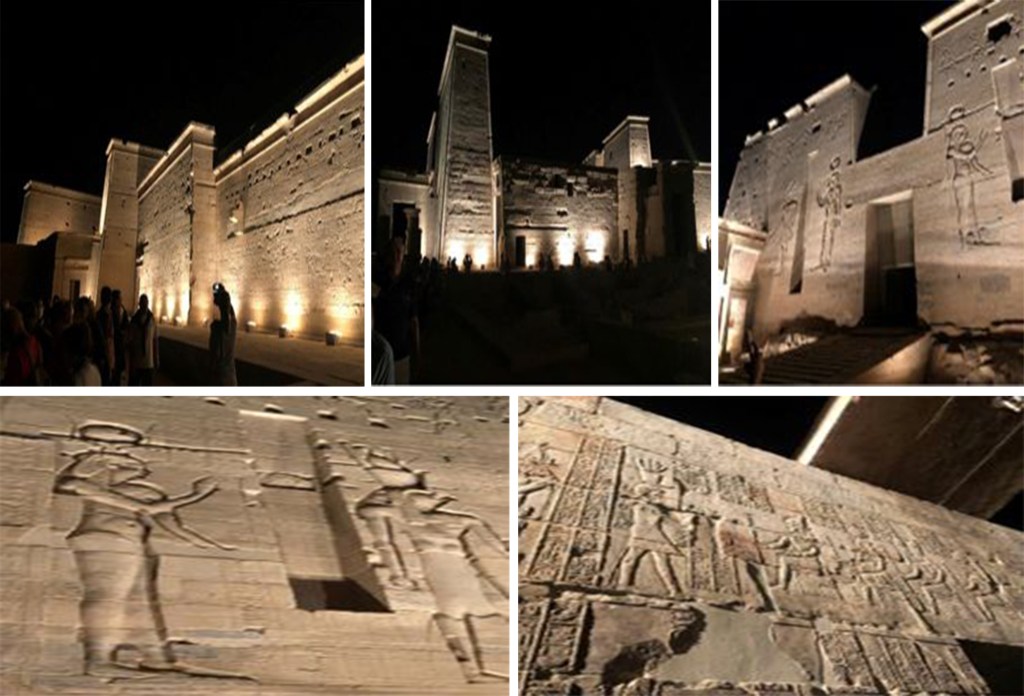
In the night we hired a Felucca (motor boat) to visit one of the most beautiful Egyptian temples the Philae Temple which is an island-based temple, dedicated to goddess Isis, Osiris and Horus, the walls disclosed scenes from Egyptian mythology of Isis bringing Osiris back to life giving birth to Horus and mummifying Osiris after death. The temple was in danger of being submerged by the new Aswan dam water therefore was dismantled from Philae Island and relocated to a nearby island called Agilkia island in Lake Nasser.
In the night we hired a Felucca (motor boat) to visit one of the most beautiful Egyptian temples the Philae Temple which is an island-based temple, dedicated to goddess Isis, Osiris and Horus, the walls disclosed scenes from Egyptian mythology of Isis bringing Osiris back to life giving birth to Horus and mummifying Osiris after death. The temple was in danger of being submerged by the new Aswan dam water therefore was dismantled from Philae Island and relocated to a nearby island called Agilkia island in Lake Nasser.
Sailing further to the north we stopped in Luxor city: which is famous to be the world’s greatest open air Museum this comes from the fact that the modern city is located at the same site as ancient Thebes, It has literally been built around two huge temples:
Navegando más al norte, nos detuvimos en la ciudad de Luxor: famosa por ser el mayor museo al aire libre del mundo, esto se debe a que la ciudad moderna está ubicada en el mismo lugar que la antigua Tebas. Literalmente, se ha construido alrededor de dos enormes templos:
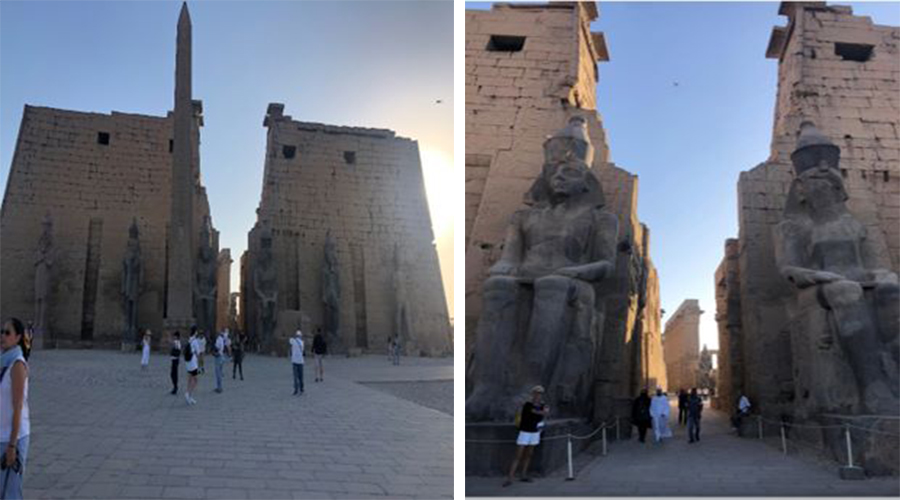
The Luxor Temple: the large complex temple was built in 1392 BC, on the east bank of the Nile River and is dedicated to the deities Mut, Khonsu, and Amun. Its construction begun with Pharaoh Amenhotep III and completed by Pharaoh Tutankhamun.
El Templo de Luxor: el gran complejo del templo fue construido en el año 1392 a.C., en la orilla este del río Nilo y está dedicado a las deidades Mut, Khonsu y Amón. Su construcción comenzó con el faraón Amenhotep III y fue completado por el faraón Tutankamón.
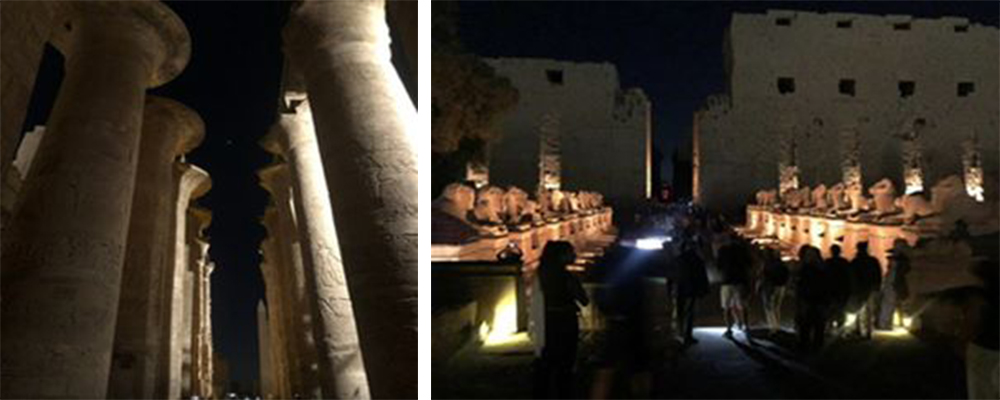
The Karnak Temple Complex: the largest religious complex in ancient Egypt, covering about 200 acres, a pilgrimage site for about 2000 years, it comprises large temples, 134 pillars of the great hypostyle hall, Pylons, Chapels, was believed to be the point of interaction between Amun- Ra and Egyptians a place of worship that provides evidences to the ancient Egyptian religion. The Luxor and Karnak temples are connected through the Sphinx Avenue
El Complejo del Templo de Karnak: el complejo religioso más grande del antiguo Egipto, que abarca aproximadamente 200 acres, un lugar de peregrinación durante unos 2000 años, consta de grandes templos, 134 columnas del gran salón hipóstilo, pilones, capillas, se creía que era el punto de interacción entre Amón- Ra y los egipcios, un lugar de culto que ofrece evidencias de la religión del antiguo Egipto.
Los templos de Luxor y Karnak están conectados a través de Sphinx Avenue
Luxor city owes its reputation as well to the existence of the mesmerizing:
La ciudad de Luxor también debe su reputación a la existencia de la asombrosa:
Valley of the kings which lies on the Nile’s west bank in Luxor enclosing the most fabulous collection of cut in the rock’s royal tombs of many important Kings of the Ancient Egypt. Being the final resting place for the kings, the tombs were decorated and beautifully painted in a way befitting the kings’ status.
Valle de los Reyes, que se encuentra en la orilla oeste del Nilo en Luxor, encierra la colección más fabulosa de tumbas reales excavadas en la roca de muchos reyes importantes del antiguo Egipto. Siendo el lugar de descanso final de los reyes, las tumbas estaban decoradas y pintadas de manera hermosa de acuerdo con el estatus de los reyes.
The painted scenes embossed on the walls were of pharaohs, gods and goddesses. Hieroglyphic texts were also engraved to guide them to the next life.
Las escenas pintadas en relieve en las paredes representaban a faraones, dioses y diosas. También se grabaron textos jeroglíficos para guiarlos hacia la próxima vida.

Hatshepsut Mortuary Temple – is a masterpiece of ancient architecture, Hatshepsut (1507-1458 B.C.) the Queen who became Pharaoh, brought great wealth and artistry to her land and Egypt witnessed a successful trading period.
Templo Funerario de Hatshepsut – es una obra maestra de la arquitectura antigua. Hatshepsut (1507-1458 a.C.), la Reina que se convirtió en Faraón, llevó gran riqueza y destreza artística a su país y Egipto presenció un exitoso período comercial.
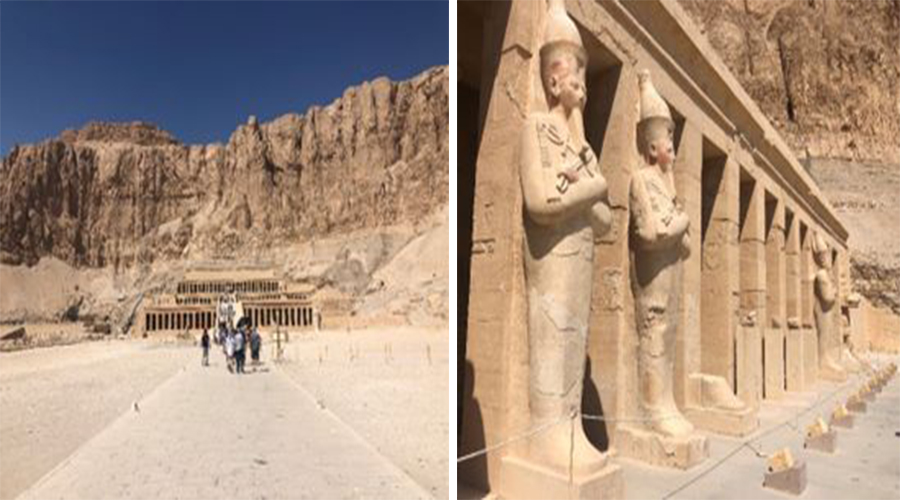
Egypt is a continuous discovering destination where tourists will be amazed at the staggering wonders offered by Egypt the mother of the World .
Egipto es un destino de descubrimiento continuo donde los turistas se asombrarán con las asombrosas maravillas que ofrece Egipto, la madre del mundo.
Descubre más desde LA AGENCIA MUNDIAL DE PRENSA
Suscríbete y recibe las últimas entradas en tu correo electrónico.

