
Myanmar: Forgotten Tragedies of Today

COLUMNISTA
A veces se produce el efecto mariposa. En este caso fue una exposición fotográfica en la Casa de la Cultura de Majadahonda, donde resido, titulada por su autor José María Arraiza, “Myanmar: La mirada tras el golpe”, lo que me puso en primer plano una de las situaciones dictatoriales más crueles y dramáticas de las muchas que están aquí y ahora delante de nuestros ojos, pero que no vemos.
Sometimes the butterfly effect happens. In this case, it was a photography exhibition at the Majadahonda Cultural Center, where I live, titled by José María Arraiza, «Myanmar: The Look After the Coup,» that brought me into sharp focus one of the cruelest and most dramatic dictatorial situations, among the many that are here and now before our eyes, but that we don’t see.
Arraiza fue a Myanmar, antigua Birmania, en una misión como trabajador humanitario para el Consejo de Refugiados Noruego, (CRN) concretamente a la región de Tanintharyi. Llegó a la ciudad de Dawei 2015, año en que unas elecciones ganadas por la Liga Nacional Democrática (LND) prometían poner fin a una larga historia de dictaduras militares. Tras dos años de esperanza, en 2017 se produjo la crisis de la minoría Rohingya, según la UNU una de las más perseguidas del mundo, en palabras de ACNUR fueron cien días de horror y esperanza cuando más de medio millón de personas huyeron a la vecina Bangladesh, donde como refugiados ni lo tuvieron ni lo tienen fácil, pero esta sería otra historia.
Arraiza went to Myanmar, formerly Burma, on a mission as a humanitarian ambassador for the Norwegian Refugee Council (NRC), specifically to the Tanintharyi region. He arrived in 2015, the year in which elections won by the National League for Democracy (NLD) ended a dictatorship. After two years of hope, in 2017 the Rohingya minority crisis occurred, according to the UNU one of the most persecuted in the world, in the words of UNHCR it was one hundred days of horror and hope when more than half a million people fled to neighboring Bangladesh, where as refugees they did not have it and do not have it easy, but that would be another story.
Luego llegó el Covid-19 y en 2021 un golpe de estado militar derrocó al gobierno de la LND, declararon el estado de emergencia, la situación derivó en guerra civil hasta hoy…
Then came Covid-19, and in 2021, a military coup overthrew the NLD government. A state of emergency was declared, and the situation spiraled into a civil war that continues to this day.
A propósito, he querido ser muy breve en la descripción de unos hechos, apenas los he rozado, no hace falta hablar de horrores para deducir la repercusión de esa situación en las poblaciones locales, en las distintas etnias que componen la población de Myanmar.
By the way, I’ve wanted to be very brief in describing the events; I’ve barely touched on them. There’s no need to talk about horrors to deduce the impact of this situation on the local populations, on the different ethnic groups that make up Myanmar.
De lo que quiero hablar es de una exposición fotográfica, sin la cual este artículo no habría existido, porque mi conciencia hubiera permanecido muy lejos de Myanmar y de los seres humanos que lo pueblan.
What I want to talk about is a photographic exhibition, without which this article wouldn’t have existed, because my conscience would have remained far removed from Myanmar and the human beings who inhabit it.
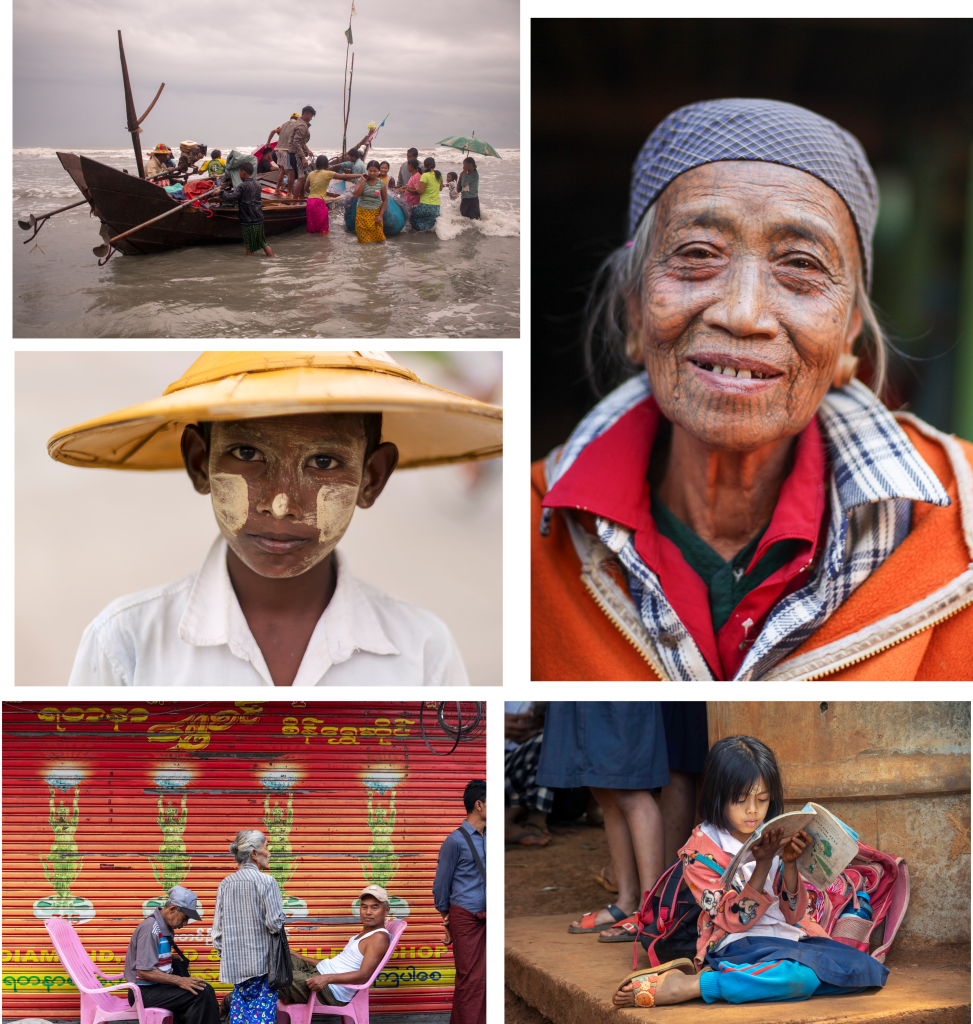
Y de la mirada del fotógrafo, antes y después del golpe. Arraiza no ha fotografiado horrores. Antes y después ha captado imágenes cotidianas de pescadores, campesinos, de rickshaws, los más humildes que he visto, niños, mujeres jóvenes, maduras y ancianas, algunas con la cara tatuada, y todos pintados de amarillo con la thanaka, pasta cosmética característica de Myanmar, como protección solar, como crema de belleza, como antiséptico y varias cosas más. Es su signo de identidad.
And from the photographer’s perspective, before and after the coup. Arraiza hasn’t photographed horrors. Before and after, he has captured everyday images of fishermen, farmers, rickshaw drivers, the humblest I’ve ever seen, children, young women, older women, and women with tattoos, all painted yellow with thanaka, a cosmetic paste characteristic of Myanmar, used as sunscreen, beauty cream, antiseptic, and various other things. It’s their hallmark.
Dice Arraiza que cuando llegó en 2015 tuvo la sensación de estar en el paraíso. Su misión consistía en ayudar a varias comunidades en tareas de registro e identificación para emitir documentos de identidad en las comunidades rurales. Habla de convivencia entre budistas, hindúes, musulmanes y personas de ascendencia china; de las fiestas de la luna llena en honor a Buda y otros festivales. Viajó por varios estados, Karen, Kayah, Mon, estados de minorías étnicas, Rakhine, Kachin, Shan, Chin, donde fotografió a las ancianas con el rostro tatuado. Eran tiempos en que se sentaba con grupos de Rohingyas que le mostraban enfadados sus antiguos documentos de identidad, reclamando igualdad de derechos. Fue al archipiélago de Myeik donde vive la etnia Moken, los “gitanos del mar”.
Arraiza says that when he arrived in 2015, he felt like he was in paradise. His mission was to help various communities with registration and identification tasks in order to issue identity documents in rural communities. He speaks of coexistence between Bhuddists, Hindus, Muslims, and people of chinese origin; of the full moon festivals in honor of Buddha and other festivals. He traveled through several states—Karen, Kayah, Mon, ethnic minority states, Rakhine, Kachin, Shan, and Chin—where he photographed elderly women with tattooed faces. These were times when he sat with groups of Rohingya who angrily showed him their old identity documents, demanding equal rights. He went to the Myeik archipelago, home to the Moken ethnic group, the “sea gypsies.”
Tras el golpe salió de Myanmar, pero siguió en contacto diario con ex colegas birmanos, que le hablaban de bombardeos, persecución política y otras desgracias. En 2023 pudo viajar al único territorio no cerrado a extranjeros, Yangon. Y a Mae Sot, en Tailandia, donde se reencontró con ex colegas de la CRN y otras ONGs, ahora refugiados. Algunos de ellos , en situación irregular debido a la falta de protección legal se escondían de las autoridades por miedo a la extorsión, la detención y posible devolución a Myanmar. Conoció los orfanatos de la ONG española Colabora Birmania, llegó a comunidades que no recibían ninguna ayuda…
After the coup, he left Myanmar but remained in daily contact with Burmese colleagues, who told him about bombings, political persecution, and other misfortunes. In 2023, he was able to travel to the only territory not closed to foreigners, Yangon. He also traveled to Mae Sot, Thailand, where he reunited with ex colleagues from the CRN and other NGOs, now refugees in irregular situation due to lack of legal protection were hiding from the Thai authorities under threat of arrest and return to Myanmar. He visited the orphanages run by the Spanish NGO Colabora Birmania and reached out to communities that received no assistance.
Al final se pregunta en qué ha cambiado su mirada después del golpe. Si la mirada pertenece al que mira o al observado. O quizá haya una tercera mirada, la del público, entre ellas la mía.
In the end, he wonders how his perspective has changed since the coup. Whether the perspective belongs to the viewer or the observed. Or perhaps there is a third perspective, that of the public, including mine.
La mía… Ví la exposición sin haber leído la información sobre las situaciones vividas por el fotógrafo antes y después del golpe. Me la llevé y la leí después, en casa.
Mine… I saw the exhibition without having read the information about the situations experienced by the photographer before and after the coup. I took it with me and read it later, at home.
Doy las gracias a José María Arraiza, porque lo que captó mi mirada atenta a las fotografías, magníficas por cierto, auténticas obras de arte, fue la vida cotidiana de gentes sencillas, que viven vidas quizá no tan distintas a las de nuestras gentes sencillas, salvando la distancia, la cultura, el clima. La guerra y sus consecuencias la describe con palabras. Pero ha conseguido que no esté en las fotos.
I thank José María Arraiza, because what captured my attentive gaze in the photographs—magnificent, by the way, true works of art—was the daily life of simple people, who live lives perhaps not so different from those of our ordinary people, despite the distance, the culture, the climate. He describes the war and its consequences with words. But he has managed to keep it from appearing in the photographs.
Antes de ver la exposición, tenía el propósito de escribir esta semana sobre Palestina para mi columna de Culturas del Mundo de La Agencia Mundial de Prensa. Pero, efecto mariposa. Una exposición de fotos me llevó directamente a Myanmar, de quién nadie habla, de quién nadie se acuerda.
Before seeing the exhibition, I had intended to write about Palestine this week for my World Cultures column at the World Press Agency. But, the butterfly effect. A photo exhibition took me directly to Myanmar, which no one talks about, which no one remembers.
Agradecería que viralizaran esta tragedia de hoy, tan olvidada.
I would appreciate it if you could make this tragedy, so forgotten today, go viral.
Descubre más desde LA AGENCIA MUNDIAL DE PRENSA
Suscríbete y recibe las últimas entradas en tu correo electrónico.
