

Teresa Fernandez Herrera. Periodista, Escritora, Editorialista CDG de Cultura. COLUMNISTA
Hay ciudades en el mundo que están predestinadas a existir por el lugar geográfico que ocupan, el lugar donde y porqué fueron fundadas. Creo que predominan las ciudades ubicadas en la orilla de grandes ríos y sobre todo en su desembocadura al mar u océano.
There are cities in the world that are predestined to exist because of their geographic location, the place where and why they were founded. I believe that cities located on the banks of large rivers, especially at their mouths in the sea or ocean, predominate.
Esta es la situación de Sanlúcar de Barrameda. Está en la orilla izquierda de la desembocadura del río Guadalquivir en el Océano Atlántico. Enfrente, en la orilla derecha están los Parques Nacional y Natural de Doñana, también Reserva de la Biosfera de la UNESCO, único en Europa en cuanto a su gran extensión de marismas que acogen en invierno a unas doscientas mil aves acuáticas procedentes de toda Europa. Doñana se extiende por las provincias de Cádiz, Sevilla y Huelva con una extensión de 122.487 hectáreas.
This is the location of Sanlúcar de Barrameda. It lies on the left bank of the mouth of the Guadalquivir River, which meets the Atlantic Ocean. Opposite, on the right bank, are the Doñana National and Natural Parks, also a UNESCO Biosphere Reserve, unique in Europe for its vast expanse of marshes that winter host some 200,000 waterfowl from all over Europe. Doñana extends across the provinces of Cádiz, Seville, and Huelva, covering an area of 122,487 hectares.
A Sanlúcar se le supone haber formado parte del núcleo de la civilización de Tartessos, (Siglos IX al V a.C.) quizá la más antigua de Europa, y el nombre de Aipora suena como el de la antiquísima ciudad en el estuario del Guadalquivir. A Tartessos le sucedió Turdetania, civilización prerromana. (siglos V a II a.C.) Su nombre en la era romana fue Ebura o Ébora. Incluso se habla de incursiones vikingas en el siglo IX. Fue Cora de Sidonia durante el emirato y califato. Sanlúcar desde su reconquista en 1297, otorgada como señorío a Guzmán el Bueno, linaje que más tarde derivaría en el ducado de Medina Sidonia, tan importante en la historia de Sanlúcar.
Sanlúcar is supposed to have formed part of the nucleus of the Tartessos civilization (9th to 5th centuries BC), perhaps the oldest in Europe, and the name Aipora sounds like that of the ancient city on the Guadalquivir estuary. Tartessos was succeeded by Turdetania, a pre-Roman civilization. (5th to 2nd centuries BC) Its name in the Roman era was Ebura or Ébora. There is even talk of Viking raids in the 9th century. It was Cora de Sidonia during the emirate and caliphate. Sanlúcar since its reconquest in 1297, granted as a lordship to Guzmán el Bueno, a lineage that would later lead to the duchy of Medina Sidonia, so important in the history of Sanlúcar
La creación de la Casa de la Contratación en Sevilla en 1503, institución para la gestión de América, determinaba que todas las expediciones de partida y regreso empezaran y terminaran en Sevilla para que la capital del Guadalquivir tuviera un gran desarrollo naval y económico, circunstancia que puso a Sanlúcar de Barrameda, situada en la bocana del Océano Atlántico, en una situación de privilegio hasta 1717 en que la Casa de Contratación se trasladó a Cádiz.
The creation of the Casa de la Contratación in Seville in 1503, an institution for the management of the Americas, stipulated that all departing and returning expeditions would begin and end in Seville so that the capital of the Guadalquivir would enjoy significant naval and economic development. This circumstance placed Sanlúcar de Barrameda, located at the mouth of the Atlantic Ocean, in a privileged position until 1717, when the Casa de Contratación moved to Cádiz.
Sanlúcar fue el necesario puerto de aprovisionamiento, supervisión y reparación de naves antes de emprender la navegación transoceánica. Expediciones hubo muchas en este periodo. Pero hay una que hizo de Sanlúcar un hito en la historia de la navegación e investigación científica oceánica.
Sanlúcar was the essential port for provisioning, supervising, and repairing ships before embarking on transoceanic voyages. There were many expeditions during this period. But one made Sanlúcar a milestone in the history of oceanic navigation and scientific research.
La primera circunnavegación del globo terráqueo que empezó con cinco carabelas, Trinidad, San Antonio, Concepción, Victoria y Santiago, capitaneadas por Fernando de Magallanes, Juan Sebastián Elcano como segundo a bordo, el italiano Antonio Pigafetta como cronista oficial y otros capitanes como Juan de Cartagena, de cuya odisea dimos noticia hace pocas ediciones de Culturas del Mundo en la llamada “Patagonia”. Se trataba de demostrar de forma práctica la esfericidad de la Tierra, aunque había otro objetivo: Llegar atravesando océanos a las Islas Molucas o Islas de las Especias, uno de los archipiélagos de Indonesia en el Océano Pacífico.
The first circumnavigation of the globe began with five caravels, Trinidad, San Antonio, Concepción, Victoria and Santiago, captained by Ferdinand Magellan, Juan Sebastian Elcano as second in command, the Italian Antonio Pigafetta as official chronicler and other captains such as Juan de Cartagena, whose odyssey we reported on a few issues of Cultures of the World a few years ago in the so-called “Patagonia”. The aim was to demonstrate in a practical way the sphericity of the Earth, although there was another objective: to reach the Moluccas Islands or Spice Islands, one of the Indonesian archipelagos in the Pacific Ocean, by crossing oceans.
Otro factor importante en esta empresa fue el interés que tomaron en ella los duques de Medina Sidonia, que ostentaban el título de Capitanes Generales del Mar Océano y de las costas de Andalucía, y por tanto responsables de la preparación, financiación y partida de las flotas.
Another important factor in this enterprise was the interest taken by the Dukes of Medina Sidonia, who held the title of Captains General of the Ocean Sea and the coasts of Andalusia, and were therefore responsible for the preparation, financing and departure of the fleets.
El 20 de septiembre de 1519 partieron las cinco naves con doscientos sesenta y cinco marinos de varios rangos y nacionalidades. Tres años más tarde, el 6 de septiembre de 1522 regresó a Sanlúcar en condiciones muy precarias únicamente la Victoria, solo con dieciocho tripulantes al mando de Juan Sebastián Elcano. Otro de los pocos supervivientes fue el cronista Antonio Pigafetta.
On September 20, 1519, the five ships set sail with 265 sailors of various ranks and nationalities. Three years later, on September 6, 1522, only the Victoria returned to Sanlúcar in very precarious conditions, with only 18 crew members under the command of Juan Sebastián Elcano. Another of the few survivors was the chronicler Antonio Pigafetta.
El objetivo estaba conseguido. Un objetivo que había empezado en 1492 con el primer viaje de Cristóbal Colón; había culminado una segunda fase Vasco Núñez de Balboa en 1513 con el descubrimiento del Océano Pacífico que confirmaba que lo descubierto en 1492 y años siguientes era un continente del que nadie tenía noticia, ni siquiera sus habitantes, muy dispersos, tenían noción de ser un continente.
The objective was achieved. A goal that had begun in 1492 with Christopher Columbus’s first voyage; a second phase had culminated in 1513 with the discovery of the Pacific Ocean by Vasco Núñez de Balboa, which confirmed that what had been discovered in 1492 and the following years was a continent of which no one had any knowledge, not even its widely dispersed inhabitants had any notion that it was a continent.
Es decir, en solo veintiocho años en tiempos en que la navegación a pesar de todos sus avances, conocimiento de vientos y mareas, era de alto riesgo, se llevó a cabo la mayor gesta histórico-científica de la historia del planeta Tierra.
That is to say, in just twenty-eight years, at a time when navigation, despite all its advances and knowledge of winds and tides, was highly risky, the greatest historical and scientific feat in the history of planet Earth was accomplished.
Y todos sabemos que único país llevó a cabo todos estos descubrimientos.
And we all know that only one country made all these discoveries.

La Ruta de la Circunnavegación / The Circumnavigation Route
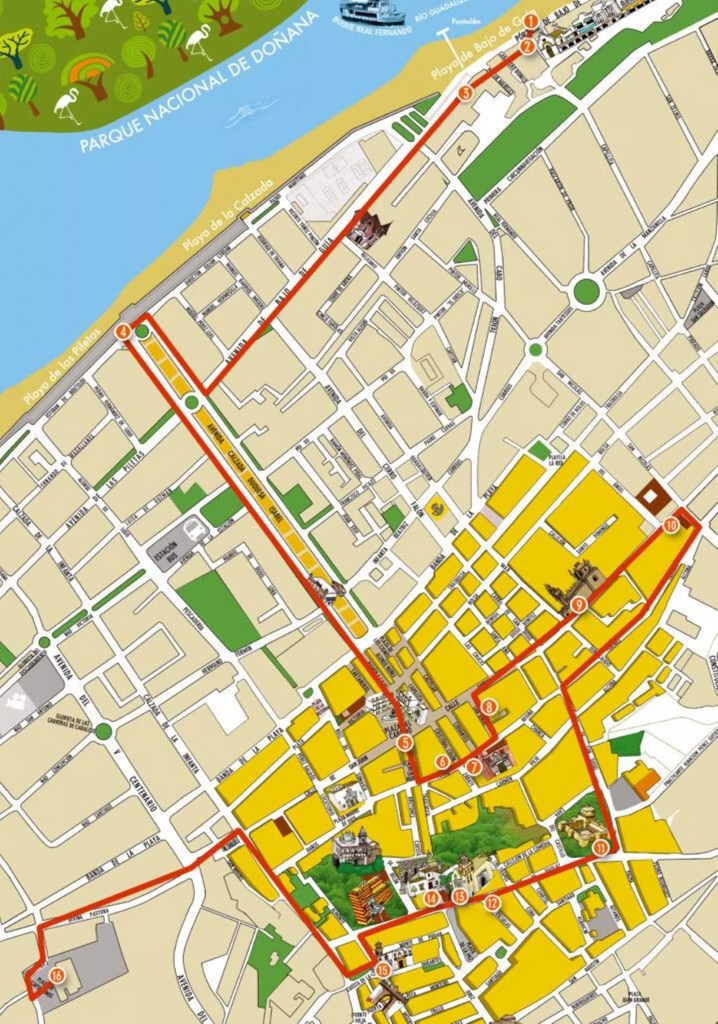
En Sanlúcar de Barrameda podemos seguir la ruta de la primera cicunnavegación. Comienza en el Paseo del Bajo de Guía, bastante cerca del Museo Manolo Sanlúcar, – Culturas del Mundo, edición anterior a la presente- donde frente a la playa se encuentra el “Reloj Ecuatorial Legua Cero”, es decir, el punto de partida y llegada de la expedición. Monumento financiado por la Fundación Puerta de América. Representa una banda equinoccial de hierro con las horas perforadas en números romanos. En mi modesta opinión creo que el Ayuntamiento de Sanlúcar podría financiar un pedestal más representativo de la importancia del monumento. Y de paso restaurar los escritos, medio borrados por el oleaje. Cito la frase de Antonio Pigafetta:
In Sanlúcar de Barrameda, we can follow the route of the first circumnavigation. It begins on the Paseo del Bajo de Guía, quite close to the Manolo Sanlúcar Museum (Cultures of the World, previous edition). The «Legua Cero Equatorial Clock» is located on the beachfront, the departure and arrival point of the expedition. This monument was financed by the Puerta de América Foundation. It represents an iron equinoctial band with the hours perforated in Roman numerals. In my humble opinion, I think the Sanlúcar City Council could finance a pedestal more representative of the monument’s importance. And, in the process, restore the writings, half erased by the waves. I quote Antonio Pigafetta:
“Desde que habíamos partido de la bahía de san Lúcar hasta que regresamos a ella recorrimos según nuestra cuenta, más de catorce mil cuatrocientas sesenta leguas, y dimos la vuelta al mundo”
“From the time we left the bay of San Lúcar until we returned to it, we traveled, according to our calculations, more than fourteen thousand four hundred and sixty leagues, and we went around the world.”
En la capilla de Nuestra Señora de Guía se conserva la imagen del siglo XVI, de la patrona y protectora de los hombres de mar. Su culto fue llevado a América y Filipinas.
The 16th-century image of the patron saint and protector of seafarers is preserved in the chapel of Our Lady of Guía. Her cult was brought to the Americas and the Philippines.
A poca distancia se encuentra el Centro de Visitantes de Doñana, antigua Fábrica de Hielo. Este lugar con tan curioso y poco descriptivo nombre conserva una maqueta de la nao Victoria, a escala 1:8 de la original. La exposición muestra también una serie de toneles, pipas, fardos y cajas donde se llevaba el agua, alimentos y enseres para la travesía.
A short distance away is the Doñana Visitor Center, a former Ice Factory. This place, with its curious and indescriptive name, houses a 1:8 scale model of the Nao Victoria. The exhibition also displays a series of barrels, pipes, bales, and crates used to carry water, food, and gear for the voyage.
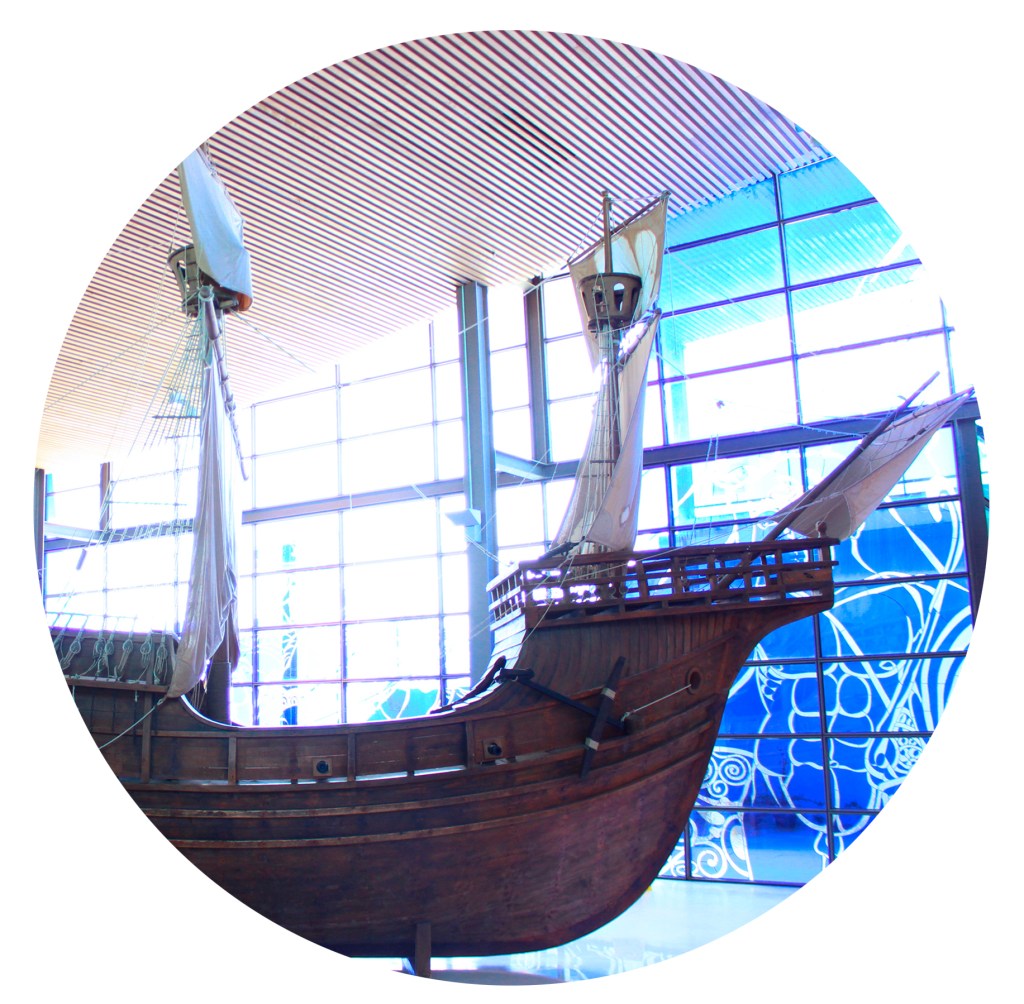
El nombre de la nao parte de la iglesia de Santa María de la Victoria de Triana, en la que Magallanes juró servir a la Corona, en la persona de Carlos I de España.
The ship’s name comes from the church of Santa María de la Victoria in Triana, where Magellan swore an oath to serve the Crown, in the person of Charles I of Spain.
Las especias que trajo la nave desde las Islas Molucas, cubrieron ampliamente los gastos de la expedición. Hay que tener en cuenta que el valor de las especias en ese tiempo era muy superior al de los metales preciosos.
The spices the ship brought from the Moluccas Islands amply covered the expedition’s expenses. It should be noted that the value of spices at that time was much higher than that of precious metals.
En la intersección del Paseo Marítimo con la Avenida Duquesa Isabel se ha instalado un mural cerámico de doble cara que conmemora la “I Vuelta al Mundo”. De un lado están Magallanes y las cinco naves en el punto de partida; del otro Elcano con una recreación de Sanlúcar en 1519.
At the intersection of the Paseo Marítimo and Duquesa Isabel Avenue, a double-sided ceramic mural has been installed commemorating the «First Voyage Around the World.» On one side, Magellan and the five ships at the starting point; on the other, Elcano with a recreation of Sanlúcar in 1519.
En la calle Isaac Peral, en la fachada lateral de la Biblioteca Municipal, hay cuatro paneles cerámicos que representan la totalidad de la expedición, participantes al regreso, retratos de Magallanes, Elcano y de la nao Victoria. En el último panel, el itinerario del viaje.
On Isaac Peral Street, on the side façade of the Municipal Library, there are four ceramic panels depicting the entire expedition, including participants on the return journey, portraits of Magellan, Elcano, and the ship Victoria. The final panel depicts the voyage itinerary.

En la ruta o visita de la expedición hay cinco iglesias que conservan iconos de esta historia compartida, entre otros un cuadro de la Patrona de México, la Virgen de Guadalupe, de autoría mexicana anónima, la pintura del siglo XVII de escuela poblana, “Ierarchia Angelorum” y una imagen de Nuestra Señora de la Antigua, Patrona del Descubrimiento.
Along the expedition’s route or visit, there are five churches that preserve icons of this shared history, including a painting of the patron saint of Mexico, the Virgin of Guadalupe, by an anonymous Mexican artist; the 17th-century painting from the Puebla school, «Ierarchia Angelorum»; and an image of Our Lady of the Ancient, patron saint of Discovery.
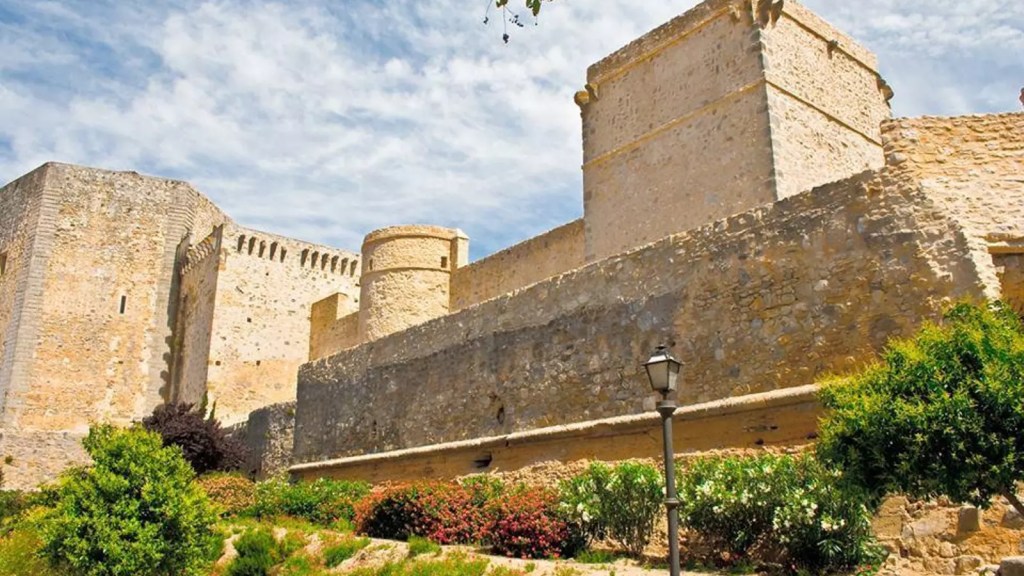
El Castillo de Santiago es una impresionante fortaleza construida en el siglo XV por el Duque de Medina Sidonia. Hay que advertir que Sanlúcar asciende desde la orilla del mar hasta una considerable altura, donde se ubica la fortaleza que domina la desembocadura del Guadalquivir.
Santiago Castle is an impressive fortress built in the 15th century by the Duke of Medina Sidonia. It should be noted that Sanlúcar rises from the seashore to a considerable height, where the fortress stands overlooking the mouth of the Guadalquivir.
En la planta baja de la Torre del Homenaje hay varias salas dedicadas a exposiciones de temática histórica de varias épocas, entre las que destaca la que nos interesa aquí: Una excelente exposición de cartografías y escritos originales, sí como de fotografías y cartelas explicativas. Una joya de las que se da poca noticia, hasta que el curioso investigador de una ciudad de la importancia histórica de Sanlúcar de Barrameda se las encuentra para su gozoso asombro en un castillo del siglo XV, que es una joya arquitectónica y de logística militar en ese tiempo.
On the ground floor of the Keep there are several rooms dedicated to exhibitions on historical themes from various periods, among which the one that interests us here stands out: An excellent exhibition of original maps and writings, as well as photographs and explanatory cartouches. A gem of which little notice is given, until the curious researcher of a city of the historical importance of Sanlúcar de Barrameda finds them to his joyful amazement in a 15th-century castle, which is an architectural and military logistical gem of that time.
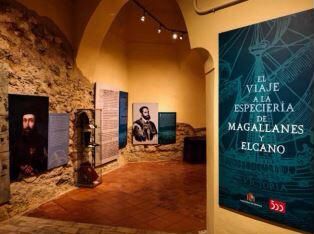
Descendiendo del Castillo de Santiago por la empinada Cuesta de la Caridad, se encuentran otro par de iglesias con memoranda de las dos orillas y su interrelación. Y también palacios – Sanlúcar tiene muchos palacios – con estilos españoles únicos en Europa como el mudéjar. El Ayuntamiento es una joya de este estilo y además está rodeado de un pequeño pero intenso jardín botánico con plantas de aquí y de allí.
Descending from Santiago Castle along the steep Cuesta de la Caridad, you’ll find another pair of churches commemorating the two banks and their interrelationship. There are also palaces—Sanlúcar has many palaces—designed in Spanish styles unique in Europe, such as Mudejar. The Town Hall is a jewel of this style and is also surrounded by a small but vibrant botanical garden with plants from both local and international sources.
Las muy interesantes Bodegas Barbadillo –de la famosa manzanilla de Sanlúcar – cuyo muro posterior es de contención del palacio de los Duques de Medina Sidonia, tan presentes en la historia de esta singular ciudad de la provincia de Cádiz, son otros dos lugares a visitar.
The very interesting Barbadillo Winery—which produces the famous Sanlúcar Manzanilla—whose back wall is the retaining wall of the palace of the Dukes of Medina Sidonia, so prominent in the history of this unique city in the province of Cádiz, are two other places worth visiting.
NOTA DE LA AUTORA. La palabra Barrameda procede del árabe Bar-am-ma’ida que significa “pozo de agua de la meseta”. Aplicado a Sanlúcar informa del agua que se tomaba en la ciudad, ya que las aguas de la desembocadura del río están muy salinizadas. El nombre de Sanlúcar proviene probablemente de la locución latina Sanctus Locus que significa lugar sagrado.
AUTHOR’S NOTE. The word Barrameda comes from the Arabic word Bar-am-ma’ida, meaning «water well of the plateau.» Applied to Sanlúcar, it refers to the water that was consumed in the city, since the waters at the river’s mouth are highly saline. The name Sanlúcar probably comes from the Latin phrase Sanctus Locus, meaning sacred place.
Descubre más desde LA AGENCIA MUNDIAL DE PRENSA
Suscríbete y recibe las últimas entradas en tu correo electrónico.
