More than an exhibition, a life: Wifredo Lam, Cuban, European, universal
El Museo Nacional Centro de Arte Reina Sofía de Madrid, ha presentado una extraordinaria retrospectiva con más de doscientas cincuenta obras del artista cubano Wifredo Lam,que abarca toda su trayectoria profesional.
The Museo Nacional Centro de Arte Reina Sofía in Madrid has presented an extraordinary retrospective with more than two hundred and fifty works by the Cuban artist Wifredo Lam, covering his entire professional career.
La fascinante vida de Wifredo Lam está marcada por toda una serie de fechas importantes en el devenir histórico del siglo XX del que fue testigo de excepción. Siempre estuvo donde había que estar para vivir todas las experiencias, traumáticas o no, de ese agitado siglo. Su propia vida está llena de experiencias e influencias que sin duda configuraron tanto las distintas etapas de su arte como de su vida personal.
The fascinating life of Wifredo Lam is marked by a whole series of important dates in the historical development of the 20th century of which he was an exceptional witness. He was always where he needed to be to live all the experiences, traumatic or not, of that hectic century. His own life is full of experiences and influences that undoubtedly shaped both the different stages of his art and his personal life.

Wifredo Lam nace el 1902 en Sagua la Grande, hoy provincia de Villa Clara, entonces de Las Villas. Su padre es un chino culto de origen cantonés, su madre mulata, originaria de Congo y padre cimarrón, circunstancia que desde muy pequeño le hizo adquirir conciencia de la diversidad racial en el mundo y de los problemas que esto entraña.. Nace en una Cuba recién salida de un dominio geográficamente lejano y entrada en otro geográficamente cercano. Su infancia transcurre entre ritos afrocubanos de origen yoruba y un mar de plantaciones de caña de azúcar gestionadas por compañías norteamericanas.
Wifredo Lam was born in 1902 in Sagua la Grande, today the province of Villa Clara, then of Las Villas. His father is a cultured Chinese of Cantonese origin, his mother is mulatto, originally from Congo, and his father is Maroon, a circumstance that from a very young age made him aware of the racial diversity in the world and the problems that this entails. He was born in Cuba. recently leaving a geographically distant domain and entering another geographically close one. His childhood takes place between Afro-Cuban rites of Yoruba origin and a sea of sugar cane plantations managed by North American companies.
Su temprana pasión por el dibujo le lleva a los dieciséis años a la escuela Profesional de Pintura y Escultura San Alejandro de La Habana. A los veintiuno, el ayuntamiento de su ciudad natal le otorga una beca para viajar a España, a finales de 1923. Vive en España de 1923 a 1938, vivencias y experiencias de la dictadura de Primo de Rivera, de la II República en 1931, la guerra civil en 1936 y su viaje a Francia en 1938. En su vida personal conoce a su primer amor, Eva. Se casan en 1929, tienen un hijo, Víctor y durante la primera mitad de 1931 pierde a ambos, víctimas de la tuberculosis. Siguen años en los que se mezclan el dolor más profundo, la esperanza, la formación, el trabajo, las primeras exposiciones y el compromiso con la República en 1936.
His early passion for drawing took him to the San Alejandro Professional School of Painting and Sculpture in Havana at the age of sixteen. At twenty-one, the city council of his hometown gave him a scholarship to travel to Spain, at the end of 1923. He lived in Spain from 1923 to 1938, experiences of the dictatorship of Primo de Rivera, of the Second Republic in 1931, the civil war in 1936 and his trip to France in 1938. In his personal life he met his first love, Eva. They married in 1929, had a son, Victor, and during the first half of 1931 he lost both of them, victims of tuberculosis. Years follow in which the deepest pain, hope, training, work, the first exhibitions and commitment to the Republic in 1936 are mixed.
Son años de definición de su arte, en los que transita por el realismo de Bailarinas, Chino sentado, los magníficos dibujos de campesinos castellanos, retratos de amigos como el del leonés Anselmo Carretero, paisajes como las casas colgadas de Cuenca, y ese paisaje plano lleno de color cercano a un incipiente surrealismo, (1932) y de pleno surrealismo en Amor y desamor, las composiciones de 1930 y 1931, en las que se intuyen una Eva ya enferma y una familia que ya se ha perdido en La ventana, con esos colores sugeridores de tantas cosas. Y los de años de guerra, la acuarela Sin título, porque no es necesario ningún título para adentrarse en el asombro y la tristeza de esas mujeres; las aguadas con escenas de la guerra civil, llenas de tragedia y caos; sus autorretratos, con una profunda expresión de sentimientos…
These are years of definition of his art, in which he moves through the realism of Dancers, Sitting Chinese, the magnificent drawings of Castilian peasants, portraits of friends like that of Anselmo Carretero from Leon, landscapes like the hanging houses of Cuenca, and that flat landscape full of color close to an incipient surrealism, (1932) and full surrealism in Amor y desamor, the compositions of 1930 and 1931, in which we sense an already sick Eva and a family that has already been lost in The Window, with those colors suggestive of so many things. And those from the war years, the watercolor Untitled, because no title is necessary to delve into the amazement and sadness of those women; the washes with scenes of the civil war, full of tragedy and chaos; his self-portraits, with a deep expression of feelings…
Son años también de fuerte compromiso con la causa republicana, primero como voluntario en el quinto regimiento de Milicias Populares, más tarde en la división de Enrique Líster; es la época de sus carteles antifranquistas. En 1937 está en Barcelona, comprometido con la resistencia republicana y con la vida artística siempre activa. Ahí va a desarrollar una gran actividad pictórica, ahí es donde produce sus aguadas de gran formato sobre la guerra, dos de ellas presentes en la exposición. Pero los bombardeos sobre Barcelona de marzo de 1938 le deciden a dejar España. Va a Francia, quizá pensando que es un país seguro, con una carta de presentación del pintor y escultor catalán Manolo Hugué para Picasso.
These were also years of strong commitment to the republican cause, first as a volunteer in the fifth regiment of Popular Militias, later in Enrique Líster’s division; It is the time of their anti-Franco posters. In 1937 he was in Barcelona, committed to the republican resistance and to an always active artistic life. There he developed a great pictorial activity, that is where he produced his large-format washes on the war, two of them present in the exhibition. But the bombings on Barcelona in March 1938 decided him to leave Spain. He goes to France, perhaps thinking it is a safe country, with a letter of introduction from the Catalan painter and sculptor Manolo Hugué for Picasso.
Tres años, 1938 – 1941, repartidos entre París y Marsella tras la ocupación alemana. Tres años que marcarán una nueva etapa en su pintura tras reencontrarse en el taller de Picasso (el taller del Guernica, en el bulevar de los Grands Augustins) con sus orígenes africanos en las máscaras y esculturas de la colección del malagueño. Éste le recibe como a un amigo, le presenta al marchante Pierre Loeb, quien inmediatamente se interesa tanto por su obra que le ofrece ayuda económica continuada. También le presenta al escritor y etnólogo Michel Leiris quien le hace de guía y maestro en el recientemente inaugurado Museo del Hombre. Wifredo siempre está entre la tragedia y la buena suerte. En dos años – 1939-1941 – produce la cifra récord de más de ciento cincuenta obras.
Three years, 1938 – 1941, divided between Paris and Marseille after the German occupation. Three years that will mark a new stage in his painting after reconnecting in Picasso’s workshop (the Guernica workshop, on Grands Augustins Boulevard) with his African origins in the masks and sculptures in the Malaga native’s collection. He received him as a friend, introducing him to the dealer Pierre Loeb, who immediately became so interested in his work that he offered him continued financial help. He also introduces him to the writer and ethnologist Michel Leiris who acts as his guide and teacher at the recently inaugurated Museum of Man. Wifredo is always between tragedy and good luck. In two years – 1939-1941 – he produced a record number of more than one hundred and fifty works.

En París expone en la Galerie Pierre con tanto éxito que el Museum of Modern Art, (MoMA) de Nueva York, adquiere su Madre e hijo II. Aún en 1939 expone una serie de aguadas junto a dibujos de Picasso en la Perls Galleries. En este otro año crucial en su vida forma pareja con la alemana Helena Holzer a quien había conocido en sus últimas semanas en Barcelona, una relación que se prolongará hasta 1950 y con la que vive los años decisivos de su evolución como artista.
In Paris he exhibited at the Galerie Pierre with such success that the Museum of Modern Art, (MoMA) in New York, acquired his Mother and Child II. Even in 1939 he exhibited a series of gouaches together with drawings by Picasso at the Perls Galleries. In this other crucial year in his life he became a couple with the German Helena Holzer, whom he had met in his last weeks in Barcelona, a relationship that would last until 1950 and with whom he lived the decisive years of his evolution as an artist.
Tras la ocupación nazi de París, Wifredo Lam logra escapar a Marsella donde se reúne con André Bréton y otros artistas, con los que participa en la elaboración del tarot surrealista El juego de Marsella.
After the Nazi occupation of Paris, Wifredo Lam manages to escape to Marseille where he meets with André Bréton and other artists, with whom he participates in the creation of the surreal tarot The Marseille Game.
Bréton le invita a ilustrar el poema Fata Morgana, pero el librito no pasa la censura del gobierno colaboracionista de Vichy, tiene que esperar. Son solo ocho meses los que pasa en Marsella, donde trabaja intensamente en obra gráfica, esperando poder embarcar rumbo al nuevo continente. Por fin, el 24 de marzo de 1941, embarcan en un viejo carguero un grupo de amigos: Wifredo Lam, Helena Holzer, André Bréton, Claude Lévi-Strauss, Víctor Serge, Anna Seghers. Es el fin de otra etapa.
Bréton invites him to illustrate the poem Fata Morgana, but the little book does not pass the censorship of the collaborationist Vichy government, it has to wait. He spends only eight months in Marseille, where he works intensely on graphic work, waiting to embark for the new continent. Finally, on March 24, 1941, a group of friends embarked on an old freighter: Wifredo Lam, Helena Holzer, André Bréton, Claude Lévi-Strauss, Víctor Serge, Anna Seghers. It is the end of another stage.
Una de las cosas más relevantes de esta exposición, es la colección de fotografías, recortes de prensa, carteles de exposiciones, etc., que revelan los aspectos íntimos de la vida personal del artista. Sus familias, mujeres e hijos, sus amigos y colaboradores, que tanto ayudan a conocer su vida y a comprender las distintas etapas de su obra, los porqués de su evolución artística, es decir van más allá del personaje, completan su persona. Esto unido a la proyección de los films inéditos de la familia Lam, ya que Wifredo fue un entusiasta de los progresos técnicos audiovisuales y siempre estuvo equipado con lo mejor que se producía en cámaras, desde 1946 con su Bell & Howell de 16 mm. Nueva York, Francia, Alemania años 50, Venecia, Cuba, Albissola años 60 y a partir de los 70 los viajes de la familia Lam por Egipto, India, Nepal, Ceilán, Grecia, Tailandia, Birmania, el Cabo Norte noruego y Kenia. Cortesía de su hijo mayor Eskil Lam.
One of the most relevant things about this exhibition is the collection of photographs, press clippings, exhibition posters, etc., which reveal the intimate aspects of the artist’s personal life. His families, wives and children, his friends and collaborators, who help so much to know his life and understand the different stages of his work, the reasons for his artistic evolution, that is, they go beyond the character, they complete his person. This together with the screening of the Lam family’s unpublished films, since Wifredo was an enthusiast of audiovisual technical progress and was always equipped with the best that was produced in cameras, since 1946 with his 16 mm Bell & Howell. New York, France, Germany in the 1950s, Venice, Cuba, Albissola in the 1960s and from the 1970s onwards the Lam family’s travels through Egypt, India, Nepal, Ceylon, Greece, Thailand, Burma, the Norwegian North Cape and Kenya. Courtesy of his eldest son Eskil Lam.
En la exposición, la sección París – Marsella se inicia con los cuadros de influencia africana a partir de su llegada a París en 1938. Una producción que podría clasificarse como primitivismo moderno, lineal y en cierto modo hierática, con matices geométricos y reducción de color salvo excepciones. Varios Sin título de mujeres, El despertar I, Muchacha sobre fondo verde claro, Madre e hijo II, (comprado por el MoMA) La familia, la preciosa Figura de mujer con vivos colores y sugerencias de maternidad. Autorretrato como máscara africana y el Desnudo acostado, la Muchacha sobre fondo verde oscuro y el Reposo de la modelo. Hay algunos leves matices cubistas, pero la figuración es perfecta. Completan la sección la interesantísima colección gráfica de los Cuadernos de Marsella, dibujos colectivos y la ilustración para Fata Morgana.
In the exhibition, the Paris – Marseille section begins with paintings of African influence from his arrival in Paris in 1938. A production that could be classified as modern primitivism, linear and in a certain way hieratic, with geometric nuances and reduction of color except exceptions. Several Untitled women, The Awakening I, Girl on a Light Green Background, Mother and Child II, (purchased by MoMA) The family, the beautiful Figure of a woman with vivid colors and suggestions of motherhood. Self-portrait as an African mask and the Lying Nude, the Girl on a dark green background and the Model’s Rest. There are some slight cubist overtones, but the figuration is perfect. The section is completed by the very interesting graphic collection of the Marseille Notebooks, collective drawings and the illustration for Fata Morgana.
En este punto Wifredo Lam no solo se ha consolidado como gran artista, sino que aún integrándose en el arte europeo, ha asumido quién es él realmente y lo expresa en esa amplia presencia de la negritud de sus orígenes, en ese auténtico homenaje en reconocimiento a sus raíces. En él se funden lo africano en su manifestación artística y lo europeo en su modo de representación. Oriente y occidente, el viejo y el nuevo mundo.
At this point Wifredo Lam has not only established himself as a great artist, but even integrating into European art, he has assumed who he really is and expresses it in that broad presence of the blackness of his origins, in that authentic tribute in recognition of its roots. In it, the African in its artistic manifestation and the European in its mode of representation merge. East and west, the old and the new world.
En esa sucesión de dramas y experiencias que forjan su vida, llega a Cuba sin ilusión, sabe que va a encontrarse con una sociedad oprimida en la que está vigente la esclavitud. Pronto se relaciona con Lydia Cabrera, investigadora de la cultura afrocubana quien va a introducirle en el mundo artístico de la isla. Por otra parte Bretón en Estados Unidos, promete organizarle alguna exposición.
In that succession of dramas and experiences that shape his life, he arrives in Cuba without hope, he knows that he is going to encounter an oppressed society in which slavery is in force. He soon meets Lydia Cabrera, a researcher of Afro-Cuban culture who will introduce him to the island’s artistic world. On the other hand, Bretón in the United States promises to organize an exhibition for him.
En el verano de 1942, el director del MoMA visita su estudio en La Habana y le compra El hombre caballo. El 15 de noviembre de 1942 se inaugura en Nueva York su primera individual en la Galería Pierre Matisse. Será la primera de seis exposiciones en esa galería a lo largo de esta etapa. En la segunda, en 1944, expone el cuadro que va a marcar un hito en la trayectoria de Lam, La Jungla (1943). En él se evoca un universo de ritmo y libertad, como describe Pierre Mabille en la revista Tropiques en enero de 1945, “en el que los árboles, las flores, los frutos y los espíritus cohabitan en la danza. Es una jungla en la que eclosiona la vida omnipresente, libre, peligrosa, surgida de la vegetación exuberante, preparada para cualquier mezcla y transmutación.
In the summer of 1942, the director of MoMA visits his studio in Havana and buys The Horse Man from him. On November 15, 1942, his first solo exhibition opened in New York at the Pierre Matisse Gallery. It will be the first of six exhibitions in that gallery throughout this stage. In the second, in 1944, he exhibited the painting that would mark a milestone in Lam’s career, The Jungle (1943). It evokes a universe of rhythm and freedom, as described by Pierre Mabille in the magazine Tropiques in January 1945, “in which trees, flowers, fruits and spirits cohabit in dance. It is a jungle in which omnipresent, free, dangerous life hatches, emerging from the exuberant vegetation, prepared for any mixture and transmutation.
En 1944 se casa con Helena Holzer, un año más tarde expone en el Centro de Arte de Puerto Príncipe, Haití y en 1946 pasa varios meses en esa isla invitado por Pierre Mabille, agregado cultural francés, médico, ensayista y etnólogo. Guiados por él, Lam y Bréton reciben un baño de cultura vudú, se organizan tres exposiciones desde noviembre de 1945 a marzo de 1946, dos en Haití y la tercera en París.
In 1944 he married Helena Holzer, a year later he exhibited at the Art Center of Port-au-Prince, Haiti and in 1946 he spent several months on that island invited by Pierre Mabille, French cultural attaché, doctor, essayist and ethnologist. Guided by him, Lam and Bréton receive a bath of voodoo culture, three exhibitions are organized from November 1945 to March 1946, two in Haiti and the third in Paris.
Regresa y expone por primera vez en La Habana, viaja a Nueva York, a Londres, Cannes y París. Su amigo el poeta Aimée Césaire lo ensalza en el artículo, “El gran perturbador, el primero que ha sabido aclamar la libertad en las Antillas”.
He returns and exhibits for the first time in Havana, travels to New York, London, Cannes and Paris. His friend the poet Aimée Césaire praises him in the article, “The great disturber, the first who knew how to hail freedom in the Antilles.”
Hasta el final de este periodo expone en Estados Unidos, Suecia, Bélgica, Inglaterra, Francia y Japón. Una vez más el espacio geográfico y su cultura configuran la temática, el estilo y el cromatismo de sus obras, no pocas de las cuales tienen reminiscencias picassianas en su composición.
Until the end of this period he exhibited in the United States, Sweden, Belgium, England, France and Japan. Once again, the geographical space and its culture shape the theme, style and chromaticism of his works, many of which have Picasso reminiscences in their composition.
Muy al estilo picassiano el final de la etapa lo marca su divorcio de Helena Holzer en mayo de 1951.
Very much in Picasso style, the end of his period was marked by his divorce from Helena Holzer in May 1951.
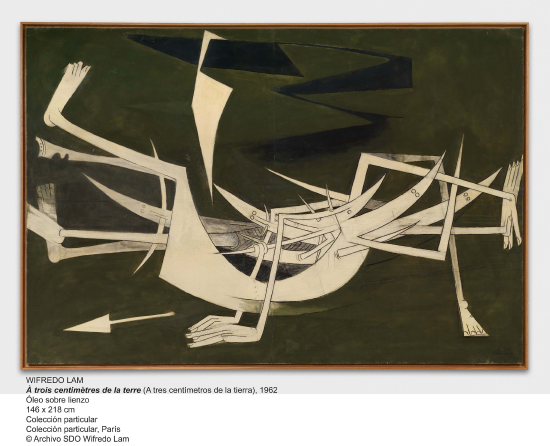
En la exposición del Reina Sofía está magníficamente plasmada esta etapa, (1943-1950) sin duda la de consolidación de su fama. Entre otras obras son verdaderos hitos Estudio para La Jungla. Las representaciones de deidades animistas, como Anamu, El sombrío Malembo, dios de la encrucijada, otra obra maestra comparable a La Jungla, Altar para Elegua, Altar para Yemaya, La luz de la jungla, El desfile antillano, Canaïma, El presente eterno, La boda, Pasos miméticos, Punto de partida, otra obra maestra absoluta, Umbral , los dos Tótem para la luna y la impresionante El rumor de la tierra. Hay mucho más en esta parte muy extensa de la exposición, entre óleos, acuarelas, cuadernos de dibujo, dibujos a tinta sobre papel, grafito sobre papel, soporte favorito de Lam a lo largo de su vida.
In the Reina Sofía exhibition this stage (1943-1950) is magnificently captured, undoubtedly the consolidation of his fame. Among other works are true milestones Study for The Jungle. The representations of animist deities, such as Anamu, The shadowy Malembo, god of the crossroads, another masterpiece comparable to The Jungle, Altar for Elegua, Altar for Yemaya, The light of the jungle, The Antillean parade, Canaïma, The eternal present, The wedding, Mimetic steps, Starting point, another absolute masterpiece, Threshold, the two Totems for the Moon and the impressive The Rumor of the Earth. There is much more in this very extensive part of the exhibition, including oil paintings, watercolors, sketchbooks, ink drawings on paper, graphite on paper, Lam’s favorite medium throughout his life.
El golpe de estado de Fulgencio Batista en marzo de 1952 decide el regreso de Lam a Europa, a París a finales de agosto, donde se reencuentra con sus amigos surrealistas y disidentes del surrealismo. En 1954 descubre en Italia un paraíso en la costa ligur, Albissola, que marcará el principio de su interés por la cerámica, hasta el final de su vida.
The coup d’état by Fulgencio Batista in March 1952 decided Lam’s return to Europe, to Paris at the end of August, where he reunited with his surrealist friends and dissidents of surrealism. In 1954 he discovered a paradise in Italy on the Ligurian coast, Albissola, which would mark the beginning of his interest in ceramics, until the end of his life.
En 1955 viaja a La Habana y a Caracas para presentar sendas exposiciones. (la de La Habana clausurada por la policía antes de su término) Regresa a París y en junio de 1956 conoce a la que será la mujer definitiva en su vida y madre de sus hijos, la joven artista sueca Lou Laurin.
In 1955 he traveled to Havana and Caracas to present exhibitions. (the one in Havana closed by the police before its end) He returned to Paris and in June 1956 he met what would be the definitive woman in his life and mother of his children, the young Swedish artist Lou Laurin.
Pasa la primavera de 1957 viajando por Cuba, Venezuela, Colombia y Brasil, en los tres últimos ampliando sus experiencias ejerciendo de buscador de oro y piedras preciosas. Regresa a Europa y pasa el verano en Albissola, pero a finales de otoño viaja a México con Lou donde residen hasta febrero de 1958. Vuelven a Cuba donde ya resuenan aires revolucionarios, después a Nueva York y el verano en Albissola trabajando en cerámicas.
He spent the spring of 1957 traveling through Cuba, Venezuela, Colombia and Brazil, in the last three expanding his experiences as a gold and precious stone prospector. He returned to Europe and spent the summer in Albissola, but at the end of autumn he traveled to Mexico with Lou where they lived until February 1958. They returned to Cuba where revolutionary airs were already echoing, then to New York and the summer in Albissola working on ceramics.
1959 y 1960 es el triunfo de la revolución cubana y allí está Lam, de nuevo como testigo de excepción de la historia, que plasma en obras maestras como La Sierra Maestra, Los albores de la madrugada y Cerca de las Islas Vírgenes en 1959, y Gran Composición II en 1960. El 21 de noviembre de ese año se casa con Lou Laurin en Manhattan.
1959 and 1960 is the triumph of the Cuban revolution and there is Lam, again as an exceptional witness to history, which he captures in masterpieces such as The Sierra Maestra, The Dawn of the Morning and Near the Virgin Islands in 1959, and Grand Composition II in 1960. On November 21 of that year, he married Lou Laurin in Manhattan.
La década de los 60 es la época gloriosa de la revolución cubana, de la que Lam es protagonista como artista, activista, conferenciante…intelectuales anticapitalistas del mundo acuden a La Habana. Es también la década del asiento definitivo europeo en Albissola, alternado con grandes viajes de promoción y de recreo con su familia. En la década siguiente, hasta 1978 en que sufre un ataque de parálisis, se dedica intensamente a la producción de cerámica en su estudio de Albissola, que para él no es una actividad accesoria, como la pintura es una manifestación de su mundo.
The decade of the 60s is the glorious era of the Cuban revolution, of which Lam is the protagonist as an artist, activist, lecturer…anti-capitalist intellectuals from around the world flock to Havana. It is also the decade of the definitive European seat in Albissola, alternating with great promotional and recreational trips with his family. In the following decade, until 1978 when he suffered an attack of paralysis, he dedicated himself intensely to the production of ceramics in his studio in Albissola, which for him is not an accessory activity, just as painting is a manifestation of his world.
En 1982 la Galería Pierre Matisse de París celebra una exposición de su obra temprana. Wifredo Lam se traslada a París y ahí le sorprende la muerte el 11 de septiembre de 1982. Tiene un gran funeral en el cementerio Père Lachaise. Sus cenizas se trasladan a Cuba y finalmente reposan en el cementerio Colón, en la parte destinada a los miembros de las Fuerzas Armadas Revolucionarias.
En 1982 la Galería Pierre Matisse de París celebra una exposición de su obra temprana. Wifredo Lam se traslada a París y ahí le sorprende la muerte el 11 de septiembre de 1982. Tiene un gran funeral en el cementerio Père Lachaise. Sus cenizas se trasladan a Cuba y finalmente reposan en el cementerio Colón, en la parte destinada a los miembros de las Fuerzas Armadas Revolucionarias.
La magnífica retrospectiva del Reina Sofía ha seguido paso a paso la vida personal y artística de este pintor, sin duda el testigo más completo de los avatares del siglo XX en dos continentes. El mejor testimonio de su fascinante vida es su obra.
The magnificent retrospective at the Reina Sofía has followed step by step the personal and artistic life of this painter, undoubtedly the most complete witness to the vicissitudes of the 20th century on two continents. The best testimony of his fascinating life is his work.
Algunos hitos de sus tres últimas décadas en la exposición son, La maleza, (1958) fantástica muestra de expresionismo abstracto; magnífica la serie de ocho aguafuertes de 1969; obras maestras Al final de la noche y Los Abalochas bailan para Dhambala (1969, 1970). Y las cerámicas expuestas, de una fuerza y belleza extraordinarias, siempre expresión de los mundos de Lam: Prehistoria, Frutos de rebelión, Pez torpedo, Los dos cuchillos, Jarrón I y II.
Some milestones of his last three decades in the exhibition are: The Weed, (1958), a fantastic example of abstract expressionism; the series of eight etchings from 1969 is magnificent; masterpieces At the End of the Night and The Abalochas Dance for Dhambala (1969, 1970). And the ceramics on display, of extraordinary strength and beauty, always an expression of Lam’s worlds: Prehistory, Fruits of Rebellion, Torpedo Fish, The Two Knives, Vase I and II.
Nunca hubo para él un reposo del guerrero, estuvo activo hasta sus últimos días, como muestra la serie de grabados que cierra la exposición y su último viaje a París.Más que una exposición, una vida: Wifredo Lam: cubano, europeo y universal
There was never a warrior’s rest for him, he was active until his last days, as shown in the series of engravings that close the exhibition and his last trip to Paris. More than an exhibition, a life: Wifredo Lam: Cuban, European and universal
Descubre más desde LA AGENCIA MUNDIAL DE PRENSA
Suscríbete y recibe las últimas entradas en tu correo electrónico.