

Carlos Martín Ballester. Isn’t it a Guinness record yet?

COLUMNISTA
Carlos Martín Ballester es el coleccionista cultural número uno de España en lo concerniente a la historia del sonido grabado. Ha dedicado toda una vida prioritariamente al patrimonio sonoro del flamenco, pero también a otros temas que reflejan la historia de España desde 1860 a nuestros días. También es el fundador y presidente del Círculo Flamenco de Madrid, director del Foro Flamenco José Ángel Galán del Real Casino de Madrid y director del Ciclo Flamenco de la Fundación Unicaja.
Carlos Martín Ballester is the number one cultural collector in Spain. He has dedicated his entire life primarily to the sound heritage of flamenco, but also to other topics that reflect the history of Spain from 1860 to the present day. He is also the founder and president of the Círculo Flamenco de Madrid, director of the José Ángel Galán Flamenco Forum of the Real Casino of Madrid and director of the Ciclo Flamenco of the Unicaja Foundation.
En una extensa conversación Carlos Martín Ballester habla exhaustivamente de la misión de su vida, a partir de la exposición El Flamenco en la dramática Luna Negra con motivo del Festival Suma Flamenca 2024 .
In an extensive conversation, Carlos Martín Ballester speaks exhaustively about his life’s mission, starting with the exhibition El Flamenco en la dramatic Luna Negra that took place on the occasion of the Suma Festival.

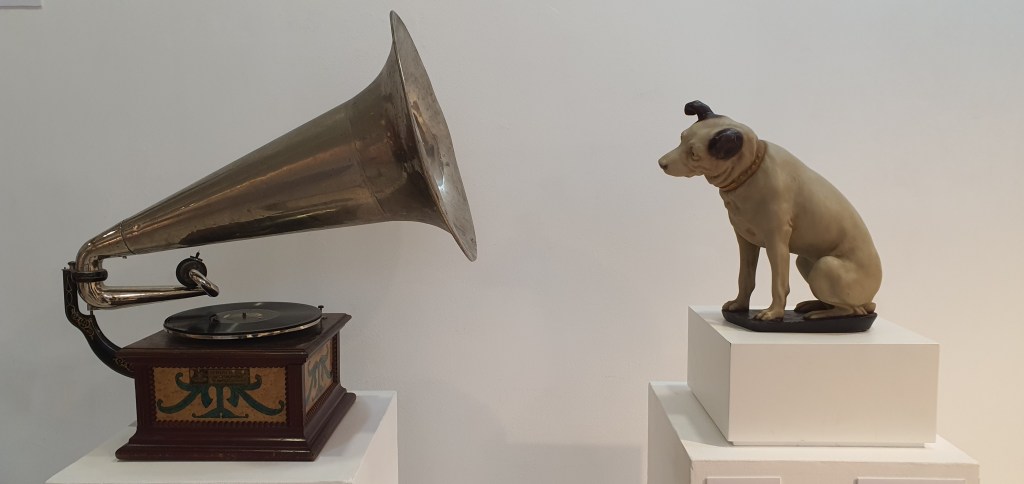
Carlos Martín Ballester .Como ves, Teresa, la exposición ocupa tres salas. La primera se centra en la época del fonógrafo, es decir, desde 1877 hasta aproximadamente 1910, cuando desaparece como soporte de grabación. La segunda está dedicada al disco llamado de pizarra, hasta el año 1925, que es cuando termina la etapa más antigua de grabación de discos. En la última sala, está la época, digamos, de mayor expansión, de mayor calidad sonora, la del gramófono, que cubre los años 1925 a 1950, hasta la llegada del microsurco.
Carlos Martín Ballester. As you see, Teresa, the exhibition occupies three rooms. The first focuses on the era of the phonograph, that is, from 1877 until approximately 1910, when it disappeared as a recording medium. The second is dedicated to the so-called slate record, until 1925, which is when the oldest stage of recording records ended. In the last room, there is the period, let’s say, of greatest expansion, of greatest sound quality, that of the gramophone, which covers the years 1925 to 1950, until the arrival of the microgroove.
Teresa Fernández. Carlos quiero que esta sea una conversación que haga historia, así que empezando por la necesariamente pequeña muestra que vemos aquí, quiero abarcar todo lo que has coleccionado desde hace treinta años.
Teresa Fernandez. Carlos, I want this to be a conversation that makes history, so starting with the necessarily small sample that we see here, I want to cover everything you have collected for thirty years.
CMB. Vamos a centrarnos en los sistemas de registro sonoro desde este fonógrafo y la muestra de cilindros que se introducían en el cilindro metálico que giraba sobre su propio eje, y el diafragma que está suspendido encima, así al posarse sobre la superficie del cilindro iba reproduciendo el sonido. Tenemos principalmente cilindros de Madrid, Barcelona y Valencia, las plazas más importantes en torno al fonógrafo. Todo acompañado de documentos que contextualizan el período y fenómeno del fonógrafo.
CMB. We are going to focus on the sound recording systems from this phonograph and the sample of cylinders that were introduced into the metal cylinder that rotated on its own axis, and the diaphragm that is suspended above, thus when it landed on the surface of the cylinder it reproduced the sound. We mainly have cylinders from Madrid, Barcelona and Valencia, the most important places around the phonograph. All accompanied by documents that contextualize the period and phenomenon of the phonograph.

TF. Me llama la atención este cartel de Carmencita, Carmen Doucet. Es que no la conozco…
TF. This poster of Carmencita, Carmen Doucet, catches my attention. I just don’t know her…
CMB. Carmencita fue entre otras cosas una bailarina española afincada en Estados Unidos, que también hizo cine, fíjate que fue la primera mujer que registró su imagen en movimiento, filmada por Edison. Hay una pieza suya en la Biblioteca del Congreso de Estados Unidos. Fue una diva absoluta. Cuñada nada menos que de Rojo el Alpargatero.
CMB. Carmencita was, among other things, a Spanish dancer living in the United States, who also made films. Note that she was the first woman to record her moving image, filmed by Edison. There is a piece of his in the United States Library of Congress. She was an absolute diva. Sister-in-law of none other than Rojo the Alpargatero.
Pasamos a esta segunda sala que se centra en la aparición del disco, como soporte de grabación del llamado disco de pizarra o de 78 rpm. Estuvo vigente durante cincuenta años hasta la aparición del microsurco.
We move on to this second room that focuses on the appearance of the record, as a recording medium for the so-called slate or 78 rpm record. It was in force for fifty years until the appearance of the microgroove.

Esta es una vitrina dedicada a 1922, al Concurso de Cante Jondo de Granada. Y aquí hay un disco del Tenazas, ganador del concurso y este otro de Manuel Torre, y alguna otra documentación vinculada al concurso.
This is a showcase dedicated to 1922, to the Granada Cante Jondo Competition. And here is an album by Tenazas, winner of the contest, and this one by Manuel Torre, and some other documentation linked to the contest.
Y ya en esta sala vamos caminando por el primer cuarto del siglo XX. Este es un gramófono también original.
And now in this room we are walking through the first quarter of the 20th century. This is also an original gramophone.
TF. He estado viendo toda tu página web y como aquí veo cosas que no están allí, creo que se trata de una pequeña muestra de digitalización.Ahí no hay fonógrafos ni gramófonos…
TF. I have been looking at your entire website and since I see things here that are not there, I think it is a small sample of digitization. There are no phonographs or gramophones there…
CMB. No, claro, la página web es el comienzo de la digitalización de la colección, que surgió como un proyecto de colaboración con el INAEM hace unos años, y lo que se ha puesto en marcha es un proceso de digitalización paulatino, una mínima parte que se ha ido digitalizando, por ejemplo fotografía, algo de disco, pero faltan muchas materias.
CMB. No, of course, the website is the beginning of the digitization of the collection, which emerged as a collaboration project with the INAEM a few years ago, and what has been launched is a gradual digitization process, a minimal part that It has been digitized, for example photography, some disks, but many subjects are missing.
En la página web hay unos dos mil documentos, que pueden ser aproximadamente de un 3%,a un 5% del conjunto de la colección. Es un proceso a muy largo plazo, que incluye catalogación, digitalización, divulgación, en fin, es un proyecto complejo que sigue en marcha. La colección continúa, nunca la vamos a dar por terminada. Es también una labor de conservación y salvaguardia, que es siempre una acción necesaria, porque siguen apareciendo materiales, que si no se pone interés en ello y no se entiende que han de conservarse se perderían, se disgregarían o se destruirían. En parte, es la responsabilidad que yo siento que tengo a la hora de poder recuperar esos materiales y darles una función. Por ejemplo, en el caso de la Copa Pavón, aquí están los carteles originales de cuando se le concedió la copa en 1925 y de cuando se le entregó la llave de oro al año siguiente en 1926.
On the website there are about two thousand documents, which can be approximately 3% to 5% of the entire collection. It is a very long-term process, which includes cataloguing, digitization, dissemination, in short, it is a complex project that is still ongoing. The collection continues, we will never end it. It is also a task of conservation and safeguarding, which is always a necessary action, because materials continue to appear, which if there is no interest in it and it is not understood that they must be conserved, they would be lost, disintegrated or destroyed. In part, it is the responsibility that I feel I have when it comes to recovering those materials and giving them a function. For example, in the case of the Pavón Cup, here are the original posters from when the cup was awarded in 1925 and when the golden key was awarded the following year in 1926.

TF. En realidad Carlos, a día de hoy, ¿cuántos documentos y objetos, hay registrados en la colección?
TF. In reality, Carlos, today, how many documents and objects are registered in the collection?
CMB. No sabemos. No te puedo decir, pero más de cien mil seguramente, que están distribuidos en varios locales en Madrid y en mi domicilio. La intención es agruparlos todos en un solo local para hacerla visitable. Ahora mismo es inviable.
CMB. We don’t know. I can’t tell you, but surely more than a hundred thousand, which are distributed in various stores in Madrid and in my home. The intention is to group them all in a single location to make it visitable. Right now it is unfeasible.
TF. Y la colección continúa…
TF. And the collection continues…
CMB.. Ayer mismo, por ejemplo, fui a ver una colección de discos, la semana pasada, fui a ver otra en Sevilla. La entrada de documentos nuevos en la colección es constante. Entonces, imagínate que los documentos que llegan, hay que prepararlos, algunos de ellos hay que restaurarlos, limpiarlos, catalogarlos y digitalizarlos. Y además de lo nuevo que va entrando, todo lo que hay ya incorporado a la colección a lo largo de años.
CMB.. Just yesterday, for example, I went to see a record collection, last week, I went to see another in Seville. The entry of new documents into the collection is constant. So, imagine that the documents that arrive must be prepared, some of them must be restored, cleaned, cataloged and digitized. And in addition to the new things that are coming in, everything that has already been incorporated into the collection over the years.
TF. Además de Zaida, ¿hay alguien más que colabore en toda esta labor?
TF. Besides Zaida, is there anyone else who collaborates in all this work?
CMB. De momento solo Zaida y yo. Ten en cuenta, Teresa, que esta labor es inabarcable, es decir si estuviéramos hablando de una institución pública, hablaríamos de decenas de especialistas trabajando en ello, ¿no? aquí nos vemos obligados a tomar esta iniciativa porque miramos a izquierda y derecha y vemos que no tenemos el acompañamiento que debería tener la conservación del patrimonio, en este caso, lo que tiene que ver con el flamenco, aunque la colección no solo se queda en el flamenco, también está otra base de la colección, toda la grabación vinculada a la historia de España, a nivel literario, científico, político, radiofónico, publicitario, etc. Consideramos que era necesario tomar la iniciativa en esos dos ámbitos, aunque eso conlleve un gran desgaste y una gran carga de trabajo, pero bueno, consideramos que es necesario.
CMB. At the moment just Zaida and me. Keep in mind, Teresa, that this work is incomprehensible, that is, if we were talking about a public institution, we would be talking about dozens of specialists working on it, right? here we are forced to take this initiative because we look left and right and see that we do not have the support that the conservation of heritage should have, in this case, what has to do with flamenco, although the collection not only remains in Flamenco is also another basis of the collection, the entire recording linked to the history of Spain, at a literary, scientific, political, radio, advertising, etc. level. We considered that it was necessary to take the initiative in those two areas, although that entails great wear and tear and a large workload, but hey, we considered that it was necessary.
TF. ¿Cómo se construye una colección como esta?
TF. How do you build a collection like this?
CMB. Bueno, pues se construye por encima de todo, con mucha curiosidad y con mucha responsabilidad. Esa es la base, luego, evidentemente, necesitas tiempo, necesitas capacidad de desplazamiento a nivel nacional y fuera de España y también necesitas inversión, lógicamente, pero todo esto que he dicho es lo menos importante. Sin la afición y la decisión firme de proteger una serie de materiales, todo esto no se podría llevar adelante. Y entonces, bueno, todo lo comencé por mi amor al Flamenco y por mi curiosidad de conocer más y mejor la historia de este arte y también para poder entender mejor lo que yo iba viendo en directo de manera constante desde hace más de treinta años. Esa fue la raíz, luego me fui involucrando.
CMB. Well, it is built above all, with a lot of curiosity and a lot of responsibility. That is the basis, then, obviously, you need time, you need the capacity to travel nationally and outside of Spain, and you also need investment, logically, but all of this that I have said is the least important. Without the hobby and the firm decision to protect a series of materials, all this could not be carried out. And then, well, I started it all because of my love of Flamenco and my curiosity to know more and better the history of this art and also to be able to better understand what I had been seeing live constantly for more than thirty years. That was the root, then I got involved.
TF. Tú empezaste y te constituiste en empresa cultural en 1993, cuando tenías diecinueve años. Quiere esto decir que ya habías empezado antes…
TF. You started and became a cultural company in 1993, when you were nineteen years old. This means that you had already started before…
CMB. Sí, sí, así fue, yo empecé muy joven. Yo desde muy niño, ya escuchaba mucha música en general. Luego en la adolescencia, me fui interesando más por la música en directo y también por el flamenco. Entonces, desde ese momento, prácticamente con dieciocho años, ya empecé a interesarme mucho por lo que era el patrimonio sonoro grabado. No ya el del vinilo que ya era muy familiar en mi caso, sino también por el disco de 78 rpm, el disco de pizarra.
CMB. Yes, yes, that’s how it was, I started very young. From a very young age, I listened to a lot of music in general. Later, as a teenager, I became more interested in live music and also in flamenco. So, from that moment, when I was practically eighteen years old, I began to be very interested in what recorded sound heritage was. Not only the vinyl that was already very familiar in my case, but also the 78 rpm record, the slate record.
De ahí a la referencia de los cantaores que yo veía en directo y que habían grabado en las 78 rpm. Empecé por ahí, empecé a viajar y a buscar colecciones para intentar armar, digamos, un corpus de grabaciones flamencas que a mí me sirvieran de referencia y que fueran de primera mano, es decir, que no fueran regrabaciones. Lo que hice fue ir a las fuentes a buscar esos registros sonoros.
From there to the reference to the singers that I saw live and who had recorded on 78 rpm. I started there, I started traveling and looking for collections to try to put together, let’s say, a corpus of flamenco recordings that would serve as a reference for me and that were first-hand, that is, they were not re-recordings. What I did was go to the sources to look for those sound records.
Yo estaba estudiando derecho y dejé la carrera en la mitad, y directamente me involucré en todo lo que tenía que ver con esto. Puse en marcha una actividad profesional que duró muchísimos años, en que hice subastas internacionales cada tres meses, con clientes por todo el mundo…
I was studying law and I left my degree halfway through, and I directly got involved in everything that had to do with this. I started a professional activity that lasted many years, in which I held international auctions every three months, with clients all over the world…
TF. ¿Subastas internacionales?
TF. International auctions?
CMB. Sí, en torno a los discos, que no entraban de lleno en el núcleo de mi colección, que no eran de flamenco, todas esas grabaciones que tenían que ver con la ópera, con la zarzuela, con música sudamericana, etc., formaban parte de un catálogo trimestral que yo editaba y viajaba por todo el mundo. Era un medio de financiación y de protección.
CMB. Yes, regarding the records, which did not fully fit into the core of my collection, which were not flamenco, all those recordings that had to do with opera, zarzuela, South American music, etc., were part of a quarterly catalog that I edited and traveled around the world. It was a means of financing and protection.
TF. ¿Cuándo empezaste a tener apoyo del Ministerio de Cultura, del INAEM o de la Unión Europea?
TF. When did you start to have support from the Ministry of Culture, INAEM or the European Union?
CMB. Bueno, nosotros tenemos relación con muchas instituciones, pero que financien la colección no. Nosotros hacemos algunos trabajos con algunas instituciones, por ejemplo, con el CSIC, hemos acabado un proyecto muy emocionante en torno a una parte de digitalización de sus fondos discográficos en nuestro estudio de grabación, porque estamos especializados en digitalización de registros sonoros. Luego, en la Biblioteca Nacional, por ejemplo, he dado cursos de formación a su personal, de adaptación y datación de registros sonoros. Tenemos una relación constante con la Biblioteca de Catalunya sobre un vasto archivo de música, con Eresbil, (Archivo Vasco de la Música) y con el Arquivo Sonoro Galicia también.
CMB. Well, we have relationships with many institutions, but they don’t finance the collection. We do some work with some institutions, for example, with the CSIC, we have finished a very exciting project around part of the digitization of their recording collections in our recording studio, because we are specialized in digitization of sound records. Then, at the National Library, for example, I have given training courses to its staff on adaptation and cataloging of sound records. We have a constant relationship with the Generalitat of Catalonia, over a vast music archive, and with Galicia as well.
Hemos tenido acuerdos puntuales con el INAEM, un acuerdo por el que se digitalizó, una pequeña parte de la colección, pero eso fue, un acuerdo puntual que no tiene continuidad. Realmente lo que es la actividad de la colección, es financiada fundamentalmente con fondos propios.
We have had specific agreements with the INAEM, an agreement by which a small part of the collection was digitized, but that was a specific agreement that has no continuity. Actually, what the collection activity is, is financed fundamentally with its own funds.
TF. Veo algunas joyitas por aquí…
TF. I see some gems here…
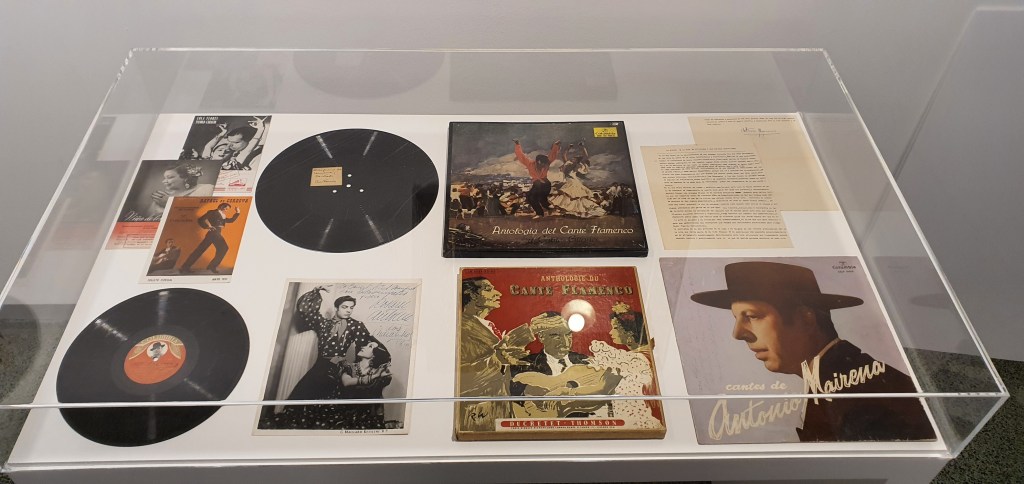
CMB. Alguna obra de arte, con alguna escultura que tiene que ver con las compañías de discos, como esta vitrina dedicada a Ramón Montoya y a la guitarra, con una selección de sus grabaciones, en España y en Francia. Aquí está la antología que le produjo Marius de Zayas, en Paris.
CMB. Some work of art, with some sculpture that has to do with record companies, like this display case dedicated to Ramón Montoya and the guitar, with a selection of his recordings, in Spain and France. Here is the anthology that Marius de Zayas produced in Paris.

Tenemos una vitrina central dedicada a Antonia Mercé, la Argentina, con un guiño a Vicente Escudero, porque ellos tuvieron una estrecha relación. Y luego seguimos un recorrido cronológico a través de la cartelería de las compañías de discos, carteles que no se ponían a la venta sino que se enviaban directamente a sus distribuidores. Un gramófono original también de la época, y por último esta vitrina dedicada al periodo final del disco de 78rpm, por ejemplo de Manolo Caracol, de Antonio Ruiz Soler y un guiño ya, a lo que venía posteriormente, el disco microsurco, de vinilo, que venía por las antologías, por los festivales, por el neoclasicismo flamenco, que enarbolaba Antonio Mairena, dedicado a Antonio el Bailarín, es decir, hay como muchos vasos comunicantes en la exposición, y una carta, a modo de corolario, en la que Antonio Mairena habla del fallecimiento de Pastora Pavón, La Niña de los Peines, y de la importancia de su obra discográfica.
We have a central display case dedicated to Antonia Mercé, Argentina, with a nod to Vicente Escudero, because they had a close relationship. And then we continue with, we follow a chronological tour through the posters of the record companies, posters that were not put up for sale but were sent directly to their distributors. An original gramophone also from the time, and finally this display case dedicated to the final period of the 78rpm record, for example by Manolo Caracol, Antonio Torres and a nod to what came later, the microgroove vinyl record, which It came from the anthologies, from the festivals, from the flamenco neoclassicism championed by Antonio Mairena, dedicated to Antonio the Dancer, that is, there are many communicating vessels in the exhibition, and a letter, as a corollary, in which Antonio Mairena talks about the death of Pastora Pavón, La Niña de los Peines, and the importance of her recording work.
TF. Tengo una pregunta muy a tono con el final de tu explicación de la exposición. Tu colección, ¿es única en España?
TF. I have a question very much in line with the end of your explanation of the exhibition. Is your collection unique in Spain?
CMB. En los dos ámbitos en los que yo me muevo, es decir, en Flamenco, y en grabaciones no performativas, decir, la vinculación de la historia de España, es una colección absolutamente de referencia, tanto en la cantidad, como sobre todo en la calidad. Insisto mucho en la calidad de las grabaciones sonoras, porque es sobre lo que orbita todo lo demás.
CMB. In the two areas in which I operate, that is, in Flamenco, and in non-performative recordings, that is, the linking of the history of Spain, it is an absolutely reference collection, both in quantity and, above all, in the quality. I insist a lot on the quality of the sound recordings, because it is what everything else revolves around.
En los registros sonoros que integran la colección, siempre hago de manera constante, un ejercicio de comparación entre el documento que se incorpora y lo que se encuentra dentro. Y lo que hago es compararlos y seleccionar el documento que se encuentra en mejor estado. Llevo en esta investigación más de treinta años. Lo que significa que los materiales que hay dentro de la colección, por ejemplo, este cartel, o por ejemplo, uno de esos discos de Montoya, pues a lo mejor han pasado por mis manos diez o veinte ejemplares hasta quedarme con este ejemplar en perfecto estado. La calidad de los otros materiales, como las obras de arte, la fotografía, la cartelería, materiales personales de artistas, etc. también es significativa.
In the sound records that make up the collection, I always constantly do a comparison exercise between the document that is incorporated and what is found inside. And what I do is compare them and select the document that is in the best condition. I have been doing this research for more than thirty years. Which means that the materials in the collection, for example, this poster, or for example, one of those Montoya records, well maybe ten or twenty copies have passed through my hands until I am left with this copy in perfect condition. state. The quality of other materials, such as works of art, photography, posters, artists’ personal materials, etc. It is also significant.
TF. ¿Qué significa eso?
TF. What does that mean?
CMB. Pues que a la hora de marcar un cartel, busco el ejemplar en mejor estado de conservación, o en el caso de un disco, poder tener una copia salida de fábrica, permite que a la hora de digitalizarlo podamos extraer la mayor cantidad de señal sonora, con un nivel de fidelidad y de pureza, con una calidad de armónicos y de frecuencias que de otra manera no se podrían encontrar.
CMB. Well, when marking a poster, I look for the copy in the best state of conservation, or in the case of a record, being able to have a copy from the factory, allows us to extract the greatest amount of sound signal when digitizing it. , with a level of fidelity and purity, with a quality of harmonics and frequencies that cannot be found otherwise.
Por eso, en las publicaciones que hacemos también, el nivel de calidad sonora es mucho más pura, más real, más fiel con el modelo, tiene esa sensación de naturalidad que muchas veces a la hora de digitalizar las grabaciones antiguas, han perdido calidad por filtros digitales o por restauraciones que limitan el resultado final de la grabación.
For this reason, in the publications we make as well, the level of sound quality is much purer, more real, more faithful to the model, it has that feeling of naturalness that many times when it comes to digitizing old recordings, they have lost quality due to digital filters or restorations that limit the final result of the recording.
TF. Otra cosa, la venta de libros como los que están expuestos, las copias por encargo de discos de Tomás Pavón, de Manuel Torres, de Antonio Chacón, que no sé si abarcan toda su producción cantaora, y otras fuentes de ingresos, ¿se reinvierten en la colección?
TF. Another thing, the sale of books like those on display, the commissioned copies of records by Antonia Pavón, Manuel Torres, Antonio Chacón, which I don’t know if they cover all of their cantaora production, and other sources of income, are they reinvested? in the collection?
CMB. Sí, prácticamente todo. En el caso de las publicaciones que dan a conocer la obra discográfica de esos artistas de una manera respetuosa y lo más fiel a lo original, indudablemente los ingresos que se perciben, a través de las muy distintas líneas de actividad que llevamos a cabo, contribuyen a seguir financiando otras compras de materiales, la catalogación, las digitalizaciones, etc., etc.
CMB. Yes, practically everything. In the case of publications that make known the recording work of these artists in a respectful manner and as faithful to the original as possible, undoubtedly the income received, through the very different lines of activity that we carry out, contribute to continue financing other purchases of materials, cataloguing, digitizations, etc., etc.

Siempre insisto que esto es un juego de dos miradas, una hacia el pasado, hacia el patrimonio, y otra hacia el presente y hacia adelante, porque sería muy triste ver un fenómeno como la música, mirando exclusivamente al pasado. Sin prescindir de él, también hay que mirar al presente y al futuro. Me parece que es una labor coherente, observar el pasado, disfrutar de él, conservarlo y a la vez proyectarlo hacia el futuro.
I always insist that this is a game of two looks, one towards the past, towards heritage, and another towards the present and forward, because it would be very sad to see a phenomenon like music, looking exclusively at the past. Without ignoring it, we must also look at the present and the future. It seems to me that it is a coherent task, observing the past, enjoying it, preserving it and at the same time projecting it into the future.
TF. ¿Tenéis todo lo grabado por estos y otros cantaores y cantaoras?
TF. Do you have everything recorded by these and other cantaores and cantaoras?
CMB. De la mayoría de los cantaores tenemos todo, aunque siempre faltan cosas, porque es inevitable y es casi de agradecer que siempre falten cosas porque eso hace que uno tenga siempre la ilusión despierta a la hora de acercarse a ver una colección, a estudiar un fondo, pero como digo, aunque falten materiales, que siempre faltan, está muy completa.
CMB. We have everything from the majority of singers, although things are always missing, because it is inevitable and it is almost to be appreciated that things are always missing because that makes one always have the illusion awake when approaching to see a collection, to study a collection. , but as I say, although there are missing materials, which are always missing, it is very complete.
TF. ¿Hay un vacío institucional en lo que se refiere a reconocimiento y apoyo financiero?
TF. Is there an institutional void when it comes to recognition and financial support?
CMB. Hay un vacío que no se cubre, por cuanto las instituciones muchas veces y no por culpa de los técnicos que hay en ellas, sino porque en general, no hay una gran consideración del patrimonio sonoro grabado como una parte representativa de nuestra cultura. Se considera que otras expresiones son más merecedoras de conservación y sin embargo, lo que tiene que ver con nuestro pasado grabado, pues no se considera tanto. Sobre todo el flamenco, que es algo tan exclusivamente español y Patrimonio Inmaterial de la Humanidad.
CMB. There is a gap that is not covered, because the institutions often do not blame the technicians in them, but because in general, there is not a great consideration of the recorded sound heritage as a representative part of our culture. It is considered that other expressions are more deserving of conservation and however, what has to do with our recorded past is not considered as much. Especially flamenco, which is something so exclusively Spanish and Intangible Heritage of Humanity.
TF. ¿Y se aprecia, al menos, por parte de las instituciones que quizás deberían ocuparse de este patrimonio?
TF. And is it appreciated, at least, by the institutions that perhaps should take care of this heritage?
CMB. Sí, sí se aprecia, pero ya te digo que no es tan culpa de instituciones, como que a nivel político, haya iniciativas firmes y claras en torno a la protección del patrimonio y que se estime que no solo es merecedor de conservación, una obra pictórica o un mapa de siglo XVII, sino también nuestra primera grabación fonográfica, que es tan representativa y tan merecedora de conservación.
CMB. Yes, it is appreciated, but well, but I already told you that it is not so much the fault of institutions, as that at a political level, there are firm and clear initiatives regarding the protection of heritage and that it is considered that it is not only worthy of conservation , a pictorial work or a map from the 17th century, but also our first phonographic recording, which is so representative and so deserving of preservation.
Entonces, mientras las cosas no cambien, uno no se puede quedar parado. No es una alegría que una institución pública no se pueda hacer cargo por ejemplo de los fondos de la colección de Manuel Vallejo o de la de Antonio Ruiz Soler y que tengan que salir a la venta en Durán hace más de veinte años. Eso para mí es una tristeza, pero como tengo una consideración alta de lo que debe ser la conservación del patrimonio, pues hago esa labor de guarda y custodia, hasta que llegue el momento de que las instituciones decidan hacerlo. Por eso adquirí los fondos de toda la parte discográfica de Antonio Ruiz Soler, y todo lo que llevo haciendo desde hace muchos años.
So, as long as things don’t change, one cannot stand still. It is not a joy that a public institution cannot take charge, for example, of the collections of Manuel Vallejo or that of Antonio Ruiz Soler and that they have to go on sale in Durán more than twenty years ago. That is sad for me, but since I have a high regard for what heritage conservation should be, I do the work of guarding and custody, until the time comes for the institutions to decide to do so. That is why I acquired the funds for the entire Antonio Ruiz Soler recording part, and everything that I have been doing for many years.
TF. Tengo una curiosidad, me llamó mucho la atención la colección de himnos de todos los colores políticos, religiosos, etc., etc., pero o yo no lo he visto o me chocó un poco, que no esté el Cara al Sol.
TF. I’m curious, the collection of hymns of all political, religious, etc., etc. colors caught my attention, but either I haven’t seen it or I was a little shocked that Cara al Sol isn’t there.
CMB. Sí, está. Te recuerdo que es una pequeña muestra lo que está en la web, pero tenemos cientos de himnos, por ejemplo, del Cara al Sol tenemos la grabación de propaganda del golpe militar del 36 y hasta prácticamente mediados de los 40, la producción fue muy amplia, sobre todo con la compañía Columbia, digamos, de todos los himnos de propaganda fascista. También de propaganda comunista.
CMB. Snap. I remind you that what is on the web is a small sample, but we have hundreds of hymns, for example, from Cara al Sol we have the propaganda recording of the military coup of ’36 and until practically the mid-40s, the production was very extensive. , especially with the Columbia company, let’s say, of all the fascist propaganda hymns. Also communist propaganda.
A nivel de colección me interesa todo lo que sea producción española. Pero también temas españoles que se graben fuera de España, tenemos ejemplos de la Marcha Real o el Himno de Riego. No nos interesan himnos de otros países pero hay casos como Yo tenía un camarada , una adaptación de la Falange del himno alemán Ich hatt einen kameraden. La letra fue un poco cambiada aquí, a gusto de la Falange.
At the collection level I am interested in everything that is Spanish production. But also Spanish songs that are recorded outside of Spain, we have examples of the Royal March or the Riego Hymn. We are not interested in anthems from other countries but there are cases like I had a comrade, an adaptation by the Falange of the German anthem Ich hatt einen kameraden. The lyrics were changed a little here, to the liking of the Falange.
Por ejemplo, tenemos una pieza única, un cilindro de cera de la primera versión del Himno de Riego, la Marcha Real y la Marsellesa. Tenemos también La Internacional grabada por Gramophone en Barcelona en 1936, cuando Cataluña no estaba ocupada. Hay alguna versión más, aunque evidentemente no se grabó lo que estaba en los escenarios, en la calle, o lo que sonaba en la radio.
For example, we have a unique piece, a wax cylinder of the first version of the Irrigation Hymn, the Royal March and the Marseillaise. We also have La Internacional recorded by Gramophone in Barcelona in 1936, when Catalonia was not occupied. There are some other versions, although obviously what was on stage, in the street, or what was played on the radio was not recorded.
La grabación es una parte importante del mosaico que nos ayuda a entender la historia de ese periodo. Pero no es lo único, son muchos los símbolos para reflejar un periodo histórico. Símbolos que servían para elevar el ánimo de la tropa y lo más importante, para hacer propaganda.
The recording is an important part of the mosaic that helps us understand the history of that period. But it is not the only thing, there are many symbols to reflect a historical period. Symbols that served to raise the morale of the troops and, most importantly, to create propaganda.
TF. Toca decir si hay algo relevante que quieras añadir que no haya preguntado.
TF. It’s time to say if there is anything relevant that you want to add that I haven’t asked.
CMB. Hemos tocado casi todo, a nivel discográfico, de sonido, de conservación, de cartelería, de catálogos. Bueno, de catálogos, sí quiero añadir que son una labor casi de espeleología, en el sentido de que las compañías discográficas apenas han conservado nada de su patrimonio. También he querido conservar todos esos suplementos de catálogos por un lado, por conocer cuál era la producción .discográfica, saber realmente qué habían grabado y también saber la secuencia de publicación, de grabaciones.
CMB. We have touched almost everything, at the record level, sound, conservation, posters, catalogues. Well, regarding catalogues, I do want to add that they are almost a caving task, in the sense that the record companies have barely preserved any of their heritage. I also wanted to preserve all those catalog supplements on the one hand, to know what the record production was, to really know what they had recorded and also to know the sequence of publication, of recordings.
Recuerdo que en los comienzos, cuando llamaba a las compañías discográficas hace treinta años para preguntar si tenían un archivo, si tenían documentación, no sabían de qué estaba hablando. Así que lo que hice, igual que con los discos, fue acudir a todo tipo de fuentes, lo que nos permitió el acceso a todos los catálogos no publicados.
I remember in the early days when I was calling record companies thirty years ago to ask if they had a file, if they had documentation, they didn’t know what I was talking about. So what I did, just like with the records, was to go to all kinds of sources, which allowed us access to all the unreleased catalogs.
TF. Vale Carlos, ante todo quiero darte las gracias por ese enorme trabajo que empezaste con diecinueve años y que vas a continuar mientras vivas, lo que te hace merecedor de muchos premios y reconocimientos a la verdadera dimensión de tu empresa cultural, sobre todo en lo que se refiere al flamenco, en lo que es única en el mundo.
TF. Ok Carlos, first of all I want to thank you for that enormous work that you started when you were nineteen years old and that you will continue as long as you live, which makes you worthy of many awards and recognitions for the true dimension of your cultural enterprise, especially in what refers to flamenco, in which it is unique in the world.
CMB. Déjame añadir una cosa más, sobre la expansión de la colección fuera de España. Nos llegan constantes peticiones del exterior y también somos socios de dos sociedades muy importantes de Estados Unidos dedicadas a la conservación del patrimonio de registros sonoros. Nuestra colaboración con investigadores tanto españoles como foráneos es muy frecuente. Nos solicitan o bien contribuir con artículos o con documentos para exposiciones o ayuda para preparar alguna discografía o catalogación de registros sonoros.
CMB. Let me add one more thing, about the expansion of the collection outside of Spain. We receive constant requests from abroad and we are also partners of two very important companies in the United States dedicated to the conservation of sound recording heritage. Our collaboration with both Spanish and foreign researchers is very frequent. They ask us to either contribute with articles or documents for exhibitions or help to prepare a discography or cataloging of sound records.

Descubre más desde LA AGENCIA MUNDIAL DE PRENSA
Suscríbete y recibe las últimas entradas en tu correo electrónico.
