

The drama of being a woman in Iran

Hoy en día ser activista de Derechos Humanos en nuestras geografías cercanas, puede suscitar polémicas, críticas, aplausos, en cualquier caso respeto y en algún caso enorme notoriedad mediática. Véase el caso de Greta Thunberg, conocida mundialmente por su activismo medioambiental y receptora de varios premios a sus 22 años.
Nowadays, being a Human Rights activist in our nearby geographies can spark controversy, criticism, applause, in any case respect, and in some cases enormous media notoriety. See the case of Greta Thunberg, known worldwide for her environmental activism and recipient of several awards at the age of 22.
La otra cara de la moneda es la activista de Derechos Humanos Narges Mohammadi, Premio Nobel de la Paz 2023, «por su lucha contra la opresión de las mujeres en Irán y su lucha por promover los derechos humanos y la libertad para todos». Encarcelada desde hace años en varias ocasiones y desde 2021 condenada a doce años, once meses y 154 latigazos, tras un juicio que duró cinco minutos sin presencia de abogado defensor alguno. Si es que a eso puede llamársele juicio.
The other side of the coin is the Human Rights activist Narges Mohammadi, Nobel Peace Prize 2023, «for her fight against the oppression of women in Iran and her fight to promote human rights and freedom for all.» Imprisoned for years on several occasions and since 2021 sentenced to twelve years, eleven months and 154 lashes, after a trial that lasted five minutes without the presence of any defense lawyer. If that can be called judgment.
A lo largo de su historia, Narges Mohammadi ha pedido justicia, ha acompañado a las familias de víctimas de violencia policial, ha exigido el fin de la pena de muerte, ha denunciado la violencia sexual, ha pasado su vida exigiendo respeto por los derechos más elementales y fundamentales.
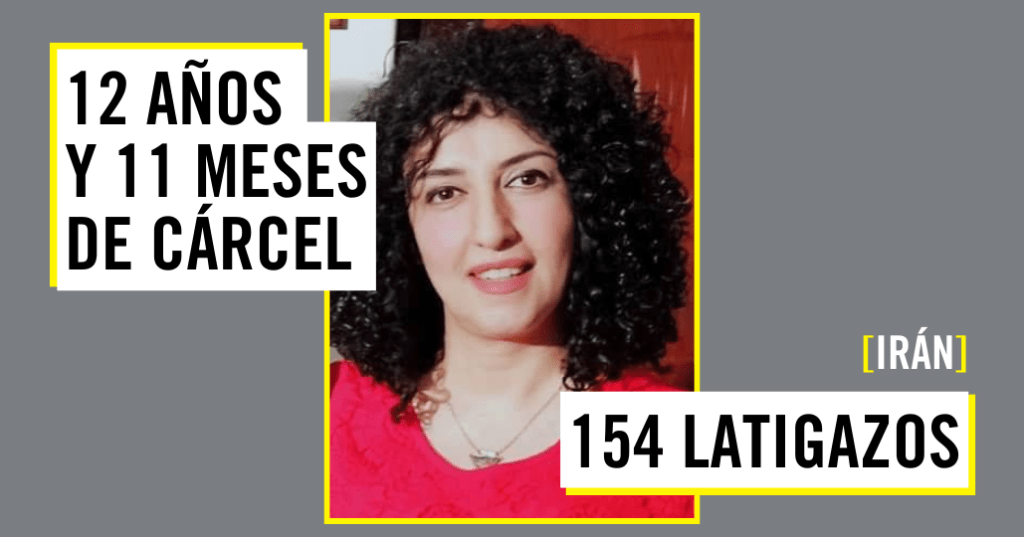
Throughout his history, Narges Mohammadi has called for justice, has accompanied the families of victims of police violence, has demanded the end of the death penalty, has denounced sexual violence, has spent his life demanding respect for the most elementary and fundamental.
Por eso está en prisión, de donde quizá no salga con vida.
That’s why he is in prison, from where he may not come out alive.
En noviembre del año pasado, un mes después de recibir el Premio Nobel de la Paz, empezó una huelga de hambre para reclamar atención médica para sus problemas cardiovasculares. Para su traslado a un hospital las autoridades penitenciarias exigieron que lo hiciese llevando el velo obligatorio para las mujeres iraníes. Se negó. Finalmente, ante su estado alarmante la trasladaron . Las pruebas revelaron que varios de sus vasos sanguíneos estaban bloqueados, lo que requería una operación de angioplastia. Después de la operación fue llevada de nuevo a prisión, en contra de la opinión médica.
In November of last year, a month after receiving the Nobel Peace Prize, he began a hunger strike to demand medical attention for his cardiovascular problems. To be transferred to a hospital, the prison authorities demanded that she do so wearing the veil mandatory for Iranian women. He refused. Finally, given her alarming condition, they transferred her. Tests revealed that several of his blood vessels were blocked, requiring angioplasty surgery. After the operation she was taken back to prison, against medical opinion.
El pasado 13 de agosto, con una valentía inclasificable, Narges y otras compañeras de prisión, protestaron pacíficamente,-¿podría ser de otra forma en una cárcel iraní?- contra la ejecución de presos condenados a muerte y en concreto contra las últimas ejecuciones.
On August 13, with unclassifiable courage, Narges and other fellow prisoners peacefully protested – could it be any other way in an Iranian prison? – against the execution of prisoners sentenced to death and specifically against the latest executions.
En respuesta todas ellas recibieron una brutal paliza. Narges Mohammadi recibió golpes brutales en el pecho. Se desplomó, ensangrentada. La prisión no facilita asistencia médica en la cárcel, ni traslado a un hospital.
In response, they all received a brutal beating. Narges Mohammadi received brutal blows to the chest. She collapsed, bloody. The prison does not provide medical assistance in prison, nor transfer to a hospital.
Así son las cosas en Irán, un país que poco o nada tiene que ver con la antigua Persia, una de las civilizaciones más antiguas del mundo y cuyo arte e historia podemos ver hoy en día en diversos museos arqueológicos en Europa.
This is how things are in Iran, a country that has little or nothing to do with ancient Persia, one of the oldest civilizations in the world and whose art and history we can see today in various archaeological museums in Europe.
Amnistía Internacional nos comunica que el estado de Narges Mohammadi es crítico. Sus graves problemas cardíacos y pulmonares se han agravado por las lesiones de la brutal paliza recibida.
Amnesty International informs us that Narges Mohammadi’s condition is critical. His serious heart and lung problems have been aggravated by the injuries from the brutal beating he received.
Narges tiene 56 años. Es licenciada en Física, ha ejercido como periodista, siempre a favor de los Derechos Humanos en su país y en el mundo. Es autora del libro Las reformas, la estrategia y las tácticas.
Narges is 56 years old. She has a degree in Physics, has worked as a journalist, always in favor of Human Rights in her country and in the world. She is the author of the book Reforms, Strategy and Tactics.
Su marido Taghi Rahmani, también activista, se exilió hace doce años en Francia, tras pasar catorce años en prisión. Pero ella quiso seguir en su país, quiso seguir reclamando todos los derechos inherentes a los seres humanos. Sus hijos gemelos, Ali y Kiana siguen en Irán.
Her husband Taghi Rahmani, also an activist, went into exile twelve years ago in France, after spending fourteen years in prison. But she wanted to continue in her country, she wanted to continue claiming all the rights inherent to human beings. His twin children, Ali and Kiana, are still in Iran.
He querido traer esta historia a Culturas del Mundo, para denunciar lo que bien podemos llamar anticultura. Ninguna religión, tampoco el Corán en su origen, predica la anulación de la mujer. En el Irán actual se les niega la educación a partir de los doce años. ¿Qué mentes enfermas, sádicas y también estúpidas, pueden, terminando el primer cuarto del siglo XXI, anular a más del 50% de la población? ¿Qué creen que pueden ganar con ello?
I wanted to bring this story to Cultures of the World, to denounce what we could well call anti-culture. No religion, not even the Koran in its origin, preaches the annulment of women. In today’s Iran they are denied education from the age of twelve. What sick, sadistic and also stupid minds can, by the end of the first quarter of the 21st century, annul more than 50% of the population? What do you think you can gain from it?
Amnistía Internacional está pidiendo firmas para pedir la libertad inmediata de Narges Mohammadi y con ella la de cientos de mujeres iraníes. En Irán puede parecer utópico, en nuestras democracias, con todas sus luces y sombras, es necesario, merece la pena.
Amnesty International is asking for signatures calling for the immediate release of Narges Mohammadi and with her that of hundreds of Iranian women. In Iran it may seem utopian, in our democracies, with all its lights and shadows, it is necessary, it is worth it.
Como testimonio de Culturas del Mundo.
As a testimony of World Cultures.
.
Descubre más desde LA AGENCIA MUNDIAL DE PRENSA
Suscríbete y recibe las últimas entradas en tu correo electrónico.
