
The Adventure of Tango: Things from Bandoneón
Se ha dicho mucho acerca del bandoneón –incluso aquí- pero siempre quedan apuntes aislados que la memoria rescata devolviéndonos ese instrumento, creado en lejanas tierras, que cambió la música del tango.
Much has been said about the bandoneon – even here – but there are always isolated notes that memory rescues, returning to us that instrument, created in distant lands, that changed the music of tango.
-El primer bandoneón que tuve me lo regaló mi papá cuando tenía seis años. Lo trajo envuelto en una caja. Yo me alegré: creí que eran los patines que le había pedido tantas veces. Fue una decepción. Me encontré con un aparato que nunca había visto. Papá me sentó en una silla, lo puso sobre mis piernas y dijo: “Éste es el instrumento del tango, quiero que aprendas a tocarlo”. Ya mayorcito, cuando mi familia volvió a Mar del Plata me regaló un ‘Doble A’, que compró a trescientos pesos. Y para mí fue como pasar de un piano vertical a uno de cola. Ya me calentaba, ya gozaba el tango y el bandoneón.
-The first bandoneon I had was given to me by my dad when I was six years old. He brought it wrapped in a box. I was happy: I thought they were the skates I had asked for so many times. It was a disappointment. I came across a device I had never seen before. Dad sat me in a chair, put it on my legs and said: “This is the tango instrument, I want you to learn to play it.” When I was older, when my family returned to Mar del Plata they gave me a ‘Double A’, which they bought for three hundred pesos. And for me it was like going from an upright piano to a grand piano. I was already warmed up, I was already enjoying the tango and the bandoneón.
Astor Piazzolla extrajo alguna vez de sus recuerdos esta anécdota, que tal vez figure también en la vida de entonces de otros jovencitos del Río de la Plata.
Astor Piazzolla once extracted this anecdote from his memories, which perhaps also appears in the lives of other young people from the Río de la Plata at that time.
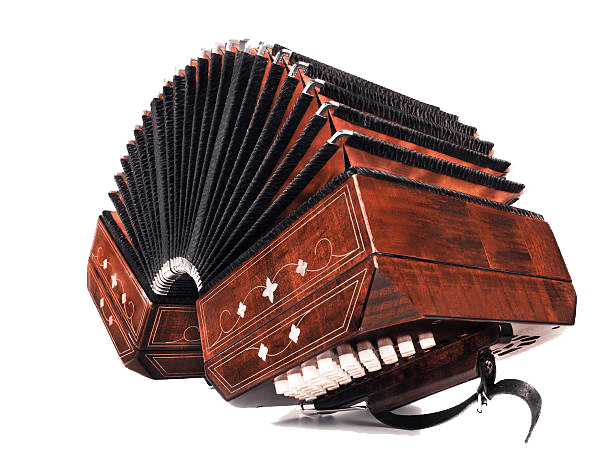
El bandoneón –llamado “bandonion” en el idioma original de su constructor- fue fabricado en Alemania alrededor de 1835 por Heinrich Band: un instrumento musical de viento, de lengüetas libres, extensible, con botoneras a ambos lados, pariente de la concertina, para hacer música religiosa en parroquias pequeñas donde no cabía un órgano tradicional e, incluso, facilitar su traslado de pueblo en pueblo para acompañar los cánticos de los feligreses. Si bien nadie asegura una fecha exacta, se sabe que llegó a estos lares en un barco del que descendió, para quedarse, un marinero alemán; y hay quienes sentencian que ya en 1864 lo tocaba el “Negro” Santa Cruz, músico y soldado, padre de Domingo Santa Cruz, quien años después compondría el famoso tango de la Guardia Vieja “Unión Cívica”. Más aún: han sido prestigiosos historiadores e investigadores, tal el caso de Ulyses Petit de Murat, quienes han asegurado que el “Negro” animaba con su bandoneón los momentos de descanso en las trincheras durante la Guerra de la Triple Alianza.
The bandoneon – called “bandonion” in the original language of its maker – was manufactured in Germany around 1835 by Heinrich Band: a wind musical instrument, with free reeds, extendable, with buttons on both sides, a relative of the concertina, for making religious music in small parishes where a traditional organ did not fit and even facilitating its transfer from town to town to accompany the songs of the parishioners. Although no one guarantees an exact date, it is known that he arrived in these parts on a ship from which a German sailor got off to stay; and there are those who say that as early as 1864 it was played by “Negro” Santa Cruz, musician and soldier, father of Domingo Santa Cruz, who years later would compose the famous Old Guard tango “Unión Cívica”. Furthermore: there have been prestigious historians and researchers, such as the case of Ulyses Petit de Murat, who have assured that the “Negro” animated the moments of rest in the trenches with his bandoneon during the War of the Triple Alliance.
Cuando el tango fue tango tal como lo conocemos a partir de la Guardia Vieja, los cultores del novedoso instrumento se multiplicaron y ayudaron a cambiar la pisada de la música ciudadana más popular. Es buena idea recordar otras afirmaciones de Piazzolla:
When tango was tango as we know it from the Guardia Vieja, the cultists of the new instrument multiplied and helped change the pace of the most popular citizen music. It is a good idea to remember other statements by Piazzolla:
-El tango tuvo grandes bandoneonistas, desde Arolas. Hay un estilo Mafia y un estilo Láurenz. Uno es más intimista, el otro, más desbordante. El gordo Troilo fue otra cosa; no era deslumbrante, pero sí un intérprete maravilloso; me hacía caer las medias tocando dos notas incomparables. En materia de técnica también estuvo Minotto di Cicco, y posiblemente el más grande de todos nosotros, aunque desconocido por el gran público, que se llamó Roberto Di Filippo. Y en la primera línea no puede faltar Leopoldo Federico, el mejor en esta época. En la generación posterior hay dos muy buenos: Dino Saluzzi y Néstor Marconi.
-Tango had great bandoneon players, since Arolas. There is a Mafia style and a Láurenz style. One is more intimate, the other, more overflowing. Fat Troilus was something else; He was not dazzling, but he was a wonderful performer; He made my socks fall by playing two incomparable notes. In terms of technique there was also Minotto di Cicco, and possibly the greatest of us all, although unknown to the general public, who was called Roberto Di Filippo. And Leopoldo Federico, the best in this era, cannot be missing from the first line. In the later generation there are two very good ones: Dino Saluzzi and Néstor Marconi.
Hoy se dice que es un instrumento en extinción, basándose en el cierre de las principales fábricas que sobrevivían en Buenos Aires: la ELA y la Doble A. Sin embargo, en 2009 una comisión de notables presidida por Rubén Juárez avaló a dos luthiers porteños, Àngel y Gabriel Gallo, para que fabricaran sus bandoneones llamados “A-Z”: claro, los hacen de modo artesanal y únicamente a pedido. También se conocen algunas empresas desparramadas por el mundo –en Alemania, Finlandia, Italia, Japón y más-, por el viento a favor del furor desatado por el tango, que se han lanzado a la aventura de construir estos instrumentos, todas a través de manos de artesanos que, con gran entusiasmo, se han ido especializando.
Today it is said that it is an instrument in extinction, based on the closure of the main factories that survived in Buenos Aires: the ELA and the Double A. However, in 2009 a commission of notables chaired by Rubén Juárez endorsed two luthiers from Buenos Aires, Àngel and Gabriel Gallo, to make their bandoneons called “A-Z”: of course, they make them by hand and only to order. There are also some companies scattered around the world – in Germany, Finland, Italy, Japan and more -, due to the tailwind of the fury unleashed by tango, that have embarked on the adventure of building these instruments, all through hands of artisans who, with great enthusiasm, have specialized.
O sea que no murió la esperanza, más allá de una verdad: la reposición es muy lenta frente a la velocidad de pérdida que los profesionales enfrentan, sea por el inexorable paso del tiempo –el deterioro por vejez de sus queridos “fueyes”-, sea por el acopio, con otros fines, que han ido haciendo coleccionistas, sobre todo extranjeros, de mucho dinero.
In other words, hope has not died, beyond one truth: the replacement is very slow compared to the speed of loss that professionals face, either due to the inexorable passage of time – the deterioration due to old age of their beloved «fueys» -, either because of the collection, for other purposes, that collectors, especially foreigners, have been making of a lot of money.
Al fin, me tomo la licencia de cerrar este desordenado pasaje por la vida del bandoneón de nuevo con una cita de Piazzolla, que nos revela otra cara de la cosa: -El bandoneón de Troilo me lo regaló Zita, su mujer. No es tocable, al menos por mí. Lo tengo que tocar como él, suavemente, casi una caricia. Y yo no acaricio nada. Mis cinco dedos son una ametralladora. Las veces que lo usé en público se me pinchó a los dos minutos: está achanchado para toda la vida. Debe ser una maldición del gordo. Nadie podrá tocarlo. Por supuesto, lo guardo como una reliquia.
Finally, I take the license to close this messy passage through the life of the bandoneon again with a quote from Piazzolla, which reveals another side of the thing: -Troilo’s bandoneon was given to me by Zita, his wife. It’s not touchable, at least by me. I have to touch him like he does, gently, almost a caress. And I don’t caress anything. My five fingers are a machine gun. The times I used it in public it punctured after two minutes: it’s flat for life. It must be a fat man’s curse. No one will be able to touch it. Of course, I keep it as a relic.
Descubre más desde LA AGENCIA MUNDIAL DE PRENSA
Suscríbete y recibe las últimas entradas en tu correo electrónico.
