

Retrospective: Toledo, Jews, El Greco, Pergolesi, Mudejar and Baroque

Me he encontrado por uno de esos avatares del destino con una deliciosa crónica que escribí hace algún tiempo y que por tratarse de Toledo, la ciudad de las Tres Culturas, no ha perdido actualidad. Toledo nunca pierde actualidad.
Through one of those twists of fate, I have come across a delicious chronicle that I wrote some time ago and that, because it is about Toledo, the city of the Three Cultures, has not lost its relevance. Toledo never loses relevance.
Y he pensado. Esto es una joya para mi columna semanal Culturas del Mundo. A partir de aquí transcribo:
And I have thought. This is a gem for my weekly World Cultures column. From here I transcribe:
“Recibí una invitación para asistir al concierto de clausura del Festival de Música El Greco en la catedral de Toledo el domingo 13 de octubre. Programa, el Stabat Mater de Giovanni Battista Pergolesi, precedida de una brevísima sinfonía de Antonio Vivaldi, Al Santo Sepolcro RV 169, música barroca del siglo XVIII. Buena ocasión para, además, revisitar, visitar y descubrir cosas en esta ciudad sin parangón. Han sido veinticuatro horas de placer para los sentidos».
“I received an invitation to attend the closing concert of the El Greco Music Festival at Toledo Cathedral on Sunday, October 13. Program, the Stabat Mater by Giovanni Battista Pergolesi, preceded by a very brief symphony by Antonio Vivaldi, Al Santo Sepolcro RV 169, baroque music from the 18th century. Good opportunity to also revisit, visit and discover things in this unparalleled city. «They have been twenty-four hours of pleasure for the senses.»
Primera parada. Un especialísimo establecimiento hotelero, que nada tiene que ver con un hotel convencional. La Posada de Manolo, a espaldas de la catedral, que ha sido hasta fecha aún reciente una gran casa familiar reciclada en posada, un lugar lleno de encanto, decorado con el amor de quien ha convertido su hogar en hogar para otros.
First stop. A very special hotel establishment, which has nothing to do with a conventional hotel. La Posada de Manolo, behind the cathedral, which until recently has been a large family house recycled into an inn, a place full of charm, decorated with the love of someone who has turned their home into a home for others.
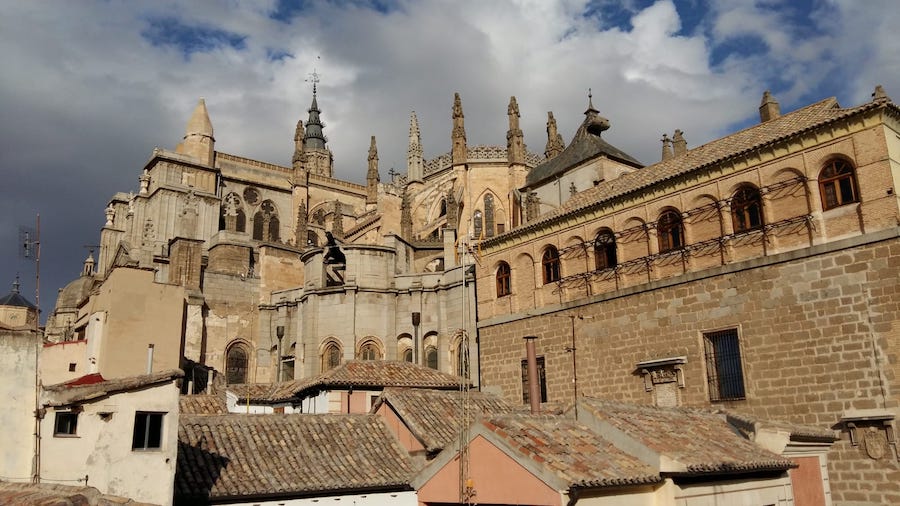
Vista de la catedral desde la terraza de la Posada de Manolo /
View of the cathedral from the terrace of the Posada de Manolo
Tenía dos objetivos para esa tarde de domingo. Revisitar el Museo Sefardí instalado en la Sinagoga de Samuel ha-Leví del siglo XIV, del Tránsito en su etimología cristiana. Más que revisitar se trataba de conocer la extraordinaria ampliación de su museo que tiene como centro la gran sala de oración, la mejor pieza arquitectónica del pasado sefardí en España.
I had two goals for that Sunday afternoon. Revisit the Sephardic Museum installed in the Synagogue of Samuel ha-Leví from the 14th century, of Transit in its Christian etymology. More than revisiting, it was about getting to know the extraordinary expansion of its museum, which has as its center the great prayer room, the best architectural piece of the Sephardic past in Spain.
El museo hace un recorrido por los lugares de la Diáspora, para centrarse en España y dentro de España en las ciudades más importantes desde cualquier punto de vista. Poblacional, religioso–cultural, florecimiento de las bellas artes y ciencias, literatura, poesía música, gastronomía, filosofía, medicina, etc.
The museum takes a tour of the places of the Diaspora, to focus on Spain and within Spain in the most important cities from any point of view. Population, religious-cultural, flourishing of fine arts and sciences, literature, poetry, music, gastronomy, philosophy, medicine, etc.
También el aspecto financiero representado por la actividad de prestar dinero, uno de los oficios limitados a los judíos y que hicieron que la banca castellana durante el siglo XV estuviera entre las más prósperas de Europa. Sin olvidar que el fundador de la sinagoga, Samuel ha-Leví, fue el tesorero real de Pedro I el Cruel. Córdoba y Toledo las más sobresalientes. También está representada la cronología cristiana desde 1492.
Also the financial aspect represented by the activity of lending money, one of the trades limited to Jews and which made Castilian banking during the 15th century among the most prosperous in Europe. Without forgetting that the founder of the synagogue, Samuel ha-Leví, was the royal treasurer of Peter I the Cruel. Córdoba and Toledo the most outstanding. The Christian chronology from 1492 is also represented.
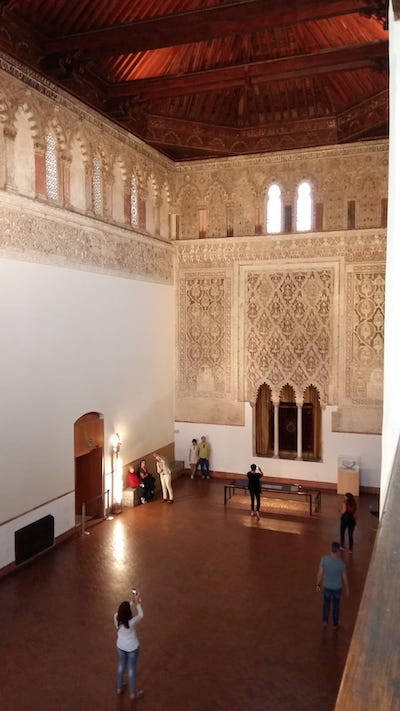
Sinagoga del Tránsito, Sala de Oración desde la galería de mujeres
Los textos están acompañados de objetos rituales y arqueológicos, mobiliario, biblias, libros, pergaminos iluminados. En la galería de mujeres están los rituales de la cultura sefardí, desde la circuncisión, el matrimonio, el Sabath o descanso, Bar Mitzvá o ritual de entrada en la adolescencia, los rituales de la muerte. Rituales de fiestas, la Pascua, Sukot o de las Cabañuelas, Yom Kipur o del Perdón, Hanuká o fiesta de las luces, Rosh Hashaná o de Año Nuevo. Para quien esté interesado en esta parte de nuestra cultura, una visita con tiempo y calma le resultará incluso emocionante.
The texts are accompanied by ritual and archaeological objects, furniture, bibles, books, illuminated scrolls. In the women’s gallery are the rituals of Sephardic culture, from circumcision, marriage, Sabbath or rest, Bar Mitzvah or ritual of entry into adolescence, the rituals of death. Holiday rituals, Easter, Sukot or Cabañuelas, Yom Kippur or Forgiveness, Hanukkah or festival of lights, Rosh Hashanah or New Year. For those interested in this part of our culture, a visit with time and calm will even be exciting.
Segundo objetivo: revisitar una vez más, y no será la última, el Apostolado de la Casa Museo de El Greco. Dicen que al Greco le gustaba repetirse. La verdad es que lo hacía a veces por encargo y sobre todo porque le gustaba observar su evolución y nada mejor que sobre un mismo tema. Pintó cuatro Apostolados, de los que quedan dos completos y los dos están en Toledo, en la sacristía mayor de la catedral y el de la Casa de El Greco, pintado en sus últimos años, una obra al que todos los adjetivos le quedan cortos.
Second objective: to revisit once again, and it will not be the last, the Apostolate of the El Greco House Museum. They say that Greco liked to repeat himself. The truth is that he sometimes did it on request and above all because he liked to observe its evolution and nothing better than on the same topic. He painted four Apostolates, of which two remain complete and both are in Toledo, in the main sacristy of the cathedral and that of the House of El Greco, painted in his last years, a work for which all adjectives fall short.
No parece pintura de comienzos del siglo XVII, es una obra moderna, atemporal, inspiradora de no pocas obras del siglo XX. Sabemos que El Greco es el mayor inspirador de obras del siglo pasado, por encima de Goya. Asombra su realismo, su expresividad, su luminosidad interior y exterior, sus volúmenes regios, sus fondos.
It does not look like a painting from the beginning of the 17th century, it is a modern, timeless work, inspiring many works of the 20th century. We know that El Greco is the greatest inspirer of works of the last century, above Goya. Its realism, its expressiveness, its interior and exterior luminosity, its regal volumes, its backgrounds are astonishing.
El Salvador, en el centro, si uno se concentra en sus ojos, llega un momento en que dejan de estar pintados, están vivos, te penetran. Seis apóstoles a su izquierda, los seis miran hacia él. Otros seis a su derecha, también le miran. Es como una cena atemporal, sin Judas, con San Pablo el converso.
El Salvador, in the center, if one concentrates on his eyes, there comes a moment when they stop being painted, they are alive, they penetrate you. Six apostles to his left, all six facing him. Six others to his right also look at him. It is like a timeless dinner, without Judas, with Saint Paul the convert.
Interesantísimo adentrarse en los símbolos, de los que El Greco fue maestro. La tenue iluminación resalta la intensidad cromática de los cuatro colores utilizados por el cretense y la volumetría. Dicen que el blanco de la túnica, rostro y manos de San Bartolomé es que quizá no esté terminado de pintar. O no. ¿Quién puede penetrar en la intención del maestro? Tal como está, impacta y establece un fortísimo punto de contraste con el conjunto de la obra. También podría representar la victoria sobre las tentaciones del demonio Astaroth, presente en la pintura. Destacan la ausencia de misticismo y la presencia de un expresionismo y simbolismo abrumadores. En la pared frontera están las famosísimas Lágrimas de San Pedro, en este caso, el cuadro homónimo de la sacristía mayor de la catedral le gana en dramatismo.
Very interesting to delve into the symbols, of which El Greco was a master. The dim lighting highlights the chromatic intensity of the four colors used by the Cretan and the volumetry. They say that the white of Saint Bartholomew’s tunic, face and hands is because he may not have finished painting. Or not. Who can penetrate the teacher’s intention? As it is, it impacts and establishes a very strong point of contrast with the work as a whole. It could also represent the victory over the temptations of the demon Astaroth, present in the painting. They highlight the absence of mysticism and the presence of overwhelming expressionism and symbolism. On the border wall are the very famous Tears of Saint Peter, in this case, the homonymous painting in the main sacristy of the cathedral surpasses it in drama.
La tarde noche está dedicada a la música, interpretada por la Orquesta Titular del Teatro Real de Madrid, dirigida por Sergio Alapont, con la contribución de la soprano María Espada, especialista en música barroca y el contratenor Christopher Lowry
The afternoon is dedicated to music, performed by the Orquesta Titular del Teatro Real de Madrid, directed by Sergio Alapont, with the contribution of soprano María Espada, a specialist in baroque music, and countertenor Christopher Lowry.
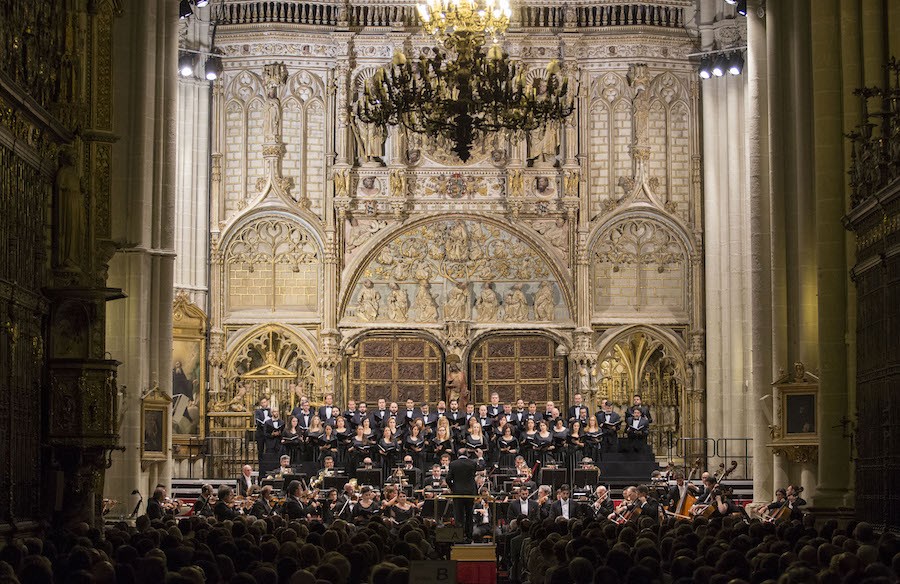
Concierto Pergolesi. Puerta de los Leones, crucero sur, catedral de Toledo Pergolesi Concert. Lions Gate, south transept, Toledo Cathedral
Un entorno arquitectónico como el del crucero de la catedral de Toledo es siempre un valor añadido. El Stabat Mater de Pergolesi no podía tener mejor encuadre para introducir al espectador en la simbología de las emociones, una cualidad que representa la mayor de las virtudes de este drama musical. Es una música tan descriptiva que crea imágenes muy sólidas, sirviéndose de las disonancias de las voces y las notas entrecortadas de los violines, del caminar de María hacia la Cruz, su dolor ante su pérdida, lo que conduce directamente hacia la compasión como reacción emocional. El hispanista Ludwig Tieck lo sintió como una empatía musical que le llevó hasta las lágrimas contenidas al escuchar la obra, que para él es “el motor del Stabat Mater hasta el Quando corpus morietur final, con esa desnudez sobrecogedora que muestra la inmensidad del vacío y el desconsuelo.”
An architectural environment like that of the transept of the Toledo Cathedral is always an added value. Pergolesi’s Stabat Mater could not have been better framed to introduce the viewer to the symbology of emotions, a quality that represents the greatest virtue of this musical drama. It is such a descriptive music that creates very solid images, using the dissonances of the voices and the broken notes of the violins, of Mary’s walk towards the Cross, her pain at her loss, which leads directly to compassion as an emotional reaction. . The Hispanist Ludwig Tieck felt it as a musical empathy that brought him to unshed tears when listening to the work, which for him is “the driving force of the Stabat Mater until the final Quando corpus morietur, with that overwhelming nakedness that shows the immensity of the emptiness and the heartbreak.”
Lunes. Hay que optar por algo que no haya visto, al menos en mucho tiempo y me decido por uno de los edificios cumbre del barroco toledano, la iglesia de San Ildefonso, o de los Jesuitas, que tiene las particularidades arquitectónicas del barroco de las órdenes religiosas. La fachada es monumental, de corte neoclásico. Interior de tres naves totalmente encaladas.
Monday. You have to opt for something that you haven’t seen, at least in a long time, and I decided on one of the pinnacle buildings of the Toledo baroque, the church of San Ildefonso, or of the Jesuits, which has the architectural particularities of the baroque of the religious orders. . The façade is monumental, neoclassical in style. Interior of three completely whitewashed naves.
Al fondo de la nave central, bajo la cúpula, se halla un enorme mural pintado al fresco por los hermanos González Velázquez, un auténtico trampantojo que representa el conocidísimo milagro de la imposición de la casulla a San Ildefonso por la Virgen María descendida del cielo, el tema más recurrente del arte toledano. San Ildefonso fue nombrado obispo de Toletum por el rey visigodo Recesvinto en el año 657. El milagro fue un premio por haber defendido la virginidad de María.
At the back of the central nave, under the dome, there is a huge mural frescoed by the González Velázquez brothers, an authentic trompe l’oeil that represents the well-known miracle of the imposition of the chasuble on Saint Ildefonso by the Virgin Mary descended from heaven, the most recurrent theme of Toledo art. Saint Ildefonso was appointed bishop of Toletum by the Visigoth king Recesvintus in the year 657. The miracle was a reward for having defended Mary’s virginity.
Los altares de las naves laterales están dedicados a ilustres jesuitas, empezando por el fundador Ignacio de Loyola, San Francisco Javier, evangelizador de Goa y otras ciudades de la costa índica como Cochín, en el actual estado de Kerala, en el cono sur de la India. San Francisco de Borja yacente, el enamorado platónico de la Emperatriz Isabel, cuya muerte fue el desencadenante de su vocación religiosa. Altares dedicados a la Virgen y a Cristo crucificado. Pero sin duda lo más espectacular es la subida a la cúpula, pasando por el coro alto y otras galerías que facilitan la subida. Desde lo alto, vistas de toda la ciudad y alrededores por sus cuatro costados.
The altars in the side naves are dedicated to illustrious Jesuits, starting with the founder Ignatius of Loyola, Saint Francis Xavier, evangelizer of Goa and other cities on the Indian coast such as Cochin, in the current state of Kerala, in the southern cone of the India. San Francisco de Borja recumbent, the platonic lover of the Empress Isabel, whose death was the trigger for his religious vocation. Altars dedicated to the Virgin and crucified Christ. But without a doubt the most spectacular is the climb to the dome, passing through the high choir and other galleries that facilitate the climb. From the top, views of the entire city and surroundings on all four sides.
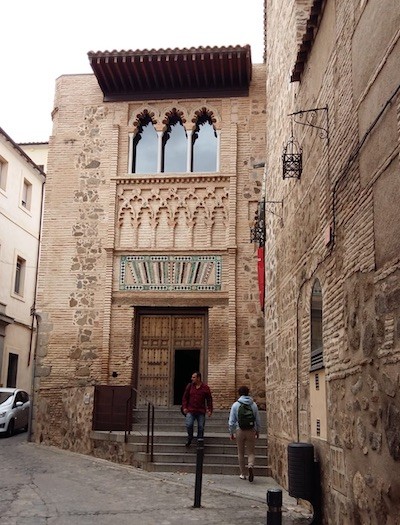
San Pedro Mártir, Universidad de Castilla la Mancha
A la izquierda de la fachada de san Ildefonso se encuentra el antiguo convento de San Pedro Mártir, que alberga el sepulcro de Garcilaso de la Vega, con ese estilo mudéjar toledano tan atractivo, hoy reconvertido en facultad de Ciencias Jurídicas y Sociales de la Universidad de Castilla la Mancha. El patio es el elemento integrador de aulas y otros departamentos.
To the left of the façade of San Ildefonso is the old convent of San Pedro Mártir, which houses the tomb of Garcilaso de la Vega, with that attractive Toledo Mudejar style, today converted into the Faculty of Legal and Social Sciences of the University of Castilla la Mancha. The patio is the integrating element of classrooms and other departments.
A dos pasos, subiendo la calle que flanquean ambos edificios se llega a la plaza de San Román, en cuyo centro rodeado de jardines está el monumento dedicado a un toledano tan ilustre como Garcilaso de la Vega, aristócrata, militar, amigo del Gran Duque de Alba, favorecido con títulos y cargos por el Emperador Carlos V y una vez también encarcelado por él. Poeta excelso de nuestro Renacimiento, introductor de nuevas formas poéticas, entre otras del verso endecasílabo en España.
Two steps away, going up the street flanked by both buildings, you reach the Plaza de San Román, in whose center surrounded by gardens is the monument dedicated to a Toledoan as illustrious as Garcilaso de la Vega, aristocrat, military man, friend of the Grand Duke of Alba, favored with titles and positions by Emperor Charles V and once also imprisoned by him. Exalted poet of our Renaissance, introducer of new poetic forms, among others of the hendecasyllabic verse in Spain.
Al fondo de la plaza, una casa de apariencia humilde, que fue la morada toledana de Santa Teresa de Jesús, en la que empezó a escribir el libro de su vida en 1562, como reza la placa en su fachada. Es mi mejor descubrimiento en esta mañana de lunes, víspera de su fiesta y de la mía. Lo vivo como experiencia emocionante, soy una fan incondicional de Teresa de Jesús, pionera del empoderamiento de la mujer en España.
At the back of the square, a humble-looking house, which was the Toledo home of Saint Teresa of Jesus, where she began to write the book of her life in 1562, as the plaque on its façade says. It is my best discovery on this Monday morning, the eve of his party and mine. I live it as an exciting experience, I am an unconditional fan of Teresa de Jesús, a pioneer of women’s empowerment in Spain.
La mejor forma no sospechada de agotar mi tiempo disponible antes de ir hacia el AVE.
The best unsuspected way to use up my available time before going to the AVE.
Descubre más desde LA AGENCIA MUNDIAL DE PRENSA
Suscríbete y recibe las últimas entradas en tu correo electrónico.
