

Unusual Malaga: When Adamuz arrived

TERESA FERNANDEZ HERRERA. Periodista, Escritora, Editorialista. CDG de CULTURA.
Andaba yo felizmente por Málaga, disfrutando de un clima privilegiado mientras de Despeñaperros para arriba se morían de frío con borrasca tras borrasca. Andaba yo por peñas flamencas, conociendo gente guapa, vagabundeando por el Muelle Uno, el casco histórico, paseos de palmeras, plaza de toros convertida en espacio de exposiciones, alcazaba y teatro romano en un mismo espacio como una muestra más entre muchas de nuestra riqueza histórico-cultural. Andaba yo por la calle Larios pavimentada con mármol, con el monumento al Marqués de Larios en su entrada, muy cerca de la Manquita, y la plaza de la Constitución al otro extremo que queda cerca del Museo Carmen Thyssen.
I was happily strolling through Málaga, enjoying the wonderful climate while north of Despeñaperros they were freezing with storm after storm. I was wandering through flamenco clubs, meeting beautiful people, strolling around Muelle Uno, the historic center, palm-lined promenades, the bullring transformed into an exhibition space, the Alcazaba and the Roman theater all in one place, just one more example among many of our rich historical and cultural heritage. I was walking along Calle Larios, paved with marble, with the monument to the Marquis of Larios at its entrance, very close to the Manquita (the Cathedral with one tower missing), and the Plaza de la Constitución at the other end, near the Carmen Thyssen Museum.
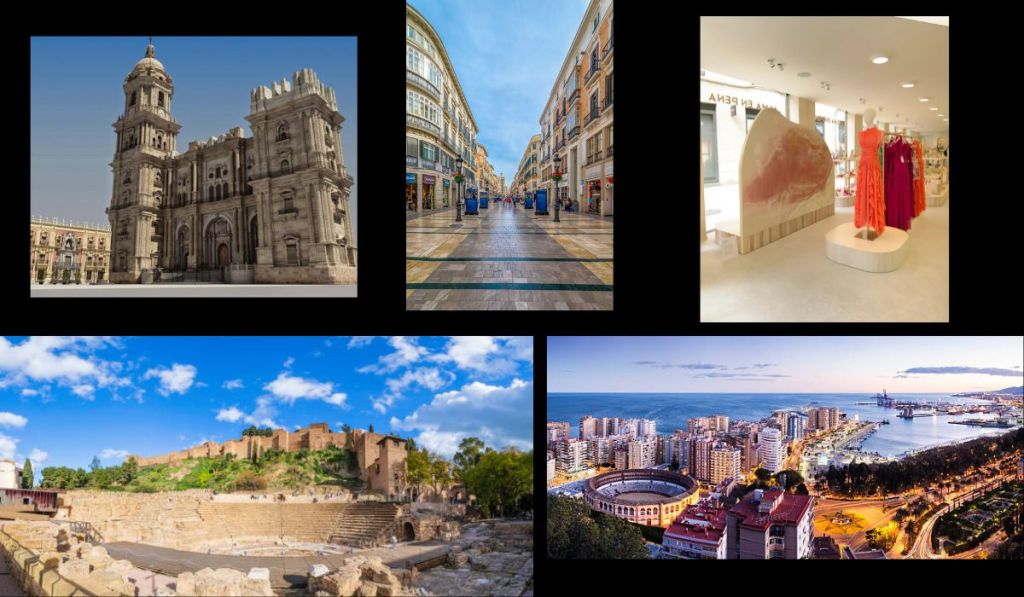
Calles y más calles convertidas en terrazas de todo tipo de sitios para comer, que Málaga en enero está llena de turistas de toda Europa, sobre todo del norte de Europa donde tienen climas insufribles y aquí al sur está la cálida y amable España con esta capital de la Costa del Sol, uno de los lugares más privilegiados de todo el continente donde hay cosas para todos los gustos: Clima y gente amable, playas, ciudad de museos que incluye uno ruso, gastronomía, peñas y tablaos, teatros en los que lo mismo ves la última versión de Godspell gracias a nuestro internacional Antonio Banderas, que una Bernarda Alba por gitanas de El Vacíe, barrio marginal, magníficas actrices sin serlo profesionalmente, y hasta una tienda de ropa y complementos llamada “Alma en Pena”. Andaba yo haciendo inmersión en todo esto, a la par que escribiendo un libro, que para eso había ido a Málaga, un libro que va de charlas entre ancianos, gente corriente sobre el devenir de nuestro mundo, cuando llegó el 18 de enero.
Streets upon streets transformed into terraces of all kinds of places to eat, because Málaga in January is full of tourists from all over Europe, especially from Northern Europe where the climate is unbearable, while here in the south lies warm and friendly Spain with this capital of the Costa del Sol, one of the most privileged places on the entire continent where there is something for everyone: climate and friendly people, beaches, a city of museums including a Russian one, gastronomy, flamenco clubs and tablaos, theaters where you might see the latest version of Godspell thanks to our internationally renowned Antonio Banderas, or a Bernarda Alba performed by Roma women from El Vacíe, a marginalized neighborhood, magnificent actresses despite not being professionals, and even a clothing and accessories shop called “Alma en Pena” (Soul in Pain). I was immersing myself in all of this, while also writing a book, which is why I had gone to Málaga, a book about conversations between elderly people, ordinary people, about the evolution of our world, when January 18th arrived.
El 18 de enero en Adamuz, provincia de Córdoba, un tren de alta velocidad que viajaba hacia Madrid descarriló y sus vagones posteriores cayeron sobre la vía paralela, con tan mala suerte que por ahí bajaba hacia Huelva otro tren de alta velocidad que irremisiblemente fue a chocar con los vagones descarrilados, produciendo una enorme tragedia en vidas humanas.
On January 18 in Adamuz, province of Córdoba, a high-speed train traveling towards Madrid derailed and its rear carriages fell onto the parallel track, with such bad luck that another high-speed train was coming down towards Huelva and inevitably collided with the derailed carriages, producing a huge tragedy in human lives.
Las noticias iban llegando gota a gota. Primero se encontraron los primeros doce muertos que día a día fueron aumentando hasta llegar a cuarenta y siete, tras el fallecimiento de un herido de los más de cien trasladados a hospitales cercanos, casi todos, menos tres, del tren que iba hacia Huelva, la capital más al sudoeste de Andalucía.
The news trickled in. First, the first twelve dead were found, a number that rose daily to forty-seven after the death of one of the more than one hundred injured who were taken to nearby hospitals. Almost all but three were from the train heading towards Huelva, the southwesternmost capital of Andalusia.
La otra más que noticia pregunta era: ¿Por qué descarrila un tren en un moderno sistema de vías de alta velocidad?
The other one, more than news was a question: Why would a train derail on a modern high-speed rail system?
A todo esto nos enteramos de que había un ministro de Transportes llamado Óscar Puente, que empezó a salir en las televisiones con el más difícil de los cometidos, hablar sin decir nada. Sobre todo nada sobre los posibles fallos estructurales en ese tramo de vía. A día de hoy, más de dos meses después todavía no está claro.
Alongside all this, we learned that there was a Minister of Transport named Óscar Puente, who began appearing on television with the most difficult task of all: to speak without saying anything. Especially nothing about the possible structural failures in that section of track. To this day, more than two months later, it’s still not clear.
Andalucía entera se encendió con esta noticia, sobre todo Huelva. Y es que cuarenta y siete muertos pesan mucho y jugar con los motivos sin aclararlos es muy peligroso para Adif, el gobierno y su portavoz, el ministro Puente.
The whole of Andalusia erupted in anger at this news, especially Huelva. Forty-seven dead are a heavy burden, and playing with the motives without clarifying them is very dangerous for Adif (the Spanish railway infrastructure manager), the government, and its spokesperson, Minister Puente.
Pero cuando Andalucía se encendió más fue con el asunto de los funerales.
But Andalusia’s anger truly intensified over the issue of the funerals.
https://share.google/mfzQnxf68MTaBvi5Q
Se anunciaron funerales en la Mezquita Catedral de Córdoba y en la catedral de la Almudena de Madrid. En Huelva como se sabía que la catedral en un funeral de Estado iba a ser insuficiente se anunció en el Palacio de los Deportes.
Funerals were announced at the Mosque-Cathedral of Córdoba and the Almudena Cathedral in Madrid. In Huelva, knowing that the cathedral would be too small for a state funeral, the Sports Palace was announced instead.
Pero hete aquí que el Presidente del Gobierno, Pedro Sánchez dice que él por norma no va a oficios religiosos, ¿? y anuncia un “funeral laico” en Huelva.
But then, the Prime Minister, Pedro Sánchez, says that he doesn’t usually attend religious services, and announces a «secular funeral» in Huelva.
Conocer la idiosincrasia andaluza, de cada provincia, de ciudades dentro de cada provincia, no es fácil, es de una enorme complejidad. Pero hablar de un “funeral laico” por esas víctimas, en la tierra de María Santísima, muestra una ignorancia ofensiva. Hasta los agnósticos en Andalucía no toleran la ignorancia de sus tradiciones religiosas.
Understanding the idiosyncrasies of Andalusia, of each province, and of cities within each province, is not easy; it’s incredibly complex. But to speak of a «secular funeral» for these victims in the land of the Most Saint Virgin Mary demonstrates an offensive ignorance. Even agnostics in Andalusia cannot tolerate ignorance of their religious traditions.
En fin, que el tal funeral laico tuvo que suspenderse porque los onubenses anunciaron que no pensaban ir. Al funeral del Palacio de Deportes el jueves 29 de enero fueron los Reyes, el Presidente de la Junta de Andalucía y todos sus consejeros, Alcalde y concejales de Huelva, Alcalde de Córdoba, el Presidente del PP, todas las autoridades eclesiásticas nacionales, regionales y locales y más de cuatro mil personas, trescientas cincuenta familiares de las víctimas. En representación del gobierno fueron, entrando por una puerta lateral, la Ministra y Vicepresidenta Montero, (ahora candidata por el PSOE a presidenta de Andalucía) y el Ministro de Pesca y Alimentación, (¡!) Luis Planas.
In short, the so-called secular funeral had to be cancelled because the people of Huelva announced they weren’t going to attend. The funeral at the Sports Palace on Thursday, January 29th, was attended by the King and Queen, the President of the Regional Government of Andalusia and all his ministers, the Mayor and councilors of Huelva, the Mayor of Córdoba, the President of the People’s Party (PP), all national, regional, and local ecclesiastical authorities, and more than four thousand people, including three hundred and fifty relatives of the victims. Representing the government, entering through a side door, were Minister and Vice President Montero (now the Socialist Party (PSOE) candidate for President of Andalusia) and the Minister of Fisheries and Food, (!) Luis Planas.
Los comentarios en Málaga con el gracejo correspondiente iban por ¿funeral laico? ¿Y ezo, qué é ? y yo repito: Y eso, ¿qué es? Podrían haber hablado de homenaje, en memoria, que tampoco habría funcionado, pero ¿funeral laico?
The comments in Málaga, with their characteristic wit, were along the lines of, «A secular funeral? What’s that all about?» And I repeat: What is that? They could have called it a tribute, a memorial service, which wouldn’t have worked either, but a secular funeral?
Las fechas del ministro Puente.
Minister Puente’s dates.
Atendiendo a lo práctico, yo tenía billete de vuelta a Madrid en AVE para el 31 de enero. Y días después del 18 el tren descarrilado seguía en el mismo sitio. La primera noticia del ministro fue que para el 2 de febrero se podría viajar de nuevo. Yo no tenía problema para retrasar mi vuelta. De hecho no tenía gana de volver. Así que contacté con Renfe para confirmar con ellos la fecha y ahí me dijeron, que ellos no sabían nada de eso.
From a practical standpoint, I had a return ticket to Madrid on the AVE high-speed train for January 31st. And days after the 18th, the derailed train was still in the same spot. The minister’s initial announcement was that travel would resume on February 2nd. I had no problem postponing my return. In fact, I didn’t want to go back. So I contacted Renfe to confirm the date, and they told me they knew nothing about it.
Dos días más tarde el Ministro Puente aseguró que para el 8 de febrero no habría problema. Nueva llamada a Renfe. Nueva respuesta de que ellos no tienen noticia, pero si me dicen que no creen que la cosa se arregle para esa fecha. Pero que sí se puede viajar, en tren desde Málaga hasta Córdoba, ahí transbordar a un autobús hasta Villanueva de Córdoba y ahí transbordar a un AVE hasta Madrid Atocha Almudena Grandes.
Two days later, Minister Puente assured that there would be no problem by February 8th. Another call to Renfe. Another response: they had no information, but they did say they didn’t think things would be resolved by then. However, they said it was possible to travel by train from Málaga to Córdoba, then transfer to a bus to Villanueva de Córdoba, and finally to an AVE high-speed train to Madrid Atocha Almudena Grandes station.
Y es lo que hice. Los transbordos funcionaron sin problema.
And that’s what I did. The transfers worked without a hitch.
Ya no volví a interesarme por las fechas del ministro Puente hasta que la semana pasada nos enteramos de que no hay AVE a Málaga hasta finales de abril, que no hay manera de saber quién o quiénes son responsables del estado de las vías del AVE, aunque el pueblo llano, andaluz o no y sobre todo los supervivientes de Adamuz y los familiares de los cuarenta y siete muertos lo sabemos.
I lost interest in Minister Puente’s dates until last week when we learned that there’s no AVE high-speed train to Málaga until the end of April, and that there’s no way to know who’s responsible for the state of the AVE tracks, even though ordinary people, Andalusian or otherwise, and especially the survivors of Adamuz and the families of the forty-seven dead, know.
No hay duda de que esta fue mi experiencia más insólita de mi estancia invernal en Málaga.
Without a doubt, this was the most unusual experience of my winter stay in Málaga.
Descubre más desde LA AGENCIA MUNDIAL DE PRENSA
Suscríbete y recibe las últimas entradas en tu correo electrónico.
