
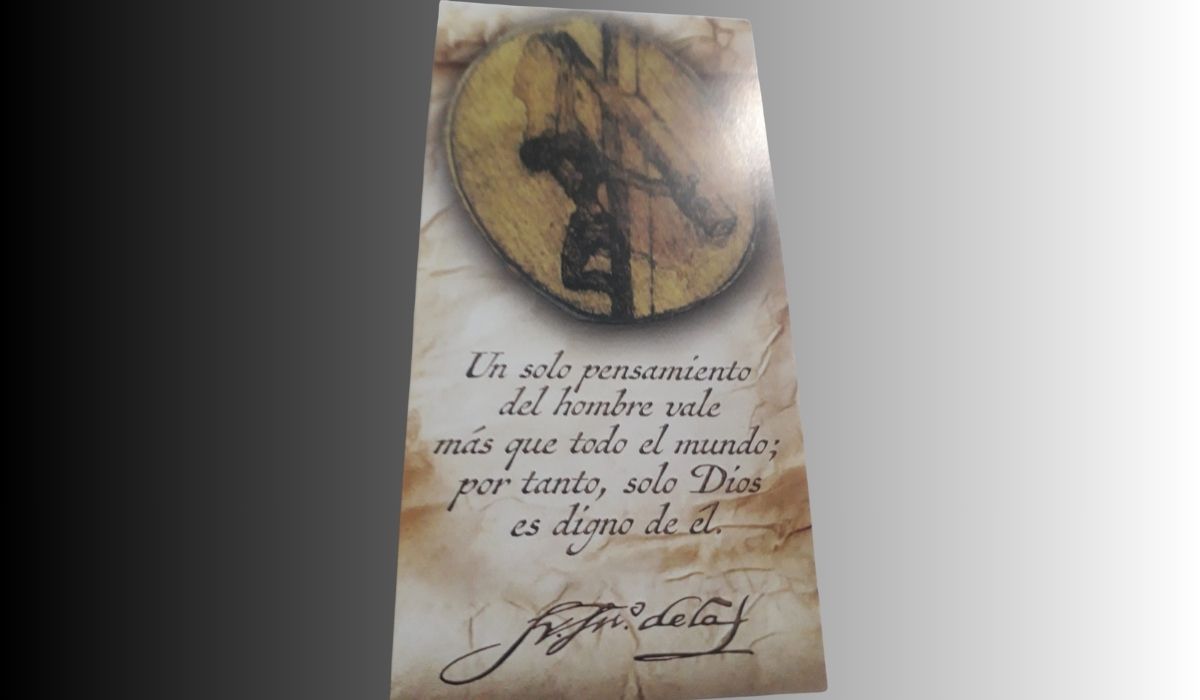
Christ of Saint John of the Cross

Vuelven a Segovia, donde está enterrado, los restos de San Juan, 300 años después de su canonización.
The remains of Saint John of the Cross have returned to Segovia, where he is buried, 300 years after his canonization.
Fue el mejor discípulo de Santa Teresa de Jesús, tanto en lo espiritual como en lo literario, aunque tengan una forma muy diferente de escribir.
He was the best disciple of Saint Teresa of Ávila, both spiritually and literarily, although they had very different writing styles.
Ambos mantienen los pies en la tierra, si bien llegan a grandes conclusiones místicas.
Both remained grounded, even as they reached profound mystical conclusions.
Si comparamos su poema “Vivo sin vivir en mí”, veremos grandes semejanzas. En otros versos, Teresa de Cepeda se dedica a describir y adoctrinar, mientras que San Juan se centra en lo esencial con una precisión de gran relojero del universo.
If we compare their poems, «I Live Without Living in Myself,» we see striking similarities. In other verses, Teresa de Cepeda focuses on description and instruction, while Saint John of the Cross concentrates on the essential with the precision of a master watchmaker of the universe.
San Juan nació en Fontiveros y murió en Úbeda.
Saint John was born in Fontiveros and died in Úbeda.
Nadie habla de los años que vivió en La Bañeza y en La Cepeda. Encontraron poemas suyos manuscritos en La Bañeza, pero no llegan más allá. Se supone que no los trajo el viento y que, por alguna razón, estarán en La Bañeza. Probablemente el Cántico Espiritual, o una parte de él, estará escrito en León.
No one talks about the years he lived in La Bañeza and La Cepeda. Some of his handwritten poems were found in La Bañeza, but the evidence doesn’t extend beyond that. It’s assumed they weren’t carried there by chance and that, for some reason, they remain in La Bañeza. The Spiritual Canticle, or at least part of it, was probably written in León.
Su Cántico es de exteriores. Ve los paisajes y las criaturas que describe, no solo las imagina.
His Canticle is about the outdoors. He sees the landscapes and creatures he describes; he doesn’t just imagine them.
Por eso sabemos que describe majadas y flores o bosques de La Cepeda. Se puede ver lo que interroga. Percibimos también que lo interrogado le responde. No es un poema para escribir dentro de una cárcel. Si todos los Cánticos los hubiera escrito donde dicen que lo hizo, no tendría 195 versos sino miles de versos. Y eso es imposible. A mí me parece un Cántico de la edad madura.
That’s why we know he describes sheepfolds and flowers or forests of La Cepeda. We can see what he questions. We also perceive that what he questions answers him. It’s not a poem to be written in prison. If he had written all the Canticles where they say he did, he wouldn’t have 195 verses but thousands. And that’s impossible. To me, it seems like a Canticle of his mature years.
Como la infección de su pierna derecha no le permitiría casi andar, recorrería los bosques, los sotos y los prados a caballo. Después escribiría lo que vio. Le da importancia a los ganados, a las ovejas, porque eran una base importante de la alimentación. La lana resultaba fundamental para los vestidos.
Since the infection in his right leg made it nearly impossible for him to walk, he would travel through the forests, groves, and meadows on horseback. Afterward, he would write about what he saw. He emphasized the importance of livestock, especially sheep, because they were a vital part of his diet. Wool was essential for clothing.
En el verso 85 vuelve a recordar a los ganados:
In verse 85 he again mentions the cattle:
“En la interior bodega
de mi Amado bebí, y cuando salía,
por toda aquesta vega,
ya cosa no sabía,
y el ganado perdí que antes seguía.”
“In the inner cellar of my Beloved I drank, and when I came out, through all this valley, I knew nothing more, and I lost the cattle I had been tending.”
Santa Teresa de Jesús también procuraba mantener los pies en la tierra, aunque fuese una gran mística. Algo parecido ocurre con San Juan de la Cruz, que siguió en muchos temas a Santa Teresa.
Saint Teresa of Ávila also tried to remain grounded, even though she was a great mystic. Something similar occurred with Saint John of the Cross, who followed Saint Teresa in many ways.
Parece que San Juan vio la pila bautismal en la que bautizaron a Santa Teresa, en tierras cepedanas. Dice que estaba cubierta por una guirnalda de flores que describían la fecha de bautismo de la Santa Teresa.
It seems that Saint John saw the baptismal font where Saint Teresa was baptized in the Cepeda region. He says it was covered with a garland of flowers that spelled out the date of Saint Teresa’s baptism.
Aunque la Inteligencia Artificial no sea un dogma, dice lo siguiente:
Although Artificial Intelligence is not a dogma, he says the following:
“Lo que sí es cierto es que San Juan de la Cruz pasó tiempo en La Bañeza, donde fue confesor y director espiritual de las monjas descalzas del convento de La Bañeza. Durante su estancia parece que escribió alguno de sus poemas más famosos como el Cántico Espiritual.”
“What is certain is that Saint John of the Cross spent time in La Bañeza, where he was confessor and spiritual director of the Discalced nuns of the La Bañeza convent. During his stay, it seems that he wrote some of his most famous poems, such as the Spiritual Canticle.”
También la primera imagen de San Juan se puso en la iglesia de La Bañeza.
The first image of Saint John was also placed in the church of La Bañeza.
Descubre más desde LA AGENCIA MUNDIAL DE PRENSA
Suscríbete y recibe las últimas entradas en tu correo electrónico.


Gracias Cristina. Es importante porque la perspectiva clásica no tiene nada que gacer aqui. Dalí no entendió muy bien e hizo una obra de gran calidad que considera que inaugura la lerspectiva cenital, lo que se ve desde lo alto. Todos los días la utilizan en los telediarios, especialmente cuando utilizan imágenes que vienen desde lo alto.
Me gustaMe gusta