
Emerita Augusta yesterday, Mérida today

COLUMNISTA
En estos días se celebra el Festival Internacional de Teatro Clásico de Mérida, fundado en 1933, interrumpido por guerras y otros avatares hasta ser refundado en 1953 y desde entonces anualmente. Está considerado el festival de teatro clásico más importante de España y uno de los más importantes de Europa.
These days, the Mérida International Classical Theatre Festival is being held. Founded in 1933, it was interrupted by wars and other vicissitudes until it was re-founded in 1953 and held annually ever since. It is considered the most important classical theatre festival in Spain and one of the most important in Europe.
En atención a los lectores de Culturas del Mundo, diré que esta Mérida, con tantas réplicas en ciudades del continente americano, -tengo maravillosos recuerdos de Mérida, Yucatán, México , es la original, y fue fundada en el año 25 antes de Cristo por el Emperador Octavio Augusto, primer emperador romano. Su nombre Emerita Augusta (pronuncien Emerita como esdrújula, en latín no existían las tildes) hacía mención del nombre del emperador y de dos legiones veteranas para quienes fue fundada la ciudad en la orilla derecha del rio Guadiana y pronto capital de la provincia Lusitania, en Hispania, que abarcaba buena parte de lo que más tarde fue Portugal.
For the benefit of readers of Culturas del Mundo, I will say that this Mérida, with so many replicas in cities across the American continent—I have wonderful memories of Mérida, Yucatán, Mexico—is the original, and was founded in 25 BC by Emperor Octavius Augustus, the first Roman emperor. Its name Emerita Augusta (pronounced Emerita as a proparoxytone; accents did not exist in Latin) referred to the name of the emperor and two veteran legions for whom the city was founded on the right bank of the Guadiana River and soon to become the capital of the province of Lusitania, in Hispania, which encompassed a good part of what later became Portugal.
En la actualidad el festival, aunque está distribuido por varias sedes, su razón de existencia como Festival de Teatro Clásico fue y es el Teatro Romano, o Teatro de Agripa, su fundador y yerno de Augusto, sin duda uno de los mayores del Imperio y uno de los mejor conservados a día de hoy.
Although the festival currently spans several venues, its reason for existence as a Classical Theatre Festival was and is the Roman Theatre, or Theatre of Agrippa, its founder and son-in-law of Augustus, undoubtedly one of the largest in the Empire and one of the best preserved today.
En esta edición de 2025 el festival se ha inaugurado con una obra de Miguel de Cervantes, escrita hacia 1585, “Numancia”.
This 2025 edition of the festival opened with a play by Miguel de Cervantes, written around 1585, «Numancia.»

¿Qué sucedió en Numancia en el año 133 antes de Cristo?.
What happened in Numancia in the year 133 BC?
A Roma le costó unos doscientos años conquistar la Península Ibérica. Mucho antes del Imperio, en el año 133 antes de Cristo, el general romano Escipión Emiliano, puso cerco a esta ciudad celtíbera, fuertemente amurallada. Los numantinos resistieron durante meses, pero cuando la derrota era irreversible, antes que entregarse a Roma decidieron morir, mediante un suicidio colectivo. Roma nunca pudo decir que había rendido la ciudad. Numancia ha quedado para la historia como símbolo de libertad, de resistencia y valor.
It took Rome some two hundred years to conquer the Iberian Peninsula. Long before the Empire, in 133 BC, the Roman general Scipio Aemilianus laid siege to this heavily walled Celtiberian city. The Numantines resisted for months, but when defeat was irreversible, they decided to die by collective suicide rather than surrender to Rome. Rome could never claim to have surrendered the city. Numantia has gone down in history as a symbol of freedom, resilience, and courage.
Otras obras que se verán en el Teatro Romano entre julio y agosto: “Alejandro y el eunuco persa”, de Miguel Murillo; “Ifigenia” de Eurípides, que tras sus representaciones en Mérida seguirá al Festival de Ostia, Italia; seguirá “Edipo Rey” de Sófocles, producida por la Fondazione Teatro di Roma; “Cleopatra enamorada”, un musical de Miguel Recio que narra la historia de amor de la reina de Egipto y Marco Antonio. Y después “Electra” de Sófocles, en versión de Eduardo Galán; “Memorias de Adriano” basada en la obra de Marguerite Yurcenar; “Las Troyanas”, de Eurípides; una obra de Terencio, “Los hermanos” y finalmente cerrando agosto “Jasón y las Furias” de Nando López, una versión más de la búsqueda del vellocino de oro.
Other works that will be seen at the Roman Theatre between July and August: “Alexander and the Persian Eunuch” by Miguel Murillo; “Iphigenia” by Euripides, which after its performances in Mérida will continue to the Ostia Festival, Italy; this will be followed by “Oedipus Rex” by Sophocles, produced by the Fondazione Teatro di Roma; “Cleopatra in Love”, a musical by Miguel Recio that tells the love story of the Queen of Egypt and Mark Antony. And then “Electra” by Sophocles, in a version by Eduardo Galán; “Memoirs of Hadrian” based on the play by Marguerite Yurcenar; “The Trojan Women” by Euripides; a play by Terence, “The Brothers” and finally, closing out August, “Jason and the Furies” by Nando López, another version of the search for the golden fleece.
Un festival consecuencia a siglos vista de la historia emeritense. Pero si hablamos de estas representaciones en un teatro del siglo I antes de Cristo, hay que verle un poco.
A festival that is a centuries-old reflection of Mérida’s history. But if we’re talking about these performances in a theater from the first century BC, you have to see it a bit.
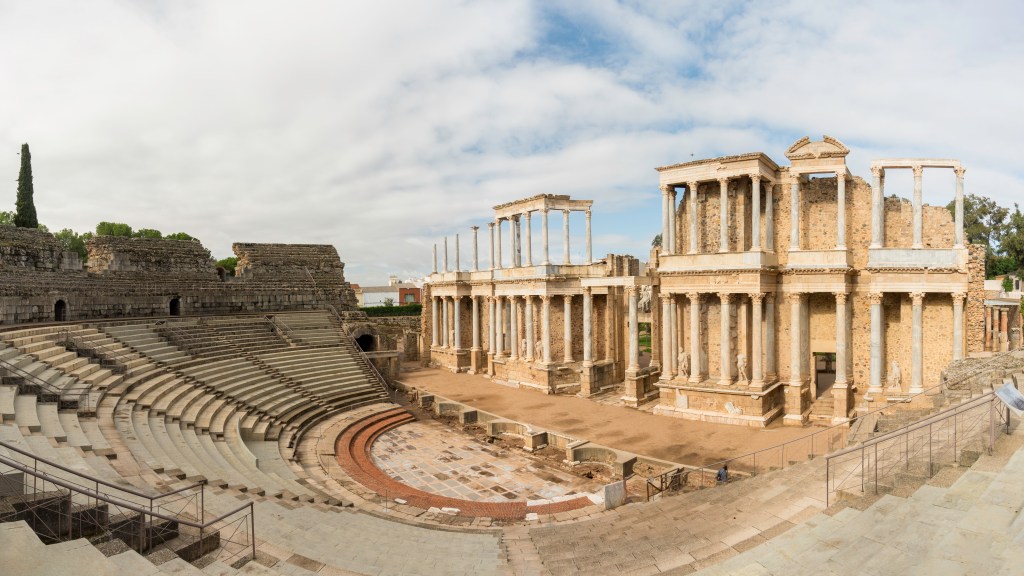
Fue construido en la ladera de un cerro, para facilitar la instalación de las gradas y abaratar su costo. Tuvo aforo para ¡seis mil! espectadores. Materiales: Hormigón forrado con sillares de piedra. Así se ve hoy, aunque obviamente ha sufrido numerosas restauraciones. ¡Es un edificio de hace veintidós siglos!
It was built on the side of a hill to facilitate the installation of the stands and reduce their cost. It had a capacity for six thousand spectators! Materials: Concrete lined with stone ashlars. This is how it looks today, although it has obviously undergone numerous restorations. It’s a twenty-two-century-old building!
Las gradas se distribuían de abajo a arriba según el rango social en tres sectores, caveas summa, media e ima, separadas por pasillos y barreras. A todas las gradas se accedía con facilidad desde escalerillas distribuidas de manera radial por las caveas. A través de pasillos se llegaba a las puertas de acceso o vomitorios. La cavea ima era para la aristocracia. Se modificó en época de Trajano, erigiendo en su centro un espacio sagrado rodeado de una baranda de mármol.
The tiers were arranged from bottom to top according to social rank into three sections: the cavea summa, media, and ima, separated by corridors and barriers. All tiers were easily accessed from ladders arranged radially throughout the cavea. Corridors led to the access doors, or vomitoria. The cavea ima was for the aristocracy. It was modified during the time of Trajan, with a sacred space surrounded by a marble railing erected in its center.
El espacio semicircular donde se ubicaba el coro, la orchestra, luce un suelo mármol, fruto de una reforma tardía. Tras la orchestra se eleva el muro del proscenio, de exedras circulares y rectangulares. Sobre él se desplegaba la escena.
The semicircular space that housed the choir and orchestra features a marble floor, the result of a late renovation. Behind the orchestra rises the proscenium wall, with circular and rectangular exedras. The stage unfolded above it.
Tras el muro del frente escénico había un amplio jardín porticado cerrado por muros con hornacinas que fueron decoradas con estatuas de miembros de la familia imperial. En el eje de este pórtico, en línea con la valva regia y el espacio sagrado de la ima cavea, se hallaba la aula sacra, un pequeño espacio sagrado con una mesa de altar donde se honraba a la figura del divino Augusto.
Behind the stage wall was a large porticoed garden enclosed by walls with niches decorated with statues of members of the imperial family. Along the axis of this portico, in line with the valva regia and the sacred space of the ima cavea, was the aula sacra, a small sacred space with an altar table where the figure of the divine Augustus was honored.
El conjunto arqueológico de Mérida es uno de los más importantes de España y un testimonio excepcional de la arquitectura y urbanismo romanos.
The archaeological complex of Mérida is one of the most important in Spain and an exceptional testament to Roman architecture and urban planning.
En una breve descripción mencionaremos el anfiteatro, contiguo al teatro, para luchas de gladiadores y animales salvajes u otros juegos; una mansión excelentemente conservada también cercana al teatro, más tarde utlizada por los primeros cristianos como basílica; el puente romano sobre el Guadiana, uno de los más largos de España; el Templo de Diana; el Acueducto de los Milagros, colosal conducción hidráulica que traía aguas procedentes del pantano de Proserpina. Se conservan más de ochocientos metros de este acueducto, alguna de cuyas pilas de granito y ladrillo se alzan veintisiete metros por encima del terreno.
In a brief description, we will mention the amphitheater, adjacent to the theater, for gladiator and wild animal fights or other games; an excellently preserved mansion also close to the theater, later used by early Christians as a basilica; the Roman bridge over the Guadiana, one of the longest in Spain; the Temple of Diana; the Aqueduct of Miracles, a colossal hydraulic conduit that brought water from the Proserpina reservoir. More than eight hundred meters of this aqueduct are preserved, some of whose granite and brick piles rise twenty-seven meters above the ground.

En el extremo norte, la conducción contó con una piscina para depurar las aguas y que servía a la vez de fuente. Según la vaguada se pronuncia, la altura de las pilas y el número de arquerías aumenta; todo ello para que la conducción hidráulica quedara suspendida a la cota necesaria para que el agua fluyese hacia la ciudad.
At the northern end, the conduit featured a pool to purify the water and also served as a fountain. As the valley steepens, the height of the basins and the number of arches increases; all this was done to ensure that the hydraulic conduit was suspended at the necessary level for the water to flow to the city.
Aunque principalmente romana, Mérida también conserva vestigios del arte visigodo y árabe.
Although primarily Roman, Mérida also preserves vestiges of Visigothic and Arab art.
De la época visigoda lo más interesante se encuentra en el Museo de Arte Visigodo que expone una importante colección de piezas de esa época, elementos arquitectónicos, mobiliario litúrgico y objetos decorativos.
The most interesting artifacts from the Visigothic period are found in the Museum of Visigothic Art, which displays an important collection of pieces from that period, architectural elements, liturgical furniture, and decorative objects.
La Alcazaba Árabe de Mérida fue construida en el año 835 por el Emir Abd al-Rahman II. De planta cuadrada, cuenta con veinticinco torres que servían de contrafuertes. En su interior se encuentra un aljibe, único en la arqueología peninsular.
The Moorish Alcazaba of Mérida was built in 835 by Emir Abd al-Rahman II. Square in plan, it has twenty-five towers that served as buttresses. Inside is a cistern, unique in Iberian archaeology.
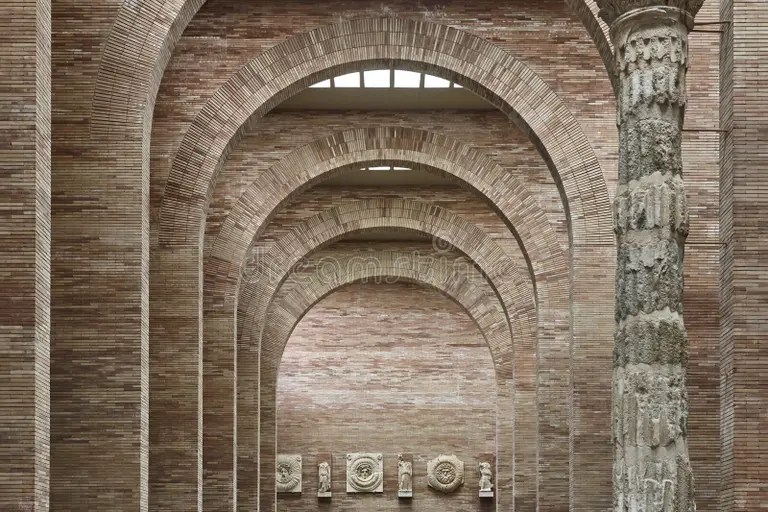
Si hablamos de arte contemporáneo no hay más remedio que referirse al Museo de Arte Romano, joya arquitectónica diseñada por Rafael Moneo. En mi opinión su obra maestra. De ladrillo visto, Moneo hizo constuirlos de la misma manera que se construyeron los antiguos ladrillos romanos. El interior es una maravilla de instalación de volúmenes en espacios, es decir, una obra de arte para cada espacio, también diseño de Moneo. Fue inaugurado el 19 de septiembre de 1986.
When talking about contemporary art, we must refer to the Museum of Roman Art, an architectural gem designed by Rafael Moneo. In my opinion, his masterpiece. Made of exposed brick, Moneo had them constructed in the same way as ancient Roman bricks. The interior is a marvel of installing volumes in spaces, that is, a work of art for each space, also designed by Moneo. It was inaugurated on September 19, 1986.
Hemos hablado de un festival de teatro clásico que se celebra en el Teatro de Agripa en Emerita Augusta, fundada por Octavio Augusto, primer Emperador. Capital de Lusitania, una de las provincias de Hispania. Hoy en día capital de Extremadura. De Numancia, y sobre todo del legado cultural asimilado y enriquecido localmente que conforman nuestra historia y riqueza artística. Ojo, nuestra historia, no la de los diversos y numerosos invasores.
We’ve talked about a classical theater festival held at the Theater of Agrippa in Emerita Augusta, founded by Octavian Augustus, the first Emperor. It was the capital of Lusitania, one of the provinces of Hispania. Today, it is the capital of Extremadura. It is also the capital of Numantia, and above all, of the cultural legacy assimilated and enriched locally that shapes our history and artistic wealth. Note: our history, not that of the various and numerous invaders.
Descubre más desde LA AGENCIA MUNDIAL DE PRENSA
Suscríbete y recibe las últimas entradas en tu correo electrónico.
