

«A ballet named «Afanador»

COLUMNISTA
Un ballet producido por el Ballet Nacional de España (BNE) que lleva por título el apellido de un fotógrafo nacido en Bucaramanga, Colombia, Ruven Afanador. Un ballet llamado “Afanador”, basado en fotografías de este artista universal, convertidas en danza por Marcos Morau, director de la compañía La Veronal, a petición con carta blanca de Rubén Olmo, actual director del BNE.
A ballet produced by the Spanish National Ballet (BNE) named after the photographer Ruven Afanador, born in Bucaramanga, Colombia. A ballet called «Afanador,» based on photographs by this universal artist, transformed into dance by Marcos Morau, director of the La Veronal company, at the request of Rubén Olmo, current director of the BNE.
Un resultado nuevo, con lenguaje distinto, surrealista, un tanto litúrgico, atrevido, heterodoxo, transgresor, embriagador, a ratos angustioso, siempre lleno de arte y belleza, nada fácil, único. No sé si falta algún ingrediente para que la suma de todos ellos sea maravilloso.
A new result, with a distinct language, surreal, somewhat liturgical, daring, unorthodox, transgressive, intoxicating, at times anguishing, always full of art and beauty, not easy, unique. I don’t know if any ingredient is missing for the sum of all of them to be wonderful.

Pero, ¿quién es Ruven Afanador, fotógrafo de toreros, de flamencos, de indígenas colombianos, que siempre toca el alma humana mediante la imagen fotográfica?
But who is Ruven Afanador, a photographer of bullfighters, flamenco artists, and Colombian indigenous people, who always touches the human soul through photographic images?
Nacido en Bucaramanga, Colombia, recuerda las caminatas con sus padres observando los parques y paisajes dramáticos de su tierra, o el proceso de revelado y retoque en un laboratorio fotográfico local.
Born in Bucaramanga, Colombia, he remembers walking with his parents, observing the parks and dramatic landscapes of his homeland, or the process of developing and retouching his photographs at a local photo lab.
Cuando tenía catorce años toda la familia se trasladó a Wisconsin, más tarde él a Washington, a Nueva York, salto a Europa, a Italia, Milán, paraíso de moda; a España, Madrid, Barcelona, Sevilla, donde descubrió la magia de la tauromaquia y del flamenco y de los flamencos. Tres libros avalan esta pasión: “Torero”, “Mil besos” –dedicado a la mujer flamenca- y “Ángel Gitano”, al hombre.
When he was fourteen, his entire family moved to Wisconsin; later, he moved to Washington, then to New York, then to Europe, to Italy, Milan, a fashion haven; to Spain, Madrid, Barcelona, and Seville, where he discovered the magic of bullfighting, flamenco, and flamenco artists. Three books attest to this passion: «Torero,» «Mil besos» (A Thousand Kisses)—dedicated to flamenco women—and «Ángel Gitano» (Gipsy Angel), dedicated to flamenco men.
Treinta años en Nueva York no le han alejado de su raíz colombiana. Los contactos con su tierra no han cesado. De ahí su obra “Hijas del agua” que en colaboración con la artista Ana González dedicaron casi tres años a explorar veintiséis comunidades indígenas en Colombia, recorriendo el país de extremo a extremo. Afanador abrió las almas de pueblos de modo casi irreal, los abrazó con su lente, indagó en su esencia más digna.
Thirty years in New York have not distanced him from his Colombian roots. His connection with his homeland has never ceased. Hence his work «Hijas del agua» (Daughters of Water), in which, in collaboration with artist Ana González, they dedicated almost three years to exploring twenty-six indigenous communities in Colombia, traveling the country from one end to the other. Afanador opened the souls of peoples in an almost unreal way, embracing them with his lens, delving into their most dignified essence.
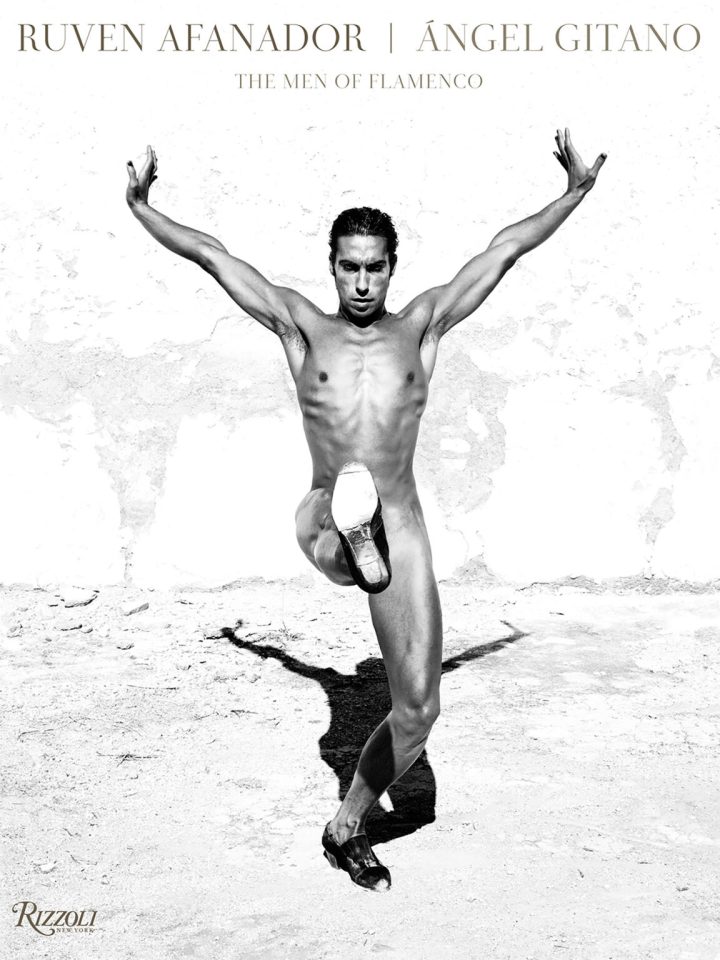
De los trabajos editoriales que han inspirado el ballet que lleva su nombre, “Ángel Gitano. Los hombres del Flamenco”, digamos que la más total desinhibición es el leit motiv . Grandiosos desnudos y semidesnudos de bailaores fuera de los tablaos y los teatros, con corsé o vestidos con bata de cola, con tutús, cubiertos con velos, todos maquillados, todos hombres llevados a otro plano. Un proyecto de tres años con escenario en Sevilla y Jerez de la Frontera. Cito a Afanador: Es como los he sentido, como los imaginé y ellos se entregaron totalmente.
Of the editorial works that inspired the ballet that bears his name, «Ángel Gitano. Los hombres del Flamenco,» let’s say that the most total lack of inhibition is the leitmotif. Magnificent nude and semi-nude dancers outside of tablaos and theaters, in corsets or dressed in bata de cola, in tutus, covered with veils, all made up, all men taken to another level. A three-year project with stages in Seville and Jerez de la Frontera. To quote Afanador: «It’s how I felt them, how I imagined them, and they gave it their all.»
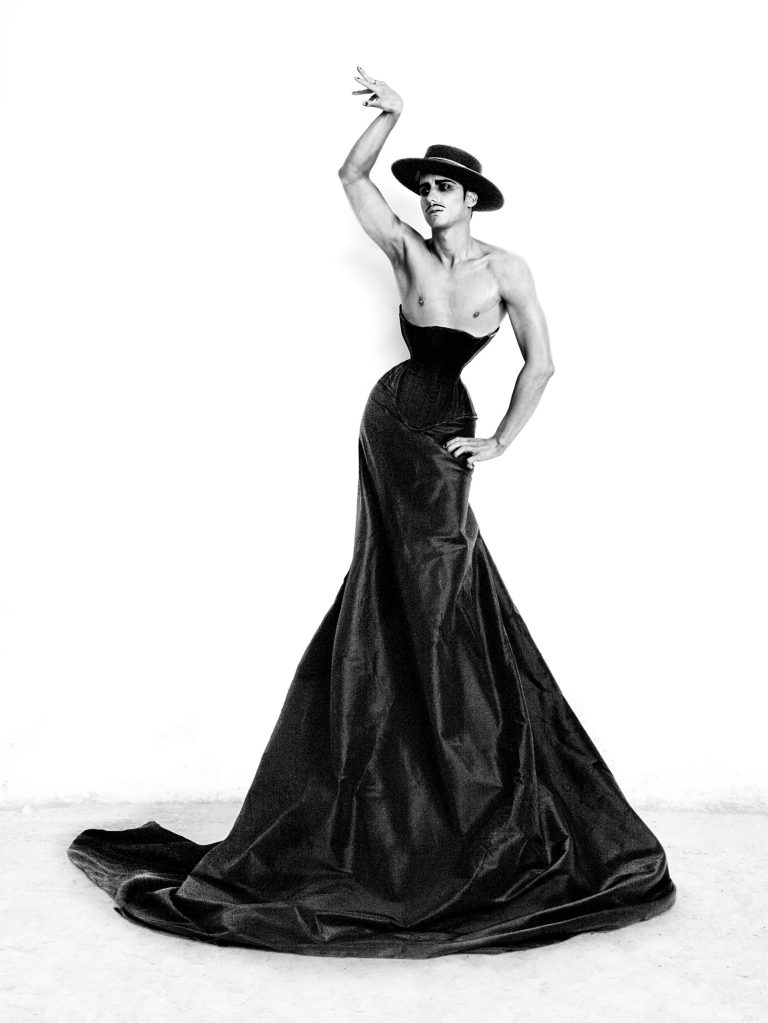
Siempre fotos en blanco y negro, siempre de negro los y las artistas del BNE en el ballet que nos ocupa. Un ballet que se estrenó en diciembre de 2023 en el Teatro de la Maestranza de Sevilla y que acaba de verse en el Teatro de la Zarzuela de Madrid en estos días de julio de 2025. Dice su director, Rubén Olmo: Afanador tendrá años de itinerancia por el mundo. La tendrá, porque nunca se ha visto, ni probablemente se verá algo igual, ni parecido.
Always in black and white, the BNE artists always in black in the ballet at hand. A ballet that premiered in December 2023 at the Teatro de la Maestranza in Seville and was just seen at the Teatro de la Zarzuela in Madrid this past July 2025. Its director, Rubén Olmo, says: Afanador will tour the world for years. It will, because nothing like it or anything similar has ever been seen, nor will it likely ever be seen.
Dice Afanador: El flamenco es un arte increíble, lleva todas las emociones del ser humano. Me siento muy de España, me apasiona mucho.
“Mil besos. Mujeres gitanas”. Dos años de trabajo entre Sevilla y Jerez, (2007-2008). Un homenaje a la mujer flamenca y gitana. Una de las imágenes fue elegida como cartel de la Bienal de Flamenco de Sevilla 2008 y durante ella toda la colección se expuso en soportes publicitarios en una calle principal de Sevilla. Habrá quién lo recuerde.
Afanador says: Flamenco is an incredible art; it embodies all the emotions of a human being. I feel very much from Spain; I am deeply passionate about it.
«A Thousand Kisses. Gypsy Women.» Two years of work between Seville and Jerez (2007-2008). A tribute to flamenco and gypsy women. One of the images was chosen as the poster for the 2008 Seville Flamenco Biennial, and during that time the entire collection was displayed on advertising media on a main street in Seville. There will be those who remember it.
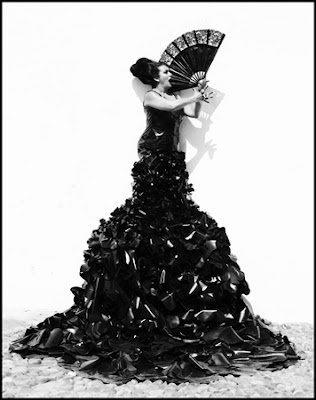
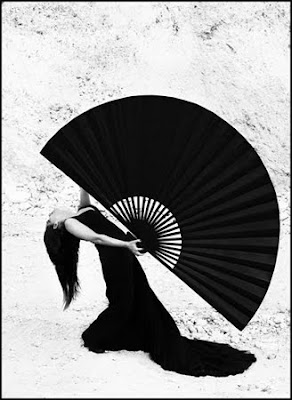
Ver la colección de fotos es ver el ochenta por ciento del ballet. Ahí uno se da cuenta de que “Afanador” es un homenaje en su totalidad a este fotógrafo realmente único. Ahí está el protagonismo del abanico realizando diversas funciones. Otro homenaje a algo tan andaluz y tan conectado al flamenco como el abanico.
Viewing the photo collection is like seeing eighty percent of the ballet. There, one realizes that «Afanador» is a tribute in its entirety to this truly unique photographer. There, the fan plays a central role, performing various functions. Another tribute to something as Andalusian and as connected to flamenco as the fan.
Arte y provocación, transgresión, alma, esencia humana paralela a la esencia artística. La sensibilidad de un colombiano es la que ha captado aspectos nunca captados antes.
Art and provocation, transgression, soul, human essence parallel to the artistic essence. The sensitivity of a Colombian is what has captured aspects never before captured.
Las más extremas: Las de Carmen Pantoja, La More, Esperanza Fernández, Pepa de Molina, María del Mar Moreno, Matilde Coral.
The most extreme: Those of Carmen Pantoja, La More, Esperanza Fernandez, Pepa de Molina, Maria del Mar Moreno, Matilde Coral.
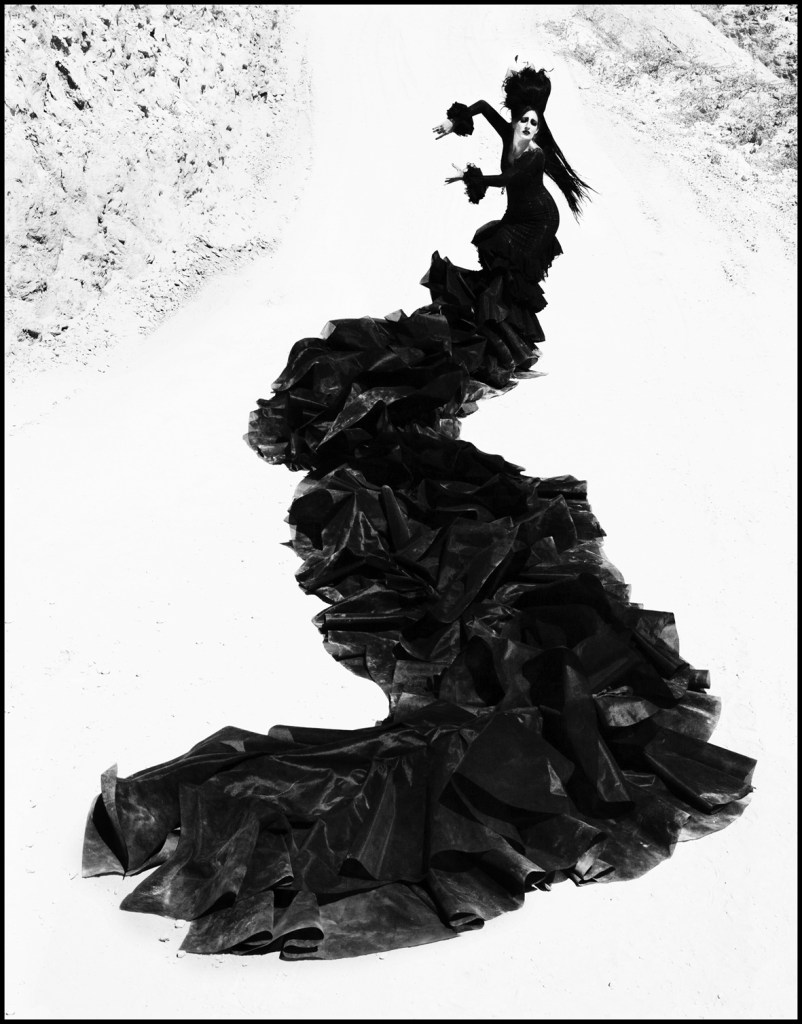
Bailando, la de La Farruca, su traje está en el ballet. La de Úrsula López con todo el protagonismo en la bata de cola. El abanico de Eva Yerbabuena en una increíble foto, toda pasión por la danza.
Ver esta colección de fotografías de “Mil besos” me ha hecho entender al cien por cien las fantasías de un ballet que volveré a ver en cuanto tenga ocasión.
Dancing, La Farruca, her costume is in the ballet. Úrsula López’s, taking center stage in her long train. Eva Yerbabuena’s fan in an incredible photo, all passion for dance.
Seeing this collection of photographs from «A Thousand Kisses» has made me fully understand the fantasies of a ballet I will see again as soon as I have the chance.
Este artículo habla del ballet pero no es una reseña del ballet, que obviamente estaría en otra columna. Esta columna habla de un artista que no creo exagerar al considerarle único, Ruven Afanador.
Y por extensión, es también un homenaje a los pueblos indígenas colombianos.
This article is about ballet, but it’s not a ballet review, which would obviously be in a separate column. This column is about an artist who, I don’t think I’m exaggerating when I consider him unique, Ruven Afanador. And by extension, it’s also a tribute to Colombia’s Indigenous peoples.
Descubre más desde LA AGENCIA MUNDIAL DE PRENSA
Suscríbete y recibe las últimas entradas en tu correo electrónico.

