

The Manolo Sanlúcar Museum

Estamos en Sanlúcar de Barrameda, en una breve escapada desde el festival Flamenco de Jerez. Una escapada cuyo objetivo prioritario es conocer el reciente Museo de Manolo Sanlúcar, fruto de la Fundación que lleva su nombre y de la iniciativa privada de la empresa catalana Aura Seguros.
We’re in Sanlúcar de Barrameda, on a short break from the Jerez Flamenco Festival. The main objective of this break is to visit the newly built Manolo Sanlúcar Museum, the brainchild of the foundation that bears his name and the private initiative of the Catalan company Aura Seguros.
Estamos en la Avenida Bajo de Guía 10, hoy Palacio del Pueblo Andaluz Manolo Sanlúcar, un edificio modernista de 1907, diseño del arquitecto sevillano Aníbal González, el genio de la Plaza de España y del Hotel Alfonso XIII de Sevilla, entre otros.
We’re at Avenida Bajo de Guía 10, now the Palacio del Pueblo Andaluz Manolo Sanlúcar, a 1907 Modernist building designed by the Sevillian architect Aníbal González, the genius behind the Plaza de España and the Hotel Alfonso XIII in Seville, among others.
Fue un encargo de Don Francisco González Ybarra y de su esposa María Luz Fernández Palacios. Ahí nació Villa Luz, residencia veraniega de la pareja. Desde entonces ha pasado por distintos dueños y usos, desde hotel de lujo, hasta garito de ocio nocturno.
It was commissioned by Don Francisco González Ybarra and his wife María Luz Fernández Palacios. It was there that Villa Luz was born, the couple’s summer residence. Since then, it has had various owners and uses, from a luxury hotel to a nightclub.
La reforma actual realizada por la Fundación Manolo Sanlúcar Aura Seguros ha recuperado la estética original del edificio, su aspecto señorial, ha introducido elementos del modernismo catalán, entre los que destacan los mosaicos con la técnica del trencadís, recordando a Antoni Gaudí.
The current renovation, carried out by the Manolo Sanlúcar Aura Seguros Foundation, has restored the building’s original aesthetic and stately appearance, introducing elements of Catalan modernism, including the trencadís mosaics, reminiscent of Antoni Gaudí.
En el interior se ha conservado el respeto a su estructura, cuyo eje central, la escalera principal ha sido totalmente restaurada. Se ha recuperado el acceso al tejado a través del lucernario, por medio de una escalera de caracol artesanal inspirada en el baile de Sara Baras.
Inside, respect for its structure has been maintained, with the main staircase, its central axis, being completely restored. Access to the roof has been restored through the skylight, via a handcrafted spiral staircase inspired by the dance of Sara Baras.
Un espacio en el que el Maestro se hubiera reconocido en la fusión del regionalismo andaluz y el modernismo, que lo han convertido en un espacio que conserva el patrimonio arquitectónico de Sanlúcar de Barrameda, idóneo para albergar el inmenso patrimonio cultural legado por el Maestro nacido en esa ciudad y que ha dado su nombre a la Fundación.
A space in which the Maestro would have recognized himself in the fusion of Andalusian regionalism and modernism, which has transformed it into a space that preserves the architectural heritage of Sanlúcar de Barrameda, ideal for housing the immense cultural heritage left by the Maestro, born in that city and for whom the Foundation is named.
El concepto y diseño expositivo de las instalaciones fueron idea de Oriol Flo, director del Bluemap Consulting Group, recientemente fallecido el pasado 7 de enero.
The concept and exhibition design of the facilities were the idea of Oriol Flo, director of the Bluemap Consulting Group, who recently passed away on January 7.
En el jardín del Museo / In the garden of the Museum
Frente a la entrada, ligeramente a la izquierda, se encuentra la que según su autor, el escultor Manuel Martín Nieto, es su obra maestra: El monumento a Manolo Sanlúcar, un encargo del Presidente y Patrono de la Fundación de las Artes Flamencas, José Martínez Talavera, también fundador y presidente de la Fundación Aura Seguros.
Opposite the entrance, slightly to the left, is what its author, the sculptor Manuel Martín Nieto, believes is his masterpiece: The monument to Manolo Sanlúcar, commissioned by the President and Patron of the Flamenco Arts Foundation, José Martínez Talavera, also founder and president of the Aura Seguros Foundation.
Una escultura del Maestro a tamaño natural, sentado con una enorme guitarra que sujeta con su brazo derecho; el pie derecho descalzo, apoyado sobre el reposa pié, con el significado de que su trabajo y su música, nacen de la tierra y del pueblo. La mirada llena de sabiduría refleja paz, y el trabajo para llegar a ser quién es; la vestimenta sencilla, de campesino andaluz, cercana como él fue.
A life-size sculpture of the Maestro, seated with an enormous guitar held in his right arm; his right foot is bare, resting on the footrest, signifying that his work and his music are born from the earth and the people. His wise gaze reflects peace, and the work he has done to become who he is; his simple Andalusian peasant clothing is as close as he was.
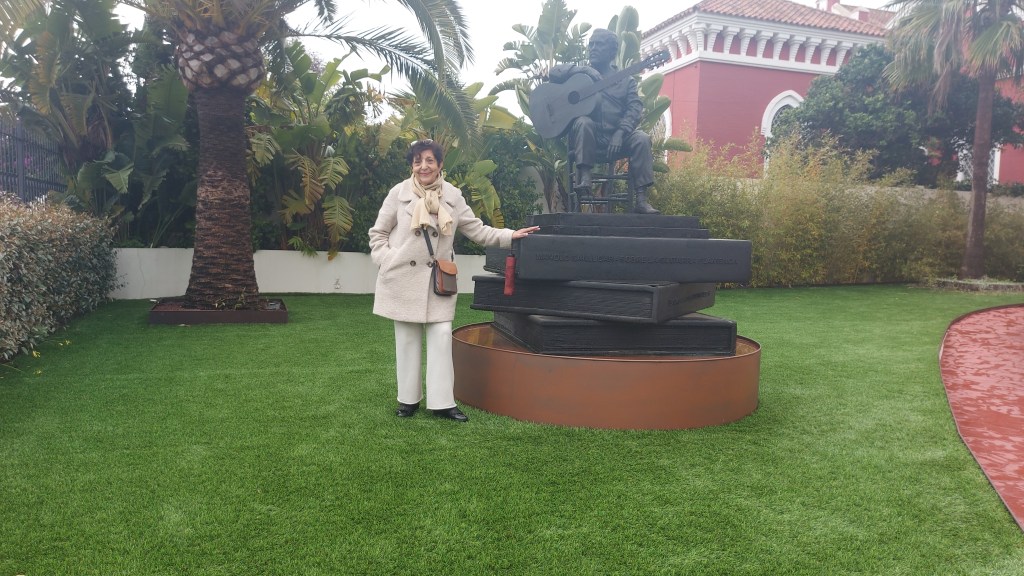
El escultor trabajó con una técnica desarrollada ¡en el siglo V antes de Cristo! Se modela en arcilla sobre estructura metálica, para ser fundida en bronce a la cera perdida. Para entendernos mejor: Se hace un prototipo de cera de abeja que se coloca en un horno. Cuando la cera se derrite, se agrega el metal fundido.
The sculptor worked on a technique developed in the fifth century before Christ. It was modelled in clay on a metallic structure, to be melted in bronze at a lost wax. That is, a prototype of bee’s wax is made, to be placed in an oven. When the wax melts, the melted metal is added.
Entramos al Museo / We entered the Museum
No encuentro mejor forma de guiar al lector por las salas del museo, que seguir las fotos, pinturas y cartelas que amablemente me permitieron fotografiar durante un recorrido guiado por Toni Román, de la Fundación Aura Seguros. El miércoles 5 de marzo el museo estaba cerrado hasta el sábado 8. Mi credencial de prensa y la promesa de este reportaje obraron el milagro. Así que tuve el privilegio de una visita guiada para mi sola. Imaginen como fue esa visita memorable.
I can’t think of a better way to guide the reader through the museum’s galleries than to follow the photos, paintings, and labels I was kindly allowed to photograph during a guided tour by Toni Román of the Aura Seguros Foundation. On Wednesday, March 5th, the museum was closed until Saturday, March 8th. My press credentials and the promise of this report worked a miracle. So I had the privilege of a guided tour all to myself. Imagine how memorable that visit was.
Necesariamente, me limitaré a los hitos. Empezaré por “Medea y Aljibe, el disco como arte total”, ilustrados por dos cuadros en los que está Manolo Sanlúcar, generosamente cedidos por la Fundación Aura Seguros.
Of course, I’ll limit myself to the highlights. I’ll start with «Medea and Aljibe, the Record as Total Art,» illustrated by two paintings featuring Manolo Sanlúcar, generously provided by the Aura Seguros Foundation.
Medea: “Sinfonía andaluza, lleva la herida de la muerte y la pena que rompió su alma en pedazos. Principio y fin. Placer y dolor. Vida y muerte. Eurípides flamenco, Medea repudiada. Jasón absorto en la fiesta de los desposorios. El arte de un hombre irrepetible, una obra inmortal llevada a la arena de la marisma.”
Medea: “An Andalusian symphony, it bears the wound of death and the sorrow that shattered his soul. Beginning and end. Pleasure and pain. Life and death. Flemish Euripides, Medea repudiated. Jason absorbed in the marriage feast. The art of a unique man, an immortal work brought to the sand of the marsh.”

Aljibe: “El blanco de una vela despunta en el horizonte inquieto de las dunas, allá donde el río se abraza a la mar salada. Y después Dios, que le concedió el don del duende, la potestad de la cultura de sus ancestros, las raíces en las que arraigó Al-Andalus, y el arte jondo elevado a las estrellas…”
Cistern: “The white of a sail rises on the restless horizon of the dunes, where the river embraces the salty sea. And then God, who granted him the gift of duende, the power of his ancestors’ culture, the roots in which Al-Andalus was rooted, and the flamenco art elevated to the stars…”
Las guitarras de Manolo Sanlúcar: “Hacia 1985 Manolo Sanlúcar buscaba una gama de guitarras elaboradas bajo sus instrucciones. Y ahí entró el taller de Manuel Rodríguez Jr. luthier reconocido por su maestría. El Maestro diseñó una colección de guitarras pensadas en función del guitarrista. Objetivo, conseguir la mayor afinación, el mejor sonido. Que el músico pudiera tocar con el menor esfuerzo, que encontrase un sonido equilibrado entre graves y agudos y la perfección de las notas en todo el recorrido del mástil”.
Manolo Sanlúcar’s guitars: «Around 1985, Manolo Sanlúcar was looking for a range of guitars made under his instructions. And that’s where the workshop of Manuel Rodríguez Jr., a luthier renowned for his mastery, came in. The Maestro designed a collection of guitars designed with the guitarist in mind. The goal was to achieve the best tuning, the best sound. So the musician could play with the least effort, finding a balanced sound between bass and treble, and perfect notes all the way down the neck.»

Fotos de los modelos de guitarra Alba, 2000, ciprés y abeto; Modelo 1ª Maestra, 2000. Palosanto de India y cedro; Venus, 2001, palosanto de India y cedro.
Photos of the Alba model guitar 2000, cypress and spruce; 1st Master Model, 2000. Indian rosewood and cedar; Venus, 2001, Indian rosewood and cedar.
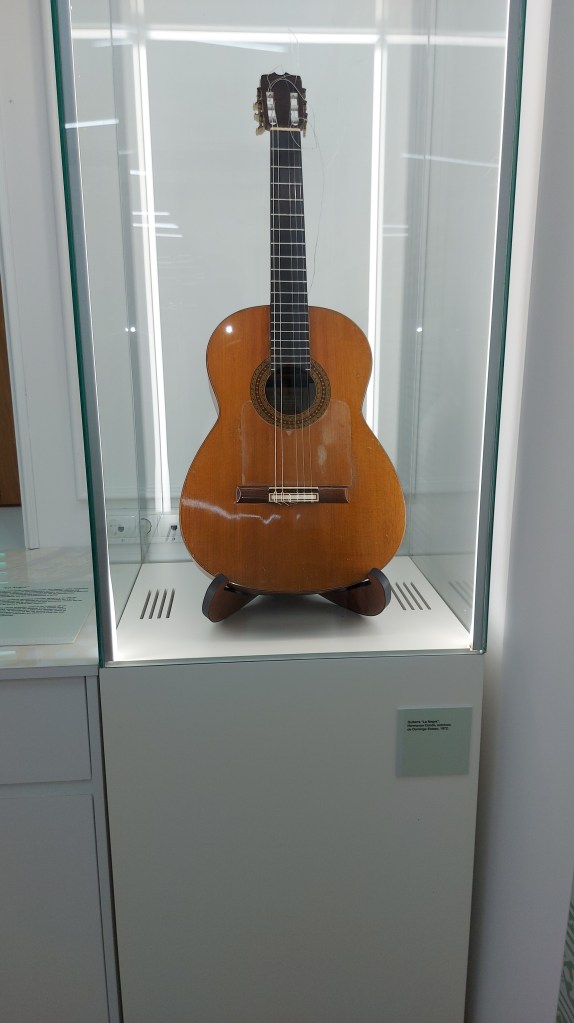
Guitarra rota. La rompió Manolo Sanlúcar tras la muerte de su único hijo en 2004, que le quebró el alma hasta el fin de sus días. “¿Para quién tocar a partir de ese momento… para qué tocar si se desvanece todo motivo?” Posteriormente fue restaurada y está en su libro autobiográfico El alma compartida, del que se han extraído varios poemas, entre otros el que sigue.
Broken guitar. Manolo Sanlúcar broke it after the death of his only son in 2004, which shattered his soul until the end of his days. “For whom should I play from that moment on… why play if all motive vanishes?” It was later restored and appears in his autobiographical book, *The Shared Soul*, from which several poems have been extracted, including the following.
Canción de Andalucía. (Del alma compartida)
Song of Andalusia. (From Shared Memory)
Aquí me tienes, noble tierra mía
Donde la herida duele por amor.
Here I am, my noble land
Where the wound aches for love.
Para entregarte el canto de alegría,
Para decirte cómo a ti te quiero yo.
To give you the song of joy,
To tell you how much I love you.
Eres entrañas, de mis mañanas,
Eres mi guía y eres mi dolor.
You are the depths of my mornings,
You are my guide and my pain.
Eres la aurora del alma mía,
donde se mece con tu luz, mi corazón.
You are the dawn of my soul,
Where my heart sways with your light.
¡Ay! Mi Andalucía, ¡Ay!
Donde el verde crece y el blanco anida.
Oh! My Andalusia, oh!
Where green grows and white nests.
¡Ay, ay, ay! Mi Andalucía, ¡Ay!
Donde ocho luceros son mis heridas…
Oh, oh, oh! My Andalusia, oh! Where eight stars are my wounds…
Caballo negro / Black horse.
Manolo Sanlúcar no solo es uno de los guitarristas más sobresalientes del mundo. No solo es un maestro del flamenco puro, también de la guitarra clásica. Su talento como intérprete se iguala a su rango de compositor en ambos géneros.
Manolo Sanlúcar is not only one of the world’s most outstanding guitarists. He’s not only a master of pure flamenco, but also of classical guitar. His talent as a performer is equal to his prowess as a composer in both genres.
De El alma compartida. “Me llamó el director de la discográfica para invitarme a comer. Apenas nos sentamos me dijo sin rodeos: ¿Manolo, ¿quieres llegar al gran público? Tienes ya cinco LP de flamenco tradicional. Qué vas a hacer, ¿otra seguiriya, otra taranta? La gente del flamenco sabe muy bien quién eres, dame un tema que podamos presentar en programas populares. De vuelta a casa cogí la guitarra y con tres acordes de base rítmica, parecida a la rumba, fui improvisando, como para una fiesta familiar. Dos horas más tarde, llamé a la compañía y los pasé la grabación. Me dijeron: “Este tema será un número uno”.
From Shared Memory. “The director of the record label called me to invite me to lunch. As soon as we sat down, he said bluntly: Manolo, do you want to reach the general public? You already have five LPs of traditional flamenco. What are you going to do, another seguiriya, another taranta? The flamenco world knows very well who you are, give me a song we can present on popular programs.” Back home, I picked up my guitar and, with three chords of a rhythmic base similar to rumba, I improvised, as if for a family party. Two hours later, I called the company and gave them the recording. They told me: “This song will be a number one.”
Así nació Caballo negro, 1974, una de las mejores composiciones para guitarra de todos los tiempos.
Thus was born Caballo Negro, 1974, one of the greatest guitar compositions of all time.
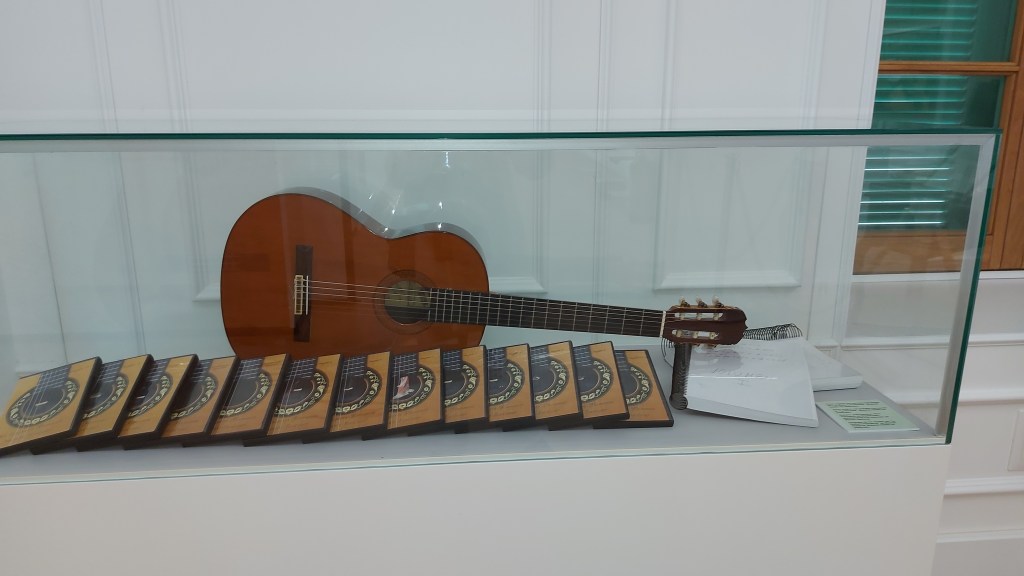
Foto: Guitarra de José Ramírez, 1974. Palosanto de Brasil/Cedro. Las carátulas de los trece DVD de La guitarra flamenca de Manolo Sanlúcar son material inédito, no publicado.
Photo: José Ramírez’s guitar, 1974. Brazilian rosewood/cedar. The covers of the thirteen DVDs of Manolo Sanlúcar’s Flamenco Guitar are unreleased material.
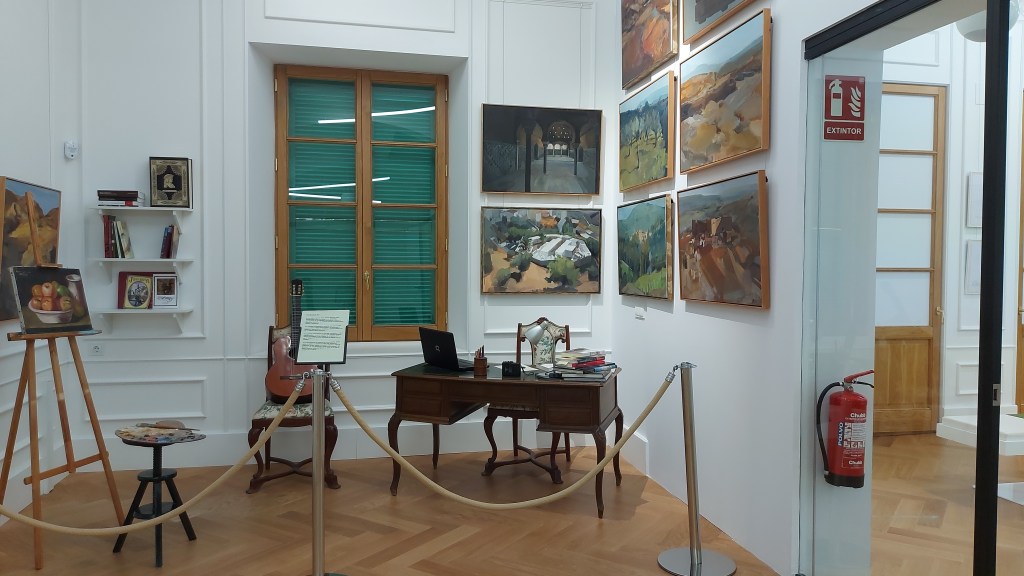
A la izquierda, la pintura sobre el caballete, es del Maestro. La cartela del centro dice: “En los últimos quince años, pasó interminables horas en su despacho, con pinturas y lienzos, su biblioteca, papeles y partituras amontonados sobre su escritorio. Al fondo los ocho cuadros a los que llamó ‘ocho monumentos del arte andaluz’, a los que dedicó una de sus últimas obras sinfónicas. Aquí, en su reducto, elaboró su obra más profunda, su gran tratado La Guitarra Flamenca, con dedicación casi monacal: “Me siento como un monje del flamenco. Todo mi ser está al servicio de mi cultura”.
On the left, the painting on the easel is by the Maestro. The label in the center reads: «Over the last fifteen years, he spent endless hours in his office, with paints and canvases, his library, papers, and scores piled up on his desk. In the background are the eight paintings he called ‘eight monuments of Andalusian art,’ to which he dedicated one of his last symphonic works. Here, in his retreat, he produced his most profound work, his great treatise The Flamenco Guitar, with an almost monastic dedication: ‘I feel like a monk of flamenco. My whole being is at the service of my culture.'»
Tauromagia, 1988. Obra cumbre de la guitarra flamenca / Tauromagia, 1988. A masterpiece of flamenco guitar.
Proyectos de la Fundación Manolo Sanlúcar Aura Seguros. Además del Palacio del Pueblo Andaluz, sede del museo descrito, están el Instituto Internacional de Guitarra Flamenca Manolo Sanlúcar, dedicada a la difusión, promoción y defensa del arte flamenco y a la transmisión de un conocimiento innovador sobre la guitarra flamenca a través de un método revolucionario ideado por Manolo Sanlúcar. El Instituto viene a cubrir una necesidad en el mundo del flamenco: La formación bajo un método pedagógico – musical creado específicamente para el estudio del flamenco y desarrollado por él, a lo largo de más de quince años.
Projects of the Manolo Sanlúcar Aura Seguros Foundation. In addition to the Palacio del Pueblo Andaluz, home to the museum described above, there is the Manolo Sanlúcar International Institute of Flamenco Guitar, dedicated to the dissemination, promotion, and defense of flamenco art and the transmission of innovative knowledge about flamenco guitar through a revolutionary method devised by Manolo Sanlúcar. The Institute addresses a need in the world of flamenco: training under a pedagogical-musical method created specifically for the study of flamenco and developed by him over more than fifteen years.
El Festival de artes flamencas, Flamenc-ON, inició su marco de acción en Santa Coloma de Gramenet, posteriormente extendido a otras localidades, es uno de los proyectos vertebradores de la Fundación. Con un cartel de artistas de primer nivel y jóvenes promesas, está dotado de una filosofía integradora, y al servicio del fomento de la diversidad.
The Flamenc-ON Flamenco Arts Festival, which began operations in Santa Coloma de Gramenet and later expanded to other locations, is one of the Foundation’s core projects. With a lineup of top-level artists and promising young talents, it is endowed with an inclusive philosophy and serves to promote diversity.
Manolo Sanlúcar en el mundo / Manolo Sanlúcar in the world
En París, Lyon y Marsella en Francia; en Sao Paulo, Brasil; en Copenhague, Dinamarca; en Toronto, Canadá; En Osaka y en dos sedes en Tokio, Japón; en Nueva York, en el Lincoln Center y en el Metropolitan Ópera House; en Washington, John F. Kennedy Center y Lindsay Auditorium; en el Palacio de Congresos del Kremlin, Moscú; en el Palacio de la Cultura de Leningrado; en el Palacio de la Ópera y ballet de Riga, Letonia; en el Teatro della Fenice de Venecia; Palacio Regio de Torino; Teatro Colón y Teatro Liceo de Buenos Aires; en el Festival Internacional de Caracas, Venezuela; en Bruselas, Viena, Oslo; en México, en Monterrey, en el antiguo D.F. y en Querétaro; en Estambul, Turquía y en Melbourne, Australia.
In Paris, Lyon and Marseille in France; in Sao Paulo, Brazil; in Copenhagen, Denmark; in Toronto, Canada; in Osaka and in two venues in Tokyo, Japan; in New York, at the Lincoln Center and the Metropolitan Opera House; in Washington, the John F. Kennedy Center and Lindsay Auditorium; at the Kremlin Palace of Congresses in Moscow; at the Palace of Culture in Leningrad; at the Opera and Ballet Palace in Riga, Latvia; at the Teatro della Fenice in Venice; Palazzo Regio in Turin; Teatro Colón and Teatro Liceo in Buenos Aires; at the Caracas International Film Festival in Venezuela; in Brussels, Vienna, Oslo; in Mexico City, in Monterrey, in the old D.F. and in Querétaro; in Istanbul, Türkiye and in Melbourne, Australia.
Discípulos de Manolo Sanlúcar/ Disciples of Manolo Sanlúcar
Todos ellos han tenido hermosas palabras para él, que no reproducimos aquí, por economía de espacio. Sobre todo la anécdota llena de humor de Carlos Lederman.
All of them have had kind words for him, which we won’t reproduce here for reasons of space. Especially the humorous anecdote about Carlos Lederman.
Rafael Riqueni, Can Wang, José Antonio Rodríguez, Paco Vidal, Vicente Amigo, Pedro Sierra, Juan Carlos Romero, Javier Conde, Diego del Morao, David Carmona, Niño de Pura, Paco Serrano, Juan Manuel Cañizares, Carlos Lederman.
Rafael Riqueni, Can Wang, José Antonio Rodríguez, Paco Vidal, Vicente Amigo, Pedro Sierra, Juan Carlos Romero, Javier Conde, Diego del Morao, David Carmona, Niño de Pura, Paco Serrano, Juan Manuel Cañizares, Carlos Lederman.
Un verdadero artista. “Tarde o temprano un verdadero artista se verá obligado a elegir: ¿Quiero vivir en la “verdad” del arte? ¿Aporto algo con mi “verdad”? ¿Dónde quiero estar, en el parto de mi alma o en el truco de mis habilidades? ¿Qué me aportará más: la canción triunfante de los simples o la tortura gozosa de mi clausura? Al margen de lo que decidamos, los arrinconados tenemos el gozo que nos justifica: pues hay “fracasos” que consolidan al artista en su grandeza, y “éxitos” que confirman la miseria de un alma mediocre.”
A true artist. “Sooner or later a true artist will be forced to choose: Do I want to live in the “truth” of art? Do I contribute something with my “truth”? Where do I want to be, in the birth of my soul or in the trick of my skills? What will bring me more: the triumphant song of the simple or the joyful torture of my seclusion? Regardless of what we decide, those of us who are cornered have the joy that justifies us: for there are “failures” that consolidate the artist in his greatness, and “successes” that confirm the misery of a mediocre soul.”
De «El alma compartida»/Excerpt from The Shared Soul
F
Signed:
Estas casi siete páginas, que se verán incrementadas con las fotos, representan una pequeñísima parte de lo expuesto en el museo, como no puede ser de otra manera.
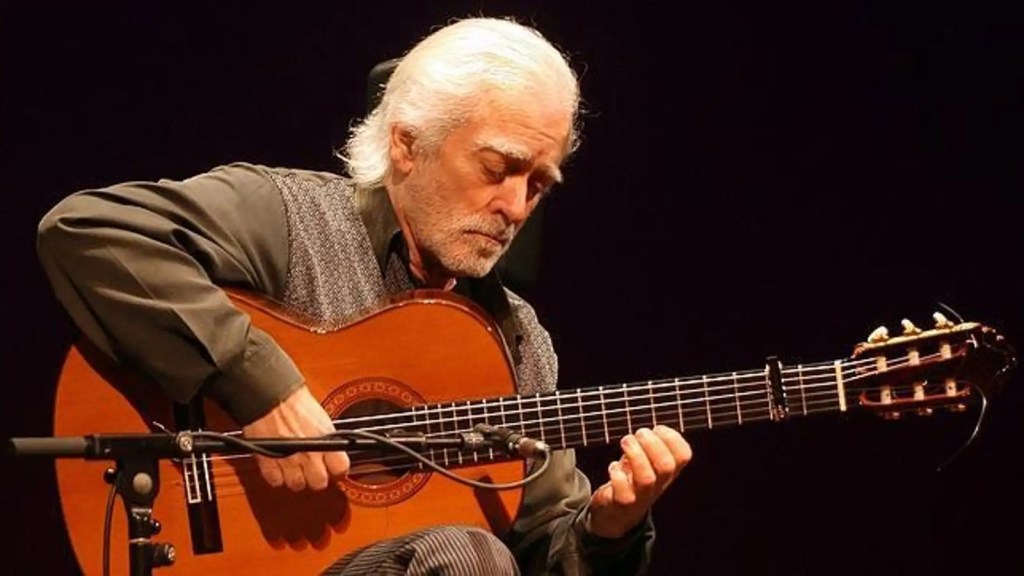
Quiero terminar con un recuerdo emocionado. Manuel Muñoz Alcón, Manolo Sanlúcar para el arte, falleció el 27 de agosto 2022 en Jerez de la Frontera. Meses antes, en el marco del Festival de Flamenco de ese mismo año, vino a Jerez, invitado por FUNDARTE, la organización del festival y por la Concejalía de Cultura del Ayuntamiento, para rendirle un cariñoso homenaje. Esa fue la última vez que le vi. Parecía estar muy sano, pero quién sabe, si aquello fue un homenaje de despedida.
I want to end with a fond memory. Manuel Muñoz Alcón, known as Manolo Sanlúcar in art, passed away on August 27, 2022, in Jerez de la Frontera. Months earlier, as part of the Flamenco Festival that same year, he had come to Jerez, invited by FUNDARTE, the festival’s organizers, and the City Council’s Department of Culture, to pay a loving tribute. That was the last time I saw him. He seemed very healthy, but who knows, maybe that was a farewell tribute.
Descubre más desde LA AGENCIA MUNDIAL DE PRENSA
Suscríbete y recibe las últimas entradas en tu correo electrónico.
