
Colonial memory. (II) Thyssen Bornemisza National Museum

El concepto eurocentrismo, como ente depredador, causante de abusos y sufrimiento, está muy presente en la literatura que acompaña a la muestra seleccionada para la memoria colonial.
The concept of Eurocentrism, as a predatory entity, causing abuse and suffering, is very present in the literature that accompanies the sample selected for colonial memory.
La historia está llena de centrismos. Y no se deben tanto a la memoria de invasiones, ocupaciones, etc., como a la expansión cultural que fue absorbida e integrada por otros pueblos. En el caso de nuestro acervo cultural destacan entre otros, Grecia, Roma, el Islam. O remontarnos a los fenicios. A nadie sensato se le ocurriría hoy en día descolonizar su enorme legado cultural.
History is full of centrism. And they are not due so much to the memory of invasions, occupations, etc., as to the cultural expansion that was absorbed and integrated by other peoples. In the case of our cultural heritage, among others, Greece, Rome, and Islam stand out. Or go back to the Phoenicians. No sensible person today would think of decolonizing its enormous cultural legacy.
En la historia que nos compete, señalaría como elemento relevante y necesario, el desarrollo de la navegación. Porqué fue posible plantearse una travesía atlántica a finales del siglo XV y no antes. Porque no había barcos capaces de hacerlo. Costeando se había descubierto y ‘colonizado’ muchísimo, desde el Atlántico hasta el Índico, por parte de Portugal. Por tierra, la rueda y sus aplicaciones para la movilidad, también tiene su historia y sus consecuencias.
In the history that concerns us, I would point out the development of navigation as a relevant and necessary element. Why was it possible to consider an Atlantic crossing at the end of the 15th century and not before. Because there were no ships capable of doing so. Coasting had been discovered and ‘colonized’ a lot, from the Atlantic to the Indian Ocean, by Portugal. On land, the wheel and its applications for mobility also have its history and its consequences.
Considerado este ángulo de la historia, habría que hablar más bien, de la inevitabilidad del llamado eurocentrismo, con sus abusos y causa de sufrimiento, pero sin ignorar como volcó e integró en el nuevo continente, un legado cultural que va desde la prehistoria al renacimiento. Digamos que desde el cuestionado descubrimiento, lo que allí ocurre deja de ser historia de España para ser historia de América. Como aquí siglos antes, la romanización, es historia de España, no del Imperio.
Considering this angle of history, we should rather talk about the inevitability of the so-called Eurocentrism, with its abuses and causes of suffering, but without ignoring how it overturned and integrated into the new continent, a cultural legacy that goes from prehistory to the Renaissance. . Let’s say that since the questioned discovery, what happens there stops being the history of Spain and becomes the history of America. As here centuries before, Romanization is the history of Spain, not the Empire.
Así se ha construido la historia de las civilizaciones.
This is how the history of civilizations has been built.
Descolonizar en sentido amplio y no en sentido reduccionista, ¿adónde nos llevaría? Si las colonizaciones, muy distintas unas de otras, son un hecho histórico, ¿qué es descolonizar?
Decolonizing in a broad sense and not in a reductionist sense, where would it take us? If colonizations, very different from each other, are a historical fact, what is decolonization?
De América llegó a Europa la patata o papa, (auténtico oro para los pueblos de este lado oceánico) el maíz, el tomate, las frutas tropicales, el café, el cacao. De España llegaron los cítricos, la vid, el trigo, los olivos, los textiles, las universidades. Las artes mutuas se intercambiaron. ¿Hablamos de apropiación o de asimilación e intercambio?
From America the potato came to Europe (authentic gold for the people of this oceanic side), corn, tomatoes, tropical fruits, coffee, and cocoa. From Spain came citrus fruits, grapevines, wheat, olive trees, textiles, and universities. Mutual arts were exchanged. Are we talking about appropriation or assimilation and exchange?
La historia de la esclavitud es horrenda y antiquísima. Traficar con seres humanos. ¿Hemos cambiado tanto? Porque a diario, traficados por mafias, llegan a nuestras costas, gentes tan desesperadas, que arriesgan la vida para tratar de salir de situaciones insostenibles en sus países, ricos en recursos, con gobiernos corruptos, conniventes con un neocolonialismo y neopatrimonialismo, que nadie trata de evitar.
The history of slavery is horrendous and ancient. Trafficking in human beings. Have we changed that much? Because every day, trafficked by mafias, people so desperate arrive on our shores that they risk their lives to try to get out of unsustainable situations in their countries, rich in resources, with corrupt governments, colluding with neocolonialism and neopatrimonialism, which no one deals with. to avoid.
El repugnante tráfico de mujeres y niños con fines sexuales, la esclavitud del siglo XXI, lo llaman. ¿En qué hemos cambiado? ¿Han terminado las guerras por intereses perversos? ¿Alguien piensa en la España de hoy, país de acogida de desesperados hispanoamericanos, procedentes de independencias perversamente gestionadas? Simplemente este hecho cambia considerablemente el concepto descolonizador.
The disgusting trafficking of women and children for sexual purposes, 21st century slavery, they call it. How have we changed? Have wars for perverse interests ended? Does anyone think about today’s Spain, a country that welcomes desperate Hispanic Americans, coming from perversely managed independence? Simply this fact considerably changes the decolonizing concept.
La huella de la hispanidad es muy distinta a la anglosajona. Ya sé que alguno de los comisarios de esta exposición dice que el mestizaje fue fruto de violaciones. ¿Así, al cien por cien? ¿Qué ha sido de las poblaciones indígenas desde las independencias hasta hoy?
The imprint of Hispanicity is very different from that of Anglo-Saxonism. I already know that some of the curators of this exhibition say that miscegenation was the result of rape. Like this, one hundred percent? What has happened to the indigenous populations since independence until today?
España es un crisol de razas muy enriquecedor, fruto de mestizajes varios. De hecho, los españoles nos consideramos mestizos de mil razas, por suerte. No somos un melting pot, como dicen los norteamericanos, somos un melted pot que se remonta a la prehistoria.
Spain is a very enriching melting pot of races, the result of various mixtures. In fact, we Spaniards consider ourselves mestizo from a thousand races, luckily. We are not a melting pot, as the Americans say, we are a melting pot that dates back to prehistory.
¿Cómo hubiera sido la historia si los pueblos indígenas americanos, bañados por los dos mayores océanos de la tierra hubieran sentido la curiosidad de viajar por mar y hubieran creado una industria de la navegación y hubieran descubierto Europa por un lado y Asia por otro? Otra muy distinta.
What would history have been like if the indigenous American peoples, bathed by the two largest oceans on earth, had felt the curiosity of traveling by sea and had created a navigation industry and had discovered Europe on the one hand and Asia on the other? A very different one.
Algunos cuadros de la exposición / Some paintings from the exhibition
Como decía en la entrega anterior, este nuevo lenguaje inevitablemente abre la vía a otros lenguajes, es más, diría que los reduccionismos en el siglo XXI carecen de sentido.
As I said in the previous installment, this new language inevitably opens the way to other languages; in fact, I would say that reductionisms in the 21st century are meaningless.
Hay cuadros muy icónicos, otros parece que traídos por los pelos a esta muestra.
There are very iconic paintings, others seem to have been brought by the skin of their teeth to this exhibition.
“La flota holandesa en Goeree”, 1672, de Willem van de Velde II. ¿Muestra de eurocentrismo o de la necesidad de expansión marítima de los Países Bajos debida a su geografía?
“The Dutch Fleet at Goeree”, 1672, by Willem van de Velde II. Sign of Eurocentrism or the need for maritime expansion of the Netherlands due to its geography?

“El rastro perdido”, 1856, de Ferdinand Wimar. Lo que se ve es una muestra de la vida de alguna tribu en territorio norteamericano. Los rastros o huellas eran muy importantes en estos pueblos nómadas. El color del continente, cada continente tiene su color, es muy preciso. Este pintor alemán afincado en Estados Unidos se especializó en la vida indígena en todos sus aspectos, con crueldad por ambos lados, con respeto en cualquier caso a una realidad.
“The Lost Trail”, 1856, by Ferdinand Wimar. What you see is a sample of the life of some tribe in North American territory. Traces or footprints were very important in these nomadic peoples. The color of the continent, each continent has its color, it is very precise. This German painter living in the United States specialized in indigenous life in all its aspects, with cruelty on both sides, with respect in any case for a reality.
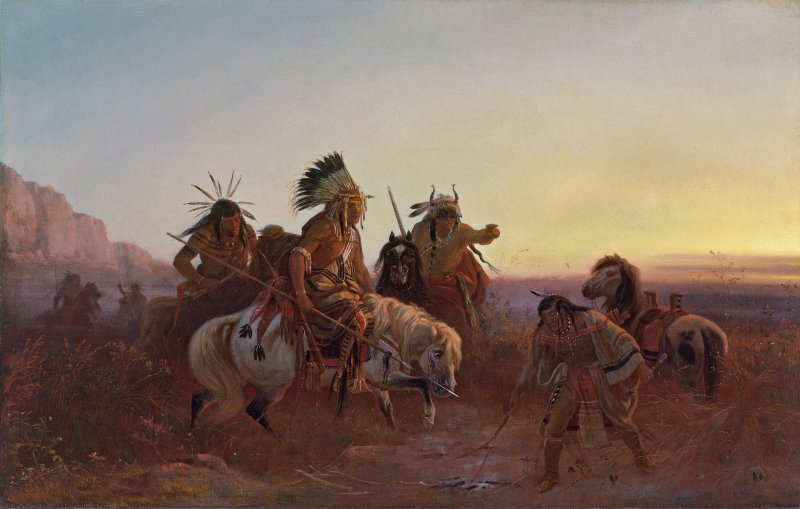
Me pregunto si lo que queda de aquellos pobladores se siente feliz hoy en día en sus reservas.
I wonder if what remains of those settlers feel happy today on their reservations.
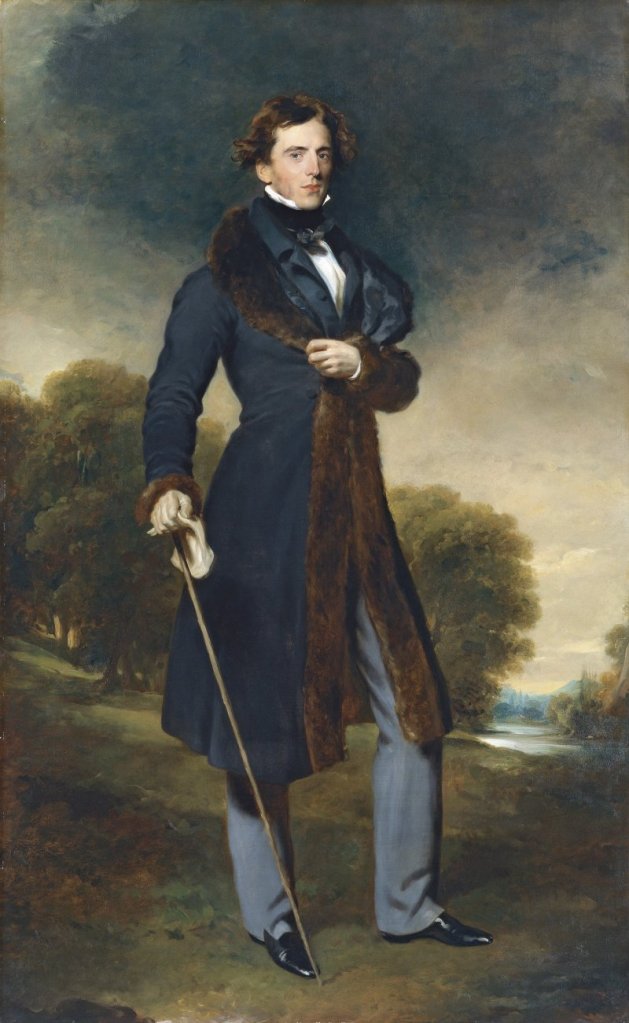
“Retrato de David Lyon” 1825, sir Thomas Lawrence. Quizá el retrato más formidable de toda la colección Thyssen. La memoria colonial informa que David era de familia esclavista, que debía su fortuna a este repugnante negocio. El dandy retratado por Lawrence parece que era bien considerado en la sociedad inglesa del XIX.
“Portrait of David Lyon” 1825, Sir Thomas Lawrence. Perhaps the most formidable portrait in the entire Thyssen collection. Colonial memory reports that David was from a slave-owning family, who owed his fortune to this disgusting business. The dandy portrayed by Lawrence seems to have been well regarded in 19th century English society.
“Dos desnudos femeninos en un paisaje” del expresionista de Die Brücke, Otto Müller, 1922. Nunca había visto en este precioso cuadro lo que ve la memoria colonial. Nunca había visto gitanas prostituidas. Mi visión del desnudo, femenino o masculino responde a un canon de belleza. Me cuesta creer que la intención de Otto Müller fuera otra distinta. Pero según la memoria colonial se trata de la historia invisibilizada de una dominación racial.
“Two female nudes in a landscape” by the Die Brücke expressionist Otto Müller, 1922. I had never seen in this beautiful painting what colonial memory sees. I had never seen gypsy prostitutes. My vision of the nude, female or male, responds to a canon of beauty. I find it hard to believe that Otto Müller’s intention was anything different. But according to colonial memory it is the invisible history of racial domination.

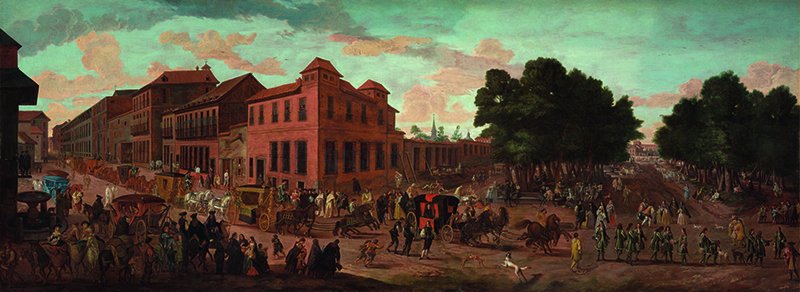
“Vista de la Carrera de San Jerónimo y el Prado con cortejo de carrozas”, Jan van Kessel, 1680. Sí, es cierto, entre la multitud cortesana hay un paje de raza negra, esclavo o no. El hecho le sirve al comisario colombiano Yeison García López, para constatar que había negros en España en el siglo XVII. Desde luego y muchos más en Sevilla, sobre todo en Triana y en ciudades portuarias como Valencia o Málaga. Pero no consta que todos fueran esclavos.
Mano de obra esclava que en origen reclutaban negros para vender a los negreros europeos. Ver, por ejemplo la historia de la isla de Zanzibar, almacén de pobres negros vulnerables secuestrados para su venta por negociantes negros ricos africanos. La historia sin fin…
“View of the Carrera de San Jerónimo and the Prado with a procession of carriages”, Jan van Kessel, 1680. Yes, it is true, among the courtly crowd there is a black page, slave or not. The fact helps the Colombian commissioner Yeison García López to verify that there were blacks in Spain in the 17th century. Of course and many more in Seville, especially in Triana and in port cities like Valencia or Malaga. From slaves as spoils of war to the ruthless trafficking of Africans when the law prohibited enslaving Indians, thanks to the writings of Bartolomé de las Casas. Slave labor that was originally recruited by blacks to sell to European slavers. See, for example, the history of the island of Zanzibar, a warehouse for poor black people kidnapped for sale by black African businessmen. The endless story…
Lo terrible es que la historia de la esclavitud no ha terminado, solo ha cambiado de aspecto.
The terrible thing is that the history of slavery is not over, it has only changed its appearance.
Lo curioso es que los negros en la exposición están bien vestidos, bien alimentados. Incluso en la escena de la “Pesca en el estrecho de Long Island” de John Goodwin Clooney, 1847. El cuadro muestra a dos amos sentados en la barca y al esclavo tumbado sujetando la caña de pescar.
The curious thing is that the blacks in the exhibition are well dressed, well fed. Even in the scene of “Fishing in Long Island Sound” by John Goodwin Clooney, 1847. The painting shows two masters sitting in the boat and the slave lying down holding the fishing rod. The violence of slavery is most explicit here.
No entiendo muy bien que esté en la muestra el “Bodegón con fuente china” de Jan van de Velde III, 1650. El comercio con China se remonta al siglo XIII.
I don’t quite understand why the “Still Life with Chinese Fountain” by Jan van de Velde III, 1650, is in the exhibition. Trade with China dates back to the 13th century.

Tampoco entiendo que consideren como apropiación las obras de Picasso inspiradas en máscaras africanas. En la muestra “Estudio para la cabeza de desnudo con paños” de 1907. De todos es conocida la admiración de Picasso por el arte africano, en el que se inspiró.
I also don’t understand why they consider Picasso’s works inspired by African masks to be appropriation. In the exhibition “Study for the head of nude with cloths” from 1907. Everyone knows Picasso’s admiration for African art, from which he was inspired.
“Montando el campamento en Little Big Horn” de Joseph Henry Sharp, sin fecha. Me trae memorias de la derrota del General Custer, no de esclavitud.
“Setting Camp at Little Big Horn” by Joseph Henry Sharp, undated. Brings back memories of General Custer’s defeat.

Y así sucesivamente. Es cierto, y lamentable que los europeos consideraron salvajes a pueblos con otras culturas, un hecho superado afortunadamente. Pero aconsejaría al comisario Yeison García López, que incluye a los árabes españoles en esta historia, que estudiara la historia de España y conociera los aportes culturales en el arte, las matemáticas, la geometría, la astrología, la medicina, la agricultura, la literatura, etc. No hay que mezclar rivalidades políticas con los aportes culturales, únicos en Europa. De los que nos sentimos orgullosos.
And so on. It is true, and regrettable, that Europeans considered people with other cultures savages, a fact fortunately overcome. But I would advise Commissioner Yeison García López, who includes the Spanish Arabs in this story, to study the history of Spain and learn about the cultural contributions in art, mathematics, geometry, astrology, medicine, agriculture, literature , etc. There is no need to mix political rivalries with cultural contributions, unique in Europe. Of which we are proud.
Sin duda hay aspectos positivos en la muestra. Lo que encuentro más triste es el negacionismo de todo lo positivo de su propia historia.
There are certainly positive aspects to the show. What I find saddest is the denial of everything positive in their own history.
Descubre más desde LA AGENCIA MUNDIAL DE PRENSA
Suscríbete y recibe las últimas entradas en tu correo electrónico.
