
Exhibition «Colonial Memory». Thyssen Bornemisza National Museum
Asistí a una vista guiada por el comisario principal del proyecto de esta exposición y conservador del museo, Juan Ángel López Manzanares. Me pareció que iba a ser interesante grabar las palabras del comisario -guía. Una de las varias particularidades de esta exposición es que tiene cuatro comisarios, aunque no del mismo rango.
I attended a guided tour by the main curator of the project for this exhibition and curator of the museum, Juan Ángel López Manzanares. I thought it would be interesting to record the words of the curator-guide. One of the several peculiarities of this exhibition is that it has four curators, although not of the same rank.
Como introducción a la exposición advirtió que iba a ser muy polémica y controvertida; que el proyecto es anterior a la ley de descolonización de museos del actual ministro de cultura Ernest Urtasun. El proyecto sí, el montaje de la exposición, no. Mencionó que el director artístico del Museo, Guillermo Solana, apareció en último lugar en la lista de candidatos de Sumar en las últimas elecciones a la Comunidad de Madrid. ¿Era necesario en este contexto?
As an introduction to the exhibition, he warned that it was going to be very controversial and controversial; that the project predates the museum decolonization law of the current Minister of Culture Ernest Urtasun. The project, yes, the assembly of the exhibition, no. He mentioned that the artistic director of the Museum, Guillermo Solana, appeared last on Sumar’s list of candidates in the last elections to the Community of Madrid. Was it necessary in this context?
Me quedé de piedra al escuchar en un Museo Nacional que “el Descubrimiento no fue tal, porque ya había personas allí”. –literal, está grabado. Argumento científico donde los haya. De revisiones o visiones de la historia, según y cuando quién la cuente, estamos al cabo de la calle.
I was shocked to hear in a National Museum that “the Discovery was not such, because there were already people there.” –literally, it is recorded. Scientific argument where there is one. Of revisions or visions of history, depending on and when who tells it, we are at the end of the street.
Pero una cosa es negar una evidencia histórica y otra negar la ciencia. Porque de ciencia hablamos, señor comisario López Manzanares. El proyecto presentado por Cristóbal Colón a varios soberanos europeos, era para demostrar la esfericidad del planeta, es decir, navegando a través de la Mar Océana siempre hacia el oeste se alcanzarían las costas de Asia, ya conocidas por tierra desde más de dos siglos atrás. Pura ciencia. El proyecto no hablaba, ni podía hacerlo, de ningún descubrimiento, puesto que lo que se descubrió no lo conocía nadie, ni siquiera sus habitantes. Señor comisario, se descubre lo que existe pero no se conoce. ¿O no?
But it is one thing to deny historical evidence and another to deny science. Because we are talking about science, Commissioner López Manzanares. The project presented by Christopher Columbus to several European sovereigns was to demonstrate the sphericity of the planet, that is, by sailing through the Ocean Sea always towards the west, the coasts of Asia would be reached, already known by land for more than two centuries ago. . Pure science. The project did not speak, nor could it, of any discovery, since what was discovered was unknown to anyone, not even its inhabitants. Commissioner, what exists but is not known is discovered. Or not?
La existencia de un nuevo continente no se materializó hasta el descubrimiento del Océano Pacífico por Vasco Núñez de Balboa en 1513, que sí llegaba a las costas de Asia. Descubrimiento científico de que la Tierra no solo era esférica, sino mucho mayor de lo que pensaban los pocos que admitían esa forma a finales del siglo XV y principios del XVI.
The existence of a new continent did not materialize until the discovery of the Pacific Ocean by Vasco Núñez de Balboa in 1513, which did reach the coasts of Asia. Scientific discovery that the Earth was not only spherical, but much larger than what the few who admitted its spherical shape thought in the late 15th and early 16th centuries.
Todo ello se completó mediante la circunnavegación del globo terráqueo (1519-1522) por el portugués al servicio de España, Fernando de Magallanes y Juan Sebastián Elcano. En los tres casos, empresas españolas. La razón o razones para no poner en su justo valor unos hechos que cambiaron la ciencia y la historia de nuestro mundo no son fáciles de entender.
All of this was completed through the circumnavigation of the globe (1519-1522) by the Portuguese in the service of Spain, Ferdinand Magellan and Juan Sebastián Elcano. In all three cases, Spanish companies. The reason or reasons for not giving their fair value to some facts that changed science and the history of our world are not easy to understand.
Sigamos tratando de reseñar una exposición temporal, una de las muchas que ha organizado este museo desde su inauguración en 1992, inauguración a la que tuve el privilegio de asistir.
Let’s continue trying to review a temporary exhibition, one of the many that this museum has organized since its inauguration in 1992, an inauguration that I had the privilege of attending.
Los otros tres comisarios: Alba Campo Rosillo historiadora de arte; Andrea Pacheco González, (Chile) comisaria independiente y directora del Espacio Felipa Manuela; y Yeison García López (Colombia) director del Centro Cultural Espacio Afro.
The other three curators: Alba Campo Rosillo, art historian; Andrea Pacheco González, (Chile) independent curator and director of Espacio Felipa Manuela; and Yeison García López (Colombia) director of the Espacio Afro Cultural Center
La exposición / The Exhibition
El planteamiento de la exposición es reduccionista: Conquista, eurocentrismo, apropiación, esclavos, en esa línea. De ciencia y las consecuencias de esa ciencia que cambió la historia del mundo y quién lo cambió ni palabra.
The approach of the exhibition is reductionist: Conquest, Eurocentrism, appropriation, slaves, along those lines. About science and the consequences of that science that changed the history of the world and who changed it not a word.
La selección de obras expuestas pertenece a las colecciones del Thyssen, a la colección Carmen Thyssen y piezas contemporáneas de la colección TBA21 de Francesca Thyssen. No hay piezas de otros museos ni de colecciones privadas.
The selection of works on display belongs to the Thyssen collections, the Carmen Thyssen collection and contemporary pieces from the TBA21 collection. There are no pieces from other museums or private collections.
Pero en el Catálogo de la exposición, sí abundan obras no expuestas de distintas procedencias, supongo que con los correspondientes permisos. Con o sin permiso, algo insólito en un catálogo de exposición temporal. Entre las obras no expuestas en el museo, figura una escultura de Cristóbal Colón vandalizada, en Miami, Florida, USA. Es decir, el descubridor –aunque murió sin saberlo – vandalizado.
But in the exhibition catalogue, there are many unexhibited works from different sources, I suppose with the corresponding permits. With or without permission, something unusual in a temporary exhibition catalogue. Among the works not on display in the museum is a vandalized sculpture of Christopher Columbus in Miami, Florida, USA. That is to say, the discoverer – although he died without knowing it – vandalized.
Tristemente no es nada nuevo. Para mis lectores que ignoren el dato, Cristóbal Colón murió en 1505 en Valladolid, caído en desgracia, sin saber que había descubierto otro continente, víctima de poderosos envidiosos de su logro. Hasta 1513, fecha del descubrimiento del Océano Pacífico, nadie sabía que esos territorios fueran de un continente nuevo.
Sadly it’s nothing new. For my readers who are unaware of the fact, Christopher Columbus died in 1505 in a prison in Valladolid, Spain, without knowing that he had discovered another continent, a victim of powerful people envious of his achievement. Until 1513, the date of the discovery of the Pacific Ocean, no one knew that these territories were part of a new continent.
Me siento bastante desconcertada ante la nueva visión de la historia que nos propone la exposición. He aquí algunos puntos. Pone en el mismo rasero los diferentes colonialismos ahí reflejados. Los de Estados Unidos, América Hispana y África. Algo que no se sostiene y que implica pasar por alto las Leyes de Indias, que convenientemente digitalizadas están a disposición de quién tenga curiosidad en el Archivo General de Indias de Sevilla. Que por encima de estas leyes, hubiera individuos, virreyes o gobernadores que abusaran de su poder, cierto. Pero del poder han abusado siempre quienes lo han detentado, incluidos los caciques precolombinos, y hasta ahora mismo. Lo vemos a diario.
I feel quite disconcerted by the new vision of history that the exhibition offers us. Here are some points. It puts the different colonialisms reflected there on the same level. Those of the United States, Hispanic America and Africa. Something that does not hold up and that implies ignoring the Laws of the Indies, which are conveniently digitized and available to anyone who is curious in the General Archive of the Indies in Seville. That above these laws, there were individuals, viceroys or governors who abused their power, true. But power has always been abused by those who have held it, including the pre-Columbian chiefs, and until now. We see it daily.
Ya he dicho como murió Cristóbal Colón. Pues Vasco Núñez de Balboa, descubridor del Pacífico en 1513 fue decapitado en 1519, acusado falsamente de traicionar a la Corona, por orden de su suegro Pedrarias Dávila, un aristócrata envidioso y resentido.
I have already said how Christopher Columbus died. Well, Vasco Núñez de Balboa, discoverer of the Pacific in 1513, was beheaded in 1519, falsely accused of betraying the Crown, by order of his father-in-law Pedrarias Dávila, an envious and resentful aristocrat.
La Sra. Campo Rosillo, segunda comisaria, en un hastag en el que se entrevista a los cuatro comisarios, después de hablar de ‘legado cultural’ se autocorrige y lo cambia por ‘legado colonial’. Sin comentarios.
Mrs. Campo Rosillo, second commissioner, in a hastag in which the four commissioners are interviewed, corrects herself, when perhaps due to an error in her judgment, she speaks of ‘cultural legacy’ and immediately changes it to ‘colonial legacy’. No comments.
Digámoslo con palabras del ministro Urtasun, quién a pesar de ‘no tener nada que ver con la exposición’, según el comisario López Manzanares, firma uno de los dos prólogos del catálogo de la misma. Otro elemento extraño en una exposición temporal. Que un ministro la prologue.
Let’s say it in the words of Minister Urtasun, who despite ‘having nothing to do with the exhibition’, according to curator López Manzanares, signs one of the two prologues of the exhibition’s catalogue. Another strange element in a temporary exhibition. Let a minister preface it.
“La exposición La memoria colonial en las colecciones Thyssen-Bornemisza impugna esa raiz primera, desactiva metáforas, quiebra silencios, repara ausencias y propone nuevos lenguajes. Nos hace preguntas que tienen que ver con la identidad y la otredad, en un sentido amplio, y plantea cuestiones, que proyectan su relevancia en el tiempo presente.”
Ernest Urtasun Domenech
Ministro de Cultura
“The exhibition Colonial memory in the Thyssen-Bornemisza collections challenges that first root, deactivates metaphors, breaks silences, repairs absences and proposes new languages. “It asks us questions that have to do with identity and otherness, in a broad sense, and raises questions that project its relevance in the present time.” Ernest Urtasun Domenech
Ministro de Cultura
Ya hemos visto anteriormente, que lo primero que impugna, en palabras del comisario y conservador del museo, Sr. López Manzanares, es el hecho científico del descubrimiento, dando como única razón que ‘ya había personas viviendo allí’.
We have already seen previously that the first thing that is challenged, in the words of the curator and curator of the museum, Mr. López Manzanares, is the scientific fact of the discovery, giving as the only reason that ‘there were already people living there’.
¿Desactiva metáforas? ¿A qué se refiere el ministro? ¿A sustituir su sentido figurado por otro más acorde al pensamiento del prologador? Si en sentido amplio desactivamos metáforas, la historia mundial de la expresión cultural humana, desaparecería.
Does it disable metaphors? What is the minister referring to? To replace its figurative meaning with another more in line with the prologue’s thoughts? If in a broad sense we deactivate metaphors, the world history of human cultural expression would disappear.
Podría decirse, que la propuesta de nuevos lenguajes en la línea Urtasun, incluiría ver una serie de obras de arte, que hemos visto siempre en función de su lenguaje pictórico y época histórica, como algo que no podíamos percibir mediante ese lenguaje.
It could be said that the proposal of new languages in the Urtasun line would include seeing a series of works of art, which we have always seen based on their pictorial language and historical era, as something that we could not perceive through that language.
En términos amplios, la propuesta podría cambiar toda la historia de la pintura. Imaginen aplicar este nuevo concepto de lenguaje a Las Meninas, por poner un ejemplo. Es más, en función del concepto propuesto, la diversidad de lenguajes puede ser infinita.
In broad terms, the proposal could change the entire history of painting. Imagine applying this new language concept to Las Meninas, for example. What’s more, depending on the proposed concept, the diversity of languages can be infinite.
La exposición se compone de seis secciones “Extractivismo y apropiación”, “La construcción racial del otro”, “Esclavismo y dominación colonial”, “Evasión a nuevas Arcadias”, “Cuerpo y sexualidad” y “Resistencia, cimarronaje y derechos civiles”.
The exhibition is made up of six sections: “Extractivism and appropriation”, “The racial construction of the other”, “Slavery and colonial domination”, “Escape to new Arcadias”, “Body and sexuality” and “Resistance, marronage and civil rights”.
Voy a sintetizar mucho. Extractivismo y apropiación. Dejemos de lado la interminable historia del extractivismo y apropiación, ciñámonos a lo que nos ocupa.
I’m going to synthesize a lot. Extractivism and appropriation. Let’s leave aside the endless history of extractivism and appropriation, let’s stick to what concerns us.
Los metales preciosos nunca beneficiaron a ningún pueblo precolombino, ni posteriormente al pueblo español. El profesor Patrick Chabal, hace unos años hablando de África, clavó la definición ‘enriquecimiento sin desarrollo’. Enriquecimiento de unos pocos, nada para los pueblos. Es otro lenguaje distinto al de la Memoria colonial, ya que se refería a los países africanos ya independizados.
Precious metals never benefited any pre-Columbian people, nor later the Spanish people. Professor Patrick Chabal, a few years ago speaking about Africa, nailed the definition ‘enrichment without development’. Enrichment of a few, nothing for the people. It is another language different from that of the colonial Memory, since it referred to the already independent African countries.
Invito a mis lectores americanos a poner en su buscador, ‘Las Médulas, oro, Hispania. Tal vez el resultado los sorprenda. Entre otras cosas, por el método de extracción, el hoy llamado fracking, prohibido en algunos países. En tiempos del emperador Octavio Augusto.
I invite my American readers to put in their search engine, ‘Las Médulas, oro, Hispania. Maybe the result will surprise you. Among other things, due to the extraction method, today called fracking, prohibited in some countries. In the time of Emperor Octavian Augustus.
Los cuadros de la exposición / The paintings in the exhibition
Veamos la nueva mirada aplicada a algunas obras de arte expuestas.
Let’s see the new look applied to some works of art on display.
“El cocinero de George Washington” de Gilbert Stuart, ahora “Hombre de la isla Dominica” de autor desconocido, probablemente inglés del entorno de Sir Joshua Reynolds.
“George Washington’s Cook” by Gilbert Stuart, now “Man from Dominica Island” by an unknown author, probably an Englishman around Sir Joshua Reynolds.
No es ningún secreto, que la familia del primer presidente de Estados Unidos era esclavista, que el mismo presidente dobló el número de sus esclavos en su propiedad de Mount Vernon, Virginia, y que tuvo un cocinero negro, esclavo o liberto, llamado Hércules.
It is no secret that the family of the first president of the United States was a slaveholder, that the president himself doubled the number of his slaves on his property in Mount Vernon, Virginia, and that he had a black cook, slave or freedman, named Hercules.
En 2017, un grupo internacional de académicos, comisarios y restauradores, entre ellos Paloma Alarcó, conservadora del Thyssen, reunidos en Mount Vernon, cuestionaron la identidad del retratado y la autoría del norteamericano Gilbert Stuart, retratista de George Washington. Se basaron entre otras cosas en que ‘el gorro de cocinero del retratado’, no podía ser un gorro de cocinero, porque éste se popularizó en Europa un siglo más tarde.
In 2017, an international group of academics, curators and restorers, including Paloma Alarcó, curator of the Thyssen, meeting at Mount Vernon, questioned the identity of the sitter and the authorship of the North American Gilbert Stuart, portraitist of George Washington. They were based, among other things, on the fact that the chef’s hat of the sitter could not be a chef’s hat, because it became popular in Europe a century later.
Pero el cocinero llamado Hércules del presidente, seguro que utilizaba algún tipo de gorro en la cocina. Y que pudo inspirar un siglo más tarde a algún cocinero europeo. Inspirarse en un modelo anterior ha ocurrido siempre. Particularmente en la visión de esta exposición. * Si Gilbert Stuart fue retratista del presidente Washington, también es verosímil que retratara a otras personas de su entorno doméstico.
But the president’s cook named Hercules surely wore some kind of hat in the kitchen. And that could inspire some European chef a century later. Taking inspiration from a previous model has always happened. Particularly in the vision of this exhibition. * If Gilbert Stuart was a portrait painter of President Washington, it is also plausible that he portrayed other people in his domestic environment.
En cualquier caso los Thyssen en su día compraron un retrato identificado como alguien importante del círculo del presidente. Retrato del cocinero de G. Washington por Gilbert Stuart.
In any case, the Thyssens once bought a portrait identified as someone important in the president’s circle. Portrait of G. Washington Cook by Gilbert Stuart.
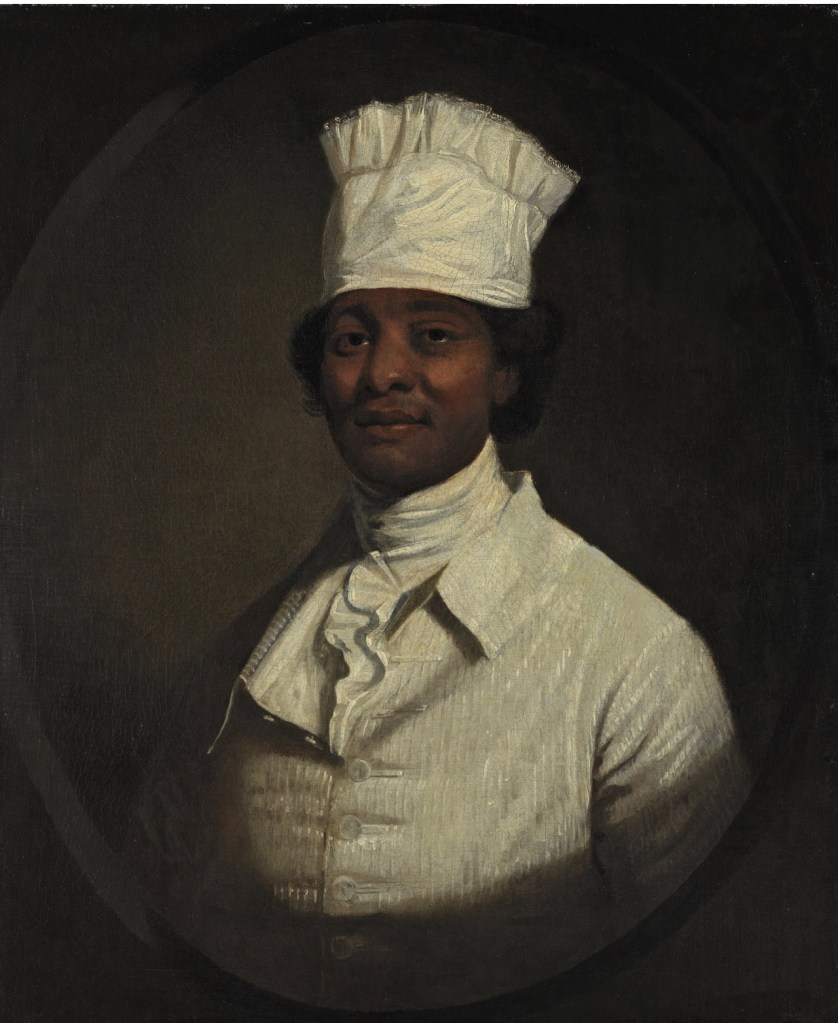
Ahora ese cuadro tendría mucho menos valor. Retrato de alguien no identificado de autor anónimo. Lo que devalúa considerablemente la colección.
Now that painting would have much less value. Portrait of an unidentified person by an anonymous author. Which considerably devalues the collection.
Ver bien el cuadro. La riqueza de las ropas, el lenguaje que transmite, no es el retrato de alguien sin nombre ni autor. La colección de pintura norteamericana del Thyssen, quizá única en España, y considerada de referencia en Europa, también se devalúa.
See the picture well. The richness of the clothes, the language it transmits, is not the portrait of someone without a name or author. The Thyssen’s collection of North American paintings, perhaps unique in Spain, and considered a reference in Europe, is also devalued.
A menos que terminen rigurosamente este trabajo de investigación e identifiquen documentalmente al personaje retratado y a su autor. Porque hasta ahora, con todo mi respeto, solo están especulando.
Unless they rigorously complete this research work and document the portrayed character and its author. Because so far, with all due respect, they are just speculating.
Frans Hals. “Grupo familiar ante un paisaje”. Hay un video de hace dos años, con la descripción habitual pictórico-histórica. En Educa Thyssen he encontrado una descripción reciente que encaja en la nueva visión que trata de visibilizar lo invisibilizado hasta la fecha. Por ejemplo los negros. Es demasiado larga como para transcribirla aquí. Y cualquiera que tenga curiosidad, puede encontrarla en un par de minutos.
Frans Hals. “Family group in front of a landscape.” There is a video from two years ago, with the usual pictorial-historical description. In Educa Thyssen I have found a recent description that fits the new vision that tries to make visible what has been invisible to date. For example the blacks. It is too long to transcribe here. And anyone who is curious can find it in a couple of minutes.
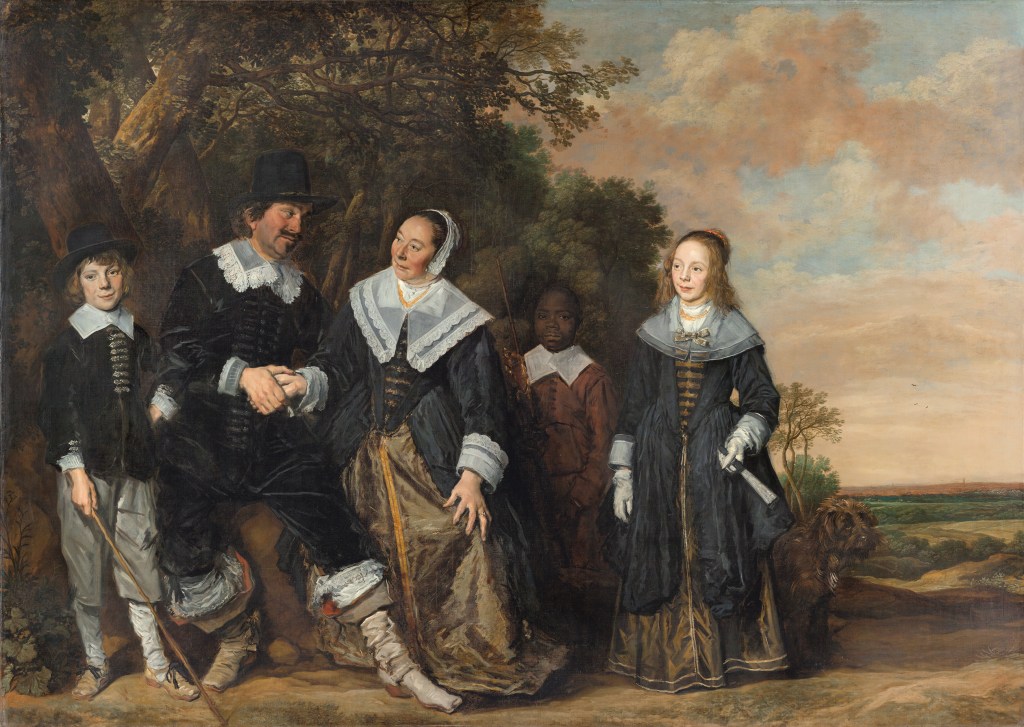
Es cierto. El joven negro es el único que mira hacia el espectador. El único que no es de la familia. Puede ser un criado (como dice el antiguo video) o un esclavo afortunado, que haya sido puesto ahí como símbolo de estatus social de la familia. Faltaría lo imposible. Preguntar al personaje quién es y quién era antes de llegar a Europa y cómo llegó. Si añora su pasado, o no. Esta pregunta crucial, no se hace.
It’s true. The young black man is the only one who looks towards the viewer. The only one who is not part of the family. It may be a servant (as the old video says) or a lucky slave, who has been placed there as a symbol of the family’s social status. The impossible would be missing. Ask the character who he is and who he was before arriving in Europe and how he arrived. Whether he longs for his past, or not. This crucial question is not asked.
En el largo escrito se hace notar la ausencia de artistas de otras razas en los museos. Cierto. Pero me permito hacer notar al Thyssen, que solo muy recientemente los museos están visibilizando a las artistas mujeres, europeas, blancas, pero mujeres.
In the long writing, the absence of artists of other races in museums is noted. TRUE. But I would like to point out to Thyssen that only very recently are museums making visible female, European, white artists, but women.
Estoy totalmente de acuerdo en que ya es hora de traer a los museos, las obras de pintoras y pintores hispano americanos, integrarlos. Y también las obras de artistas negros, visibilizarlos. O de cualquier raza. Sería muy enriquecedor. Sufrimos una gran incultura a este respecto.
I totally agree that it is time to bring the works of Hispanic American painters to museums and integrate them. And also the works of black artists, make them visible. Or any race. It would be very enriching. We suffer a great lack of culture in this regard.
Museos inclusivos, dicen. Pues manos a la obra.
Inclusive museums, they say. Well let’s get to work.
.........Continuará en siguiente entrega
..........To be continued in the next installment.
*
Descubre más desde LA AGENCIA MUNDIAL DE PRENSA
Suscríbete y recibe las últimas entradas en tu correo electrónico.
