
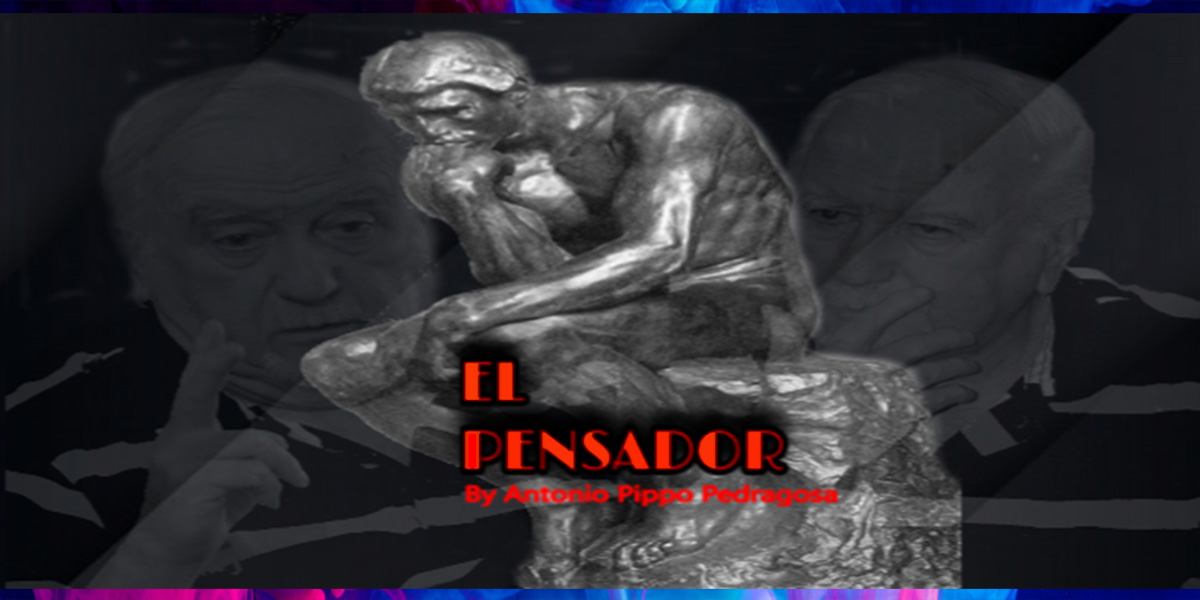
The Thinker
Por Antonio Pippo
Imaginemos una serie de circunstancias, lector. No digo que ellas estén, aunque lo parezca, relacionadas con la realidad. Usted lo decidirá después de leer esta noche, ansiolítico mediante, esta columna. Es apenas un ejercicio intelectual que quiero compartir.
Let’s imagine a series of circumstances, reader. I am not saying that they are, although it may seem so, related to reality. You will decide after reading this column tonight, anxiolytically. It is just an intellectual exercise that I want to share.
Primero, vamos caminando en una breve recorrida por la ciudad. Le tomo del brazo, le señalo algo y le pregunto:
First, we walk on a short run through the city. I take him by the arm, point to something and ask him:
-¿Eso, qué es?
-What is that?
-Un contenedor de basura, con bolsas rotas y otras porquerías afuera, alrededor.
-A garbage container, with torn bags and other rubbish outside, around it.
-¿Y eso otro?
-And that other one?
-Una calle céntrica a la que han quitado la capa asfáltica superior para arreglarla.
-A central street from which the top asphalt layer has been removed to fix it.
-¿Sabe usted cuánto hace que está en tales condiciones?
-Do you know how long he has been in such conditions?
-Vivo cerca… Al menos tres meses…
-I live nearby… At least three months…
-Y allá enfrente… ¿Qué es aquello amontonado?
-And there in front… What is that piled up?
-Personas durmiendo en la calle, con sus pertenencias desparramadas en la vereda.
-People sleeping on the street, with their belongings scattered on the sidewalk.
-Bueno. Le diré algo: las autoridades dicen que lo que ocurre con los contendores es responsabilidad de malos ciudadanos, desprolijos. Dicen que están haciendo obras en las vías de tránsito para mejorarlas, que hay que darle tiempo al tiempo… Y dicen, finalmente, que hay menos gente roncando, orinando y defecando por todas partes, y hasta que “no se puede desconocer su libertad de pernoctar donde puedan porque la calle es un derecho de todos”.
-Well. I’ll tell you something: the authorities say that what happens with the containers is the responsibility of bad, untidy citizens. They say that they are doing work on the traffic routes to improve them, that we must give time to time… And they say, finally, that there are fewer people snoring, urinating and defecating everywhere, and until «their freedom to spend the night where they can because the street is everyone’s right.”
Usted, y esto lo presumo pero con mucha convicción, queda estupefacto, y yo lo arrastro a una excursión a la avenida principal de la ciudad y, juntos, vemos veredas rotas y suciedades en vidrieras, paredes de edificios y unos cuantos vehículos mal estacionados. Y le cuento:
You, and I presume this but with great conviction, are stunned, and I drag you on an excursion to the main avenue of the city and, together, we see broken sidewalks and dirt on stained glass windows, walls of buildings and a few poorly parked vehicles. And I tell him:
-Hubo una manifestación anunciada pacífica a favor del plebiscito contra la reforma jubilatoria. No, no se sorprenda. Acá pasan cosas raras. Había policías por todas partes, pero en cierto momento unos individuos ocultos sus rostros por bufandas y capuchas hicieron un desastre. ¡No me pregunte por esa policía! Me obligará a decirle que se limitó a observar y no intervino. Obvio, no hay detenidos, ni fiscales actuando de oficio.
-There was an announced peaceful demonstration in favor of the plebiscite against the retirement reform. No, don’t be surprised. Strange things happen here. There were police everywhere, but at one point some individuals hiding their faces with scarves and hoods made a mess. Don’t ask me about that police! You’ll force me to tell you that you just watched and didn’t intervene. Obviously, there are no detainees, nor prosecutors acting ex officio.
Finalmente, lo llevo a otro lugar, que no vale la pena mencionar porque todo el mundo sabe dónde es, y le cuento que unos escasos trabajadores, durante un acto oficial, pretendieron extender una pancarta reclamando trabajo, sin alusiones ofensivas.
Finally, I take him to another place, which is not worth mentioning because everyone knows where it is, and I tell him that a few workers, during an official event, tried to hold up a banner demanding work, without offensive references.
-¿Y qué pasó?
-And what happened?
-Unos amigables colaboradores del Ministro del Interior, con pinta de recién liberados sin el certificado de rehabilitación, intentaron tapar la pancarta. Ante la lógica y pacífica insistencia de sus portadores, un audaz bien pensante usó sus nalgas, enormes, sin pudor, para empujar a los trabajadores y también impedir su empeño. ¡Qué locura!
-Some friendly collaborators of the Minister of the Interior, looking like they had just been released without the rehabilitation certificate, tried to cover the banner. At the logical and peaceful insistence of his bearers, a bold, well-thinking man used his enormous buttocks, shamelessly, to push the workers and also prevent their efforts. How crazy!
-¿Y…?
-AND…?
-Bueno, sin mediar palabra aunque sí prepotencia con semejante obstáculo carnal, los tipos que trataban de disuadir la movilización condujeron a la comisaría a dos o tres de los insistentes reclamantes y dijeron que al menos uno de ellos tenía antecedentes penales.
-Well, without saying a word although they did have arrogance with such a carnal obstacle, the guys who were trying to dissuade the mobilization took two or three of the insistent complainants to the police station and said that at least one of them had a criminal record.
-¿Cómo lo supieron, hicieron controles, inteligencia previa?
-How did they know, did they do controls, prior intelligence?
-No, no. Fue, aparentemente, a simple “ojo de halcón”. Je, je… Supongo que usted entiende lo que quiero decir… Ahora, y le pido disculpas si le molesta, yo imagino que le pregunto qué opina. Y que usted me dice:
-No no. It was, apparently, a simple “hawk’s eye”. Heh heh… I guess you understand what I mean… Now, and I apologize if it bothers you, I imagine I’m asking you what you think. And what you tell me:
-Una vez leí que el poder, me refiero al poder de quienes mandan, suele negarse a aceptar la realidad y trata de que nosotros, los ciudadanos racionales, no la sepamos o aceptemos el absurdo, perverso dibujo de ella que nos quiere vender.
-I once read that power, I mean the power of those in power, usually refuses to accept reality and tries to ensure that we, rational citizens, do not know it or accept the absurd, perverse drawing of it that they want to sell us.
– Caramba. Hombre advertido al que leyó… Algo de eso escribí la semana pasada, con el tema de la palabra, que es un símbolo fuera de su literalidad, pero siempre hay un contexto en que es dicha que la define. Es más, dejé entrever que la palabra –incluso en brutal contradicción con los hechos- puede ser como un chicle…
– Wow. Man warned who read… I wrote something about that last week, with the topic of the word, which is a symbol outside of its literality, but there is always a context in which it is said that defines it. What’s more, I hinted that the word – even in brutal contradiction with the facts – can be like chewing gum…
-Mire… creo que fue Aldous Huxley. Pero, en este mundo loco, no sé. Pudo haber sido un sarcasmo de cualquier candidato local a las internas, a quien no tengo del todo definido, que se me metió en la cabeza y me confundió… ¡Es que a usted le da por imaginar cada cosa y meterme en el lío de la búsqueda de la verdad!
-Look… I think it was Aldous Huxley. But, in this crazy world, I don’t know. It could have been a sarcasm from any local candidate for the internal elections, whom I don’t have completely defined, that got into my head and confused me… It’s just that you tend to imagine everything and get me into the mess of the search for the truth!
Descubre más desde LA AGENCIA MUNDIAL DE PRENSA
Suscríbete y recibe las últimas entradas en tu correo electrónico.
