
VELÁZQUEZ AND SAINT TERESA: LETTERS AND DNA

ANTONIO NATAL ALVAREZ Dr. en Filosofía, Lic.: Psicología, Pedagogo, Catedrático de Filosofía, Escritor PRENSA ESPECIALIZADA
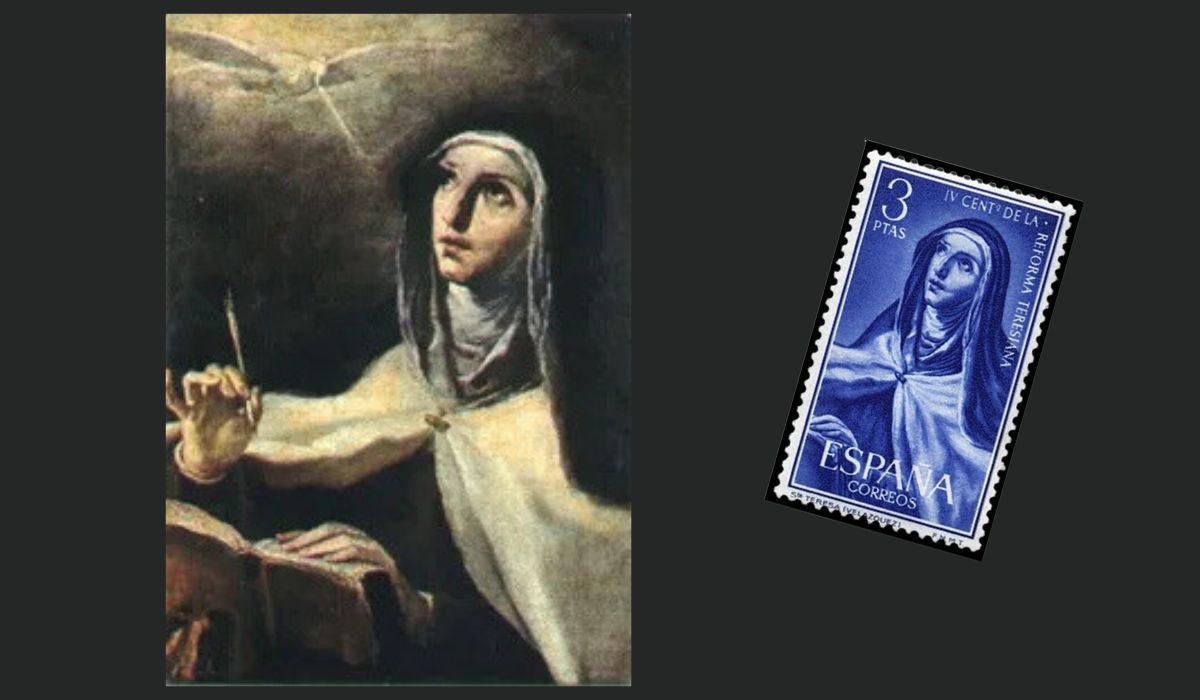
El mejor retrato de Santa Teresa lo pintó Velázquez. Aunque el pintor no la conoció personalmente, se sirvió de otros retratos y apuntes para realizar una obra magnífica. Los Carmelitas Descalzos utilizaron esta pintura para emitir un sello de correos con motivo del IV Centenario de la Reforma Teresiana. El sello, de 3 pesetas, muestra en su base: “STA TERESA”. Junto a este nombre aparece el de “VELÁZQUEZ”, y todo está certificado por la Fábrica Nacional de Moneda y Timbre.
The best portrait of Saint Teresa was painted by Velázquez. Although the painter did not know her personally, he used other portraits and sketches to create a magnificent work. The Discalced Carmelites used this painting to issue a postage stamp on the occasion of the IV Centenary of the Teresian Reform. The stamp, worth 3 pesetas, shows at its base: “STA TERESA”. Next to this name appears “VELÁZQUEZ”, and everything is certified by the National Mint and Stamp Factory.
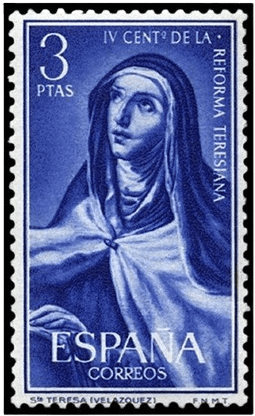
No obstante, los Carmelitas de Alba de Tormes realizan algo increíble: niegan que el sello esté basado en un cuadro del genial pintor y jamás citan a Velázquez entre los artistas que retrataron a la Santa. En Alba de Tormes entregan un folleto donde, bajo la imagen del sello, se lee:
However, the Carmelites of Alba de Tormes do something incredible: they deny that the stamp is based on a painting by the brilliant painter and never mention Velázquez among the artists who portrayed the Saint.In Alba de Tormes, they hand out a brochure where, under the image of the stamp, it reads:
“Autor: Desconocido. Técnica: Desconocida. Fecha aproximada: Desconocida. Población/Ciudad: Desconocida. Edificio: Desconocido”.
“Author: Unknown. Technique: Unknown. Approximate Date: Unknown. Town/City: Unknown. Building: Unknown.”

A cambio, recomiendan el retrato realizado por el monje Juan de la Miseria, que la propia Teresa de Cepeda criticó porque no le gustaba: “Que Dios te bendiga, Juan de la Miseria, porque yo soy guapa y curiosa (bien proporcionada) y tú me has pintado fea y legañosa”. Ese es el respeto que muestran a la opinión de la propia Santa.
Instead, they recommend the portrait made by the monk Juan de la Miseria, which Teresa de Cepeda herself criticized because she didn’t like it: “May God bless you, Juan de la Miseria, because I am beautiful and well-proportioned, and you have painted me ugly and bleary-eyed.” That is the respect they show for the opinion of the Saint herself.
El Prior de Alba de Tormes recibió en 2025 una carta del Papa Francisco con motivo de la apertura del sepulcro de la Doctora de la Iglesia. Pedí una copia, pero el Prior se negó rotundamente. Afirma que el Papa solo pide que se traten bien las reliquias, pero no me lo creo. Lo lógico es que el Papa insistiera en que se aclaren los orígenes de Santa Teresa, como lleva recomendando cinco años.
The Prior of Alba de Tormes received in 2025 a letter from Pope Francis on the occasion of the opening of the sepulcher of the Doctor of the Church. I requested a copy, but the Prior flatly refused. He claims that the Pope only asks that the relics be treated well, but I don’t believe it. It would be logical for the Pope to insist that the origins of Saint Teresa be clarified, as he has been recommending for five years.
He intercambiado varias cartas con este Prior, pero no aporta ni un solo documento, ni una mínima información. Tampoco quería realizar las pruebas de ADN. El Papa León XIV me recomienda “tender puentes de diálogo”. Estoy agradecido, pero es difícil dialogar con quien no quiere hacerlo y pone todo tipo de excusas, incluso negando la evidencia.
I have exchanged several letters with this Prior, but he provides not a single document, nor the slightest information. He also didn’t want to conduct the DNA tests. Pope Leo XIV recommends to me “building bridges of dialogue.” I am grateful, but it is difficult to dialogue with someone who doesn’t want to and makes all kinds of excuses, even denying the evidence.
Dicen los filósofos que “nada se da sin razón suficiente”. ¿Cuál es la razón para ignorar o marginar a Velázquez? Quizá el hecho de que el famoso retrato no esté firmado, aunque deberían saber que Velázquez no firmaba sus obras. Ni esta ni ninguna.
Philosophers say that “nothing happens without sufficient reason.” What is the reason for ignoring or marginalizing Velázquez? Perhaps the fact that the famous portrait is not signed, although they should know that Velázquez did not sign his works. Neither this one nor any.
Velázquez llevó a Murillo a la Corte como pintor de Cámara por su valía, pero le ordenó que no firmara sus obras “porque eso es de provincianos. Hay que pintar tan bien que todo el mundo debe reconocer al pintor sin firma”.
Velázquez brought Murillo to the Court as a Chamber Painter for his merit, but he ordered him not to sign his works “because that is for provincials. One must paint so well that everyone should recognize the painter without a signature.”
También puede haber otra razón: Velázquez acompañaba al Rey a La Cepeda. Le encantaba ver los caballos cepedano‑babianos e incluso participar en sus juegos ecuestres, como atravesar ríos que casi cubrían por completo a los animales.
There may also be another reason: Velázquez accompanied the King to La Cepeda. He loved seeing the Cepedano-Babiano horses and even participating in their equestrian games, such as crossing rivers that almost completely covered the animals.
Los Cepeda poseían unos 700 caballos, preparados por Templarios y Hospitalarios. Para entrar en la mesnada de los Cepeda era necesario vencer a diez enemigos, por lo que los setecientos lanceros equivaldrían a siete mil. Velázquez conocía perfectamente la historia de los Cepeda en León. Cuando el Rey los necesitaba, acudían en su ayuda “con armas y caballos a sus expensas”. Velázquez podría haber hablado demasiado y revelar la verdadera historia de Teresa de Cepeda.
The Cepeda family owned about 700 horses, prepared by Templars and Hospitallers. To enter the Cepeda mesnada, it was necessary to defeat ten enemies, so the seven hundred lancers would be equivalent to seven thousand. Velázquez knew perfectly the history of the Cepeda in León. When the King needed them, they came to his aid “with arms and horses at their own expense.” Velázquez might have spoken too much and revealed the true history of Teresa de Cepeda.
Algo similar ocurrió con el Marqués de Ciadoncha. Carlos II creó este marquesado, y el Marqués escribió en el Boletín de la Academia de la Historia:
Something similar happened with the Marquis of Ciadoncha. Charles II created this marquisate, and the Marquis wrote in the Bulletin of the Academy of History:
“CEPEDA, tiene este antiquísimo linaje en la villa de su nombre (Cepeda), que con jurisdicción y merindad existía en el Reino de León, junto a la ciudad de Astorga, de que fueron Señores. Desde dicha villa pasaron a Tordesillas, Ávila, Segovia, Toledo, Sevilla, Torrijos, Aguilar y Osuna, todas derivadas de la casa principal, como veremos en su genealogía”.
“CEPEDA, this ancient lineage has its name in the town of the same name (Cepeda), which with jurisdiction and merindad existed in the Kingdom of León, next to the city of Astorga, of which they were Lords. From said town they passed to Tordesillas, Ávila, Segovia, Toledo, Seville, Torrijos, Aguilar, and Osuna, all derived from the main house, as we will see in its genealogy.”
Siempre se podría comparar el ADN de Santa Teresa con el de la actual Teresa de Cepeda, familiar del hermano de la Santa y residente hoy en la provincia de León.
One could always compare the DNA of Saint Teresa with that of the current Teresa de Cepeda, a relative of the Saint’s brother and resident today in the province of León.
MONASTERIOS “DESCONOCIDOS” / “UNKNOWN” MONASTERIES
Podemos hablar, con fundamento, de dos monasterios casi desconocidos que se habrían fundado en los últimos años de vida de la Santa, uno en La Cepeda y otro en la zona de La Bañeza. Quizá ya bajo la firma de Ana de San Bartolomé.
We can speak, with foundation, of two almost unknown monasteries that would have been founded in the last years of the Saint’s life, one in La Cepeda and another in the area of La Bañeza. Perhaps already under the signature of Ana de San Bartolomé.
Uno de ellos estaría en los Barrios de Nistoso, de donde era padrino del bautizo de Teresita el responsable de las fuerzas de seguridad de los Cepeda: 700 lanceros a caballo que, por su preparación, equivaldrían a siete mil. Se conservan los abrevaderos y una fuente llamada “La del Monasterio de las Carmelitas”. También permanece una iglesia-catedral impresionante. De aquí era el fraile “Fray Segundo de Santa Teresa”, quien tradujo al castellano la encíclica *Rerum Novarum* (*Sobre las cosas nuevas*). Esta encíclica fue leída por el Papa actual y por ello tomó el nombre de León XIV.
One of them would be in the Barrios de Nistoso, where the godfather of Teresita’s baptism was the head of the Cepeda security forces: 700 mounted lancers who, due to their preparation, would be equivalent to seven thousand. The watering troughs and a fountain called “La del Monasterio de las Carmelitas” are preserved. An impressive church-cathedral also remains. From here was the friar “Fray Segundo de Santa Teresa,” who translated into Spanish the encyclical Rerum Novarum (On New Things). This encyclical was read by the current Pope, and for that reason, he took the name Leo XIV.
En la comarca de La Bañeza (León) hubo otro monasterio carmelita que visitó San Juan de la Cruz, dejando en el lugar un poema autógrafo que conserva el hermano del poeta Antonio Colinas.
In the region of La Bañeza (León), there was another Carmelite monastery that Saint John of the Cross visited, leaving in the place an autograph poem preserved by the brother of the poet Antonio Colinas.
Algunos versos de San Juan hacen referencia a paisajes de León:
Some verses by Saint John refer to landscapes of León:
“Pastores, los que fueredes
allá por las majadas del Otero,
si por ventura vieredes
aquel que yo más quiero,
decidle que adolezco, peno y muero”.
“Shepherds, those of you who go
up there through the sheepfolds of the Otero,
if by chance you see
the one I love most,
tell him that I suffer, grieve, and die.”
En Otero de Escarpizo y alrededores existían tres majadas.
In Otero de Escarpizo and surroundings, there were three sheepfolds.
El *Cántico Espiritual* de San Juan de la Cruz finaliza así:
The Spiritual Canticle of Saint John of the Cross ends like this:
“Y la caballería
a vista de las aguas, descendía”.
“And the cavalry
at the sight of the waters, descended.”
Se refiere a los caballos de los Cepeda que bajaban desde su monte sagrado, el Cueto de San Bartolo.
It refers to the horses of the Cepeda that came down from their sacred mountain, the Cueto de San Bartolo.
San Juan de la Cruz también comenta que la pila bautismal, traída desde este Cueto, está adornada con guirnaldas de flores que representan las fechas del nacimiento y la muerte de Santa Teresa.

Saint John of the Cross also comments that the baptismal font, brought from this Cueto, is adorned with garlands of flowers that represent the dates of the birth and death of Saint Teresa.
Descubre más desde LA AGENCIA MUNDIAL DE PRENSA
Suscríbete y recibe las últimas entradas en tu correo electrónico.

