
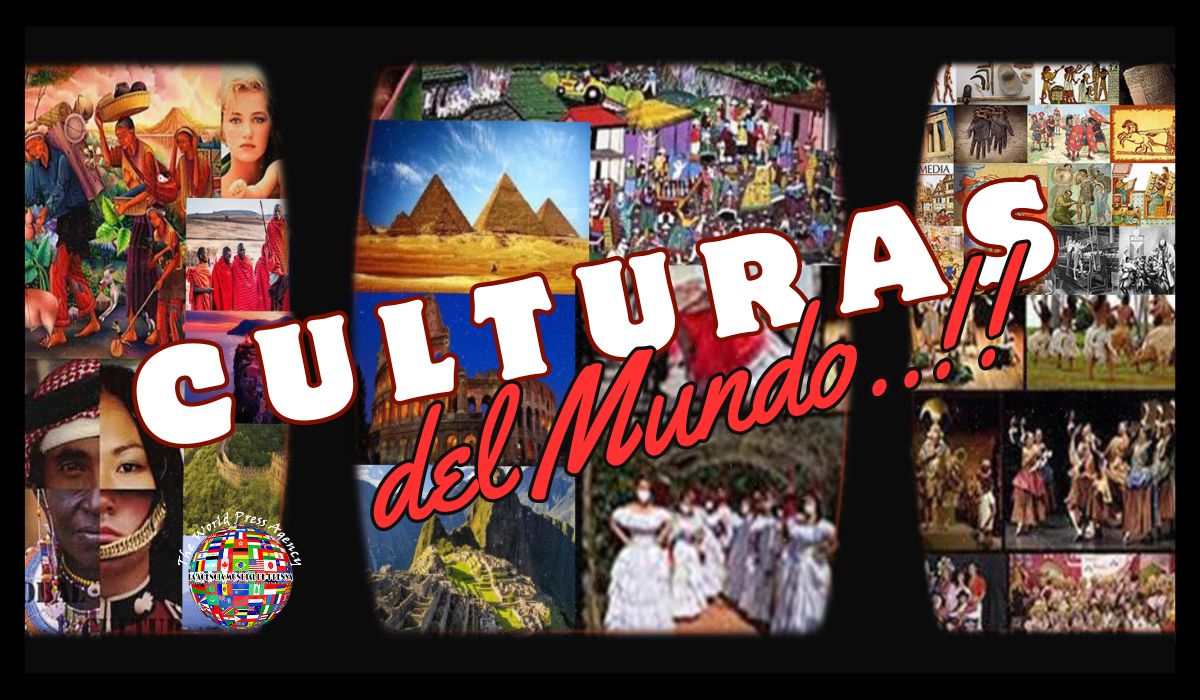
Seville, center of world cultures
Hablamos de la Spal tartésica, de la Hispalis romana, de la Spalis visigoda, de la Ishbiliya musulmana, de la Sevilla desde el siglo XIII, desde que la conquistó Fernando III el Santo de Castilla y asentó aquí su capital.
We are talking about Tartessian Spal, Roman Hispalis, Visigothic Spalis, Muslim Ishbiliya, and Seville since the 13th century, since Ferdinand III the Saint of Castile conquered it and settled his capital here.
Estaba predestinado que en este lugar, en la margen derecha de un río navegable, a una treintena de kilómetros de su desembocadura en el Océano que primero llamaron Mar Tenebroso, luego Mar Océana y finalmente Atlántico, tenía que nacer desde casi la prehistoria una ciudad para ser siempre importante. El río Betis, que luego se llamó en la era musulmana Oued-el-Kebir, el río grande, nombre que castellanizado es Guadalquivir, puerto fluvial de salida y llegada hasta y desde las Américas.
It was predestined that in this place, on the right bank of a navigable river, about thirty kilometers from its mouth in the Ocean that they first called the Dark Sea, then the Ocean Sea and finally the Atlantic, a city had to be born almost in prehistory. always be important. The Betis River, which was later called Oued-el-Kebir in the Muslim era, the big river, a name that in Spanish is Guadalquivir, a river port of departure and arrival to and from the Americas.
Ciudad de artistas geniales, de poetas, pintores, filósofos, músicos, novelistas, dramaturgos, historiadores y cuna del arte hoy llamado flamenco. Tierra creativa, libre de espíritu.
City of brilliant artists, poets, painters, philosophers, musicians, novelists, playwrights, historians and cradle of the art today called flamenco. Creative land, free of spirit.
Esa es Sevilla / That’s Seville
Estoy en Sevilla esta semana, cubriendo la XXIII Bienal de Flamenco, tan internacional, que aquí se juntan aficionados al arte, artistas y prensa que justifica que los anuncios de los espectáculos se hagan en español, inglés y japonés, en representación de múltiples potencias flamencas en el mundo.
I am in Seville this week, covering the XXIII Flamenco Biennial, so international that art fans, artists and the press gather here, which justifies that the announcements of the shows are made in Spanish, English and Japanese, representing multiple flamenco powers. in the world.
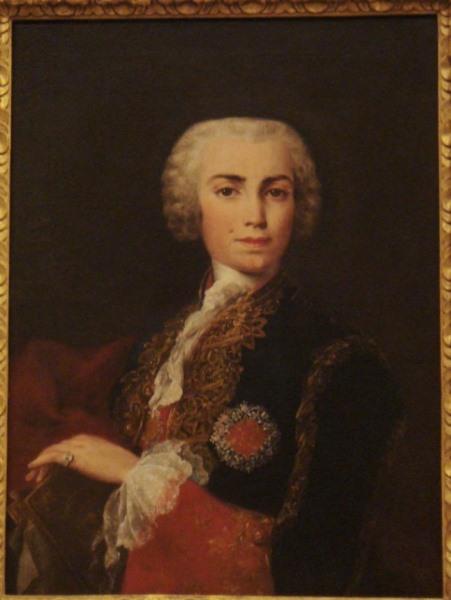
Caminar por las calles del extenso casco antiguo, de Sevilla y Triana en la margen izquierda del río, o la Isla Cartuja, ya da mucha información, hace rememorar datos almacenados en el ordenador de la mente. Ayer por ejemplo asistí a un concierto en la iglesia más barroca del mundo, San Luis de los Franceses, calle de San Luis. Hablaré en otra parte de este concierto, pero si puedo decir que está inspirado en Sonatas de Doménico Scarlatti, músico barroco, que primero fue maestro de música de una princesa portuguesa, Bárbara de Braganza, que luego se casó con un rey de España, Fernando VI, y aquí se instaló en Sevilla, y aquí compuso las más o menos quinientas sonatas, inspirándose en las músicas locales, como tambíén lo había hecho antes en Lisboa, por lo que Scarlatti está considerado un precursor del fado y del flamenco y por eso artistas tan reconocidos internacionalmente como el guitarrista Juan Manuel Cañizares y David Peña Dorantes se hayan ocupado de él.
Walking through the streets of the extensive old town, of Seville and Triana on the left bank of the river, or Isla Cartuja, already provides a lot of information, it makes you recall data stored in the computer of the mind. Yesterday, for example, I attended a concert in the most baroque church in the world, San Luis de los Franceses, Calle de San Luis. I will talk elsewhere about this concert, but I can say that it is inspired by Sonatas by Domérico Scarlatti, a baroque musician, who was first the music teacher of a Portuguese princess, Barbara of Braganza, who later married a king of Spain, Ferdinand. VI, and here he settled in Seville, and here he composed more or less five hundred sonatas, inspired by local music, as he had also done before in Lisbon, which is why Scarlatti is considered a precursor of fado and flamenco and that is why such internationally recognized artists as guitarist Juan Manuel Cañizares and David Peña Dorantes have worked on it.
Paseando y es un placer pasear por la amplia Sevilla histórica, pasamos por la calle Bustos Tavera, que inmediatamente me trajo a la memoria a Lope de Vega, el Fénix de los Ingenios y su drama “La estrella de Sevilla”, aunque escrita a mediados del siglo XVII, narra hechos históricos del siglo XIII, y es sin paliativos una crítica del absolutismo real.
Walking and it is a pleasure to walk through the vast historical Seville, we passed by Bustos Tavera street, which immediately brought to mind Lope de Vega, the Phoenix of Wits and his drama “The Star of Seville”, although written in the middle from the 17th century, narrates historical events from the 13th century, and is an unmitigated criticism of royal absolutism.
Paso por la calle de Doña María Coronel, otra víctima del absolutismo y capricho real de Pedro I el Cruel, con hechos que sucedieron en Sevilla. Pedro fue finalmente asesinado por su hermanastro Enrique de Trastámara, forma expeditiva de hacerse con el trono de Castilla. Este Enrique fue el introductor de la dinastía Trastámara que llegaría hasta Isabel I de Castilla y su esposo Fernando V de Aragón. Ahí se extinguió, fue sustituida por la austríaca dinastía Habsburgo en la persona de Carlos V hasta 1700.
I pass through the street of Doña María Coronel, another victim of the absolutism and royal whim of Pedro I the Cruel, with events that happened in Seville. Pedro was finally assassinated by his half-brother Enrique de Trastámara, an expeditious way to take over the throne of Castile. This Enrique was the introducer of the Trastámara dynasty that would reach Isabel I of Castile and her husband Fernando V of Aragón. There it became extinct, replaced by the Austrian Habsburg dynasty in the person of Charles V until 1700.
Cerca está la calle de la Cabeza de Don Pedro y nicho con el busto de Pedro el Cruel o el Justiciero. Otra historia legendaria acaecida en Sevilla. Ambos sucesos acaecidos en el siglo XIV. Pedro I fue muerto en 1366. Sus restos reposan en la Capilla Real de la Catedral de Sevilla. Esto nos lleva a cuantas veces se pueden aplicar unos versos del sevillano Don Juan Tenorio.
Nearby is Calle de la Cabeza de Don Pedro and a niche with the bust of Pedro the Cruel or the Justiciero. Another legendary story that occurred in Seville. Both events occurred in the 14th century. Pedro I died in 1366. His remains rest in the Royal Chapel of the Cathedral of Seville. This brings us to how many times some verses by the Sevillian Don Juan Tenorio can be applied.
“No tendréis queja de mí, aquellos a quienes maté.
Si buena vida os quité, buena sepultura os dí”.
“You will have no complaint against me, those whom I killed. If I took a good life from you, I gave you a good burial.”
Don Juan Tenorio es un drama en verso del dramaturgo vallisoletano Don José Zorrilla.
Don Juan Tenorio is a verse drama by the Valladolid playwright Don José Zorrilla.
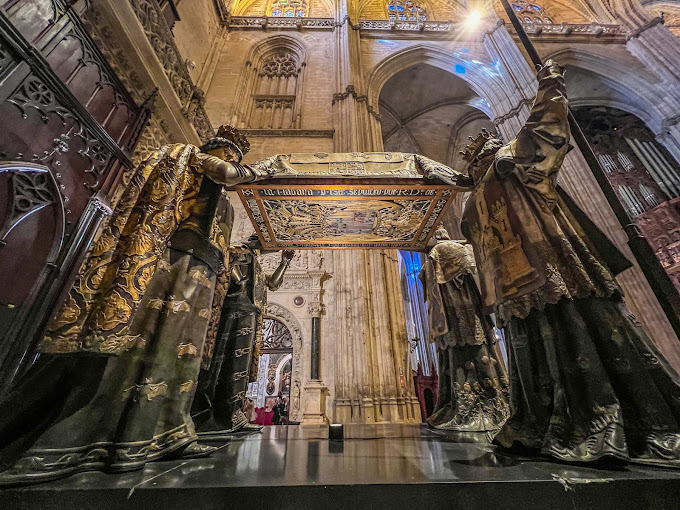
El súmmum de la representación de las culturas del mundo es la monumental tumba de Cristóbal Colón en la catedral de Sevilla desde 1899, un año después de la pérdida de Cuba. Su primera tumba estuvo en Valladolid, donde murió en prisión en 1505 sin saber que había descubierto un nuevo continente. Más tarde estuvo en Santo Domingo y en La Habana. Doña Emilia Pardo Bazán lo llamó “el hombre de las catorce cunas y de las dos tumbas”.
The apex of the representation of world cultures is the monumental tomb of Christopher Columbus in the cathedral of Seville since 1899, a year after the loss of Cuba. His first tomb was in Valladolid, where he died in prison in 1505 without knowing that he had discovered a new continent. Later he was in Santo Domingo and Havana. Doña Emilia Pardo Bazán called him “the man of the fourteen cradles and the two tombs.”
Recientemente se vandalizan o profanan monumentos a Colón en varios lugares americanos. No nos escandalizamos demasiado. La envidia y la ignorancia llevaron a prisión en Valladolid a uno de los hombres más decisivos de la historia universal. Y es que a cainitas no nos gana nadie. Ni a tirar piedras a nuestro tejado, ni a negar nuestra historia incluso en un museo nacional… Volvamos a Sevilla.
Monuments to Columbus have recently been vandalized or desecrated in several American places. We are not too shocked. Envy and ignorance led one of the most decisive men in world history to prison in Valladolid. And no one beats Cainites. Neither to throw stones at our roof, nor to deny our history even in a national museum… Let’s return to Seville.
Paseando, pasé por la calle de San Leandro, quién fue obispo de Sevilla, o mejor Spalis, a finales del siglo VI, donde falleció en 602. Fue el primer obispo católico, tras la conversión del rey visigodo Recaredo y su hermano Hermenegildo que profesaban la creencia arriana.
Walking, I passed by the street of San Leandro, who was bishop of Seville, or better Spalis, at the end of the 6th century, where he died in 602. He was the first Catholic bishop, after the conversion of the Visigoth king Recaredo and his brother Hermenegildo who professed the Arian belief.
Su hermano Isidoro le sucedió en el cargo. Fue uno de los hombres más sabios de su tiempo, con un enorme legado de trabajos históricos, litúrgicos, tratados de astronomía y geografía, teología, ensayos sobre el antiguo y nuevo testamento, un diccionario de sinónimos y su obra cumbre, la Etimología u Orígenes, nada menos que en veinte libros, que tratan entre otras cosas de gramática, retórica, dialéctica, aritmética, geometría, música, astronomía, medicina, derecho, ciclos del tiempo, sagradas escrituras, bibliotecas, estudio de otras religiones, lenguas, instituciones de otros pueblos, textos de autores romanos e hispano romanos, elementos del universo… Representado en la catedral de Sevilla, en un cuadro del pintor barroco sevillano Bartolomé Esteban Murillo.
His brother Isidoro succeeded him in office. He was one of the wisest men of his time, with an enormous legacy of historical and liturgical works, treatises on astronomy and geography, theology, essays on the old and new testament, a dictionary of synonyms and his masterpiece, Etymology or Origins. , in no less than twenty books, which deal, among other things, with grammar, rhetoric, dialectics, arithmetic, geometry, music, astronomy, medicine, law, cycles of time, sacred scriptures, libraries, the study of other religions, languages, institutions of other peoples, texts by Roman and Spanish-Roman authors, elements of the universe… Represented in the cathedral of Seville, in a painting by the Sevillian baroque painter Bartolomé Esteban Murillo.
A propósito de Murillo, que vivió y murió en el histórico barrio de Santa Cruz, antigua judería sevillana y si duda la mayor y mejor conservada judería española, mencionemos otros grandes pintores sevillanos, el más importante sin duda Diego Velázquez, presente en todos los grandes museos de dos continentes, uno de los grandes innovadores, incluyendo la ciencia del espacio dentro y fuera del cuadro en la pintura y un lenguaje descriptivo de la psicología y sensibilidad de sus personajes; Juan de Valdés Leal y su hijo Lucas Valdés y el impresionista y músico Gonzalo Bilbao.
Regarding Murillo, who lived and died in the historic neighborhood of Santa Cruz, the old Sevillian Jewish quarter and if we doubt the largest and best preserved Spanish Jewish quarter, let us mention other great Sevillian painters, the most important without a doubt Diego Velázquez, present in all the great museums on two continents, one of the great innovators, including the science of space inside and outside the painting in painting and a descriptive language of the psychology and sensitivity of its characters; Juan de Valdés Leal and his son Lucas Valdés and the impressionist and musician Gonzalo Bilbao.
Volvamos a las calles de Sevilla. También en mi caminar pasé por la calle Trajano, nacido en Itálica, cerca de Hispalis, el primer emperador romano nacido fuera de Roma, algo posible porque la Bética, la región del sur de Hispania, no fue colonia sino provincia del imperio, conditio sine qua non para ostentar cualquier cargo imperial. Le sucedió su sobrino Adriano, también de Itálica. Y de esta ciudad también Teodosio el Grande, siglo IV después de Cristo, el último en gobernar todo el imperio. A su muerte se dividió en Imperio de Oriente o Bizantino y de Occidente. Hoy en día, Itálica es uno de los sitios arqueológicos más importantes del imperio.
Let’s return to the streets of Seville. Also on my walk I passed through Trajano Street, born in Italica, near Hispalis, the first Roman emperor born outside of Rome, something possible because Baetica, the southern region of Hispania, was not a colony but a province of the empire, conditio sine qua non to hold any imperial position. He was succeeded by his nephew Hadrian, also from Itálica. And from this city also Theodosius the Great, 4th century after Christ, the last to govern the entire empire. Upon his death it was divided into the Eastern or Byzantine Empire and the Western Empire. Today, Itálica is one of the most important archaeological sites in the empire.

Monumento al Emperador Adriano, nacido en Itálica
Podríamos continuar ad infinitum con la Sevilla representativa de las culturas del mundo. Barrio de Santa Cruz, antigua bellísima judería intramuros, de restos de muralla romana y musulmana. La Torre del Oro, junto al Guadalquivir, fue parte del sistema defensivo almorávide, hoy en día museo de navegación. El Archivo General de Indias, el más completo que existe de esta materia. Frente a la catedral de Sevilla, comenzada en 1401 por canónigos sevillanos a quienes se atribuye la frase “Hagamos una iglesia tal y tan grande que las futuras generaciones nos tomen por locos”.
We could continue ad infinitum with Seville, representative of the cultures of the world. Santa Cruz neighborhood, a beautiful old Jewish quarter within the walls, with remains of Roman and Muslim walls. The Torre del Oro, next to the Guadalquivir, was part of the Almoravid defensive system, today a navigation museum. The General Archive of the Indies, the most complete that exists on this subject. In front of the cathedral of Seville, begun in 1401 by Sevillian canons to whom the phrase «Let’s make a church so big that future generations will take us for crazy» is attributed.
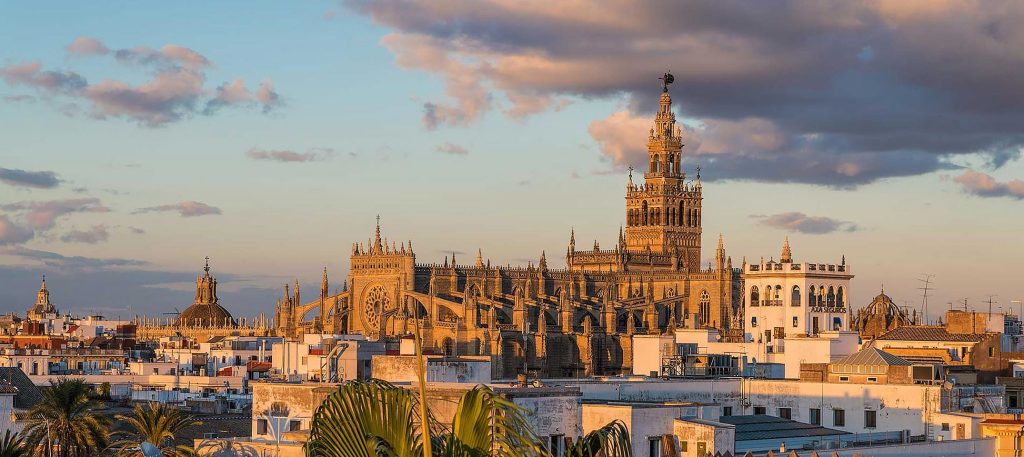
Esta catedral renacentista y barroca, con un campanario, la Giralda, que fue antiguo minarete de una mezquita, de la que también se conserva su Patio de los Naranjos, tiene uno de los museos catedralicios más ricos del mundo.
This Renaissance and Baroque cathedral, with a bell tower, the Giralda, which was the former minaret of a mosque, of which its Patio de los Naranjos is also preserved, has one of the richest cathedral museums in the world.
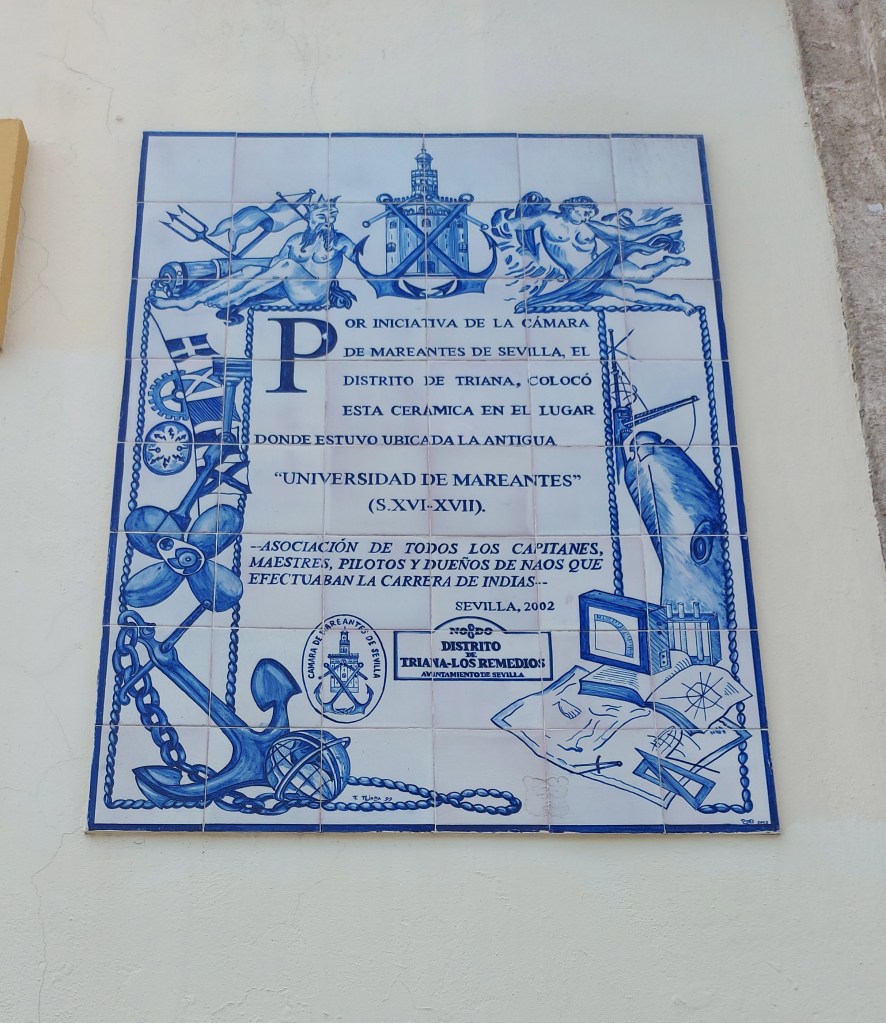
El Alcázar, residencia real hasta hoy, único de origen cristiano, adoptando eso sí la arquitectura musulmana, uno de los grandes museos de Sevilla. Triana, en la orilla izquierda del Guadalquivir, barrio plurirracial desde la llegada de pueblos nómadas gitanos en la segunda mitad del siglo XV, y de negros desde el siglo XVII. Cuna de Rodrigo de Triana, el primer hombre en avistar tierra americana… Y hablando de Triana, calle Betis a lo largo del río, con edificios históricos como la Casa de Mareantes y la casa donde nació Ana Ruiz, madre de los hermanos Machado, Manuel y Antonio.
The Alcázar, royal residence until today, the only one of Christian origin, adopting Muslim architecture, one of the great museums of Seville. Triana, on the left bank of the Guadalquivir, a multiracial neighborhood since the arrival of nomadic gypsy people in the second half of the 15th century, and of blacks since the 17th century. Birthplace of Rodrigo de Triana, the first man to sight American land… And speaking of Triana, Betis Street along the river, with historic buildings such as the Casa de Mareantes and the house where Ana Ruiz, mother of the Machado brothers, Manuel, was born. and Antonio.
Uno de los versos de Antonio Machado enlaza con el Palacio de las Dueñas, residencia sevillana de la Casa de Alba, porque la familia Machado vivió en alquiler en una de las viviendas dentro del recinto del palacio:
One of Antonio Machado’s verses links to the Palacio de las Dueñas, the Sevillian residence of the Casa de Alba, because the Machado family lived for rent in one of the homes within the palace grounds:
“Mi infancia son recuerdos de un patio de Sevilla,
y un huerto claro donde madura el limonero…”
“My childhood is memories of a patio in Seville, and a clear orchard where the lemon tree ripens…”

Era conocido por su seudónimo Demófilo, fué escritor, antropólogo y folklorista, autor entre otras obras de un artículo titulado “Cantes flamencos”, germen de su libro “Colección de cantes flamencos” publicado en 1881. Su biografía es tan extensa y notoria que mejor consultarla digitalmente por quienes se sientan interesados.
He was known by his pseudonym Demófilo, he was a writer, anthropologist and folklorist, author among other works of an article titled “Flamenco Songs”, the basis of his book “Collection of Flamenco Songs” published in 1881. His biography is so extensive and well-known that it is better consult it digitally for those who feel interested.
La casa posterior de Demófilo está en Triana, en la calle Pureza, donde también se encuentra la archi famosa iglesia de Nuestra Señora de la Esperanza de Triana, que compite con la aún más famosa Nuestra Señora de la Esperanza Macarena, ambas imágenes puntales de la Procesión del Silencio de la Semana Santa de Sevilla, con un famoso y emotivo encuentro de las dos Esperanzas…
Demófilo’s later house is in Triana, on Pureza Street, where the arch-famous church of Nuestra Señora de la Esperanza de Triana is also located, which competes with the even more famous Nuestra Señora de la Esperanza Macarena, both main images of the Procession of Silence during Holy Week in Seville, with a famous and emotional meeting of the two Hopes…
No voy a extenderme con la historia de la imaginería religiosa sevillana, conocida como la Escuela Sevillana de Escultura, desde los tiempos de Fernando III. Solo mencionar a su figura más relevante, Martínez Montañés. Hoy en día esta escuela es una de las más importantes a nivel internacional.
I am not going to go into detail with the history of Sevillian religious imagery, known as the Sevillian School of Sculpture, since the time of Ferdinand III. Just mention its most relevant figure, Martínez Montañés. Today this school is one of the most important internationally.
No se puede hablar de la transcultural Sevilla sin mencionar la Alameda de Hércules, (1574) el jardín público más antiguo de Europa y hasta hoy el mayor de los espacios públicos intramuros del casco antiguo. Desde el extremo norte de la muralla cercana al Guadalquivir hasta el barrio de la Macarena.
One cannot talk about transcultural Seville without mentioning the Alameda de Hércules, (1574) the oldest public garden in Europe and to date the largest of the intramural public spaces of the old town. From the northern end of the wall near the Guadalquivir to the Macarena neighborhood.
Este jardín fue tomado como modelo por otras ciudades a ambos lados del Atlántico. Por mencionar dos de ellos, la Alameda de los Descalzos de Lima, Perú (1611) y la Alameda Central de Ciudad de México (1592).
This garden was taken as a model by other cities on both sides of the Atlantic. To mention two of them, the Alameda de los Descalzos in Lima, Peru (1611) and the Alameda Central in Mexico City (1592).
Las columnas de Hércules originales fueron romanas, cercanas a Tánger, Marruecos, junto al Atlántico, entonces Mare Tenebrarum, con la inscripción Non plus ultra. (no más allá). En el siglo XVI, Carlos V las incorporó a su escudo, flanqueándole, con la inscripción Plus ultra. Más allá…
The original Pillars of Hercules were Roman, near Tangier, Morocco, next to the Atlantic, then Mare Tenebrarum, with the inscription Non plus ultra. (not beyond). In the 16th century, Charles V incorporated them into his shield, flanking him, with the inscription Plus ultra. Beyond…

Parece que hemos hablado de mil ciudades y puede que sea así. Pero todas ellas convergen, desde Tartesos, en la Sevilla de hoy, crisol de culturas donde los haya.
It seems that we have talked about a thousand cities and it may be so. But all of them converge, from Tartessos, in today’s Seville, a melting pot of cultures if they exist.
Descubre más desde LA AGENCIA MUNDIAL DE PRENSA
Suscríbete y recibe las últimas entradas en tu correo electrónico.
